Loading article
Back to Health Guides
Medical Certificates 101•Part 1 of 4
Medical Certificates for Mental Health Days
What the certificate says, how to notify your employer, the telehealth process, and when one day off is enough versus when to seek ongoing support.
8 min read
·Updated 10 May 2026
·Doctor Reviewed
AHPRA Verified
In this article
- 1Mental Health Is Valid Sick Leave
- 2When a Mental Health Day Is Appropriate
- 3The Telehealth Process for Mental Health
- 4What the Certificate Actually Says
- 5Notifying Your Employer
Medical information only. This article is for general information and does not constitute medical advice. Treatment decisions are made by an AHPRA-registered doctor after reviewing your circumstances.
Review
InstantMed Clinical Team
Clinical governance review for guide content
Updated
10 May 2026
General information only, not personal medical advice.
Jump to section
1Mental Health Is Valid Sick Leave2When a Mental Health Day Is Appropriate3The Telehealth Process for Mental Health4What the Certificate Actually Says5Notifying Your Employer6Same-Day Versus Next-Day Certificate7How Many Days Is Appropriate8Returning to Work9The Scale of Mental Health Absence in Australia10Medicare Better Access to Mental Health Care11When to Seek More Support12Sources
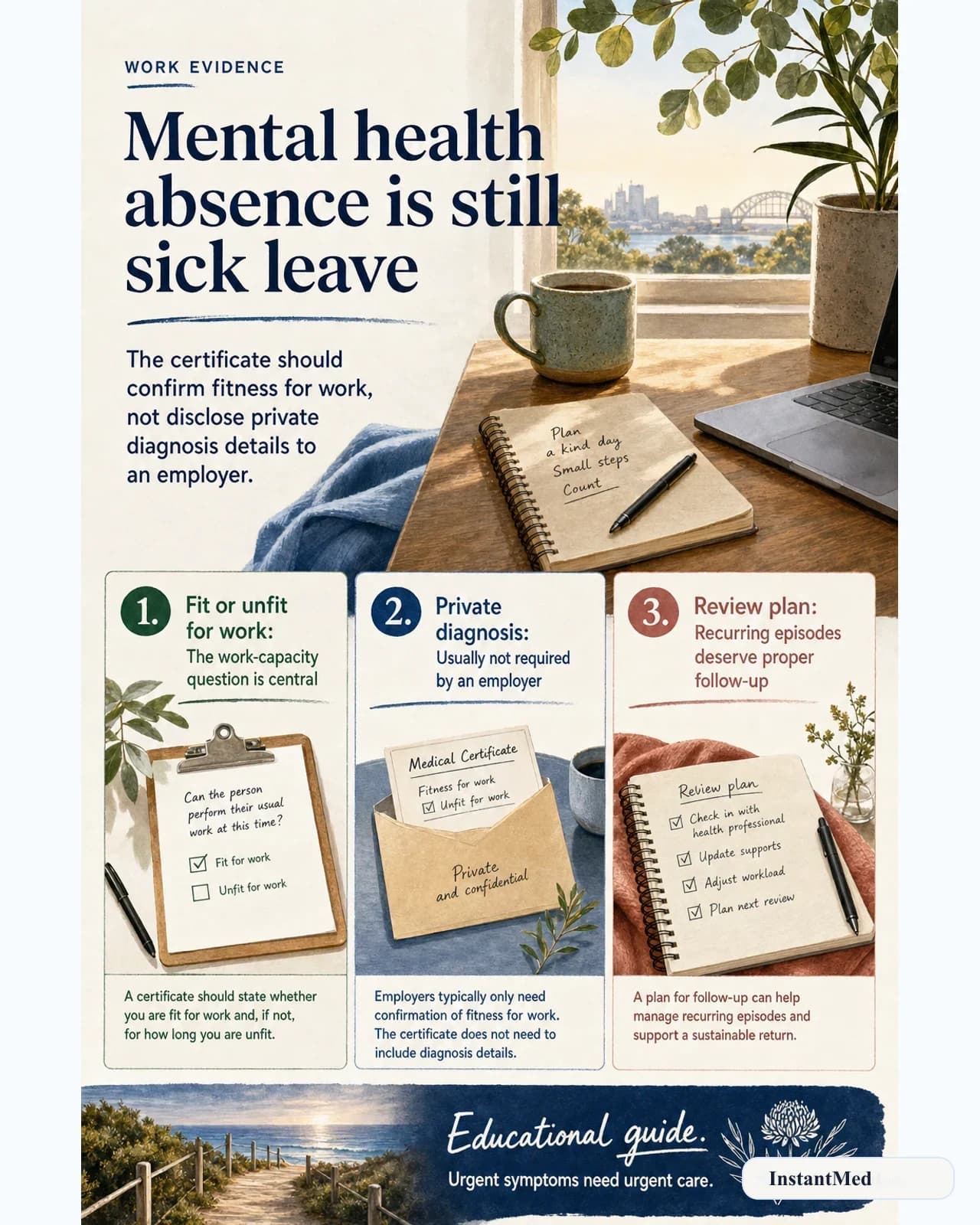
Mental health conditions are treated identically to physical health conditions under Australian workplace law. If anxiety, depression, burnout, or acute stress is preventing you from working safely and effectively, you are unfit for work - and a medical certificate supports your entitlement to take that time. Here is exactly how the process works, what your certificate will say, and how to notify your employer without disclosing anything you do not want to share.
Mental Health Is Valid Sick Leave
Under the Fair Work Act 2009 and the National Employment Standards (NES), personal/sick leave covers any illness or injury that prevents an employee from performing their role. "Illness" includes mental health conditions. There is no legal distinction between a migraine preventing you from working and a panic attack doing the same. Full-time employees are entitled to 10 days of paid sick and carer's leave per year; part-time employees accrue it pro-rata. It can be used for any genuine illness - physical or mental.
Key Information
Your employer cannot treat mental health absence differently from other illness. Taking sick leave for a mental health condition is legally protected. Adverse action against an employee for taking legitimate personal leave - including mental health leave - is unlawful under the Fair Work Act.
When a Mental Health Day Is Appropriate
A mental health day is appropriate when your psychological state is genuinely preventing you from functioning at work. This includes:
- Anxiety severe enough to impair concentration, decision-making, or interaction with colleagues
- Symptoms of depression including persistent low mood, fatigue, or inability to engage
- Burnout presenting as emotional exhaustion, detachment, and reduced effectiveness
- Panic attacks or acute stress responses that make working unsafe or impossible
- Sleep deprivation severe enough to impair judgment or motor function
- An acute worsening of an existing mental health condition
- Significant distress from a personal crisis requiring time to stabilise
Taking a day when genuinely unwell is appropriate. If you are well enough to work and simply prefer not to, that is annual leave territory, not sick leave. The medical assessment is what distinguishes the two.
The Telehealth Process for Mental Health
Mental health presentations are well-suited to telehealth. Assessment is based on your symptom description - unlike conditions requiring physical examination, anxiety, depression, and stress-related presentations can be clinically assessed through a thorough conversation about what you are experiencing.
The process:
- Complete a health questionnaire describing your current symptoms, how they are affecting your ability to function, and how long you have been experiencing them
- Note any relevant history: existing diagnoses, current medications or treatment, whether you are under the care of a GP or psychologist
- An AHPRA-registered doctor reviews your case and may ask follow-up questions
- If your presentation is consistent with being unfit for work, a certificate is issued covering the appropriate period
- The certificate is delivered as a PDF, typically the same day
Be specific about functional impact in your description. "I am experiencing severe anxiety and have not slept properly in three days, making it impossible to concentrate" gives the doctor what they need. "Feeling stressed" is too vague to support a clear clinical assessment.
What the Certificate Actually Says
Your medical certificate will state:
- Your full legal name
- The consultation date
- That you were assessed by an AHPRA-registered doctor
- The approved period you were unable to attend your usual duties
- The period covered (for example, "15 April 2026" or "15-16 April 2026")
- The doctor's name, AHPRA registration number, and contact details
It will not state anxiety, depression, burnout, panic disorder, another mental health diagnosis, or symptom details. If you need a workplace accommodation letter that identifies a diagnosed condition, speak with your regular GP or treating clinician. InstantMed's standard short-certificate pathway documents absence only.
Notifying Your Employer
Notify your employer as early as reasonably possible on the day of your absence. Most workplace policies and awards require notification before your shift starts, or as soon as practicable. A brief message is sufficient - you do not need to explain what is wrong.
"I am unwell today and will not be in. I will provide a medical certificate as required."
Escalation ladder
Occasional stress leave and crisis symptoms are different problems and need different pathways.
That is all that is legally necessary. You are not required to say it is mental health. You are not required to explain the circumstances. If your employer asks for more detail, you can say "a medical condition" - nothing further is required.
For absences of two or more days, most employers will request a medical certificate. For single-day absences, your award, enterprise agreement, or workplace policy will determine whether documentation is required. Many workplaces only request certificates for absences of two consecutive days or more.
Same-Day Versus Next-Day Certificate
Telehealth certificates are typically same-day. If you complete a consultation in the morning of the day you are absent, the certificate covering that day will arrive the same day. This is useful if your employer contacts you requesting documentation promptly.
Next-day certificates for the previous day are also possible where a genuine illness prevented you from accessing care on the day itself - for example, if symptoms were so severe you were unable to complete a consultation. The doctor will assess whether the retrospective period is clinically appropriate based on your account.
How Many Days Is Appropriate
Duration depends entirely on your situation. For an acute episode - a particularly difficult night, a panic attack, a severe anxiety flare - one to two days is typically appropriate. This is time to stabilise, implement self-care, and return to work with some capacity restored.
For more significant presentations involving persistent symptoms, the doctor will recommend a duration that reflects what you describe. A certificate covering three to five days is reasonable for a more significant acute episode.
Helpful Tip
If you find you are regularly needing mental health days - more than three or four times a year - this pattern warrants a proper assessment from your regular GP. Recurring acute episodes often reflect an underlying condition that responds well to treatment. A Mental Health Care Plan from your GP provides access to up to 10 subsidised psychology sessions per calendar year under Medicare.
Returning to Work
Most mental health absences of one to two days do not require a formal return-to-work process. You return when you are ready.
For longer absences, or if your mental health condition is related to workplace factors (excessive workload, conflict with a manager, toxic team environment), consider whether a conversation with your employer about adjustments is warranted before you return. Your doctor can include return-to-work notes on a certificate - for example, "fit for return to work with reduced hours for the first week" or "avoid situations involving [specific stressor] on return."
You are not required to disclose what caused the absence. If it was workplace-related, that is your choice to raise or not raise.
The Scale of Mental Health Absence in Australia
Mental health conditions are one of the leading causes of workplace absence and reduced productivity in Australia. According to the AIHW's Australian Burden of Disease study, mental and substance use disorders represent one of the largest contributors to the total burden of disease in Australia, exceeded only by cancer and cardiovascular conditions combined.
Beyondblue research indicates that depression and anxiety cost Australian employers an estimated $10.9 billion per year in absenteeism, presenteeism, and compensation claims. The AIHW notes that approximately 1 in 5 Australians experience a mental illness in any 12-month period.
Next step
One handles work evidence for a short absence. Recurring symptoms need doctor review, treatment planning, and follow-up.
This context matters for understanding workplace mental health absence: it is not a marginal or unusual circumstance. It is one of the most common reasons people miss work, comparable in frequency to musculoskeletal conditions and respiratory infections. Employees who have a mental health condition are entitled to take personal leave for it on exactly the same terms as any physical illness.
Medicare Better Access to Mental Health Care
For workers whose mental health needs go beyond a single day off, the Medicare Better Access initiative provides access to subsidised psychological treatment. Under this scheme, a GP can create a Mental Health Care Plan that provides:
- Up to 10 individual sessions with a registered psychologist, clinical psychologist, or other eligible mental health professional per calendar year
- Medicare rebates for eligible sessions; the rebate and any out-of-pocket gap depend on the clinician, item number, and current MBS rules
- A referral to a psychiatrist if required, with a psychiatrist consultation rebate applying
The Better Access program requires an initial GP consultation. The GP prepares the plan, which documents the patient's mental health goals and treatment approach. You do not need to be in crisis to access this program - it is available for anyone experiencing a mental health condition affecting their daily functioning.
If you are taking mental health days regularly, creating a Better Access plan with your GP is the next step. The plan provides a structured treatment pathway and ongoing support, which is more effective for persistent or recurrent mental health difficulties than relying on acute sick leave management alone.
When to Seek More Support
A certificate handles the immediate absence. If your mental health is regularly affecting your ability to work or function, additional support makes a meaningful difference:
- Your GP can create a Mental Health Care Plan for up to 10 subsidised psychology sessions per year under Medicare
- Employee Assistance Programs (EAP) - offered by most medium to large employers - provide free, confidential counselling sessions that are completely separate from your employer
- A psychiatrist referral is appropriate for complex or treatment-resistant conditions
- Beyond Blue (1300 22 4636) provides 24/7 phone support and resources
- Lifeline (13 11 14) provides crisis support 24/7
Emergency Information
If you are experiencing thoughts of self-harm or suicide, contact Lifeline on 13 11 14, or call 000 in an emergency. These services are free and available 24 hours a day, 7 days a week.
Sources
- Fair Work Ombudsman: Sick and carer's leave
- Fair Work Ombudsman: Notice and medical certificates
- Australian Government Department of Health, Disability and Ageing: Better Access initiative
- Services Australia: Mental health services for patients
- AIHW: Prevalence and impact of mental illness
- AIHW: Burden of disease - mental health
Frequently Asked Questions
Will my employer know it's for mental health?
No. InstantMed's standard certificate confirms the approved absence period and does not include a diagnosis or symptom details.
Can I get a mental health certificate online?
Yes, when online assessment is clinically appropriate. Telehealth doctors can assess mental health concerns and may issue a routine sick-leave certificate. Many people find it more comfortable to describe symptoms from home without the added stress of travelling to a clinic.
How many mental health days can I take per year?
There is no separate allocation for mental health days. They come from your personal/sick leave entitlement. Full-time employees get 10 days of paid sick and carer's leave per year, while part-time employees accrue this pro-rata. If you are regularly needing more than a few days per year, speaking with your GP about a Mental Health Treatment Plan is worthwhile.
Can my employer ask why I'm taking sick leave?
Your employer can request evidence you were unwell, but cannot require you to disclose your specific diagnosis. InstantMed's standard certificate confirms the approved absence period and does not include a diagnosis or symptom details.
Can I get a same-day certificate for a mental health day?
Yes. Telehealth consultations for mental health certificates are typically completed and delivered on the same day. If you wake up unable to work and complete the consultation in the morning, you will receive your certificate as a PDF within a few hours.
What if I need more than a few days off for mental health?
For extended absences, your treating GP or psychologist is better placed to provide documentation and support. A GP can issue longer-term certificates, create a Mental Health Care Plan for subsidised psychology sessions, and refer to specialists. Telehealth is appropriate for acute episodes; ongoing mental health management benefits from a continuing treating relationship.
InstantMed Medical Team
Related Articles
8 min read
Are Online Medical Certificates Valid in Australia?
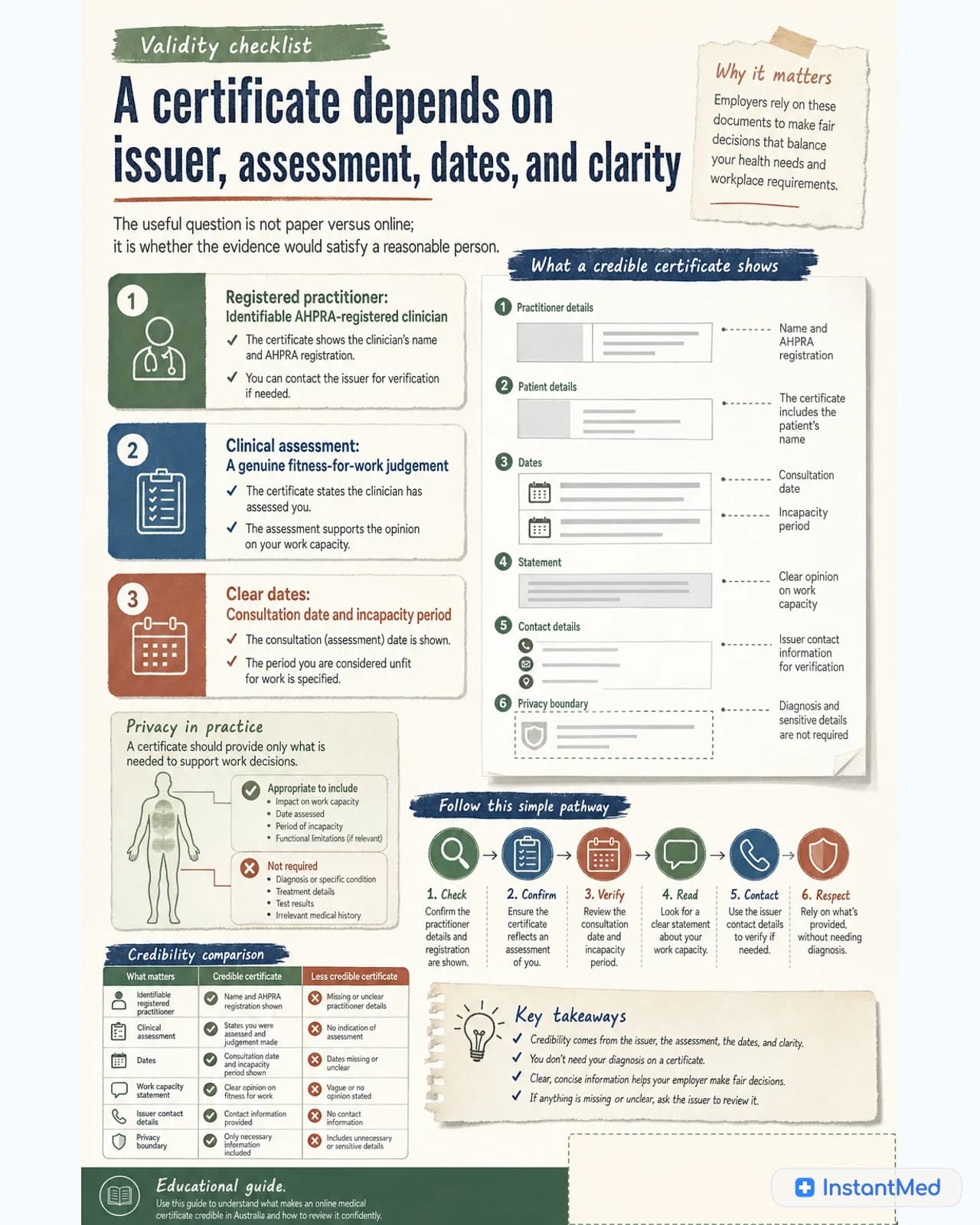
Online medical certificates from AHPRA-registered practitioners can be valid evidence in Australia when they follow a genuine assessment and contain clear details. This guide explains the Fair Work standard and common employer questions.
InstantMed Medical Team
13 min read
Doctor's Note for Work Australia: What Counts?
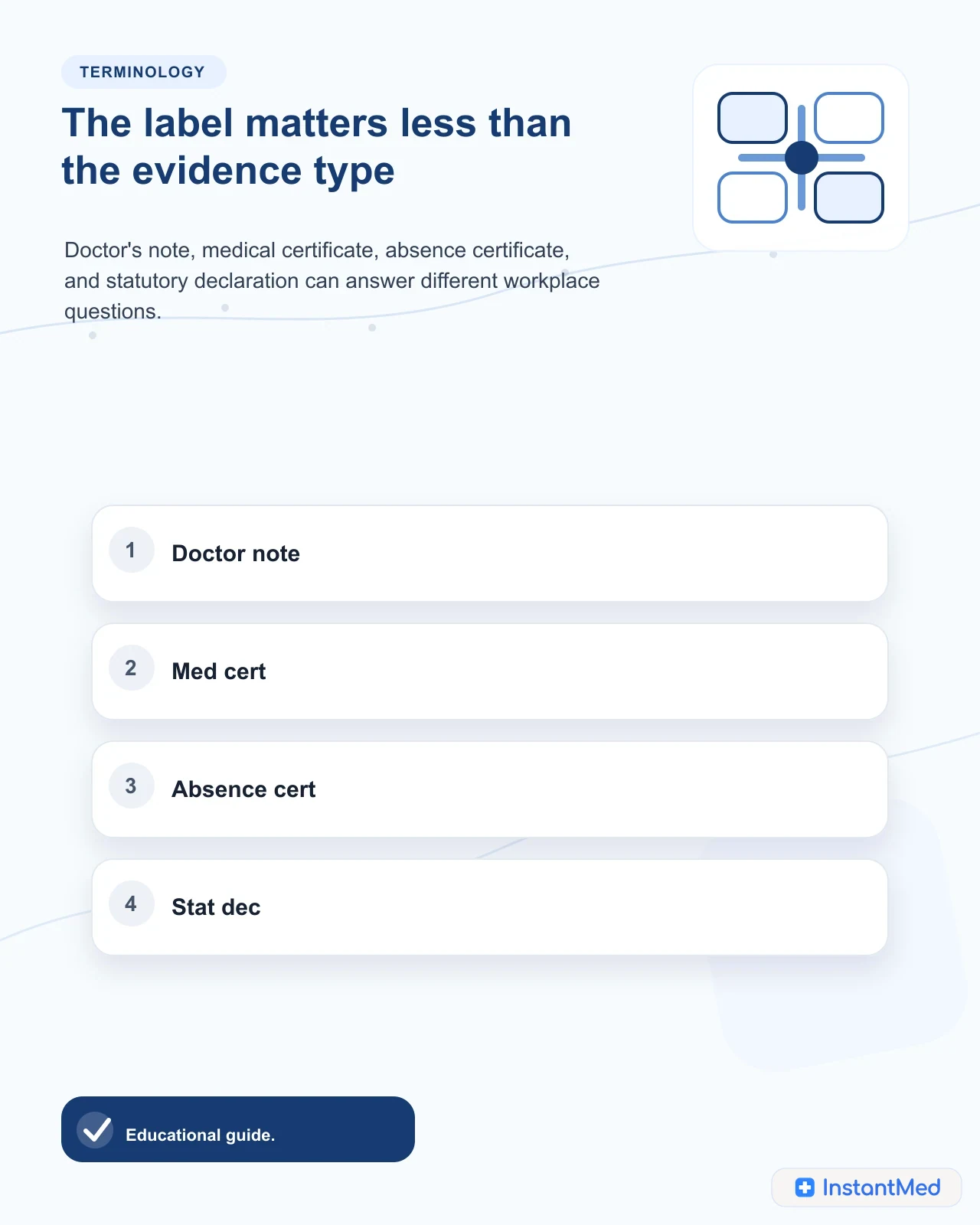
A doctor's note for work in Australia usually means a medical certificate, but sick notes, absence-from-work certificates, and statutory declarations can also matter. Learn what counts as evidence, what a strong certificate includes, and when a workplace may ask questions.
InstantMed Medical Team
10 min read
How Long Can a Medical Certificate Cover?
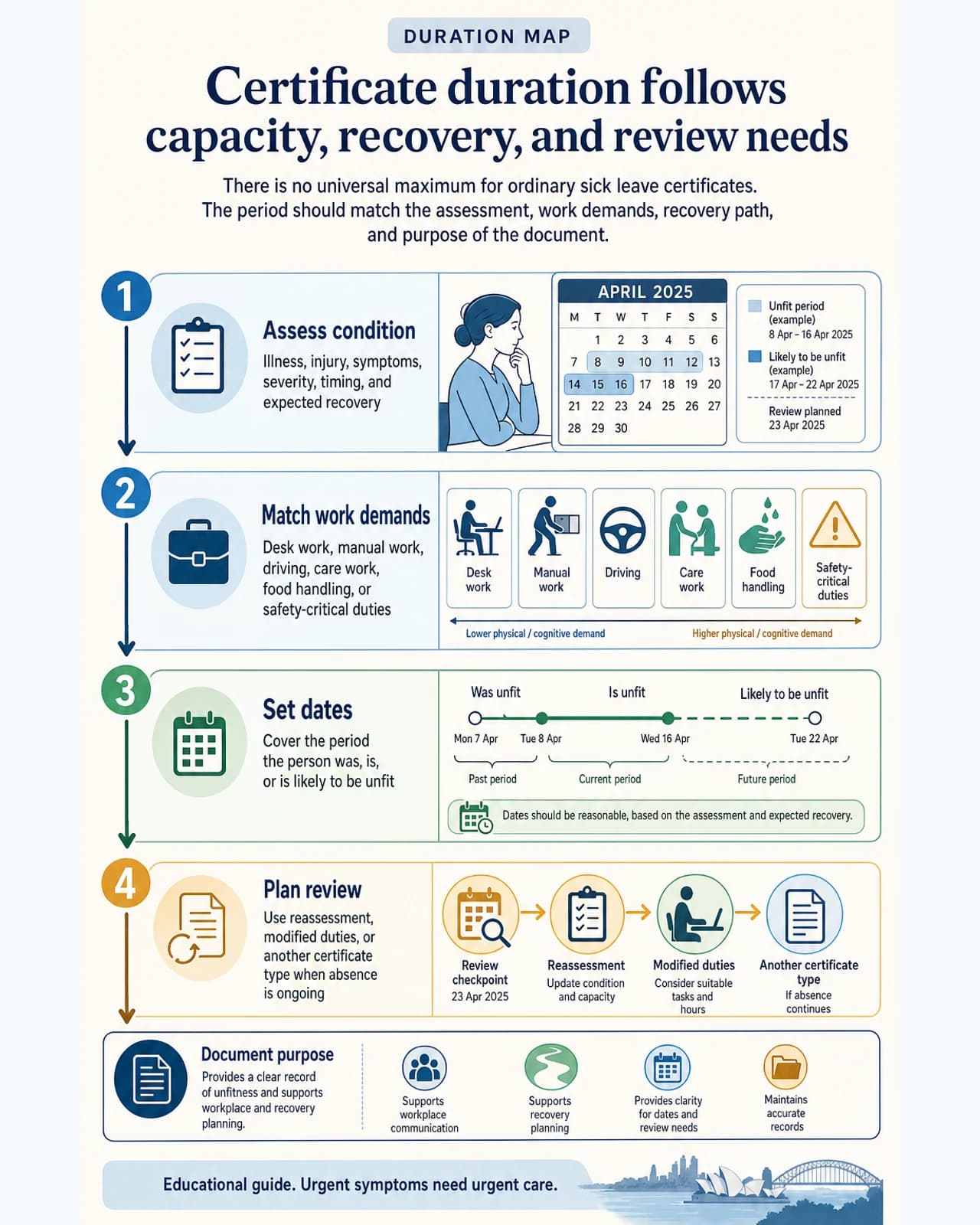
Medical certificate duration depends on clinical judgment, work capacity, workplace evidence rules, and the purpose of the certificate. Learn what can be covered, what cannot be assumed, and when a different certificate type is needed.
InstantMed Medical Team