Loading article
Back to Health Guides
Doctor's Note for Work Australia: What Counts?
For work, the practical question is whether the document is credible evidence for the absence, the policy, and the purpose.
13 min read
·Updated 5 July 2026
·Doctor Reviewed
AHPRA Verified
In this article
- 1What "Doctor's Note" Usually Means
- 2The Fair Work Evidence Test
- 3What A Strong Medical Certificate Includes
- 4Who Can Provide Absence Evidence?
- 5Stat Dec Vs Medical Certificate
Medical information only. This article is for general information and does not constitute medical advice. Treatment decisions are made by an AHPRA-registered doctor after reviewing your circumstances.
Review
InstantMed Clinical Team
Clinical governance review for guide content
Updated
5 July 2026
General information only, not personal medical advice.
Jump to section
1What "Doctor's Note" Usually Means2The Fair Work Evidence Test3What A Strong Medical Certificate Includes4Who Can Provide Absence Evidence?5Stat Dec Vs Medical Certificate6Can A Doctor's Note Be Issued Online?7Why Some Doctor's Notes Are Questioned8Can An Employer Check A Doctor's Note?9How Many Days Can A Doctor's Note Cover?10Different Purpose, Different Document11What To Do If Evidence Is Questioned12The Bottom Line13Sources Used In This Guide
Key Information
In Australia, a "doctor's note for work" usually means a medical certificate or other reasonable evidence for sick or carer's leave. Employers usually care less about the nickname and more about whether the document covers the dates, capacity for work, practitioner details, and policy being applied.
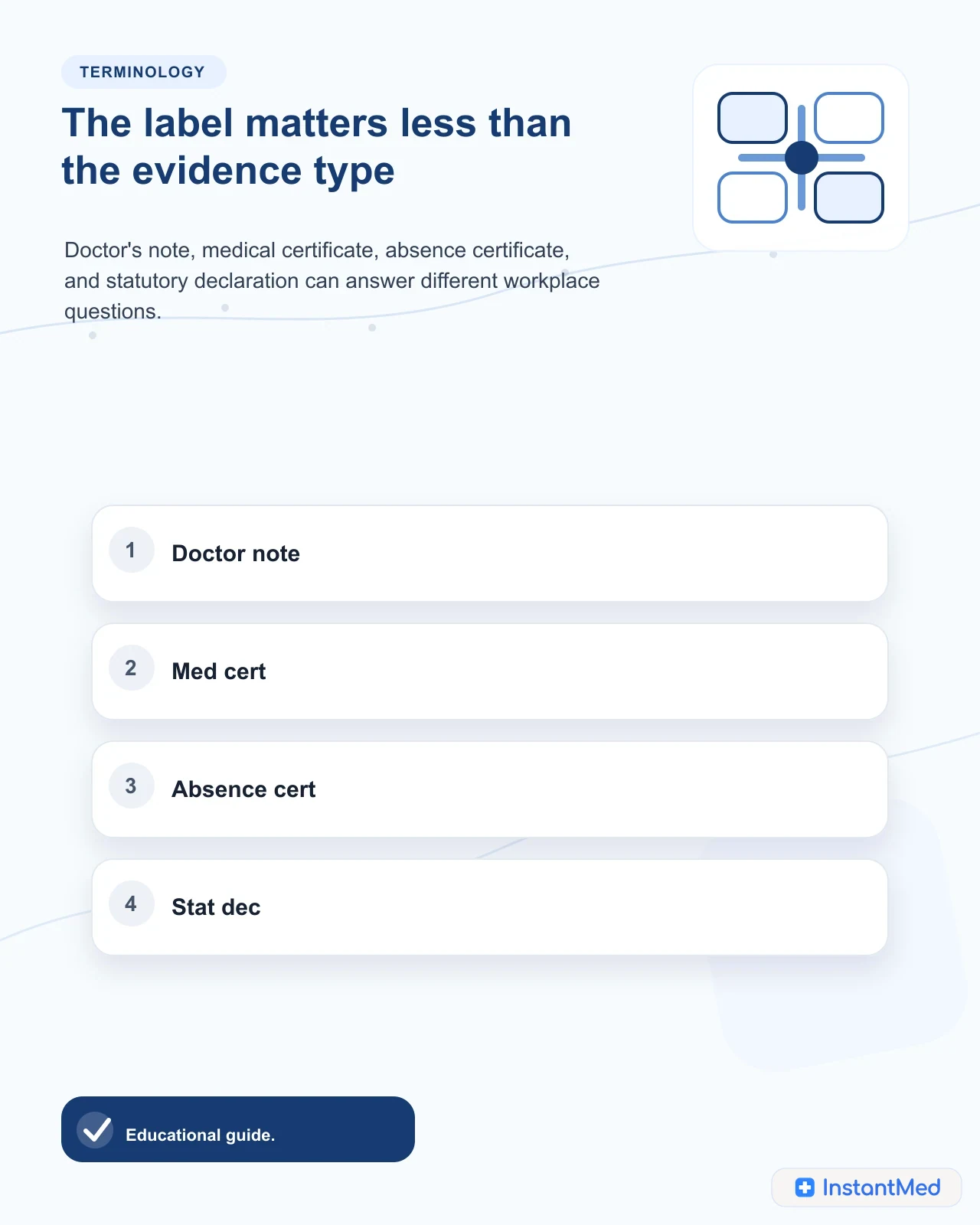
Australians use several labels for the same broad idea: doctor's note, sick note, med cert, doctor's certificate, medical certificate, absence-from-work certificate, and statutory declaration.
The labels overlap, but they are not interchangeable in every setting. A one-day cold, a carer's leave request, a university special-consideration form, a workers' compensation matter, and a return-to-work restriction can all require different evidence.
What "Doctor's Note" Usually Means
In ordinary workplace language, a doctor's note usually means a short certificate from a doctor saying you were not fit for work, study, or usual duties for a stated period.
The more formal Australian term is medical certificate. A workplace policy might also use "evidence", "sick leave certificate", "doctor's certificate", or "supporting documentation".
| Term | What it usually means | Watch point |
|---|---|---|
| Doctor's note | Informal term for a doctor's medical certificate or short letter | The workplace may still require specific fields |
| Sick note | Informal term for illness-related absence evidence | Not a technical legal category |
| Medical certificate | Clinical certificate from a registered practitioner | Strongest routine sick leave evidence when clinically justified |
| Med cert | Common shorthand for medical certificate | Same practical meaning as medical certificate |
| Absence-from-work certificate | Often used for pharmacist-issued absence evidence | Usually narrower scope than a doctor's certificate |
| Statutory declaration | Your legal statement of facts | Not a clinical assessment |
| Fit note | Mostly a UK term | Not standard Australian workplace wording |
If an employer says "doctor's note", ask what details they actually need. Sometimes the answer is simple: they need evidence covering the date you were away. Sometimes they need a particular form because the issue is not ordinary sick leave.
The Fair Work Evidence Test
For most Australian employees, the Fair Work Act lets an employer request evidence that shows the employee took sick or carer's leave for a valid reason. Fair Work Ombudsman guidance says an employer can ask for evidence even for as little as one day or less off work, and that medical certificates and statutory declarations are examples of acceptable evidence.
That does not mean every request is automatically reasonable. The same guidance says the evidence requested must be reasonable in the circumstances, and awards, registered agreements, contracts, and workplace policies can add process details.
| Situation | Evidence question |
|---|---|
| One day unwell | Does the policy ask for evidence, and does the document cover the date? |
| Monday or Friday absence | Does the workplace have a consistent policy for evidence around weekends? |
| Carer's leave | Does the evidence show the need to care for an immediate family or household member? |
| Pre-arranged appointment | Was the person unable to work because of illness or injury, or is another leave type more accurate? |
| Long absence | Is there a review plan, expected duration, or additional form needed? |
| Workplace injury | Is a workers' compensation certificate or certificate of capacity required instead? |
The practical lesson is that evidence is not just about having a piece of paper. It needs to match the leave type, the date range, and the policy.
What A Strong Medical Certificate Includes
A good certificate is boring in the right way. It should be clear, traceable, and limited to what the recipient needs.
| Certificate field | Why it matters |
|---|---|
| Patient name | Confirms the document is about the right person |
| Date of assessment or issue | Shows when the practitioner assessed and issued the document |
| Covered dates | Matches the absence period being claimed |
| Work-capacity statement | Explains whether the person was unfit for work or usual duties |
| Practitioner name and profession | Identifies who formed the clinical view |
| Registration or identifying details | Helps verify the practitioner where relevant |
| Practice or service contact | Lets the document be authenticated without disclosing diagnosis |
| Signature or secure digital equivalent | Supports document integrity |
It usually does not need:
- The diagnosis
- Medication names
- Test results
- Full clinical history
- Private details unrelated to work capacity
- A long explanation of symptoms
Who Can Provide Absence Evidence?
The right issuer depends on what happened, what the policy asks for, and whether the practitioner is working within scope.
| Issuer | Often useful for | Limits |
|---|---|---|
| GP or medical specialist | Routine illness, injury, carer's certificates, longer or complex absence | Needs a genuine clinical basis |
| Nurse practitioner or other registered practitioner | Conditions within professional scope | Acceptance depends on the policy and purpose |
| Pharmacist | Minor illness or short carer's leave circumstances within scope | Not suitable for complex, prolonged, disputed, fitness-for-duty, or workers' compensation issues |
| Dentist or optometrist | Dental or eye-related absence | May not satisfy policies asking specifically for a medical practitioner |
| Psychologist or allied health practitioner | Evidence related to care within that professional scope | Some processes still ask for a doctor's certificate |
| Statutory declaration | A sworn account when clinical evidence was not practical | Not a clinical opinion |
Pharmacist absence-from-work certificates deserve a separate note because people often confuse them with doctor's certificates. A pharmacist can be registered and professionally accountable, but the certificate is generally designed for narrower circumstances, commonly short minor illness or carer's leave. If the issue is severe, prolonged, unclear, or connected to workplace injury or fitness for duties, a doctor or the exact required form is usually more appropriate.
Stat Dec Vs Medical Certificate
A statutory declaration is a legal statement that sets out facts you declare to be true and accurate. It can be useful when you could not reasonably get a medical certificate, or when the absence was brief and the workplace accepts a stat dec.
It is not the same as a medical certificate.
Detail check
Missing identity, dates, capacity wording, or practitioner details is what often makes evidence hard to rely on.
| Question | Medical certificate | Statutory declaration |
|---|---|---|
| Who creates it? | A registered health practitioner after assessment | You, as the person making the declaration |
| What does it prove? | A professional view about capacity, dates, or care need | Your declared facts |
| Is it clinical evidence? | Yes, within the practitioner's scope | No |
| Can it support sick or carer's leave? | Often yes | Sometimes yes, depending on the circumstances |
| Best for | Illness, injury, carer's leave, clinical work-capacity evidence | Brief absence where clinical evidence was impractical |
Can A Doctor's Note Be Issued Online?
Yes, a medical certificate can be digital. The question is not whether the document was printed on paper. The question is whether the assessment and certificate are clinically and professionally sound.
Online evidence is more credible when it has:
- A real clinical assessment, not a pre-approved form outcome
- An identifiable registered practitioner
- Clear dates and work-capacity wording
- A secure PDF or document format
- A verification path that does not reveal diagnosis
- A process for correction if a factual detail is wrong
- Escalation to in-person care when telehealth is not suitable
Decision guide
When telehealth evidence may or may not fit
May fit telehealth
- Short, non-urgent illness where history is enough to assess work capacity.
- Carer's leave evidence where the care need is clear and within scope.
- A digital certificate after an appropriately registered practitioner forms a genuine view.
Needs in-person care
- Significant injury, physical restriction, or a return-to-work capacity question.
- Workers' compensation, occupational health, insurance, or disputed fitness-for-duty processes.
- Symptoms where examination, observations, imaging, or tests are needed before evidence is safe.
Urgent care
- Chest pain, severe breathing trouble, collapse, stroke symptoms, severe allergic reaction, or major injury.
- Self-harm risk, severe confusion, or rapidly worsening symptoms.
- Any situation where getting paperwork would delay urgent clinical care.
The Medical Board's telehealth guidance supports responsible telehealth, but says telehealth is not appropriate for every consultation. It expects doctors to keep the same standard of care as far as possible and to arrange in-person review if telehealth alone is not appropriate.
Why Some Doctor's Notes Are Questioned
Most disputes are about document quality, policy fit, or authenticity. They are not always about whether the person was genuinely unwell.
| Reason questioned | What to check first |
|---|---|
| Missing details | Name, issue date, covered dates, capacity wording, practitioner details |
| Date mismatch | Whether the certificate period matches the absence and notification |
| Wrong evidence type | Whether the policy asked for a doctor's certificate, stat dec, certificate of capacity, or specific form |
| Diagnosis request | Whether the process really needs diagnosis or only work capacity |
| Online certificate concern | Whether the practitioner is identifiable and the assessment was genuine |
| Suspicion of fake document | Whether the issuer can verify authenticity without sharing clinical details |
| Long absence | Whether a review date, treatment plan, or specialist/occupational evidence is needed |
If the problem is a clerical error, ask the issuer for a corrected certificate. If the problem is policy interpretation, ask the employer to identify the exact clause or requirement in writing.
Can An Employer Check A Doctor's Note?
An employer can usually check that a document is genuine. That is different from asking for your private medical details.
Reasonable verification often means:
- Confirming the issuer exists
- Confirming the certificate was issued
- Checking the practitioner's registration on the AHPRA register where relevant
- Using a secure reference number or verification tool if the issuer provides one
- Asking the employee for a corrected copy when details are incomplete
What is more sensitive:
- Asking for diagnosis when it is not required
- Contacting a doctor for clinical details without consent
- Attending a medical appointment unless the employee requests it
- Rejecting evidence only because the assessment happened by telehealth
The AHPRA public register is useful because it lists registered health practitioners and can show whether a practitioner is allowed to practise, including any published registration limits or conditions.
How Many Days Can A Doctor's Note Cover?
There is no simple national rule that a medical certificate can only cover one, two, or three days. The period should reflect the practitioner's clinical judgement and the evidence available.
For common short illnesses, one to several days is common. For more significant illness, injury, surgery recovery, mental health, or ongoing symptoms, the certificate may cover a longer period or include a review date.
Two common myths cause confusion:
- "You only need evidence after two days." Some workplaces have that policy, but Fair Work guidance says evidence can be requested for as little as one day or less if the request is reasonable in the circumstances.
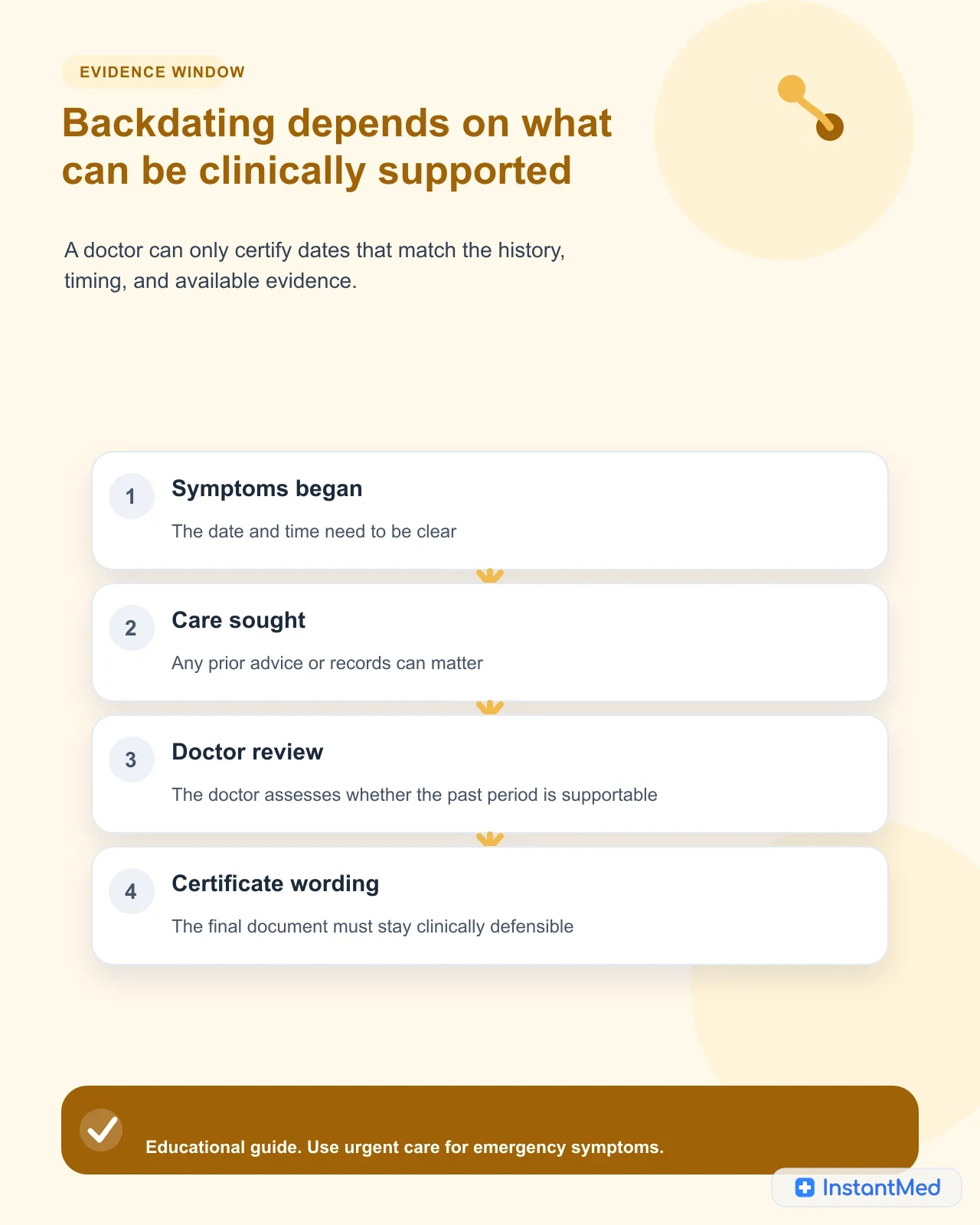
- "A doctor can always backdate a note." A certificate can sometimes cover a past period if the practitioner has a sound clinical basis, but the issue date itself should be accurate. Our guide on backdating a medical certificate covers that separately.
If the absence is long or changing, a practitioner may certify a shorter period and review you again. That can be better evidence than a broad certificate written before the recovery path is clear.
Different Purpose, Different Document
A routine work certificate is not a universal document. The higher the stakes, the more likely you need the exact form or a treating-practitioner report.
| Purpose | Usually safer evidence |
|---|---|
| Ordinary sick leave | Medical certificate, pharmacist absence certificate, or stat dec depending on policy |
| Carer's leave | Evidence of need to care for an immediate family or household member |
| University extension or special consideration | Evidence matched to study, exam, or assessment impact |
| Centrelink or government process | The specific government form or treating-practitioner report requested |
| Workers' compensation | Jurisdiction-specific certificate of capacity or work capacity form |
| Insurance claim | Detailed treating-practitioner report and records |
| Court or official summons | Evidence matched to the authority's requirement |
| Return-to-work restrictions | Capacity-focused certificate, occupational health input, or workplace form |
Privacy
Workplaces usually need capacity and dates. Diagnosis and treatment detail usually stay in the private clinical record.
If the recipient has supplied a form, use that form. If they have supplied a policy, check the exact words before assuming a normal sick note will be enough.
What To Do If Evidence Is Questioned
Keep the discussion specific and documented.
- 1
Ask for the exact concern in writing.
- 2
Check the certificate for patient name, issue date, covered dates, capacity wording, and practitioner details.
- 3
Ask the issuer for a corrected document if a factual detail is missing or wrong.
- 4
Keep diagnosis and treatment details separate unless the process genuinely requires them.
- 5
Check your award, enterprise agreement, contract, and workplace policy.
- 6
Use Fair Work, union, HR, student advocacy, or legal advice if pay, discipline, enrolment, or a formal claim is affected.
It is usually better to fix the evidence gap than argue about terminology. "Doctor's note" is the label; the actual question is what evidence the recipient is entitled to request and whether your document answers it.
The Bottom Line
A doctor's note in Australia usually means a medical certificate, but absence evidence is broader than that. A medical certificate, pharmacist absence certificate, statutory declaration, dentist certificate, psychologist letter, or official capacity form can all be valid in the right context.
The strongest evidence is not the most detailed document. It is the document that matches the absence, states the relevant dates and capacity clearly, comes from the right source, protects unnecessary health information, and fits the policy asking for it.
Sources Used In This Guide
- Fair Work Ombudsman: Notice and medical certificates
- Fair Work Ombudsman: Paid sick and carer's leave
- Medical Board of Australia: Good medical practice
- Medical Board of Australia: Telehealth consultations with patients
- AHPRA: Register of practitioners
- Attorney-General's Department: Statutory declarations
- Pharmaceutical Society of Australia and Pharmacy Guild of Australia: Absence from Work Certificates guidelines
Frequently Asked Questions
Is a doctor's note the same as a medical certificate?
In everyday Australian workplace language, usually yes. 'Doctor's note', 'sick note', 'med cert', and 'doctor's certificate' usually mean evidence from a health practitioner that you were unfit for work. 'Medical certificate' is the more formal term.
Can a pharmacist issue a sick leave certificate?
Pharmacists may issue absence-from-work certificates for minor conditions within their scope and under professional guidelines. Some employers or agreements may still specify a medical certificate from a doctor for particular circumstances, so check the policy if there is a dispute.
Does a certificate need to state my diagnosis?
Usually no. Ordinary sick leave evidence normally focuses on work capacity and dates. A diagnosis is private health information and is not usually required unless a specific process, safety issue, claim, or legal setting requires more detail.
Can a doctor's note be issued online?
Medical evidence can be issued after telehealth when the practitioner is appropriately registered, the assessment is genuine, and the document meets the relevant policy. The consultation method is not the only question; evidence quality matters.
Is a statutory declaration the same as a medical certificate?
No. A statutory declaration is your sworn statement. It can be reasonable evidence in some sick or carer's leave situations, but it is not a clinical assessment and may not satisfy every workplace, university, insurance, or compensation process.
InstantMed Medical Team
Related Articles
9 min read
Medical Certificates for Work: Complete Australian Guide
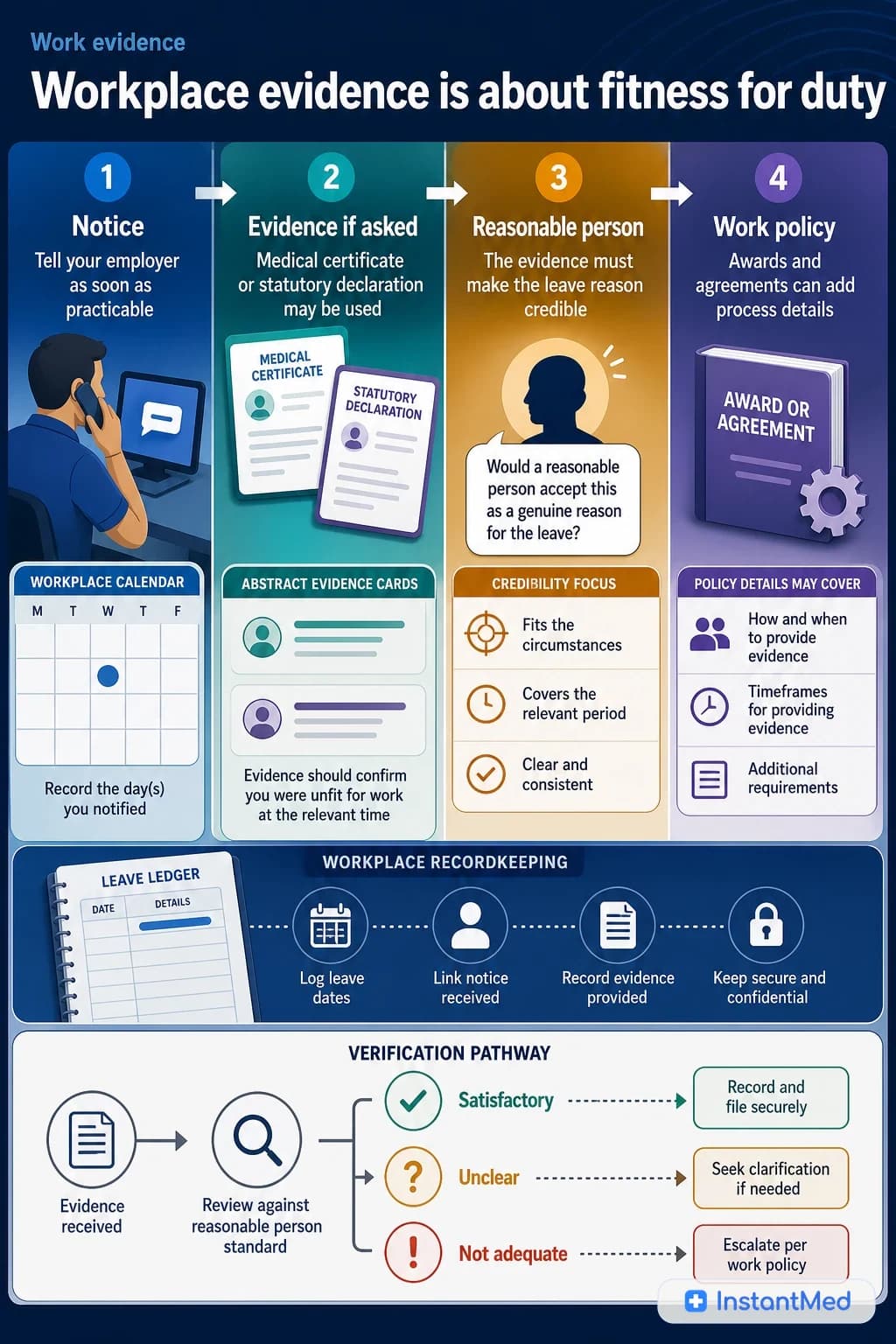
A work medical certificate is evidence that you were unfit for work, not a public explanation of your diagnosis. This Australian guide explains employer evidence rules, privacy, telehealth, stat decs, and return-to-work issues.
InstantMed Medical Team
9 min read
How to Get a Medical Certificate Online in Australia
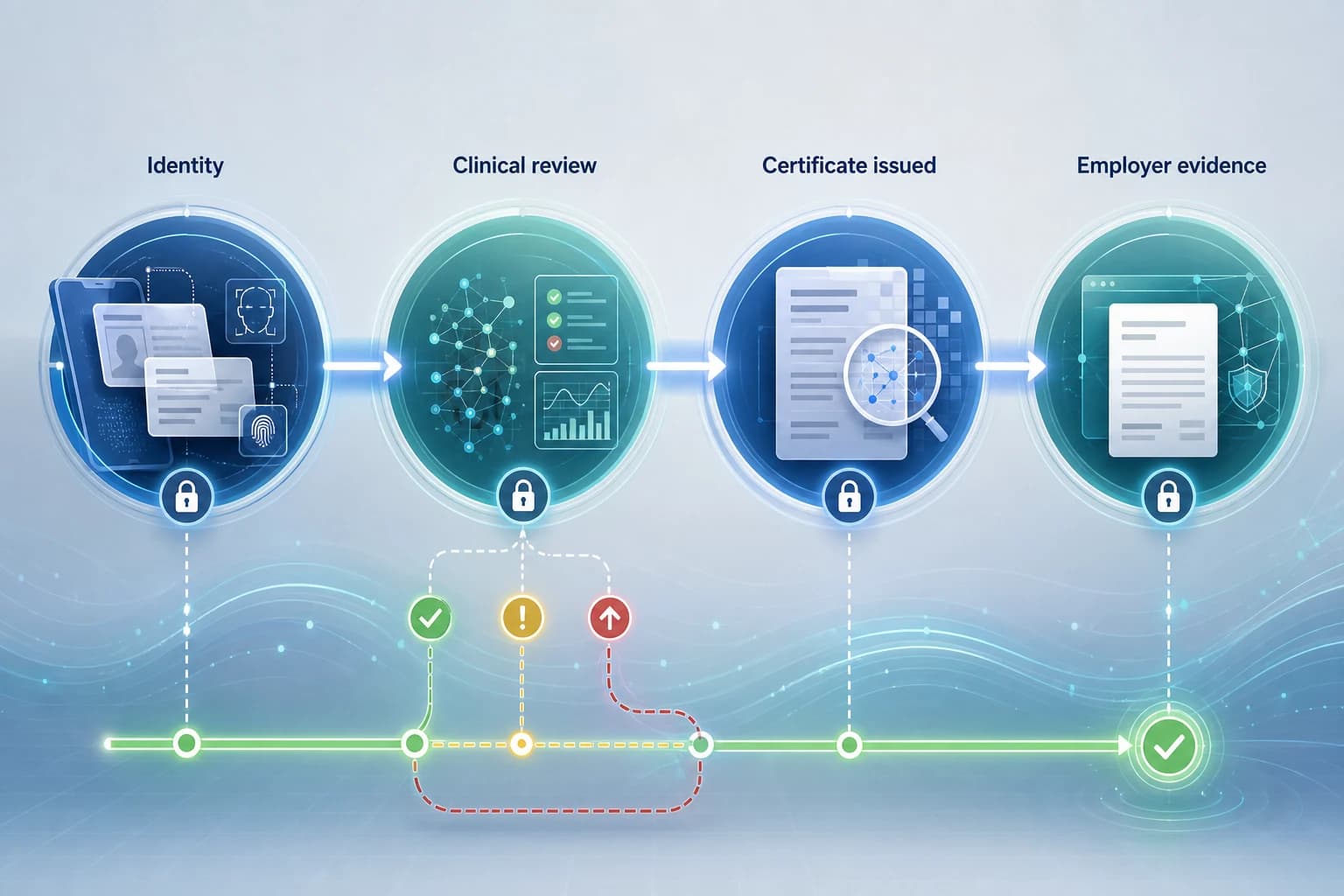
Online medical certificates can be valid workplace evidence in Australia when issued after an appropriate clinical review by a registered practitioner. Learn what matters, what to prepare, and where the limits are.
InstantMed Medical Team
8 min read
Can You Backdate a Medical Certificate in Australia?
Backdating falsifies the consultation date - no legitimate doctor will do it. A retrospective certificate covers past dates and is legal. Here is the difference and what to do now.
InstantMed Medical Team