Loading article
Back to Health Guides
Medical Certificates 101•Part 3 of 4
Medical Certificate for Period Pain
Severe dysmenorrhoea can make someone unfit for work or study. Here is how sick leave evidence, privacy, and red flags fit together.
8 min read
·Updated 11 June 2026
·Doctor Reviewed
AHPRA Verified
In this article
- 1Period Pain Is a Medical Condition
- 2Primary vs Secondary Dysmenorrhoea
- 3Your Fair Work Act Entitlements
- 4What Your Employer Can and Cannot Ask
- 5Assessment and Documentation
Medical information only. This article is for general information and does not constitute medical advice. Treatment decisions are made by an AHPRA-registered doctor after reviewing your circumstances.
Review
InstantMed Clinical Team
Clinical governance review for guide content
Updated
11 June 2026
General information only, not personal medical advice.
Jump to section
1Period Pain Is a Medical Condition2Primary vs Secondary Dysmenorrhoea3Your Fair Work Act Entitlements4What Your Employer Can and Cannot Ask5Assessment and Documentation6What the Certificate Will Say7Symptoms That Warrant Investigation8Treatment Options for Severe Period Pain9Menstrual Leave in Australian Workplaces10Sources
Severe period pain - medically called dysmenorrhoea - can prevent someone from working or studying safely and effectively. If cramping, pelvic pain, nausea, dizziness, heavy bleeding, fatigue, or medication side effects make you unfit for your usual duties, the absence should be handled as a health issue rather than dismissed as "just cramps." This guide explains how sick leave evidence, certificate privacy, and investigation red flags fit together.
Period Pain Is a Medical Condition
Dysmenorrhoea is not "just cramps." For people who experience moderate to severe period pain, symptoms can include:
- Cramping pain in the lower abdomen, sometimes radiating to the back and thighs
- Nausea and vomiting
- Diarrhoea
- Headache and dizziness
- Fatigue that makes concentration and physical activity difficult
- Fainting in severe cases
These are not trivial symptoms when they stop normal activity. Jean Hailes advises medical review when period pain affects daily life, school, or work. The Royal Women's Hospital similarly lists pain that requires regular painkillers, time off work or study, or wakes you at night as a reason to seek medical review.
Primary vs Secondary Dysmenorrhoea
Understanding this distinction matters for your long-term health, even if it does not change your immediate sick leave entitlement.
Primary dysmenorrhoea is period pain without an underlying cause. It results from prostaglandins that trigger uterine contractions during menstruation. It typically starts within a year or two of the first period and tends to improve with age and after pregnancy.
Secondary dysmenorrhoea is period pain caused by an underlying condition. It tends to start later in life, worsen over time, and often lasts longer than primary dysmenorrhoea. Common causes include:
- Endometriosis: uterine-like tissue growing outside the uterus. It affects an estimated 1 in 9 Australian women and is frequently underdiagnosed, with an average delay of 7-8 years from symptom onset to diagnosis.
- Adenomyosis: uterine lining growing into the muscular wall of the uterus, causing heavy, painful periods.
- Uterine fibroids: non-cancerous growths in or around the uterus.
- Pelvic inflammatory disease: infection of the reproductive organs, often from an untreated STI.
- Copper IUD: can increase cramping, particularly in the first few months after insertion.
If your period pain is worsening over time, lasting longer than 2-3 days, or affecting you significantly beyond the first day or two, the underlying cause warrants investigation with your GP or gynaecologist.
Your Fair Work Act Entitlements
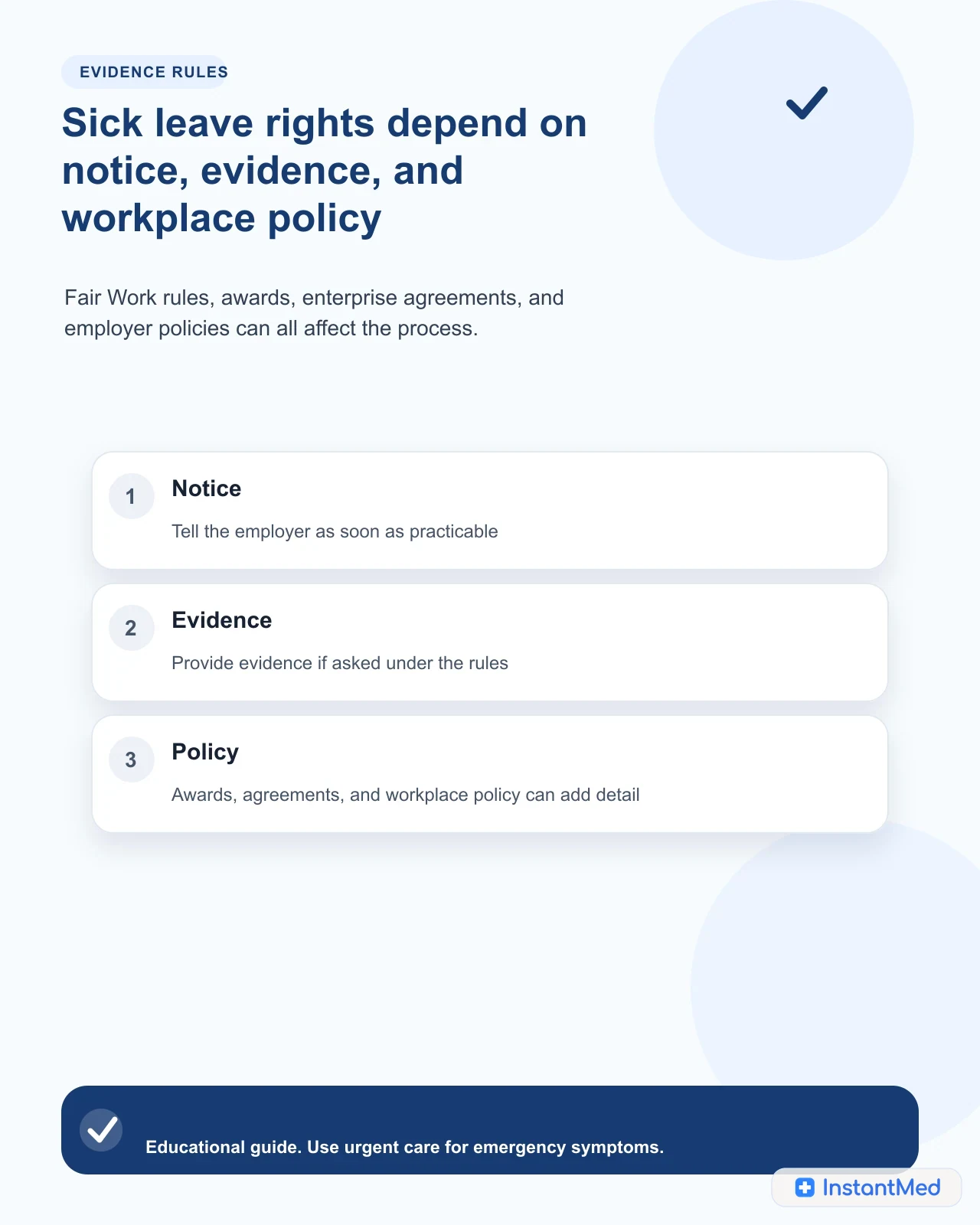
Under the National Employment Standards (NES), full-time employees accrue 10 days of paid personal/carer's leave per year, while part-time employees accrue this entitlement pro rata. Fair Work frames the evidence question around whether the employee was unable to work because of illness or injury. Severe period pain can meet that threshold when symptoms prevent someone from doing their role.
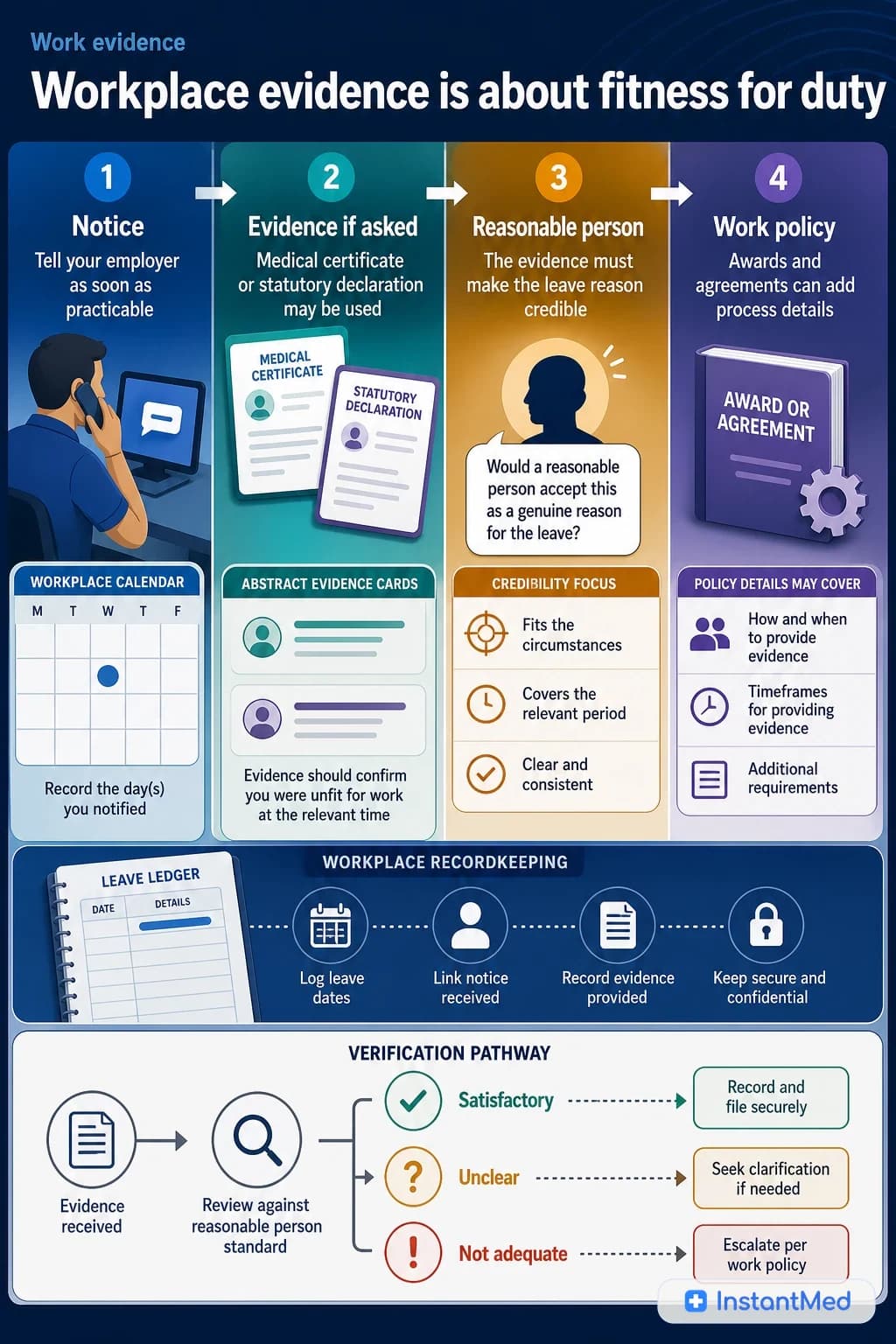
Your employer can request evidence when:
- Your absence is two or more consecutive days
- Your award, enterprise agreement, or workplace policy requires evidence for single-day absences
- You have a pattern of single-day absences that triggers a documentation requirement
Some workplaces request evidence even for a single day. Others only request it after a set number of days or when a pattern triggers their policy. The Fair Work Ombudsman states that medical certificates and statutory declarations are examples of acceptable evidence, provided the evidence would convince a reasonable person that the leave was genuinely taken for sick or carer's leave.
Key Information
Casual employees do not accrue paid sick leave. Their rights around unpaid leave, notice, evidence, and adverse action depend on the specific circumstances, so Fair Work or workplace-specific advice may be needed.
What Your Employer Can and Cannot Ask
Employers can legitimately:
- Request a medical certificate for absences that meet their evidence threshold
- Ask for the expected duration of absence
- Ask when you expect to return to work
Documentation
A certificate can support absence without disclosing private gynaecological details to an employer.
Employers generally should not:
- Demand your specific diagnosis when evidence of incapacity is sufficient
- Treat reproductive-health details as a routine workplace requirement
- Require more information than is reasonable in the circumstances
- Treat genuine personal leave as misconduct
For ordinary sick leave evidence, the useful information is usually capacity and dates: whether you were unfit for work and the period covered. A certificate generally does not need to disclose period pain, endometriosis, adenomyosis, heavy bleeding, or any other reproductive-health detail unless there is a specific reason you want that documented.
Assessment and Documentation
Period pain documentation should start with function, not embarrassment or over-disclosure. The assessment needs enough information to decide whether you were fit for your normal duties and whether your symptoms suggest a routine pattern, a concerning pattern, or an urgent issue.
Useful details include:
- When the pain started and how long it usually lasts
- Whether this cycle is similar to previous cycles or unusually severe
- Whether pain is one-sided, worsening, or present outside your period
- Associated symptoms such as heavy bleeding, fever, fainting, dizziness, nausea, vomiting, bowel pain, bladder pain, or pain during sex
- What you could not safely do at work or study
- Relevant history such as endometriosis, adenomyosis, fibroids, pelvic inflammatory disease, pregnancy possibility, or a recent IUD insertion
Some period pain can be assessed from history. Other presentations need in-person examination, pregnancy testing, urine testing, STI testing, ultrasound, or urgent care depending on the pattern.
What the Certificate Will Say
Your medical certificate will state:
- Your full legal name
- The consultation date
- The approved period you were unable to attend your usual duties
- The period covered (start date to end date)
- The doctor's name, AHPRA registration number, and contact details
It will not specify period pain, dysmenorrhoea, another menstrual-related diagnosis, or symptom details.
If you need a workplace adjustment letter or other documentation that identifies a diagnosed condition, speak with your regular GP or treating clinician. InstantMed's standard short-certificate pathway documents absence only.
Symptoms That Warrant Investigation
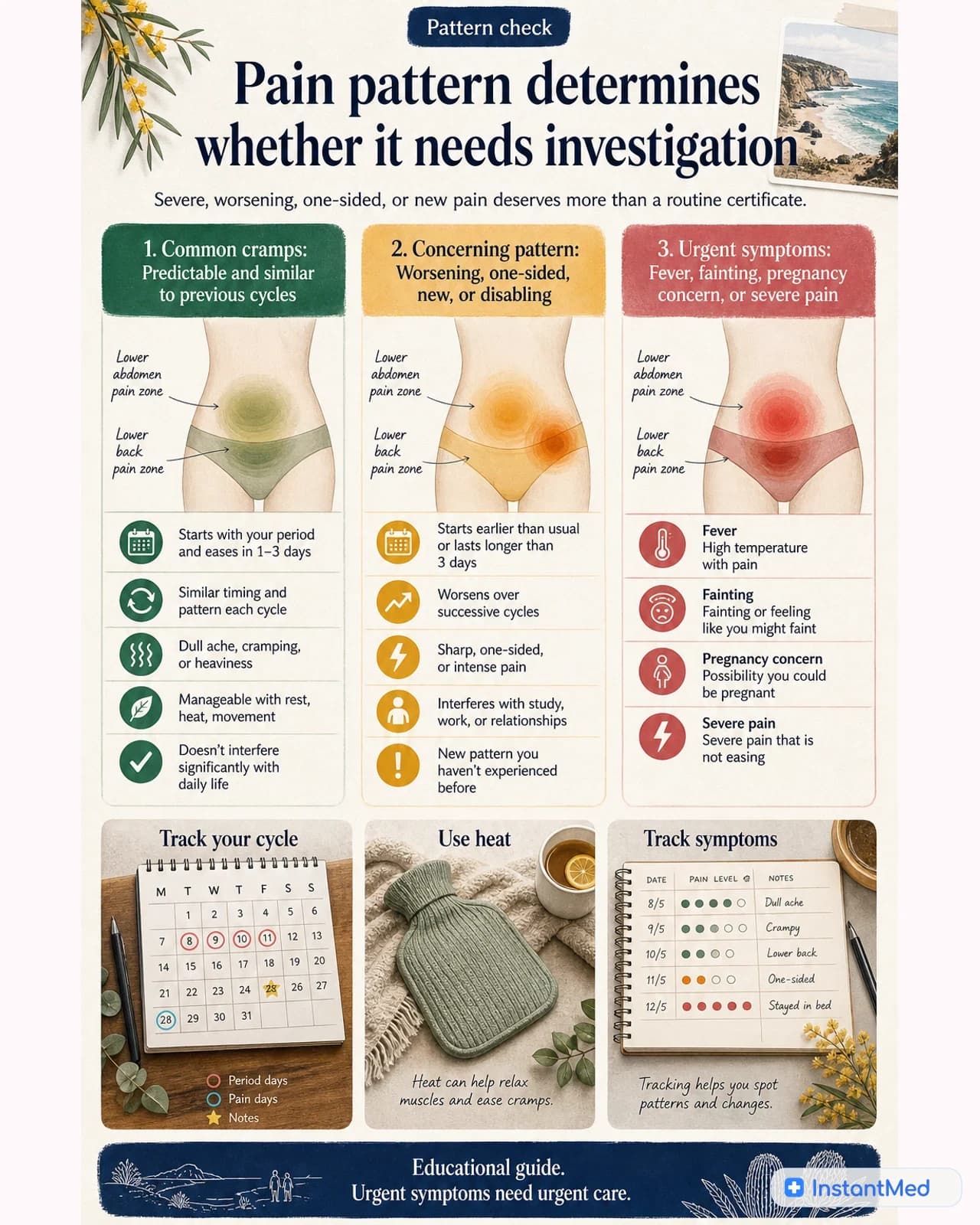
A medical certificate deals with your immediate absence. But if any of the following apply, the underlying cause warrants investigation with your GP:
- Your pain is worsening with each cycle
- Pain lasts more than 2-3 days, or continues outside your period
- You have pain during sex (dyspareunia)
- You experience heavy or irregular bleeding
- Standard pain relief such as ibuprofen or naproxen no longer helps
- You are regularly missing work, social activities, or study due to pain
- You have been unable to fall pregnant despite trying
Endometriosis in particular is common and can be under-recognised. The Australian Government states that endometriosis affects at least 1 in 7 girls and women and those assigned female at birth in Australia. If your period pain matches the pattern above, medical review is appropriate, and referral pathways may include a GP, gynaecologist, pelvic pain service, or an Endometriosis and Pelvic Pain Clinic depending on the situation.
Helpful Tip
If you consult a doctor for a medical certificate and mention worsening pain or the symptoms above, ask whether a referral for further investigation is appropriate. Addressing an underlying cause like endometriosis is far more effective long-term than managing pain episode by episode.
Treatment Options for Severe Period Pain
For immediate relief:
- Non-steroidal anti-inflammatory drugs (NSAIDs) such as ibuprofen or naproxen are first-line treatment. Take them at the first sign of cramping, before pain becomes severe - they work best when started proactively.
- Heat packs on the lower abdomen provide genuine pain relief and are safe alongside medication.
- For severe pain unresponsive to OTC NSAIDs, prescription-strength options are available through your GP.
Review map
Timing, bleeding, pain location, medicines tried, and daily impact help separate routine cramps from pelvic pain that needs review.
For longer-term management:
- Combined oral contraceptive pill: reduces prostaglandin production and often significantly reduces dysmenorrhoea.
- Hormonal IUD (Mirena): many women experience significantly lighter periods and less pain.
- For confirmed endometriosis: specialist treatment including hormonal therapy or laparoscopic surgery.
Menstrual Leave in Australian Workplaces
Australia does not currently have mandatory menstrual or reproductive health leave. Unlike some countries that have introduced specific provisions, Australian employment law does not separately categorise period-related absence.
Your paid personal/carer's leave entitlement, if you have one, can cover period pain in the same way as other illness that makes you unfit for work. Some Australian employers have begun voluntarily introducing menstrual leave policies or additional personal leave as part of their wellbeing offerings. Check your enterprise agreement, workplace policy, or staff handbook to see if your employer offers this.
The absence of a specific menstrual leave category does not mean severe period pain is irrelevant. The practical question is whether symptoms make you unfit for work and whether your employer has asked for reasonable evidence.
Sources
- Fair Work Ombudsman: Sick and carer's leave
- Fair Work Ombudsman: Notice and medical certificates
- Jean Hailes: Period pain
- The Royal Women's Hospital: Problem periods
- Australian Government Department of Health, Disability and Ageing: What we're doing about endometriosis
Frequently Asked Questions
Can I get a medical certificate just for period pain?
A certificate may be appropriate if period pain makes you unfit for work or study. The key issue is functional capacity: whether pain, nausea, dizziness, bleeding, fatigue, or medication effects mean you cannot safely perform your usual duties.
Will my employer know the reason is period pain?
An InstantMed certificate confirms the approved absence period and does not name period pain, endometriosis, adenomyosis, or another gynaecological diagnosis.
How many days can I take off for period pain?
There is no fixed number that applies to everyone. The period covered should match how long you are unfit for your usual duties. Recurrent multi-day absence, worsening pain, pain outside your period, or pain that repeatedly disrupts work or study should be investigated rather than handled only as paperwork.
Is menstrual leave a legal entitlement in Australia?
Not currently. There is no mandatory menstrual leave in Australia. Period pain is covered by your existing personal/carer's leave entitlement under the Fair Work Act. Some employers offer additional menstrual or reproductive health leave voluntarily - check your enterprise agreement or workplace policy.
What should a certificate for period pain say?
It should usually include your name, the assessment date, the approved absence period, and clinician details. InstantMed's standard certificate does not include private reproductive-health details.
InstantMed Medical Team
Related Articles
9 min read
Medical Certificates for Work: Complete Australian Guide
A work medical certificate is evidence that you were unfit for work, not a public explanation of your diagnosis. This Australian guide explains employer evidence rules, privacy, telehealth, stat decs, and return-to-work issues.
InstantMed Medical Team
13 min read
Doctor's Note for Work Australia: What Counts?
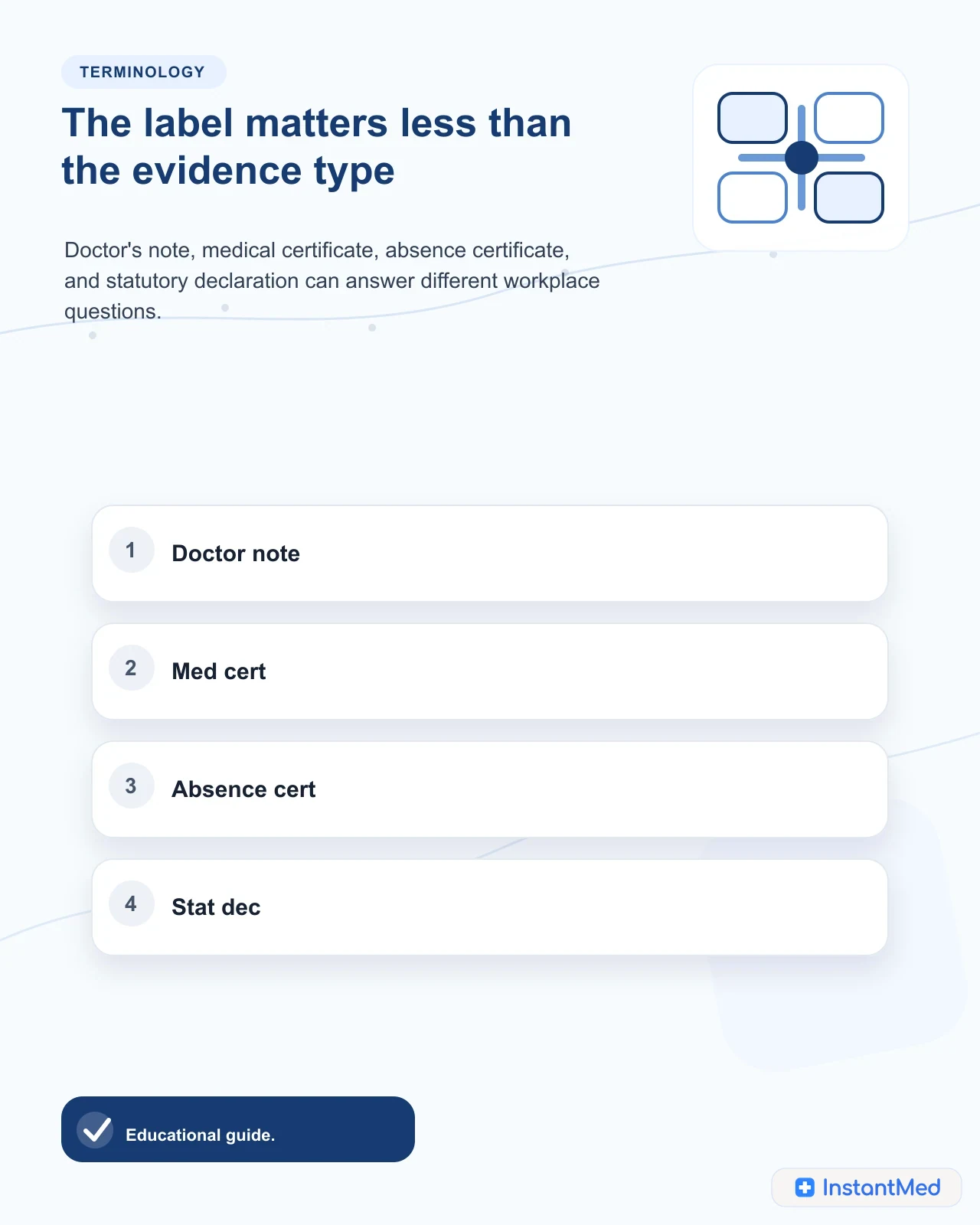
A doctor's note for work in Australia usually means a medical certificate, but sick notes, absence-from-work certificates, and statutory declarations can also matter. Learn what counts as evidence, what a strong certificate includes, and when a workplace may ask questions.
InstantMed Medical Team
9 min read
Sick Leave Rights in Australia: What You Are Entitled To
Full-time employees accrue 10 days of paid personal leave per year under the NES. It rolls over, covers mental health, and your employer cannot demand your diagnosis. Here is exactly what the law says.
InstantMed Medical Team