Loading article
Back to Health Guides
Medical Certificates 101•Part 4 of 4
Medical Certificate for Carer's Leave
How carer's leave evidence works in Australia, who counts as immediate family or household, and when a medical certificate or statutory declaration may be enough.
8 min read
·Updated 4 June 2026
·Doctor Reviewed
AHPRA Verified
In this article
- 1What Carer's Leave Covers
- 2Paid Carer's Leave
- 3Unpaid Carer's Leave
- 4Who Counts as Immediate Family
- 5What Evidence Can Be Requested
Medical information only. This article is for general information and does not constitute medical advice. Treatment decisions are made by an AHPRA-registered doctor after reviewing your circumstances.
Review
InstantMed Clinical Team
Clinical governance review for guide content
Updated
4 June 2026
General information only, not personal medical advice.
Jump to section
1What Carer's Leave Covers2Paid Carer's Leave3Unpaid Carer's Leave4Who Counts as Immediate Family5What Evidence Can Be Requested6Medical Certificate vs Statutory Declaration7Who the Certificate Is About8Children's Illnesses9Older Parents and Other Adults10Unexpected Emergencies11Notice to the Employer12Privacy Boundaries13If Leave Is Refused or Challenged14Sources
Carer's leave is part of personal/carer's leave. It lets an employee take time off to care for or support an immediate family member or household member who is sick, injured, or affected by an unexpected emergency.
The evidence question is usually simpler than people make it. The employer is not entitled to every private clinical detail. They can ask for reasonable evidence that the employee was genuinely entitled to the leave.
This guide is general information for Australia. Awards, enterprise agreements, workplace policies, and individual facts can affect the practical process.
What Carer's Leave Covers
Fair Work says employees can take carer's leave, paid or unpaid, if they need to look after an immediate family member or household member who is:
- Sick
- Injured
- Affected by an unexpected emergency
The caring need can happen at home, during a medical appointment, after hospital discharge, during a sudden child illness, after an accident, or when an unexpected event means the person cannot safely manage without support.
The key question is not whether the person is related in a narrow sense. It is whether they are an immediate family member or household member under the workplace rules, and whether they genuinely needed care or support.
Paid Carer's Leave
Paid carer's leave is available to full-time and part-time employees. It comes from the same personal/carer's leave balance as sick leave.
Fair Work says full-time employees are entitled to 10 sick days per year. Part-time employees receive a pro-rata amount. Unused sick and carer's leave carries over to the next year.
Because the leave balance is shared, the same pool can be used for:
- The employee's own illness or injury
- Caring for an immediate family or household member
- Supporting someone affected by an unexpected emergency
If the paid balance is exhausted, unpaid carer's leave may still be available.
Unpaid Carer's Leave
Fair Work says all employees, including casual employees, are entitled to 2 days of unpaid carer's leave per occasion.
The unpaid entitlement applies each time an immediate family member or household member needs care or support because of:
- Illness
- Injury
- An unexpected emergency
Full-time and part-time employees can only access unpaid carer's leave if they do not have paid sick/carer's leave left. Casual employees do not accrue paid personal/carer's leave, but they do have the 2-day unpaid entitlement per occasion.
Unpaid carer's leave can be taken as one continuous period, such as 2 working days, or in separate periods if the employee and employer agree.
Who Counts as Immediate Family
Fair Work defines immediate family broadly. It includes:
- Spouse or former spouse
- De facto partner or former de facto partner
- Child
- Parent
- Grandparent
- Grandchild
- Sibling
- The child, parent, grandparent, grandchild, or sibling of the employee's spouse or de facto partner
This definition includes step-relations and adoptive relations.
A household member is any person who lives with the employee. They do not need to be related.
What Evidence Can Be Requested
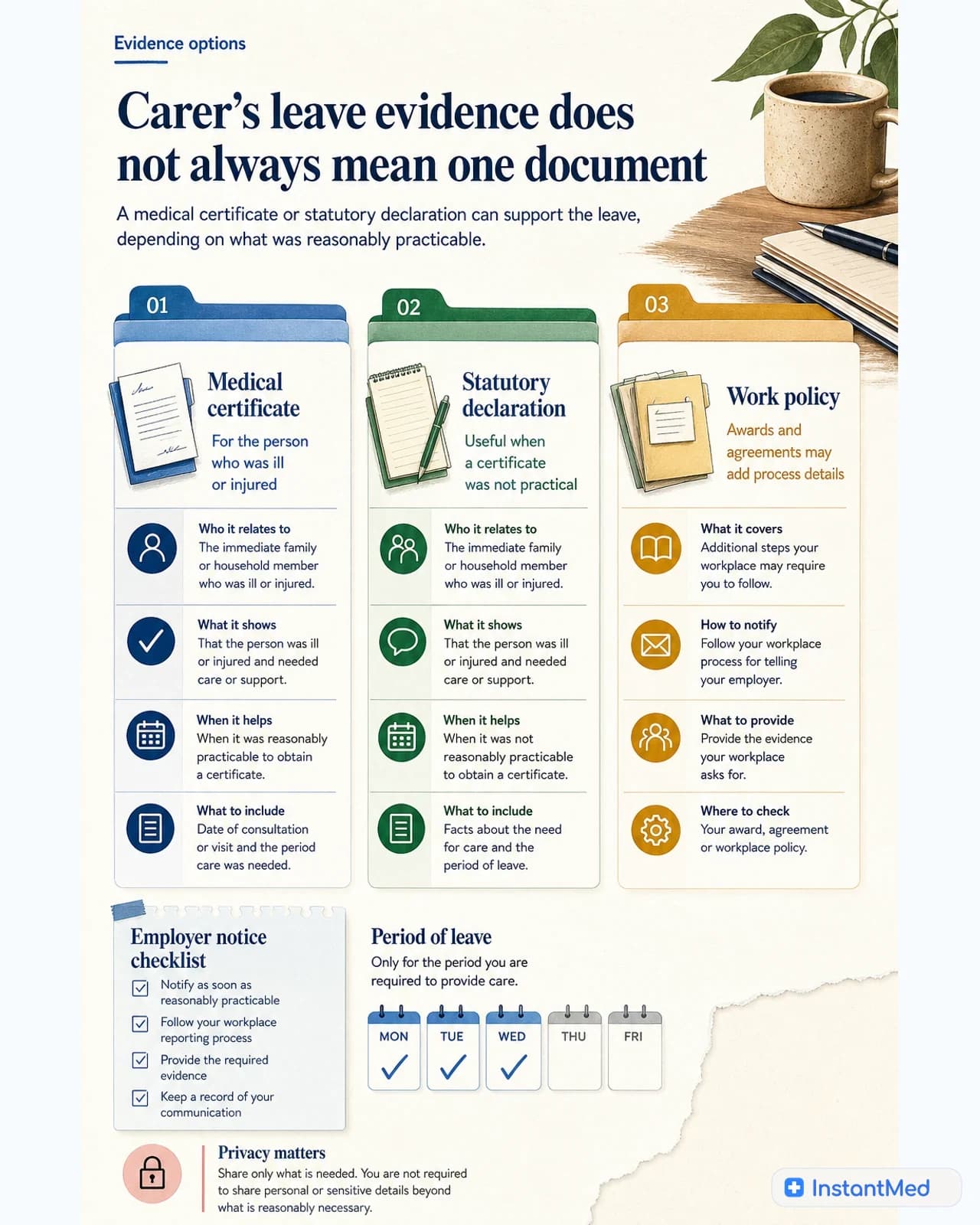
Fair Work says an employer can ask an employee to provide evidence that would satisfy a reasonable person that they were entitled to take sick or carer's leave. Medical certificates and statutory declarations are examples of acceptable evidence.
For carer's leave, evidence should usually show:
- The person needing care was ill, injured, or affected by an unexpected emergency
- Care or support was required
- The relevant date or period
- Enough information to connect the absence to a legitimate carer's leave reason
The evidence does not usually need to include a diagnosis, treatment plan, medication list, test results, or detailed family history.
Medical Certificate vs Statutory Declaration
A medical certificate may be useful where:
- The person needing care was assessed by a clinician
- The illness or injury was significant enough to require medical review
- The absence covered multiple days
- The employer has asked for medical evidence
- The situation involves a child, older parent, hospital attendance, or recovery support
Certificate boundary
The document should confirm the cared-for person's condition and dates, not disclose unnecessary family details.
A statutory declaration may be useful where:
- A medical appointment was not reasonably practical
- The illness was brief and resolved without medical review
- The issue was an unexpected emergency rather than a diagnosed medical condition
- The employer asks for evidence but a certificate is not available
The legal test is not "certificate only". The evidence has to satisfy a reasonable person that the leave was genuinely available.
Who the Certificate Is About
For carer's leave, the certificate or evidence is usually about the person who needed care, not about the employee taking leave.
Useful wording focuses on capacity and care need:
- The person had a medical condition, illness, or injury.
- They required care or support.
- The relevant dates are listed.
- The certificate avoids unnecessary diagnosis detail.
It generally does not need to say exactly how the employee provided care. The workplace only needs enough to verify the entitlement.
Children's Illnesses
Carer's leave is commonly used when a child wakes with fever, vomiting, diarrhoea, rash, conjunctivitis, ear pain, cough, asthma symptoms, injury, or a childcare exclusion illness.
Evidence may be easier where the child has been assessed by a doctor, pharmacist, nurse, or hospital. But some short childhood illnesses resolve with home care. In those cases, a statutory declaration or other reasonable evidence may be the practical option if the employer asks.
Seek medical advice promptly for a child with:
- Breathing difficulty
- Blue lips or severe drowsiness
- Dehydration signs
- A non-blanching rash
- A seizure
- Fever in a very young infant
- Severe pain
- Symptoms that are worsening or not making sense
The leave document is secondary to the child's safety.
Older Parents and Other Adults
Carer's leave can also apply when an adult immediate family member or household member needs support. Examples include:
- Parent with acute illness
- Partner after injury
- Grandparent after a fall
- Household member with sudden severe symptoms
- Adult child needing support after a hospital visit
The evidence should still avoid unnecessary medical detail. If the adult patient has privacy concerns, they can ask the clinician to keep the certificate focused on work-capacity and care need rather than diagnosis.
Unexpected Emergencies
Fair Work describes an unexpected emergency as an unforeseen or sudden and urgent event or situation. It is not limited to illness or injury.
Examples may include:
Leave flow
Illness, injury, or an unexpected emergency can trigger leave when an immediate family or household member needs care.
- A child suddenly needs to be picked up from school or care
- A regular carer becomes unavailable without warning
- A household member has an urgent safety issue
- A family member has a sudden medical event
Whether carer's leave applies depends on the circumstances, including notice, alternative care options, the person's age and independence, and whether other work arrangements were possible.
Notice to the Employer
The employee should tell the employer as soon as possible that they need carer's leave. If possible, they should also say how long they expect to be away.
If evidence is requested, provide it as soon as reasonably practicable. Awards, registered agreements, employment contracts, and workplace policies can set extra process details, but they cannot undercut the National Employment Standards.
Privacy Boundaries
A carer's leave certificate should be enough to prove the leave reason without over-disclosing private information.
Usually avoid sending:
- Test results
- Photos of symptoms
- Hospital discharge summaries unless genuinely required
- Medication lists
- Detailed diagnosis notes
- Private family details unrelated to the leave
If the employer wants more information, ask what entitlement question they are trying to verify. Often the answer can be given without exposing unnecessary health information.
If Leave Is Refused or Challenged
If an employer disputes carer's leave:
- 1
Check the relevant award, enterprise agreement, contract, and workplace policy.
- 2
Confirm whether the person needing care is immediate family or a household member.
- 3
Confirm whether paid leave balance exists.
- 4
Provide reasonable evidence if asked.
- 5
Keep records of notice, dates, and evidence provided.
- 6
Use Fair Work Ombudsman resources or workplace advice if the issue continues.
Fair Work says an employer cannot take negative action against an employee for taking unpaid carer's leave.
Sources
- Fair Work Ombudsman: Sick and carer's leave
- Fair Work Ombudsman: Unpaid carer's leave
- Fair Work Ombudsman: Notice and medical certificates
- Fair Work Ombudsman: Sick and carer's leave and compassionate leave fact sheet
Frequently Asked Questions
Do I need a medical certificate for carer's leave?
Not always. Fair Work says an employer can ask for evidence that would satisfy a reasonable person that the leave was taken for a valid reason. A medical certificate or statutory declaration can be acceptable evidence, depending on the circumstances.
Who can I take carer's leave for?
Fair Work says carer's leave can be used for an immediate family member or household member who is sick, injured, or affected by an unexpected emergency. Immediate family includes spouse or former spouse, de facto partner or former de facto partner, child, parent, grandparent, grandchild, sibling, and the same relatives of a spouse or de facto partner.
How much paid carer's leave do full-time and part-time employees get?
Paid carer's leave comes from the same personal/carer's leave balance as sick leave. Fair Work says full-time employees get 10 days of paid sick and carer's leave per year, with part-time employees receiving a pro-rata amount.
Can casual employees take carer's leave?
Yes. Casual employees do not receive paid personal/carer's leave, but Fair Work says all employees, including casual employees, are entitled to 2 days of unpaid carer's leave per occasion.
What if my paid leave balance is exhausted?
Full-time and part-time employees can take unpaid carer's leave if they have no paid sick or carer's leave left. The unpaid entitlement is 2 days per occasion.
Does the certificate need to disclose the diagnosis?
Usually no. Evidence should show that the family or household member needed care or support because of illness, injury, or an unexpected emergency. It should avoid unnecessary medical detail.
InstantMed Medical Team
Related Articles
11 min read
Can I Take Sick Leave If My Child Is Sick?
If your child is sick, you may be able to use personal/carer's leave rather than ordinary sick leave. Here is what employers can ask for, when a medical certificate helps, and when child symptoms need urgent care.
InstantMed Medical Team
9 min read
Medical Certificates for Work: Complete Australian Guide
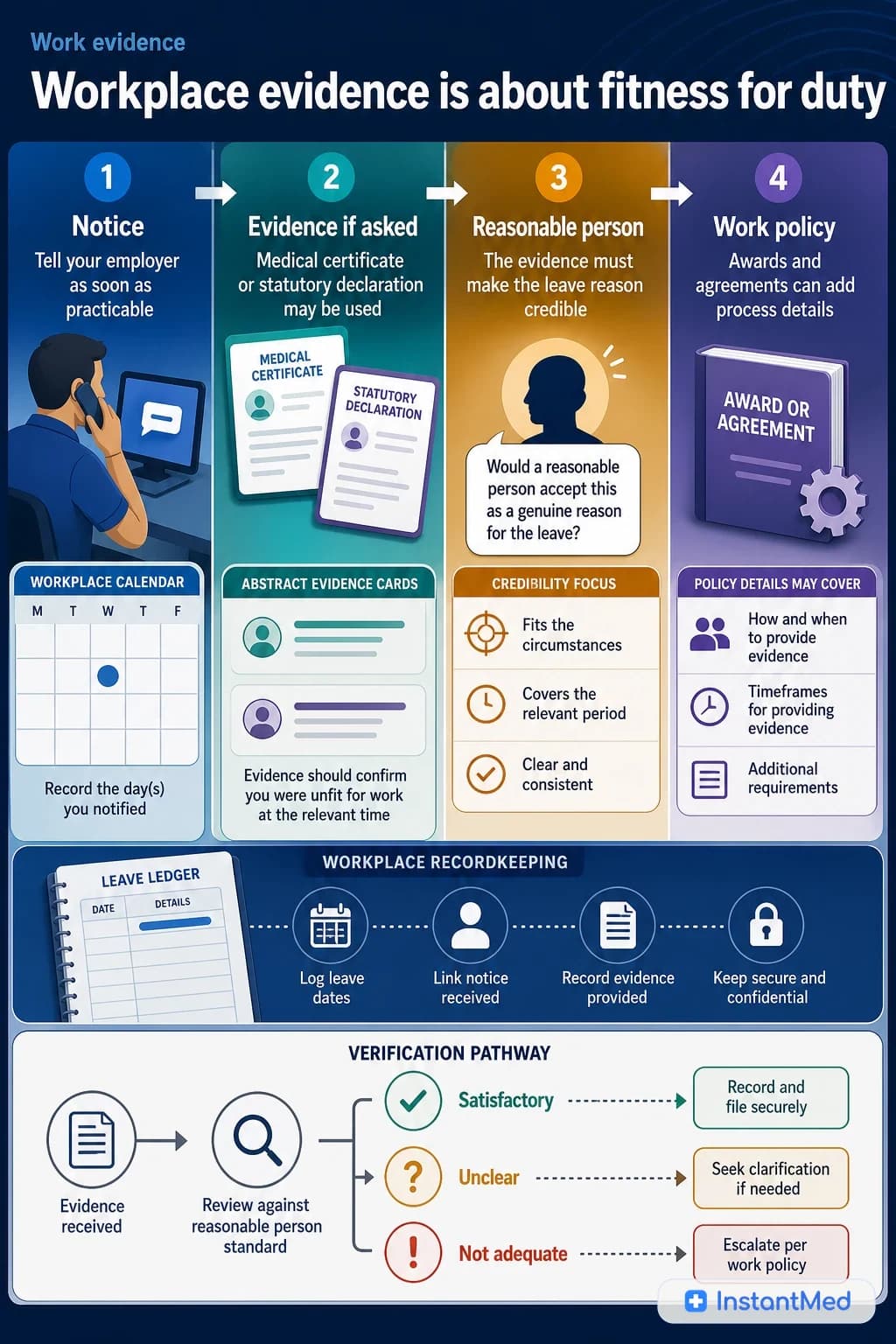
A work medical certificate is evidence that you were unfit for work, not a public explanation of your diagnosis. This Australian guide explains employer evidence rules, privacy, telehealth, stat decs, and return-to-work issues.
InstantMed Medical Team
13 min read
Doctor's Note for Work Australia: What Counts?
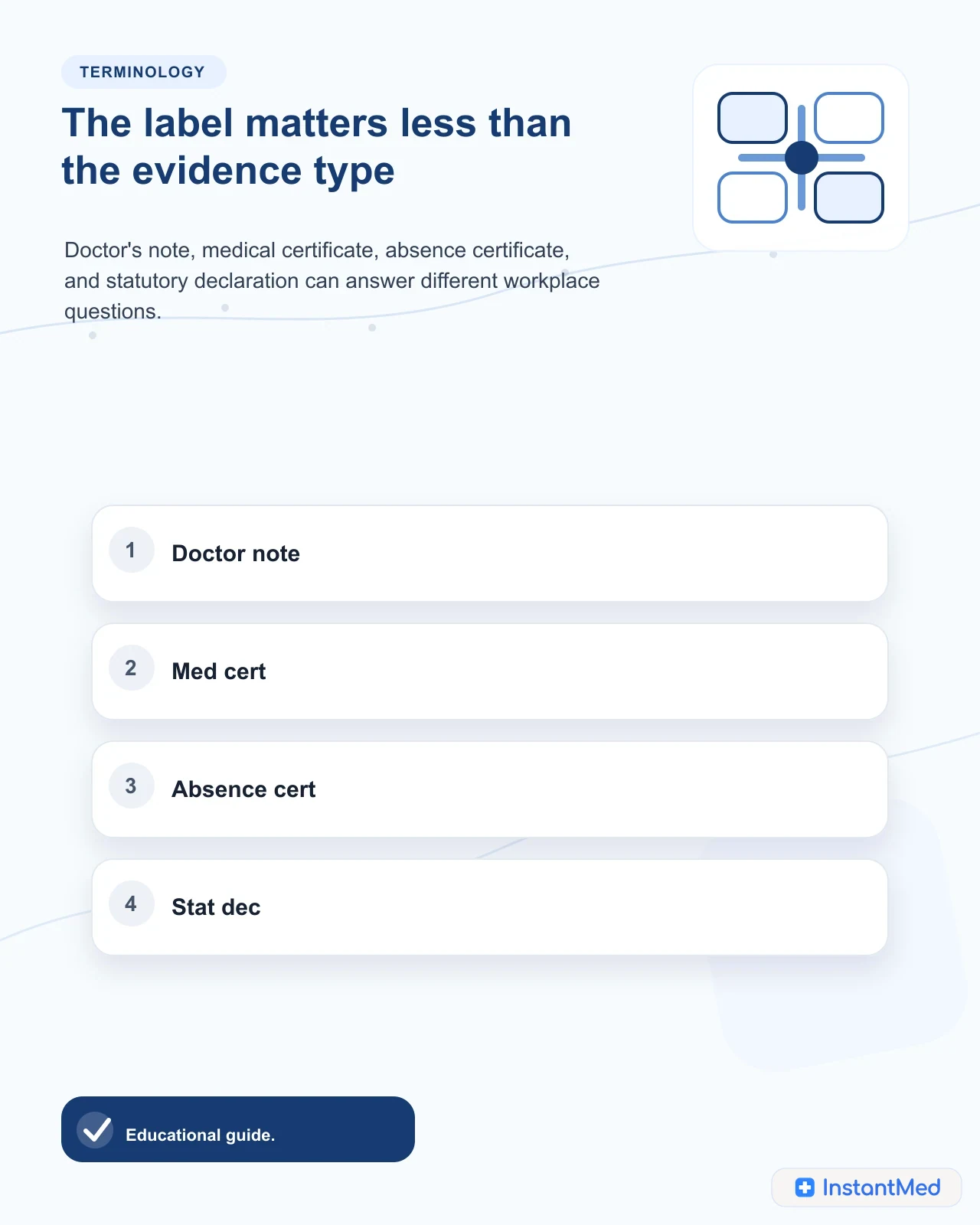
A doctor's note for work in Australia usually means a medical certificate, but sick notes, absence-from-work certificates, and statutory declarations can also matter. Learn what counts as evidence, what a strong certificate includes, and when a workplace may ask questions.
InstantMed Medical Team