Loading article
Back to Health Guides
How Long Can a Medical Certificate Cover?
A practical Australian guide to one-day certificates, multi-day illness, extensions, retrospective certification, long-term absence, and workers compensation certificates.
10 min read
·Updated 11 June 2026
·Doctor Reviewed
AHPRA Verified
In this article
- 1The Short Answer
- 2Evidence Can Be Requested For One Day
- 3Medical Certificate Or Statutory Declaration
- 4What A Certificate Should Usually State
- 5One-Day Certificates
Medical information only. This article is for general information and does not constitute medical advice. Treatment decisions are made by an AHPRA-registered doctor after reviewing your circumstances.
Review
InstantMed Clinical Team
Clinical governance review for guide content
Updated
11 June 2026
General information only, not personal medical advice.
Jump to section
1The Short Answer2Evidence Can Be Requested For One Day3Medical Certificate Or Statutory Declaration4What A Certificate Should Usually State5One-Day Certificates6Multi-Day Certificates7Extensions8Retrospective Certification Is Different From False Backdating9Long-Term Absence10Workers Compensation And Certificate Of Capacity11Returning Before The End Date12What Employers Can Reasonably Look At13The Bottom Line14Sources Used In This Guide
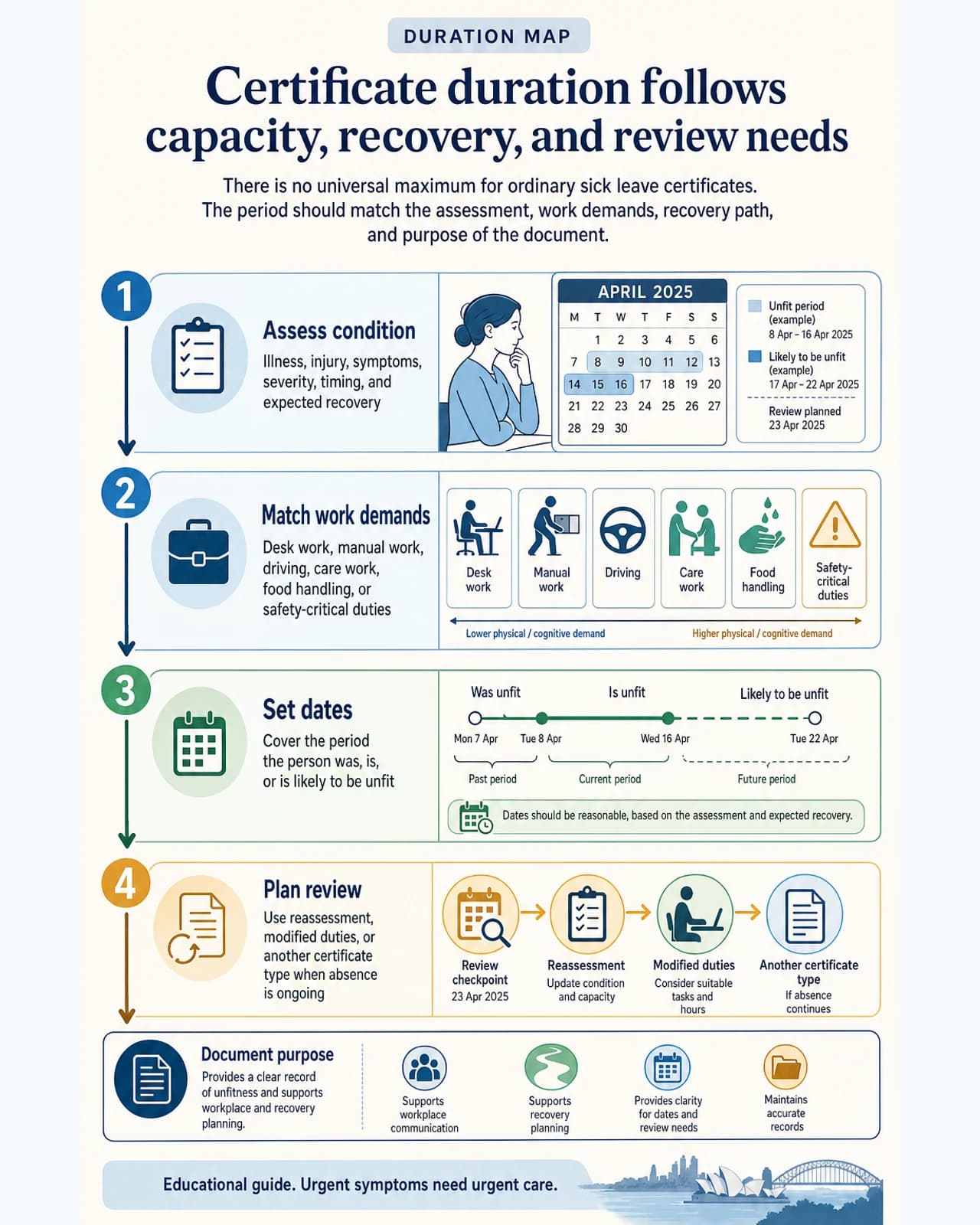
Medical certificate duration is not a fixed number of days. The useful question is narrower: what period was the person assessed as unfit for work, study, or usual duties, and what evidence would reasonably support that period?
For a simple viral illness, the answer may be one or two days. For surgery, injury, pregnancy-related illness, significant mental health symptoms, or a work-related injury, the answer may require review, restrictions, modified duties, or a different certificate form.
Key Information
A certificate should match the medical assessment and the purpose it is being used for. A sick leave certificate, a university certificate, a Centrelink medical certificate, and a workers compensation certificate of capacity are not interchangeable documents.
The Short Answer
A medical certificate can usually cover the period a practitioner reasonably believes you were, are, or are likely to be unfit for work or study.
That period depends on:
- The condition or injury
- When symptoms started
- Whether the person is improving, stable, or worsening
- The person's actual work or study demands
- Whether modified duties are realistic
- Whether review is needed before more time is certified
- Whether the certificate is for ordinary sick leave, a workplace injury, study, Centrelink, insurance, or another purpose
There is no safe rule that says "all certificates cover X days" or "online certificates can only cover Y days." Those shortcuts are how bad certificates get written.
Evidence Can Be Requested For One Day
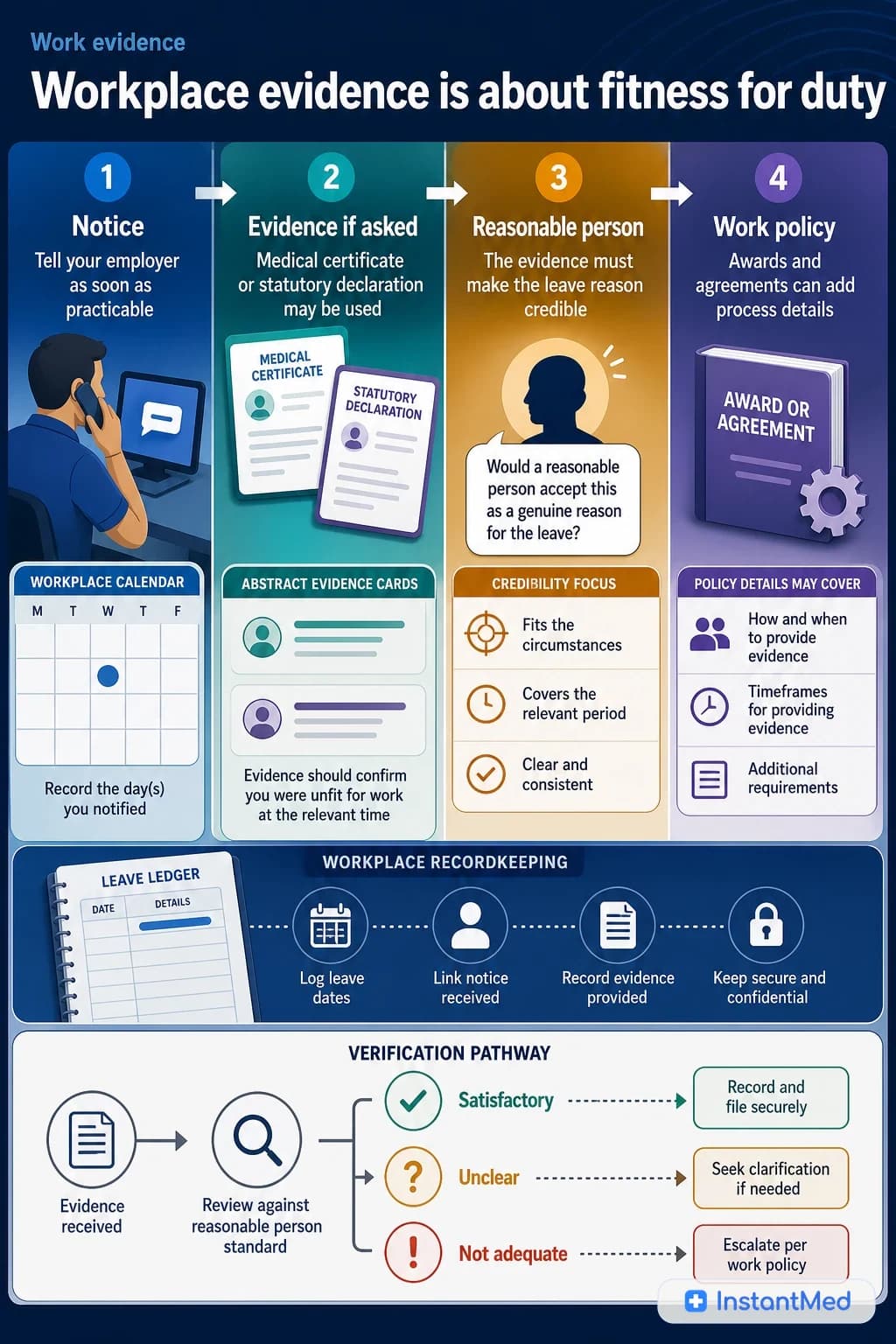
For Australian employees covered by the national workplace relations system, the Fair Work Ombudsman explains that an employer can ask for evidence showing the employee took sick or carer's leave because they were unfit for work or needed to provide care or support.
Fair Work also says employers can ask for evidence for as little as one day or less off work. If evidence is requested and not provided, the employee may not be entitled to paid sick or carer's leave for that absence.
The evidence requested must still be reasonable in the circumstances. Awards, registered agreements, contracts, and workplace policies can also specify when evidence is required and what type of evidence is expected.
Medical Certificate Or Statutory Declaration
Fair Work lists medical certificates and statutory declarations as examples of acceptable evidence. The evidence does not need to reveal every private medical detail. It needs to be enough to convince a reasonable person that the employee was genuinely entitled to the leave.
This distinction matters:
| Evidence question | Practical meaning |
|---|---|
| "Was the person unfit for work?" | The certificate should address capacity for the relevant dates. |
| "Is a diagnosis mandatory?" | Usually not for routine sick leave unless a specific process requires it. |
| "Can evidence be requested for one day?" | Yes, if reasonable in the circumstances. |
| "Can a stat dec ever be enough?" | Yes, it can be acceptable evidence depending on the circumstances and workplace rules. |
What A Certificate Should Usually State
A routine certificate for sick leave normally needs to be clear, dated, and specific enough to identify the relevant period.
Useful certificate details usually include:
- The practitioner's name, provider details, and signature
- The patient's name
- The date the certificate was written
- The date or dates the patient was unfit for work, study, or usual duties
- Whether the person is unfit for usual duties or may be fit for modified duties
- A review date or recommendation for reassessment if the situation is ongoing
Diagnosis is a privacy-sensitive issue. Routine workplace certificates commonly focus on capacity rather than naming the diagnosis. If a particular scheme requires more detail, the patient should understand what is being disclosed and why.
One-Day Certificates
A one-day certificate is common when the illness is short, acute, and functionally significant for that day.
Examples that may fit a one-day certificate include:
- A migraine episode
- Acute gastroenteritis
- Severe period pain
- A short viral illness
- An acute flare of a known condition
- A mental health day where the person was not fit for work
- A minor injury that prevented usual duties for the day
A one-day certificate should still be based on an adequate assessment. It should not be a formality, a purchased absence note, or a document written without enough information to support the conclusion.
Multi-Day Certificates
Multi-day certificates are appropriate when the expected recovery period is longer or the person's duties create a higher risk of returning too early.
The duration may be influenced by:
Evidence rules
Fair Work focuses on evidence that would satisfy a reasonable person. Medical certificates and statutory declarations can both be acceptable evidence depending on the circumstances.
- Fever, vomiting, diarrhoea, pain, fatigue, or reduced concentration
- Whether the person works in food handling, care work, driving, heavy labour, health care, childcare, or safety-critical work
- Whether symptoms are improving
- Whether the illness is contagious
- Whether the job can be done from home or with lighter duties
- Whether a review is needed before more time is certified
General duration tables can help people understand common patterns, but they are not rules.
| Situation | Common evidence pattern | Why review may be needed |
|---|---|---|
| Short viral illness | Often one to several days | Worsening fever, breathing symptoms, or prolonged illness changes the risk. |
| Gastroenteritis | Often short, with attention to return-to-work hygiene rules | Food handling, dehydration, blood, fever, or persistent symptoms may need review. |
| Acute back or neck pain | Depends heavily on duties | Heavy lifting, driving, neurological symptoms, or work injury questions change the certificate type. |
| Migraine | Often episode-based | Frequent episodes need diagnosis and prevention planning, not repeated short certificates only. |
| Mental health symptoms | May start short, then review | Longer absence often needs continuity, treatment planning, and return-to-work support. |
| Surgery or procedure recovery | Depends on the procedure and role | Clearance, restrictions, wound care, anaesthetic effects, and follow-up may matter. |
Extensions
If you are still unfit when the certificate period ends, the usual approach is a new certificate or an extension after reassessment.
The reassessment should address:
- What has changed since the first certificate
- Whether symptoms are improving or worsening
- Whether the original diagnosis still makes sense
- Whether complications or red flags are present
- Whether modified duties could work
- Whether a regular GP, specialist, or in-person assessment is needed
Repeated short extensions for the same issue are a signal to step back. The problem may need proper management, not just another certificate.
Retrospective Certification Is Different From False Backdating
People often use the word "backdating" loosely, but there are two different ideas.
| Term | What it means | Usually acceptable? |
|---|---|---|
| Retrospective certification | The certificate is written today but states the person was unfit during an earlier period. | Sometimes, if clinically justified. |
| False backdating | The document is made to look like it was written on an earlier date. | No. That is misleading. |
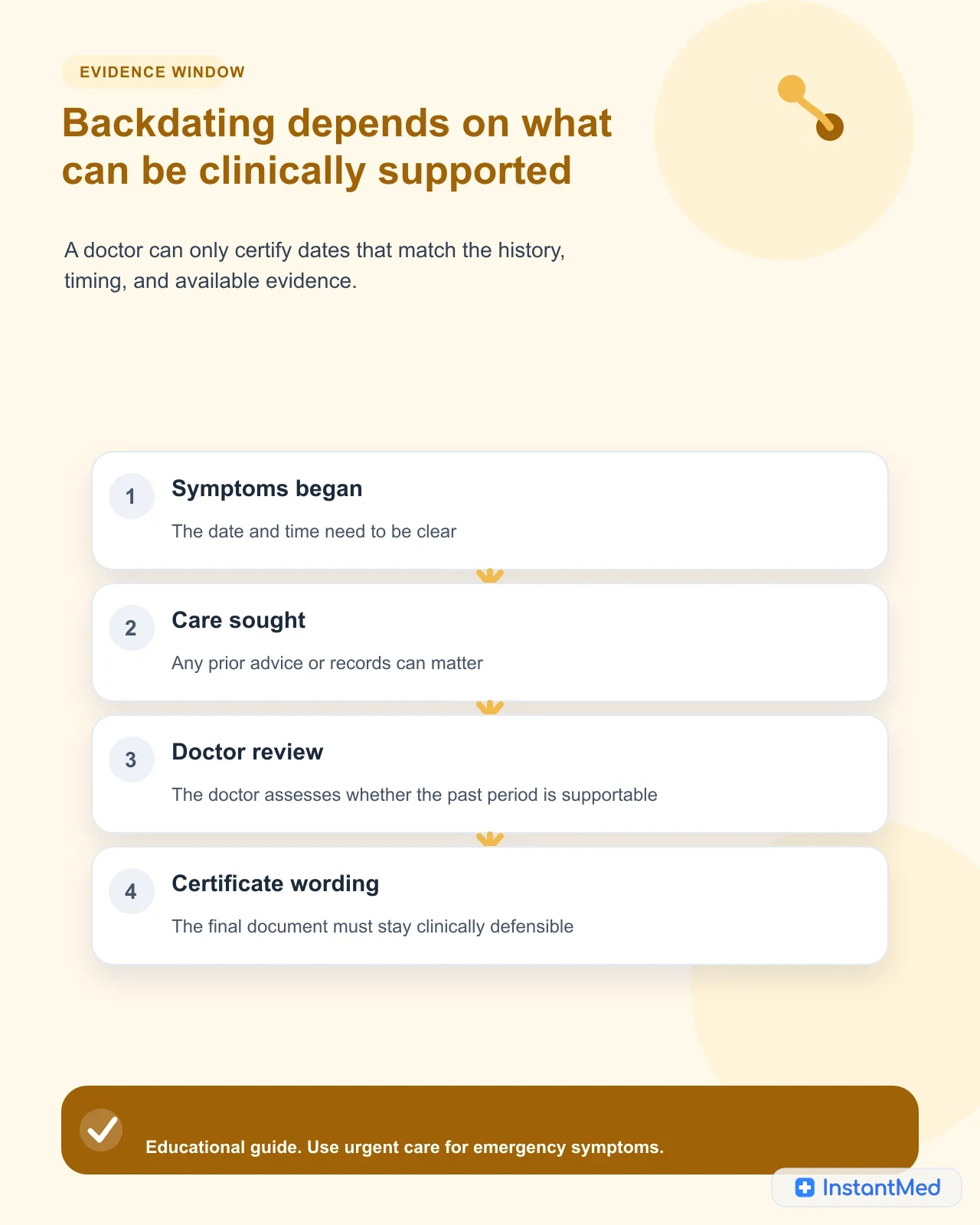
The certificate should be dated on the day it is written. A practitioner may still certify a past period if, after assessment, they reasonably believe the person was unfit for work during that period.
The longer the gap, the harder this becomes. A two-day illness discussed a day later is very different from asking for several weeks or months to be certified after the fact with little supporting evidence.
Long-Term Absence
Longer absences need a different level of care.
For absences lasting beyond the expected short recovery period, the priority becomes:
- Continuity with a regular GP or treating practitioner
- Diagnosis and treatment planning
- Review dates
- Functional capacity
- Modified duties or graduated return
- Specialist input if needed
- Workplace communication that protects privacy
A long certificate without review can be weak evidence if it does not explain work capacity or why the period is clinically appropriate. For some conditions, a shorter certificate with a planned review is better medical practice than guessing a long end date.
Workers Compensation And Certificate Of Capacity
If the illness or injury is work-related, ordinary sick leave evidence may not be the right document.
Workers compensation schemes often use a certificate of capacity. These certificates are designed to show:
Ongoing absence
Extensions should explain what changed. Work-related injuries may need a certificate of capacity rather than a standard sick leave certificate.
- The worker's injury or illness
- Capacity for pre-injury duties, modified duties, or no work
- Functional restrictions
- Treatment plan
- Expected recovery or review timeline
- Return-to-work planning
For example, Comcare describes the certificate of capacity as a tool for understanding capacity for work, limitations, treatment, and safe return to work. SIRA in NSW says a certificate of capacity is used for workplace injuries and helps insurers, workers, and employers plan recovery or return to work.
If the absence relates to a workplace injury, use the relevant state, territory, or Commonwealth workers compensation process rather than assuming a standard sick leave certificate is enough.
Returning Before The End Date
A certificate states the period the practitioner considered you unfit, or likely unfit, at the time of assessment. It does not always mean you are legally forbidden from returning earlier.
However, check before returning early if:
- You work in a safety-critical role
- You drive, operate machinery, lift, climb, or provide direct care
- The absence followed surgery, concussion, infection risk, or a workplace injury
- The certificate mentions no work, modified duties, or review
- Your employer has a return-to-work or clearance process
For longer absences, early return should be planned rather than improvised.
What Employers Can Reasonably Look At
Employers do not need your full medical history for routine sick leave, but they can look at whether the evidence supports the leave claimed.
Practical checks include:
- Does the certificate identify the employee?
- Is it dated and signed?
- Does it cover the relevant date or dates?
- Does it state unfitness for work or relevant capacity?
- Is the issue date different from the illness period, and if so is that understandable?
- Does the certificate appear genuine and internally consistent?
If there is a dispute, the answer is usually not to add private diagnosis details by default. The better first step is to clarify what evidence is being requested and why.
The Bottom Line
A medical certificate can cover one day, several days, or a longer period if the duration is clinically justified and the document suits the purpose. The safest certificate is specific, dated, honest, privacy-conscious, and matched to the person's capacity.
For routine sick leave, Fair Work's central test is reasonable evidence of entitlement to leave. For longer absence or workplace injury, the focus shifts toward review, capacity, restrictions, treatment, and return-to-work planning.
Sources Used In This Guide
- Fair Work Ombudsman: Notice and medical certificates
- Medical Board of Australia: telehealth guidance
- RACGP: Sickness certification
- Comcare: Certificate of capacity
- SIRA NSW: Certificates of Capacity for workplace injuries
Frequently Asked Questions
Can a medical certificate cover one day off work?
Yes. The Fair Work Ombudsman says employers can ask for evidence for as little as one day or less off work, if the request is reasonable in the circumstances and consistent with the applicable award, agreement, contract, or policy.
Is there a maximum number of days a medical certificate can cover?
There is no single everyday sick-leave maximum that applies to every illness and workplace. The period should be clinically justified, based on the assessment, the likely recovery period, work capacity, and whether review or a different certificate type is needed.
Can a certificate cover days before the appointment?
Sometimes. The certificate should be dated on the day it is written, but a practitioner may certify a past period of illness if they believe the person was unfit for work during that period. This is retrospective certification, not changing the issue date.
Can I return to work before the certificate period ends?
Often, yes, if you have recovered and your workplace does not require clearance or a return-to-work process. For longer absences, safety-critical roles, workplace injuries, or modified duties, check the relevant workplace process before returning.
Is a standard sick leave certificate the same as a workers compensation certificate of capacity?
No. A workers compensation certificate of capacity is a specific form used for work-related injuries or illnesses. It usually covers capacity, restrictions, treatment, review dates, and return-to-work planning rather than simply confirming sick leave.
InstantMed Medical Team
Related Articles
9 min read
Medical Certificates for Work: Complete Australian Guide
A work medical certificate is evidence that you were unfit for work, not a public explanation of your diagnosis. This Australian guide explains employer evidence rules, privacy, telehealth, stat decs, and return-to-work issues.
InstantMed Medical Team
13 min read
Doctor's Note for Work Australia: What Counts?
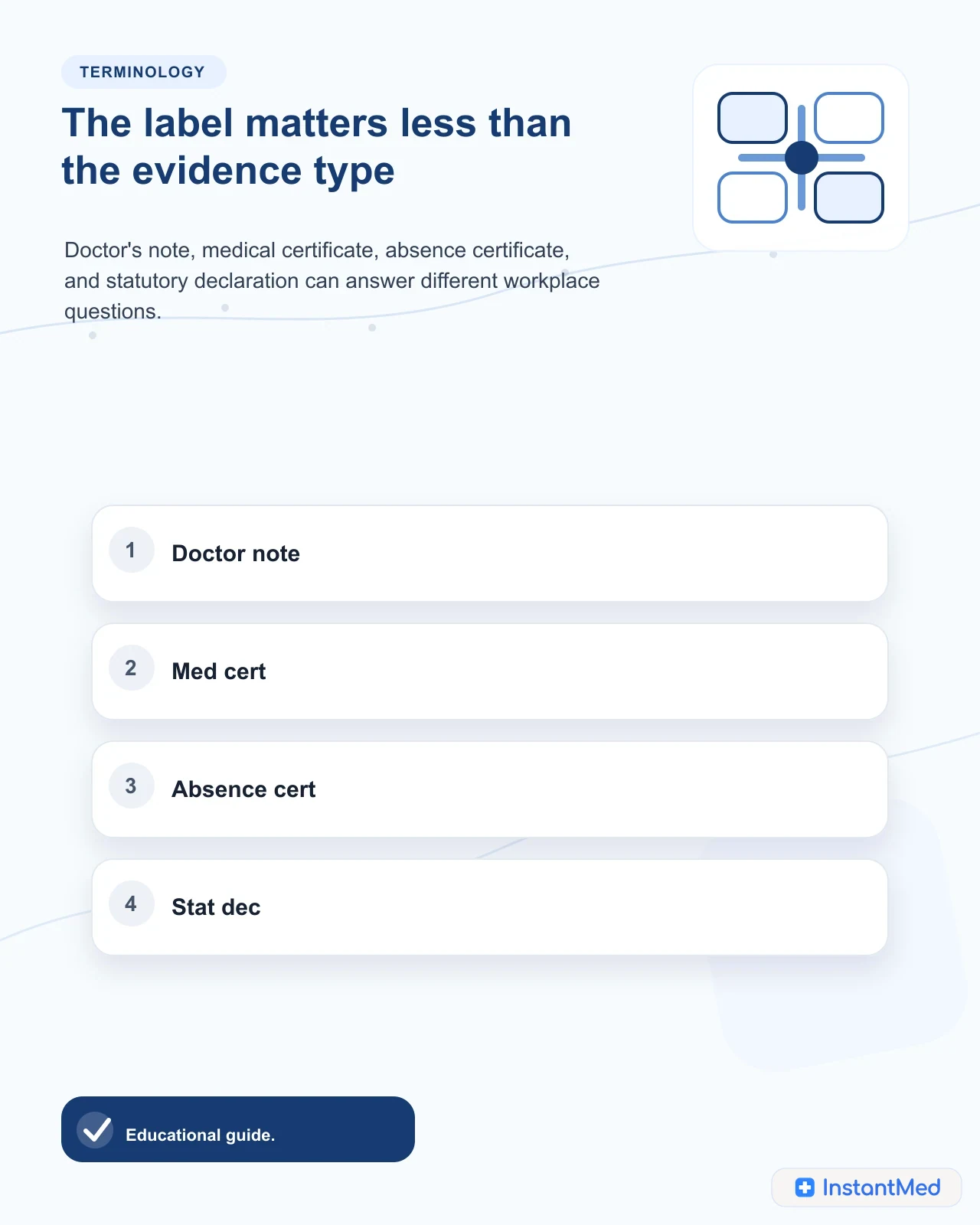
A doctor's note for work in Australia usually means a medical certificate, but sick notes, absence-from-work certificates, and statutory declarations can also matter. Learn what counts as evidence, what a strong certificate includes, and when a workplace may ask questions.
InstantMed Medical Team
8 min read
Can You Backdate a Medical Certificate in Australia?
Backdating falsifies the consultation date - no legitimate doctor will do it. A retrospective certificate covers past dates and is legal. Here is the difference and what to do now.
InstantMed Medical Team