Loading article
Back to Health Guides
Are Online Medical Certificates Valid in Australia?
How telehealth certificates fit the Fair Work evidence standard, what makes a certificate credible, and what employers can reasonably ask.
8 min read
·Updated 4 June 2026
·Doctor Reviewed
AHPRA Verified
In this article
- 1What the Law Actually Says
- 2The Medical Board's Position
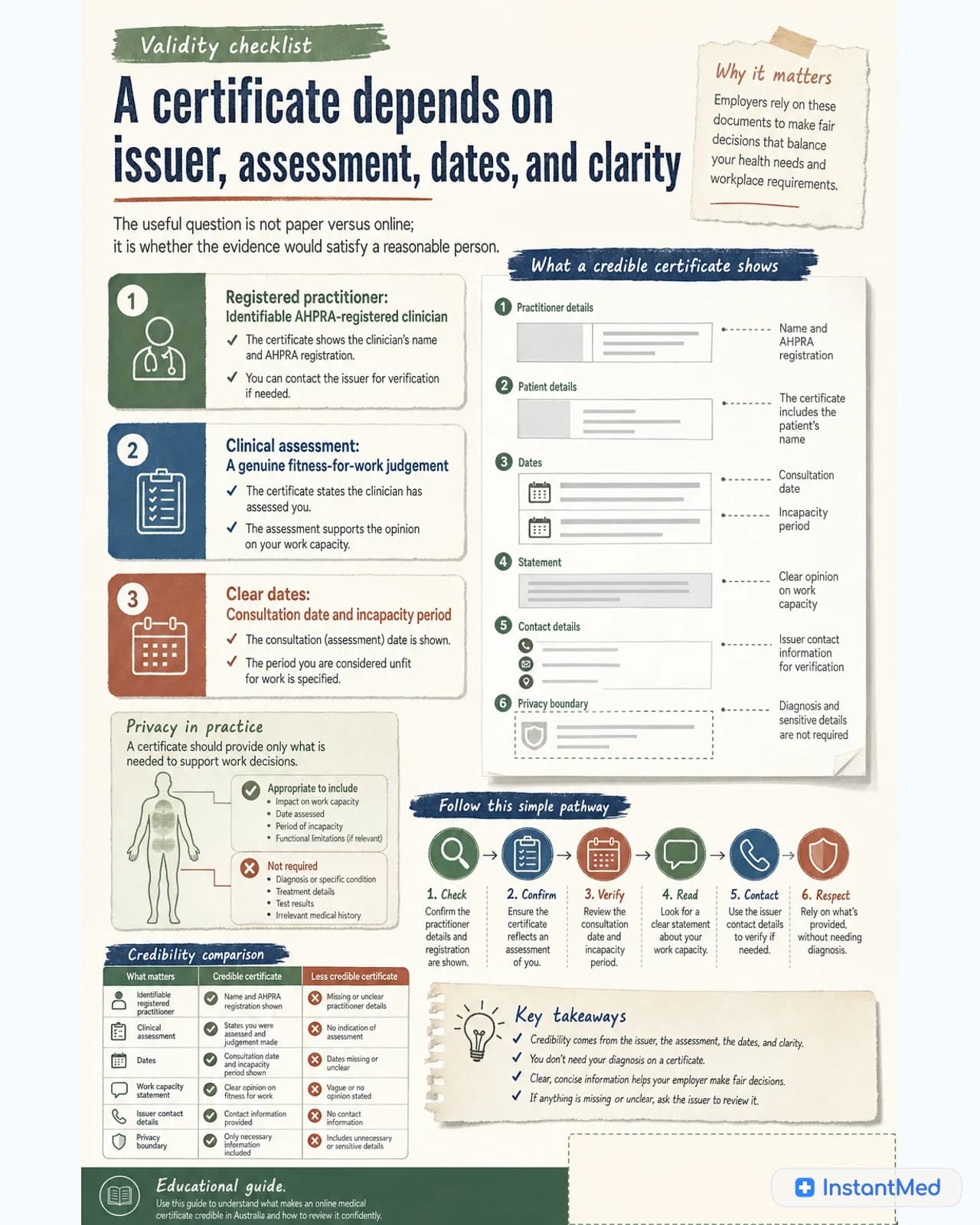
- 3What Makes a Certificate Credible
- 4What Employers Can and Cannot Do
- 5Acceptance by Different Institutions
Medical information only. This article is for general information and does not constitute medical advice. Treatment decisions are made by an AHPRA-registered doctor after reviewing your circumstances.
Review
InstantMed Clinical Team
Clinical governance review for guide content
Updated
4 June 2026
General information only, not personal medical advice.
Jump to section
1What the Law Actually Says2The Medical Board's Position3What Makes a Certificate Credible4What Employers Can and Cannot Do5Acceptance by Different Institutions6What If Your Employer Still Refuses?7Award and Enterprise Agreement Considerations8The Historical Context: Why Some Employers Are Still Uncertain9The Certificate Is Only as Good as the Underlying Assessment10Sources
Key Information
Online medical certificates issued by AHPRA-registered practitioners can be valid evidence in Australia. The key test is whether the evidence would satisfy a reasonable person, not whether the consultation happened online or in person.
This guide is general information. Awards, enterprise agreements, university policies, Centrelink rules, and workers' compensation schemes can add specific evidence requirements for particular situations.
What the Law Actually Says
The workplace value of a medical certificate in Australia is determined by the evidence it provides: who issued it, whether there was a genuine assessment, and whether it contains clear information about work capacity and dates. The consultation method, in-person versus telehealth, is not by itself the legal test.
The Fair Work Act 2009 governs sick leave entitlements for most Australian employees. Under section 107, an employee who takes personal leave and is asked for evidence must provide "evidence that would satisfy a reasonable person" of the illness or injury. The Act then specifies what constitutes acceptable evidence:
- A medical certificate from a registered health practitioner, OR
- A statutory declaration
A "registered health practitioner" means a practitioner registered under the Health Practitioner Regulation National Law. The Act does not say the assessment must be in person.
A telehealth consultation conducted by an AHPRA-registered doctor or other appropriately registered practitioner can be a legitimate medical consultation. The certificate produced from that assessment can satisfy the Fair Work evidence standard when it is credible and complete.
The Medical Board's Position
The Medical Board of Australia's guidelines for telehealth practice are explicit: doctors can provide telehealth services across the full scope of general medical practice, including issuing medical certificates, provided they conduct an adequate clinical assessment. The guidelines place an obligation on doctors to meet the same standard of care via telehealth as they would in person - not a lesser standard.
This means a telehealth doctor issuing a medical certificate has:
- Assessed the patient's reported symptoms
- Made a clinical judgment about fitness for work
- Documented the consultation to medical record standards
- Applied their professional judgment as an AHPRA-registered doctor
The certificate should be the output of a genuine medical assessment, not a rubber stamp. When an online certificate is questioned, the useful distinction is whether it reflects a real clinical assessment by an identifiable registered practitioner.
What Makes a Certificate Credible
A workplace medical certificate should include specific information. Regardless of how the consultation was conducted, the certificate should contain:
- The patient's full legal name (as it appears on employment records)
- The date the consultation occurred
- A statement that the patient was assessed and found unfit for work
- The period of incapacity - the start date and end date the certificate covers
- The issuing doctor's full name
- The doctor's AHPRA registration number
- The doctor's practice name and contact details
- The doctor's signature, digital signature, or authenticated issue details
The certificate should state "unfit for work due to a medical condition" or similar. It should not include the specific diagnosis unless you have explicitly consented to disclosure - your diagnosis is private health information protected under the Privacy Act.
Helpful Tip
Check your certificate before submitting it to your employer. Verify that your name is spelled correctly, the dates are accurate, and the doctor's registration details are visible. An error on the certificate does not invalidate it but may cause unnecessary questions.
What Employers Can and Cannot Do
Employers can legitimately:
- Request a medical certificate for absences that exceed workplace policy thresholds
- Request a certificate for any single-day absence adjacent to a public holiday
- Ask for the expected duration of absence
- Ask for the period of incapacity covered by the certificate
- Request a new or follow-up certificate if the period covered has expired and absence continues
Fair Work standard
A valid telehealth certificate should not be rejected simply because it was online, but employers can ask reasonable evidence questions.
Employers cannot:
- Refuse credible evidence from an AHPRA-registered practitioner merely because it was issued via telehealth
- Demand the specific diagnosis or clinical details beyond fitness-for-work status
- Require you to attend a specific clinic or use a specific doctor
- Require you to attend an employer-nominated doctor as the exclusive evidence (though they may request it as additional evidence in some circumstances under specific enterprise agreements)
- Take adverse action against you for submitting a valid certificate
If your employer refuses your certificate without a clear reason, ask for the reason in writing and consider seeking advice from the Fair Work Ombudsman, your union, or an employment adviser.
Acceptance by Different Institutions
Private sector employers
All private sector employers covered by the Fair Work Act are bound by its evidence provisions. A credible telehealth certificate can meet the evidentiary requirement. Industry sector, company size, and company policy do not make online evidence invalid by default.
Government employers
Commonwealth, state, and local government employees are covered by different frameworks. The same practical principle usually applies: evidence from a registered practitioner is assessed by credibility and policy requirements, not by assuming telehealth is invalid.
Schools and universities
Schools accept medical certificates for student absences. Universities set their own evidence policies: routine absence is usually straightforward, but exam deferrals, special consideration, and assessment extensions often require specific institutional forms rather than a standard certificate. Check your institution's policy for the exact application type.
Centrelink and government payments
Centrelink may accept medical evidence from AHPRA-registered doctors. However, some payment types require completion of specific Centrelink forms rather than a standard medical certificate. Contact Centrelink directly for your specific payment type and circumstance.
Workers' compensation
Workers' compensation claims typically require specific forms or certificates completed by treating doctors. A standard medical certificate may be part of the claim process but should be combined with the specific documentation required by your state's workers' compensation authority.
What If Your Employer Still Refuses?
If your employer refuses a certificate from an AHPRA-registered practitioner, follow these steps:
- Ask them to explain in writing why the certificate is not accepted. A legitimate employer should be able to point to a specific provision of your employment agreement, award, or relevant legislation.
- If the explanation relies only on "it was done online," direct them to Fair Work guidance on evidence for sick and carer's leave. The consultation method alone is not the useful distinction.
- If the refusal continues, contact the Fair Work Ombudsman for advice. You can also raise the matter with your union if you are a member.
- Document all communications about the certificate refusal in writing.
Refusing credible medical evidence without a legitimate basis can become a workplace rights issue. The Fair Work Ombudsman can provide guidance on next steps.
Award and Enterprise Agreement Considerations
Most Australian employees are covered by either a modern award or an enterprise agreement. These instruments can impose additional documentation requirements beyond the Fair Work Act's minimum standards, but they cannot reduce your legal entitlements below those minimums.
Common provisions found in modern awards and enterprise agreements:
Requiring a certificate for single-day absences adjacent to public holidays or weekends: Many awards include provisions requiring a medical certificate when the absence occurs immediately before or after a public holiday or weekend. This is a valid workplace requirement. A telehealth certificate meets this requirement just as any other certificate does.
Required notice periods: Awards frequently specify that employees must notify employers of absence "as soon as reasonably practicable." Your obligation is to notify promptly - not to have the certificate in hand at the point of notification. You can notify in the morning and submit the certificate later the same day once the telehealth consultation is complete.
Employer-nominated doctors: Some enterprise agreements (particularly in industries like mining, healthcare, and construction) permit employers to require a consultation with a specific or nominated medical practitioner, in addition to - not instead of - the employee's own certificate. These provisions are enforceable only where they are in the enterprise agreement or award, not simply a workplace policy. The Fair Work Commission has scrutinised these provisions and upheld them only where there is a legitimate and proportionate occupational health and safety rationale.
Public sector frameworks: Commonwealth, state, and territory public service frameworks have their own leave provisions but all accept medical certificates from registered practitioners. The APS (Australian Public Service) Enterprise Agreements vary by agency but none exclude telehealth certificates - they require evidence from a "medical practitioner" or "registered health practitioner," which a telehealth doctor is.
The key principle: awards and enterprise agreements can impose additional or higher-threshold requirements for documentation, but they cannot reduce the workplace evidence status of a certificate from an AHPRA-registered doctor.
The Historical Context: Why Some Employers Are Still Uncertain
Until 2020, telehealth services were not widely used in Australian primary care, and it was reasonable for employers to associate "medical certificate" with an in-person GP visit. Medicare-subsidised telehealth was limited to specific circumstances and patient groups before the COVID-19 pandemic.
The pandemic changed this completely. The Australian Government dramatically expanded telehealth access from March 2020. According to the AIHW, approximately 37% of all GP Medicare consultations in 2021-22 were delivered via telehealth, making it a standard mode of practice rather than an exception.
Assessment quality
A certificate issued after an adequate remote assessment is different from a document generated without real review.
The Medical Board of Australia updated telehealth guidance to address remote consultation standards. Fair Work guidance focuses on whether the evidence would satisfy a reasonable person.
Employer uncertainty about telehealth certificates today often reflects outdated policy language or concern about low-quality certificate vendors. The answer is to assess the quality of the evidence, not to reject telehealth as a category.
The Certificate Is Only as Good as the Underlying Assessment
Credible certificates come from genuine clinical assessments, not from clicking a box and paying a fee. A doctor who issues a certificate without adequate assessment can breach professional obligations.
This is why the clinical questions matter. A telehealth service that does not adequately assess symptoms before issuing documentation is weak evidence. Employers who scrutinise online certificates are partly reacting to the existence of lower-quality services.
Using a legitimate telehealth medical certificate service, one that conducts a genuine clinical assessment, uses AHPRA-registered practitioners, and displays registration details on documents, gives the certificate a much stronger basis if it is questioned.
Sources
- Fair Work Ombudsman: Notice and medical certificates
- Fair Work Ombudsman: Sick and carer's leave
- Federal Register of Legislation: Fair Work Act 2009, section 107
- Medical Board of Australia: Updated telehealth guidance
- Ahpra: Register of practitioners
- AIHW: Medicare-subsidised GP, allied health and specialist health care across local areas
- Services Australia: Medical certificates
Frequently Asked Questions
Can my employer refuse an online medical certificate?
An employer should not refuse a certificate simply because it was issued after telehealth. Under Fair Work, the evidence must satisfy a reasonable person. A certificate from an identifiable registered practitioner after a genuine assessment will usually be strong evidence, but employers may ask reasonable questions if details are missing or inconsistent.
Do online certificates count as 'real' medical certificates?
Yes, if they are issued by an appropriately registered practitioner after a genuine assessment. The consultation method alone does not make a certificate invalid. What matters is the issuing practitioner, the assessment, and whether the certificate provides credible evidence for the absence.
What information should be on a workplace medical certificate?
A doctor-issued medical certificate must include: the patient's full name, the date of consultation, a statement that the patient is unfit for work due to a medical condition, the period of incapacity (start and end dates), the issuing doctor's full name and AHPRA registration number, and the doctor's contact details or practice information. The certificate should NOT include the specific diagnosis unless you have explicitly consented to its disclosure.
Can a university refuse an online medical certificate?
Universities and educational institutions set their own evidence policies. Routine absence documentation is different from exam deferrals, special consideration, and assessment-extension requests, which may require additional documentation or specific forms.
Are online certificates suitable for Centrelink?
Centrelink has specific requirements for medical evidence depending on the payment type and circumstance. Some situations require specific forms rather than a standard workplace-style medical certificate. Check the Services Australia instructions for your exact situation.
InstantMed Medical Team
Related Articles
9 min read
How to Get a Medical Certificate Online in Australia
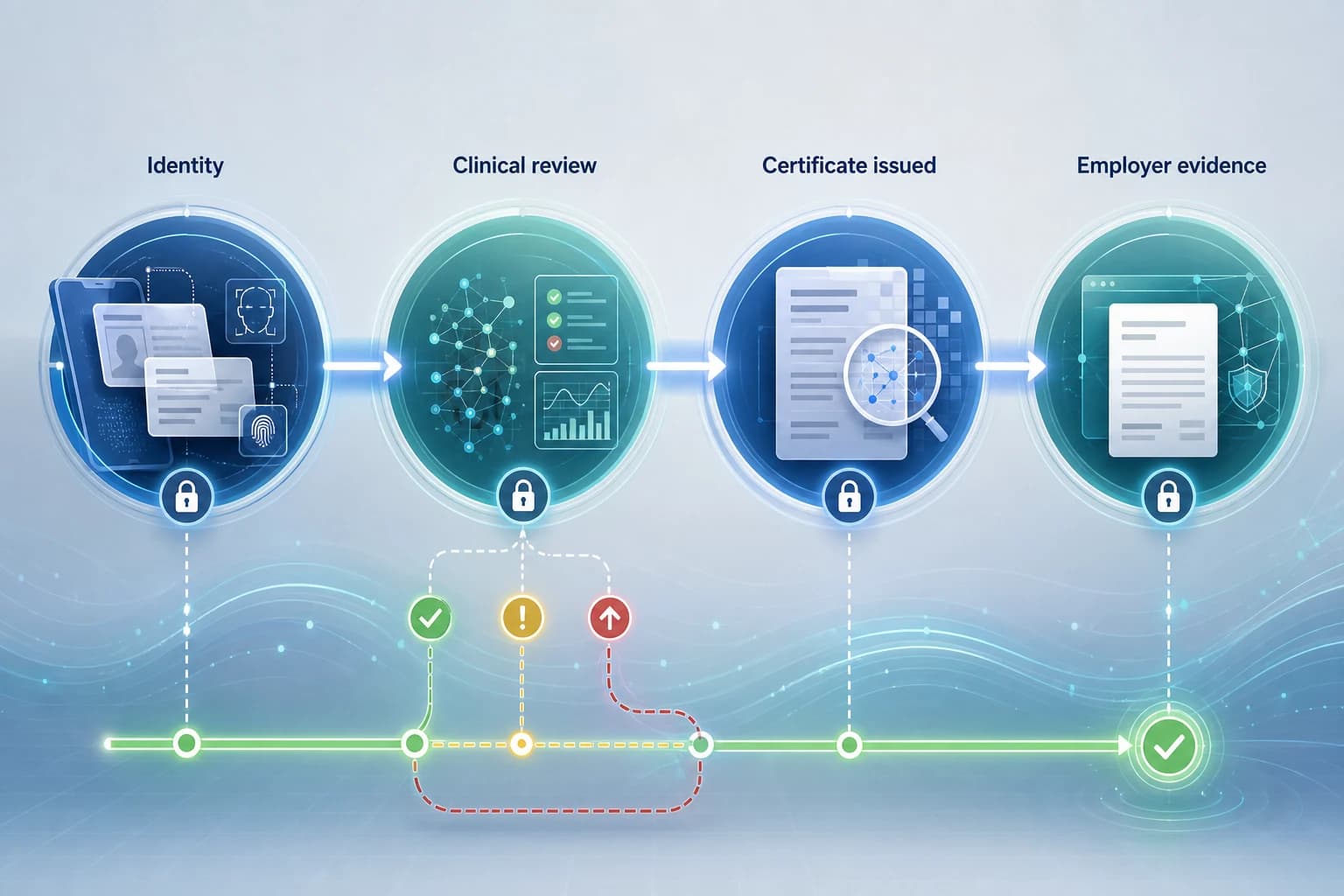
Online medical certificates can be valid workplace evidence in Australia when issued after an appropriate clinical review by a registered practitioner. Learn what matters, what to prepare, and where the limits are.
InstantMed Medical Team
9 min read
Medical Certificates for Work: Complete Australian Guide
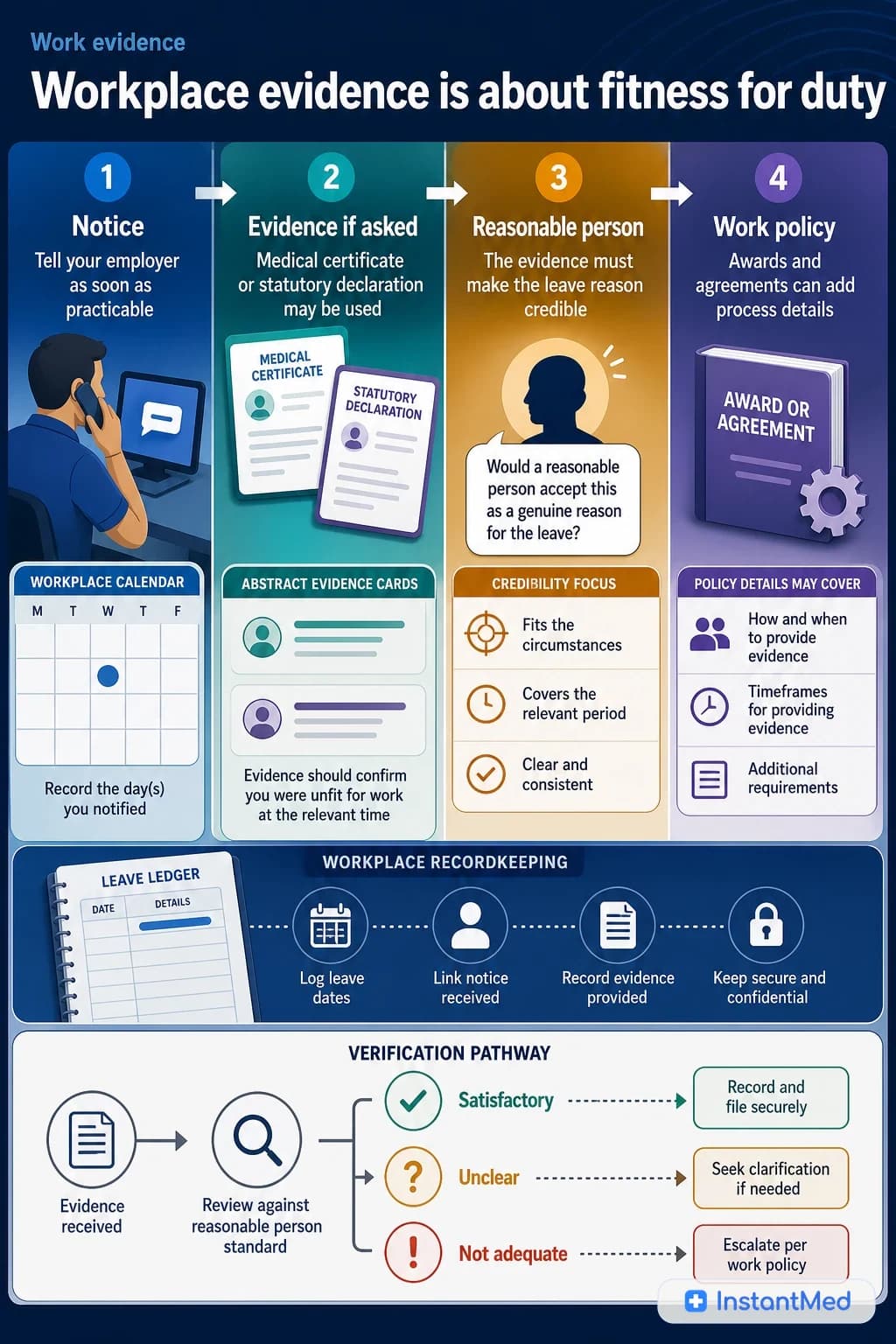
A work medical certificate is evidence that you were unfit for work, not a public explanation of your diagnosis. This Australian guide explains employer evidence rules, privacy, telehealth, stat decs, and return-to-work issues.
InstantMed Medical Team
13 min read
Doctor's Note for Work Australia: What Counts?
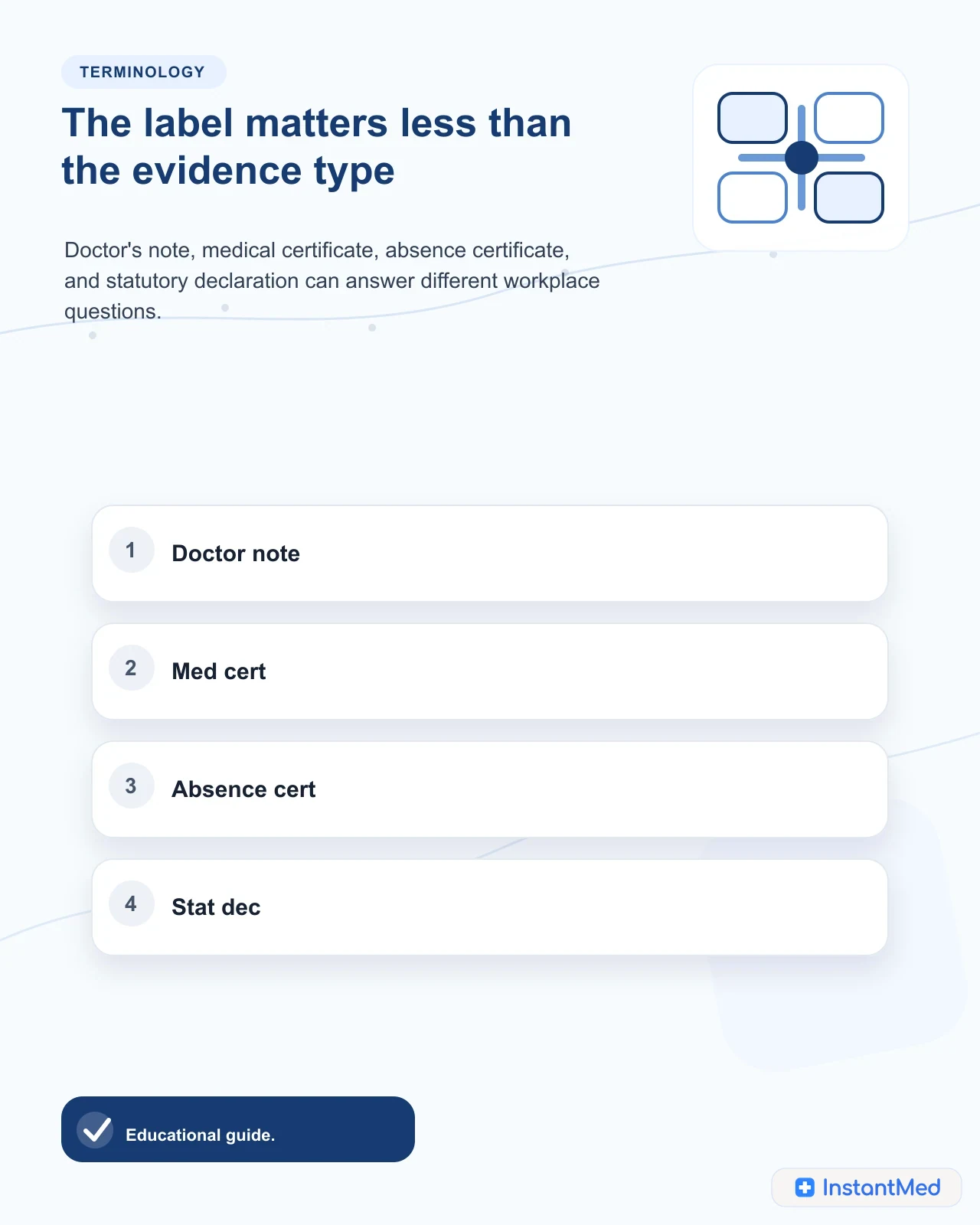
A doctor's note for work in Australia usually means a medical certificate, but sick notes, absence-from-work certificates, and statutory declarations can also matter. Learn what counts as evidence, what a strong certificate includes, and when a workplace may ask questions.
InstantMed Medical Team