Loading article
Back to Health Guides
IBS and Digestive Issues: Diagnosis, Triggers, and Management
Irritable bowel syndrome is common and manageable. Understanding the gut-brain connection and evidence-based treatments changes long-term outcomes.
8 min read
·Updated 10 May 2026
·Doctor Reviewed
AHPRA Verified
In this article
- 1Rome IV Diagnostic Criteria
- 2IBS Subtypes
- 3The Gut-Brain Axis
- 4Common Triggers
- 5The Low FODMAP Diet
Medical information only. This article is for general information and does not constitute medical advice. Treatment decisions are made by an AHPRA-registered doctor after reviewing your circumstances.
Review
InstantMed Clinical Team
Clinical governance review for guide content
Updated
10 May 2026
General information only, not personal medical advice.
Irritable bowel syndrome (IBS) is a functional gastrointestinal disorder characterised by abdominal pain associated with altered bowel habits. The AIHW and Gastroenterological Society of Australia (GESA) estimate that IBS affects approximately 1 in 5 Australians, with higher prevalence in women than men. It is one of the most common conditions presenting to both GPs and gastroenterologists, and one of the most common reasons for outpatient specialist referral in Australia.
IBS does not damage the bowel, does not increase cancer risk, and does not progress to inflammatory bowel disease. It does, however, significantly impact quality of life - affecting work capacity, sleep, social function, and mental health in a substantial proportion of those affected.
Rome IV Diagnostic Criteria
IBS is diagnosed clinically. The Rome IV criteria (2016), the current international standard used by GESA and RACGP, define IBS as:
Recurrent abdominal pain, on average at least 1 day per week in the last 3 months, associated with two or more of:
- 1
Related to defecation
- 2
Associated with a change in frequency of stool
- 3
Associated with a change in form (appearance) of stool
Criteria should be fulfilled for the last 3 months, with symptom onset at least 6 months prior to diagnosis.
IBS is a diagnosis of exclusion - conditions that mimic IBS must be ruled out before a confident diagnosis is made. This typically includes coeliac disease (coeliac serology), inflammatory bowel disease, infection (stool culture), and colorectal cancer in older patients or those with alarm features.
IBS Subtypes
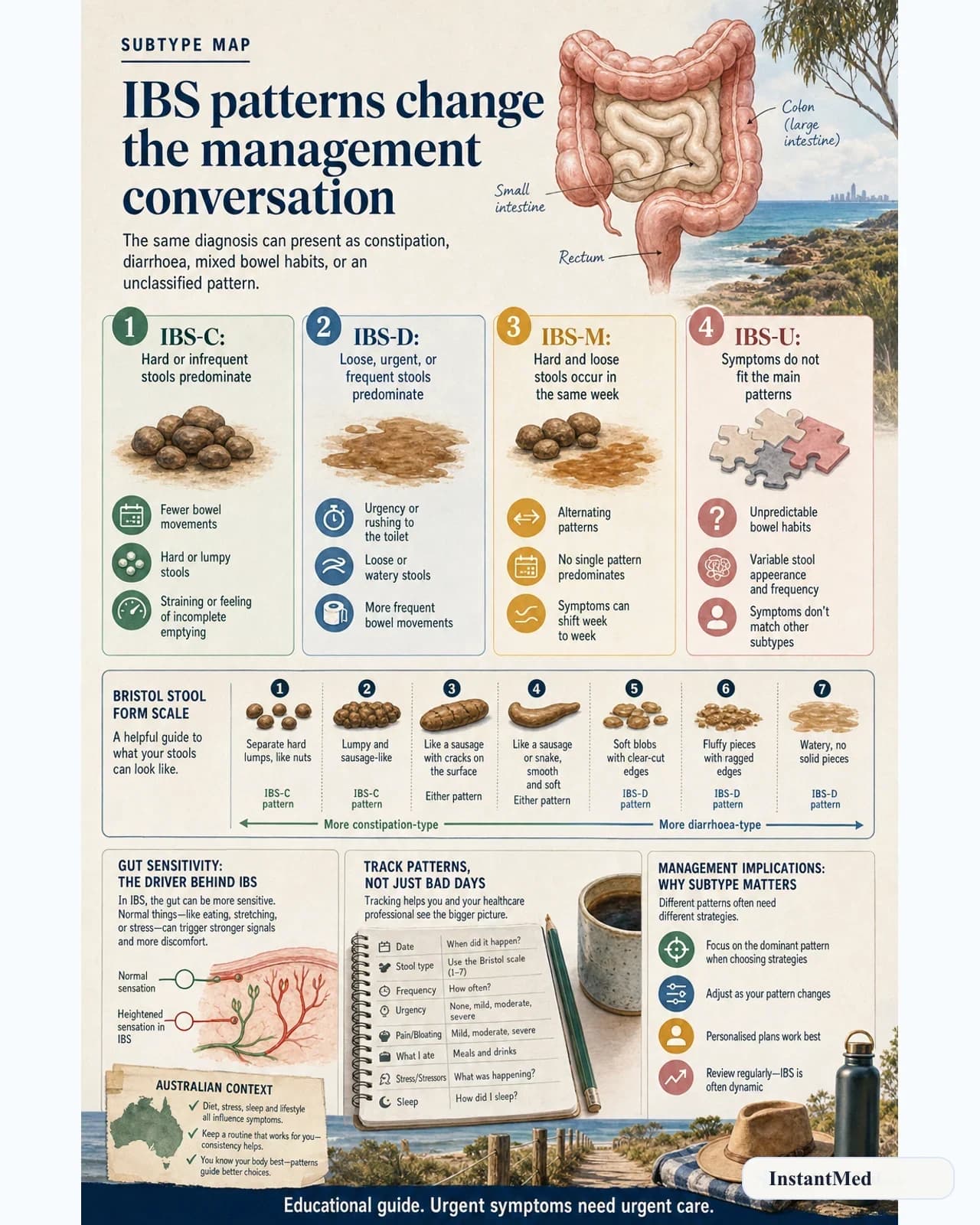
IBS subtype describes the predominant bowel pattern. It is not just a label; it changes which diet, fibre, laxative, anti-diarrhoeal, pain, or gut-brain treatment options make sense.
- IBS-C (constipation-predominant): infrequent, hard, or lumpy stools, usually with Bristol Stool Chart types 1-2 predominating.
- IBS-D (diarrhoea-predominant): frequent, loose, or watery stools, usually with Bristol Stool Chart types 6-7 predominating.
- IBS-M (mixed): alternating constipation and diarrhoea, with both hard and loose stools occurring in the same week.
- IBS-U (unclassified): abnormal bowel habits that do not fit the above patterns; this is less common but still clinically recognised.
Subtype classification matters because it guides treatment choices. Several IBS medications and diet strategies target specific symptom patterns, and using the wrong approach can worsen bloating, urgency, or constipation.
The Gut-Brain Axis
A defining feature of IBS is the bidirectional relationship between the central nervous system and the enteric nervous system (the "second brain" in the gut wall). The gut-brain axis mediates:
- Visceral hypersensitivity: IBS patients experience lower pain thresholds in the gut - the same amount of gas or bowel distension produces more pain than in people without IBS
- Altered gut motility in response to stress and psychological state
- Heightened stress response amplifying gut symptoms
This explains why IBS symptoms worsen during stressful periods, why anxiety and depression are significantly more common in IBS patients than in the general population, and why psychological therapies targeting the gut-brain axis are effective treatments - not just coping strategies.
The AIHW notes that mental health conditions and functional gastrointestinal disorders frequently co-occur, and effective IBS management often requires addressing both.
Common Triggers
Common triggers are most useful when linked to a mechanism and a practical adjustment. The goal is not to remove everything at once; it is to identify the few triggers that reliably change symptoms.
- High-FODMAP foods: poorly absorbed short-chain carbohydrates can ferment in the colon, producing gas and drawing water into the bowel lumen. A structured 3-phase Low FODMAP diet is the evidence-based approach, ideally with a dietitian.
- Stress and anxiety: stress activates the gut-brain axis, alters motility, and amplifies visceral pain. CBT, gut-directed hypnotherapy, pacing, sleep support, and stress-management strategies can reduce symptom severity.
- Large meals: the gastrocolic reflex, a normal reflex that triggers bowel activity after eating, may be amplified in IBS. Smaller, more frequent meals can help, particularly before travel, work, or stressful events.
- Caffeine and alcohol: both can stimulate gut motility; alcohol may also affect the gut microbiome. Reducing or eliminating them for a trial period can clarify whether they are personal triggers.
- Hormonal changes: menstrual-cycle changes can affect bowel transit time and pain sensitivity. Symptom tracking can help people anticipate flares and adjust diet, activity, or medication timing.
- Antibiotics: antibiotic courses can disrupt the gut microbiome. Probiotics after antibiotics have modest evidence but may be reasonable for some people, especially if symptoms clearly worsen after treatment.
Diet pathway
The goal is not permanent restriction. The useful endpoint is a personalised diet that identifies specific triggers.
The Low FODMAP Diet
The Low FODMAP diet was developed at Monash University in Melbourne and is now the most extensively researched dietary intervention for IBS globally. FODMAP stands for Fermentable Oligosaccharides, Disaccharides, Monosaccharides and Polyols - categories of short-chain carbohydrates that are poorly absorbed in the small intestine and fermented by bacteria in the large intestine.
Clinical trial data, including multiple randomised controlled trials conducted at Monash University and replicated internationally, shows symptom improvement in approximately 70-75% of IBS patients following the Low FODMAP diet.
The diet has three phases:
- 1
Elimination phase (2-6 weeks): Avoid all high-FODMAP foods. This determines whether FODMAPs are a significant trigger for you.
- 2
Reintroduction phase (6-8 weeks): Systematically reintroduce FODMAP categories one at a time to identify personal triggers. Not all FODMAP categories affect every patient.
- 3
Personalisation phase (ongoing): Maintain a diet that avoids only your identified triggers - not all FODMAPs indefinitely.
Helpful Tip
Tip: The Low FODMAP diet is complex and nutritionally restrictive in its elimination phase. A dietitian experienced in IBS is strongly recommended for effective implementation. Monash University provides the Monash University FODMAP app (available in the App Store and Google Play) with certified food databases to guide the diet.
High-FODMAP foods that are common IBS triggers include: wheat and rye, onion and garlic, apples, pears, watermelon, stone fruits, legumes, most dairy, cashews, and sorbitol or mannitol (in sugar-free products).
Medications for IBS
Medications are selected based on predominant symptoms:
For IBS-D
- Loperamide: reduces stool frequency and urgency; available without prescription
- Antispasmodics (mebeverine, hyoscine): reduce abdominal cramping
- Low-dose tricyclic antidepressants (amitriptyline 10-25mg): reduce visceral hypersensitivity and slow transit
For IBS-C
- Soluble fibre (psyllium/ispaghula): increases stool bulk and softness; superior to insoluble fibre for IBS-C
- Osmotic laxatives (macrogol/polyethylene glycol): soften stool
- Lactulose is not recommended for IBS-C (increases gas and bloating)
For IBS Pain and General Symptoms
- Antispasmodics: peppermint oil capsules (enteric-coated) have evidence for reducing abdominal pain
- Low-dose antidepressants (tricyclics for IBS-D; SSRIs for IBS-C): address the gut-brain axis and visceral hypersensitivity
Note: Many medications for IBS are used off-label or at sub-antidepressant doses. Discuss the rationale with your doctor if this is not clearly explained.
Gut-Directed Psychological Therapies
Psychological therapies targeting the gut-brain axis have strong evidence for IBS:
Cognitive Behavioural Therapy (CBT): GESA acknowledges the evidence for gut-directed CBT, including internet-delivered CBT programs, in reducing IBS symptom severity and improving quality of life. CBT helps patients modify thought patterns and behaviours that amplify IBS symptoms.
Gut-directed hypnotherapy: One of the most extensively researched psychological treatments for IBS, with multiple clinical trials demonstrating efficacy comparable to the Low FODMAP diet. Works by reducing gut-brain pathway sensitisation. Available from therapists trained in gut-directed hypnotherapy and via audio programs for home use.
These are not "it's all in your head" treatments - they address real neurobiological mechanisms in IBS.
Red Flags: When IBS Is Not the Diagnosis
IBS does not cause the following features. Their presence requires investigation to exclude other diagnoses:
- Blood in the stool (always investigate - may indicate inflammatory bowel disease, diverticular disease, or colorectal cancer)
- Unexplained, unintentional weight loss
- Symptoms waking you from sleep
- Fever associated with gastrointestinal symptoms
- Family history of colorectal cancer, inflammatory bowel disease, or coeliac disease
- Onset of symptoms after age 50
- Anaemia or raised inflammatory markers on blood tests
Safety boundary
Blood, weight loss, night symptoms, fever, anaemia, and new symptoms after 50 need investigation before assuming IBS.
The RACGP and GESA recommend that alarm features prompt investigation (typically colonoscopy) before a diagnosis of IBS is confirmed.
When to Seek Medical Review
Seek medical review if symptoms are new, worsening, difficult to control, or not clearly explained by a previous IBS diagnosis. Initial diagnosis usually needs a GP-led assessment and may include blood tests, coeliac screening, stool testing, or referral depending on age, family history, and alarm features.
Ongoing IBS care is usually strongest when it is structured: confirm the subtype, screen for red flags, identify dietary and stress triggers, trial one change at a time, and review whether the plan is actually improving pain, bowel pattern, sleep, work capacity, and quality of life.
Sources
- healthdirect: Irritable bowel syndrome
- The Rome Foundation: Rome IV criteria
- Monash FODMAP: Starting the Low FODMAP diet
- Dietitians Australia: Irritable bowel syndrome
- Monash University: Low FODMAP research and diet resources
Frequently Asked Questions
How is IBS diagnosed in Australia?
IBS is diagnosed clinically using the Rome IV criteria - recurrent abdominal pain linked to changes in bowel habits, present for at least 6 months. Your GP will also rule out other conditions with similar symptoms, such as coeliac disease, inflammatory bowel disease, and infection, through blood tests and stool cultures before confirming IBS.
What is the Low FODMAP diet and does it work for IBS?
The Low FODMAP diet, developed at Monash University in Melbourne, removes fermentable carbohydrates that trigger symptoms in the gut. Clinical trials show symptom improvement in approximately 70-75% of IBS patients. It involves three phases - elimination, systematic reintroduction, and personalisation - and is best done with guidance from a dietitian experienced in IBS.
Can stress cause IBS symptoms?
Yes. IBS involves a bidirectional gut-brain connection, so stress directly affects gut motility, pain sensitivity, and symptoms. Psychological therapies including cognitive behavioural therapy (CBT) and gut-directed hypnotherapy have strong clinical evidence for reducing IBS severity - not as a last resort, but as a primary treatment.
Can medication help IBS?
Medication can help some people, but the choice depends on the IBS subtype and dominant symptom pattern. Loperamide may reduce urgency in IBS-D, soluble fibre and osmotic laxatives may help IBS-C, and low-dose gut-brain medicines are sometimes used for pain or visceral hypersensitivity. Medication should sit inside a broader plan that includes diagnosis, red-flag screening, diet, and follow-up.
Does IBS increase the risk of bowel cancer?
No. IBS does not damage the bowel lining, does not progress to inflammatory bowel disease, and does not increase colorectal cancer risk. However, symptoms such as blood in the stool, unexplained weight loss, or new symptoms after age 50 should always be investigated to exclude other diagnoses.
InstantMed Medical Team
Related Articles
8 min read
Acid Reflux and GORD: Symptoms, Red Flags, and Treatment
Occasional reflux is common, but frequent heartburn, regurgitation, swallowing symptoms, chest pain, bleeding signs, or persistent vomiting need a more careful plan.
InstantMed Medical Team

8 min read
Burnout vs Stress: How to Tell the Difference
Stress and burnout overlap, but they are not the same. Learn the practical differences, common warning signs, workplace drivers, recovery steps, and when to seek professional support.
InstantMed Medical Team
8 min read
Conjunctivitis (Pink Eye): Types, Treatment, and When to Seek Care
Conjunctivitis is common, but not every red eye is routine pink eye. Discharge, itch, contact lens use, pain, light sensitivity, and vision change determine the safest next step.
InstantMed Medical Team