Loading article
Back to Health Guides
Sick Leave Rights in Australia: What You Are Entitled To
NES entitlements, evidence requirements, casual workers, and what employers can and cannot do under the Fair Work Act.
9 min read
·Updated 11 June 2026
·Doctor Reviewed
AHPRA Verified
In this article
- 1Your Core Entitlement Under the NES
- 2What Personal Leave Covers
- 3Mental Health Is Sick Leave
- 4Accumulation: How Leave Accrues
- 5Evidence Requirements: When Certificates Are Needed
Medical information only. This article is for general information and does not constitute medical advice. Treatment decisions are made by an AHPRA-registered doctor after reviewing your circumstances.
Review
InstantMed Clinical Team
Clinical governance review for guide content
Updated
11 June 2026
General information only, not personal medical advice.
Jump to section
1Your Core Entitlement Under the NES2What Personal Leave Covers3Mental Health Is Sick Leave4Accumulation: How Leave Accrues5Evidence Requirements: When Certificates Are Needed6What Employers Can and Cannot Do7Protections Against Adverse Action8Casual Employees9When Your Balance Runs Out10Cashing Out Personal Leave11The Fair Work Ombudsman12Sources Used In This Guide
Knowing your sick leave rights before you need them removes the anxiety from taking time off when you are genuinely unwell. Australian law is clear on this: sick leave is an employment entitlement you earn, not a privilege your employer grants. Here is exactly what you are entitled to and what your employer can and cannot do.
Your Core Entitlement Under the NES
The Fair Work Act 2009 and the National Employment Standards (NES) set the minimum entitlements for most Australian employees. Personal/carer's leave is one of these:
| Employment type | Paid personal leave | Accumulates? |
|---|---|---|
| Full-time | 10 days per year | Yes, indefinitely |
| Part-time | Pro-rata (based on ordinary hours) | Yes, indefinitely |
| Casual | None (paid) | Not applicable |
| Fixed-term | Same as full-time/part-time | Yes, while employed |
"Personal/carer's leave" is one combined pool - not separate sick leave and carer's leave buckets. The 10 days covers both your own illness and caring for an immediate family or household member who is ill or injured.
Key Information
Personal/carer's leave accrues continuously throughout employment. There is no cap, no annual reset, and no expiry. After 5 years, a full-time employee who has never taken personal leave has 50 days in their balance.
What Personal Leave Covers
The NES covers personal leave for three situations:
Your own illness or injury: Any physical or psychological condition that prevents you from working or makes it unsafe for you to work. This includes acute illness (flu, food poisoning, infection), chronic condition flares, mental health conditions, and recovery from surgery or medical procedures.
Caring for an immediate family or household member: If a member of your household or immediate family is ill, injured, or has an unexpected emergency, you can take personal leave to care for them. "Immediate family" includes spouses, de facto partners, children, parents, grandparents, grandchildren, and siblings.
Compassionate leave: Two days per occasion for when an immediate family member dies or is critically ill. This is a separate entitlement under the NES, not drawn from your personal leave balance.
Mental Health Is Sick Leave
The Fair Work Act makes no distinction between physical and psychological illness. Anxiety, depression, burnout, acute stress, or any other mental health condition that affects your ability to work is covered by personal leave.
The Fair Work Ombudsman's official guidance states explicitly: "Employees can take paid sick leave when they can't work because of a personal illness or injury. This can include stress and mental health conditions."
Your employer cannot:
- Treat a mental health absence differently from a physical illness absence
- Require more evidence for mental health leave than for physical illness
- Penalise you for using personal leave for mental health reasons
A medical certificate for a mental health absence does not need to state your diagnosis. "Unfit for work due to a medical condition" is sufficient.
Accumulation: How Leave Accrues
Personal leave accrues based on your ordinary hours of work, not calendar days. For a full-time employee working 38 hours per week:
- 10 days per year = 76 hours per year
- Accrues at approximately 1.46 hours per week
- Begins accruing from day one of employment
For part-time employees, the accrual is proportional. A part-time employee working 50% of full-time hours accrues 5 days (38 hours) per year.
Leave accrues based on your contract of employment, not actual hours worked. If you are on paid annual leave, long service leave, or paid personal leave itself, you continue to accrue personal leave entitlements.
Evidence Requirements: When Certificates Are Needed
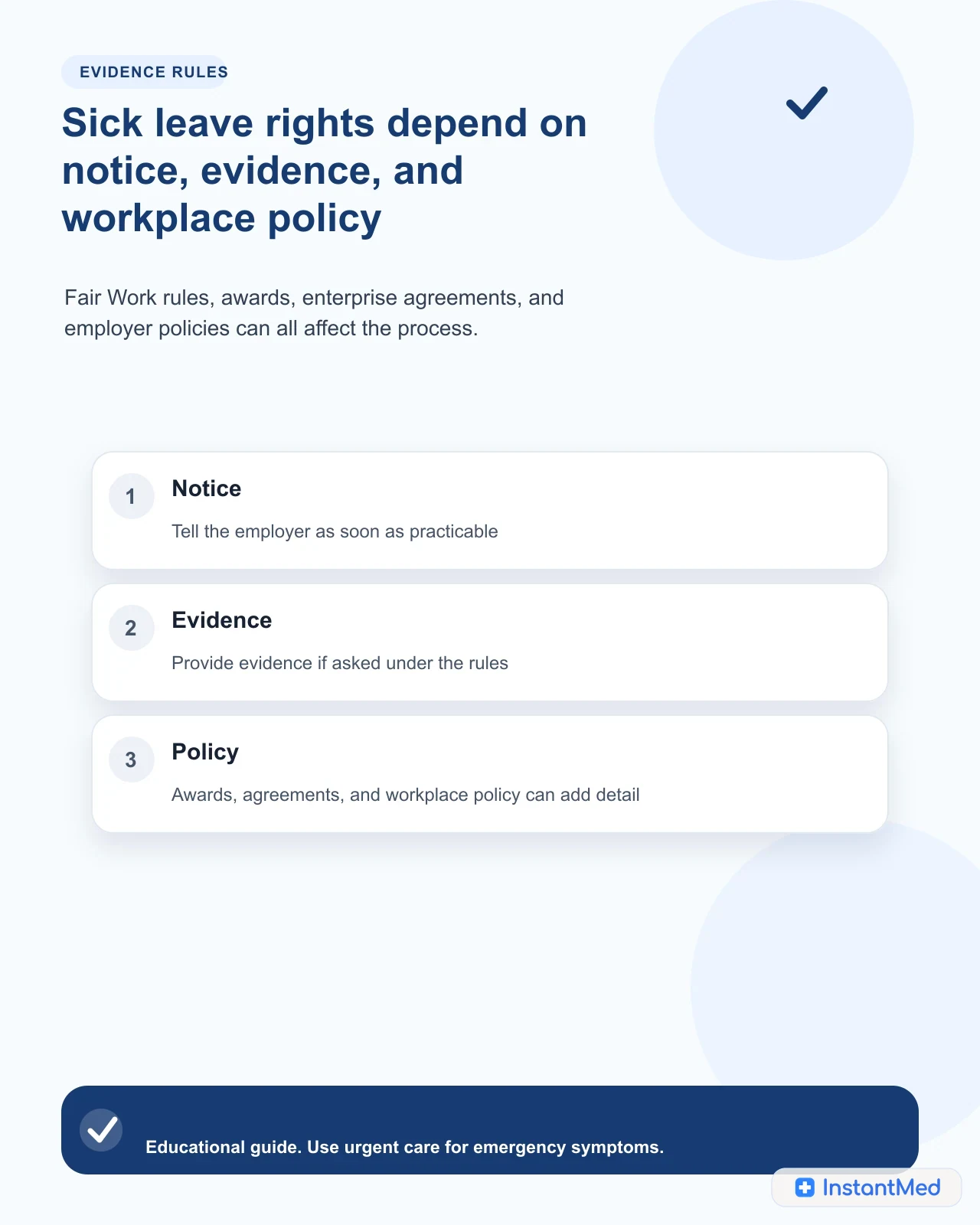
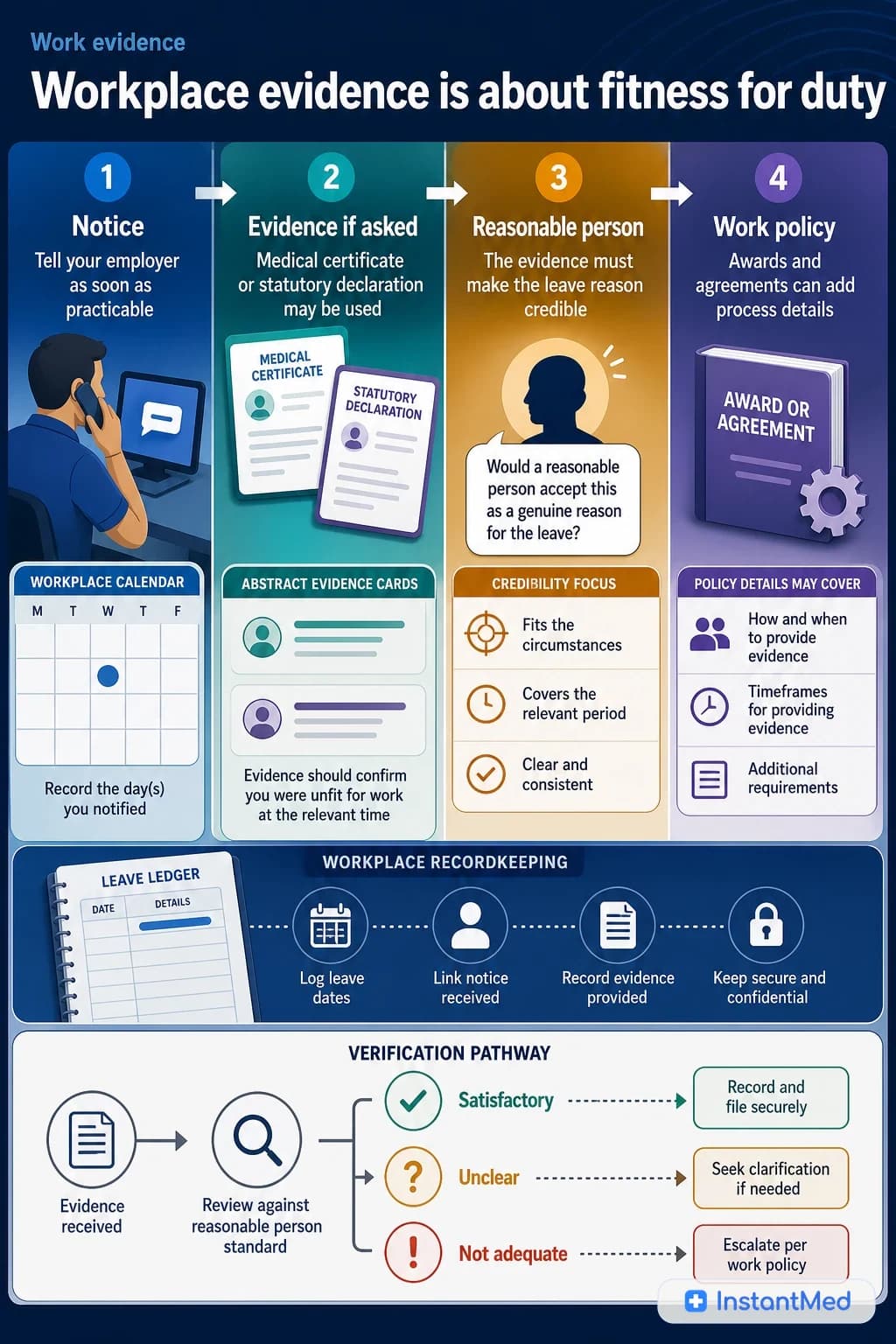
Your employer can require evidence of illness for any personal leave absence. The nature of that evidence is governed by the Fair Work Act: it must be "evidence that would satisfy a reasonable person."
What this means in practice:
- Medical certificate from an AHPRA-registered practitioner: The standard. Valid for any length of absence. Issued after in-person or telehealth consultation. Does not need to state your diagnosis.
- Statutory declaration: A sworn written statement that you were unwell. Acceptable under the Act when a medical certificate was not "reasonably obtainable" - for example, if you were too sick to leave home or if the illness was brief and resolved without medical attention.
- Other evidence: In rare circumstances, other convincing evidence may be accepted.
When employers typically ask for evidence:
Most awards and enterprise agreements set a threshold of two or more consecutive sick days before evidence is required. However, your employer can request evidence for any single-day absence if their policy or your award permits it. Absences adjacent to public holidays, weekends, or annual leave blocks are more likely to attract requests.
Helpful Tip
Telehealth makes same-day certificate access practical. If you wake up unwell and suspect your employer may ask for documentation, getting a certificate the same day removes any ambiguity - and means you do not have to travel to a clinic while sick.
What Employers Can and Cannot Do
What they can do
- Request evidence for any absence (certificate or stat dec)
- Specify in their policy when evidence will be required
- Ask how long your absence is expected to last
- Ask when you expect to return to work
- Discuss patterns of frequent absence as an attendance management matter
- Request an independent medical examination for extended absences (at their cost)
What they cannot do
- Demand your specific medical diagnosis
- Contact your doctor without your written consent
- Require you to see a specific doctor for your initial certificate
- Reject a valid certificate from an AHPRA-registered practitioner
- Withhold sick leave pay if you have provided valid evidence
- Take disciplinary action solely for taking legitimate personal leave
Protections Against Adverse Action
Under Part 3-1 of the Fair Work Act, it is unlawful for an employer to take "adverse action" against an employee because they exercised a workplace right. Exercising personal leave entitlements is a workplace right.
Adverse action includes: dismissal, demotion, reduction in pay, changing your roster without agreement, or any other action that disadvantages you in connection with your employment.
Privacy boundary
Work capacity and dates are usually more relevant than the specific medical condition.
If you believe you have been adversely actioned for taking sick leave:
- Document everything: dates, what was said, any written communications
- Contact the Fair Work Ombudsman on 13 13 94 (free advice service)
- Lodge an adverse action claim with the Fair Work Commission (time limits apply - generally 21 days from the action)
- Seek assistance from your union if you are a member
Note that employers can lawfully manage genuine patterns of unexplained or poorly-evidenced absences through a performance process. This is separate from adverse action for legitimate leave. The distinction is whether they are acting against you for exercising your right or for a legitimate operational reason.
Casual Employees
Casual employees do not accrue paid personal/carer's leave under the NES. However, they are entitled to:
- 2 days unpaid personal/carer's leave per occasion: For each separate occasion of illness or caring responsibility, a casual employee can take 2 days of unpaid leave
- 2 days unpaid compassionate leave per occasion: For bereavement or critical illness of an immediate family member
Casual employees can be rostered off or have shifts cancelled, but they cannot be penalised for being genuinely unable to work due to illness - particularly if they have indicated availability and been rostered on.
Some awards and enterprise agreements provide additional entitlements for casual employees beyond the NES minimums. Check your specific award on the Fair Work Ombudsman website.
When Your Balance Runs Out
If you have exhausted your personal leave balance but are still unwell:
- Annual leave: You can request to access annual leave with employer agreement
- Unpaid personal leave: You are entitled to take unpaid personal leave after your paid entitlement is exhausted. Your employer cannot refuse this if you are genuinely unwell
- Long service leave: Depending on your state's legislation and length of service, you may be able to access long service leave
- Award or enterprise agreement provisions: Some instruments provide additional sick leave above the NES minimum
An employer cannot require you to take annual leave when you are genuinely ill - personal leave is the appropriate entitlement. However, if you request annual leave to cover sick days (to preserve your sick leave balance), most employers will accommodate this.
Cashing Out Personal Leave
Under the Fair Work Act, an employee can cash out personal leave only if:
- Their award or enterprise agreement allows it
- They retain a minimum of 15 days untouched
- They agree to the arrangement in writing
Most modern awards do not permit cashing out personal leave. Where it is permitted, it is limited in scope. You cannot be required to cash out personal leave.
The Fair Work Ombudsman
If you have questions about your entitlements or believe you have been treated unfairly:
- Online: fairwork.gov.au has a complete guide to personal leave entitlements and a tool to search your specific award
- Phone: 13 13 94 (free, Monday to Friday 8am-5:30pm local time)
- In person: Fair Work Ombudsman offices exist in most major cities
The Fair Work Ombudsman provides free advice and can investigate complaints. They can recover unpaid entitlements and issue compliance notices to employers.
Sources Used In This Guide
- Fair Work Ombudsman: Sick and carer's leave
- Fair Work Ombudsman: Paid sick and carer's leave
- Fair Work Ombudsman: National Employment Standards
- Fair Work Ombudsman: Protections at work (adverse action)
- Fair Work Commission: Modern awards
- Attorney-General's Department: Statutory declarations
Frequently Asked Questions
How many sick days are you legally entitled to in Australia?
Full-time employees accrue 10 days of paid personal/carer's leave per year under the National Employment Standards. Part-time employees accrue on a pro-rata basis. Casual employees do not accrue paid personal leave but are entitled to 2 days of unpaid carer's leave per occasion.
Does sick leave carry over year to year?
Yes. Under the NES, unused personal/carer's leave accumulates with no cap and no expiry. There is no 'use it or lose it' rule. If you leave a job, your accrued balance at termination is generally not paid out (unlike annual leave), but it accumulates throughout your employment.
Can your employer ask why you were sick?
No. Your employer can request evidence that you were unwell - a medical certificate satisfies this. They cannot demand your specific diagnosis. A certificate stating you were unfit for work due to a medical condition is legally sufficient under the Fair Work Act.
Can you be fired for taking sick leave?
Taking adverse action against an employee for exercising the right to take personal leave is unlawful under the Fair Work Act. An employer cannot dismiss you because you took legitimate sick leave supported by valid evidence. However, they can lawfully manage genuine patterns of frequent unplanned absence through a performance process.
Does mental health count as sick leave?
Yes. The Fair Work Act does not distinguish between physical and psychological illness. Mental health conditions including anxiety, depression, and burnout are valid reasons for personal leave. The Fair Work Ombudsman has explicitly confirmed this.
What if you run out of sick leave?
Options include accessing annual leave (with employer agreement), taking unpaid personal leave, or accessing other leave entitlements such as compassionate or community service leave if applicable. Some awards and enterprise agreements provide additional sick leave beyond the NES minimum.
InstantMed Medical Team
Related Articles
9 min read
Medical Certificates for Work: Complete Australian Guide
A work medical certificate is evidence that you were unfit for work, not a public explanation of your diagnosis. This Australian guide explains employer evidence rules, privacy, telehealth, stat decs, and return-to-work issues.
InstantMed Medical Team

9 min read
Can an Employer Reject a Medical Certificate in Australia?
An employer should not reject a credible medical certificate simply because it came from telehealth, but they can ask reasonable questions if evidence is incomplete or inconsistent. Learn the practical boundaries.
InstantMed Medical Team
13 min read
Doctor's Note for Work Australia: What Counts?
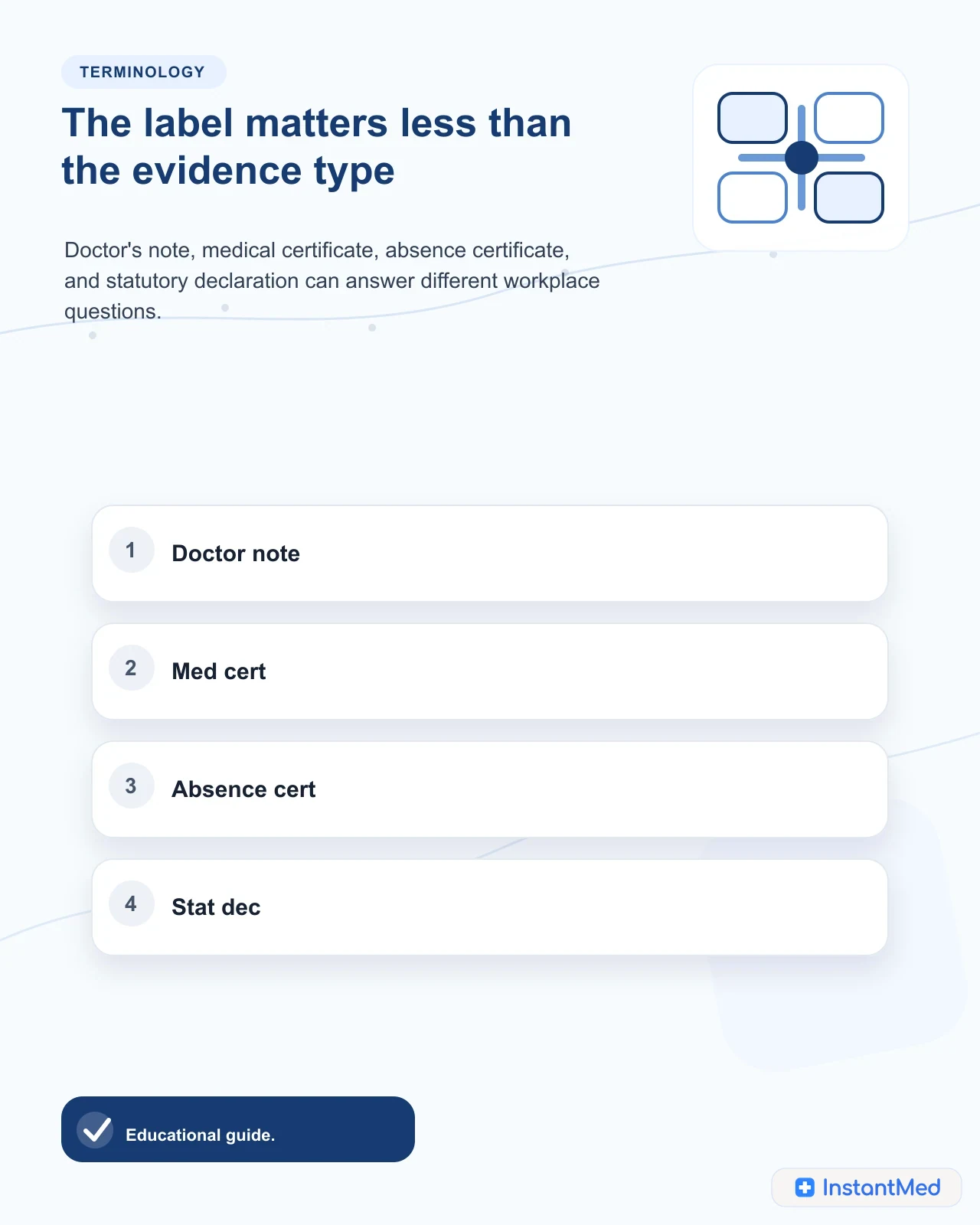
A doctor's note for work in Australia usually means a medical certificate, but sick notes, absence-from-work certificates, and statutory declarations can also matter. Learn what counts as evidence, what a strong certificate includes, and when a workplace may ask questions.
InstantMed Medical Team