Loading article
Back to Health Guides
How eScripts Work in Australia: Electronic Prescriptions Explained
A practical guide to tokens, Active Script Lists, pharmacy dispensing, repeats, PBS/private prescriptions, privacy, and common problems.
10 min read
·Updated 11 June 2026
·Doctor Reviewed
AHPRA Verified
In this article
- 1How Do You Get an eScript?
- 2Token Versus Active Script List
- 3How A Token-Based eScript Works
- 4What Happens At The Pharmacy
- 5Repeats
Medical information only. This article is for general information and does not constitute medical advice. Treatment decisions are made by an AHPRA-registered doctor after reviewing your circumstances.
Review
InstantMed Clinical Team
Clinical governance review for guide content
Updated
11 June 2026
General information only, not personal medical advice.
Jump to section
1How Do You Get an eScript?2Token Versus Active Script List3How A Token-Based eScript Works4What Happens At The Pharmacy5Repeats6PBS And Private eScripts7Active Script List8Lost, Missing, Or Broken Tokens9Privacy And Sharing10Paper Prescriptions Still Matter11Controlled Medicines And Higher-Risk Prescribing12The Bottom Line13Sources Used In This Guide
Key Information
An eScript is a legal prescription format, not a separate medicine service. The prescribing decision still has to be clinically appropriate, and the pharmacy still performs normal dispensing checks.
Electronic prescriptions make medicine supply less dependent on paper. They are used after GP visits, specialist appointments, telehealth reviews, hospital discharge, and regular medicine management.
The system is easiest to understand in two parts: the prescription record itself and the way the patient or pharmacy accesses it.
How Do You Get an eScript?
You do not request an eScript as a separate product. You get an electronic prescription whenever a prescriber decides a medicine is appropriate and issues it in the electronic format. That can happen after:
- A GP or specialist appointment, in person, where the prescriber sends the token to your phone or email instead of printing paper.
- A hospital discharge, where discharge medicines are increasingly issued electronically.
- A telehealth review. When a doctor reviews a request online and decides a prescription is clinically appropriate, an eScript token can be sent digitally, ready to take to any pharmacy. This is how most online prescription and repeat-script services deliver medicine access once a doctor has approved the request.
In every case the prescription is a clinical decision first and a delivery format second. The electronic format changes how you receive and store the prescription, not whether you should have the medicine. A prescriber can still decide a paper prescription, an in-person review, or no prescription at all is the right outcome.
Token Versus Active Script List
Australian electronic prescribing commonly uses either a token or an Active Script List.
| Pathway | What the patient manages | Practical use |
|---|---|---|
| Token | A unique SMS or email token for a prescription | Simple prescriptions, occasional medicines, people who want direct token control |
| Active Script List | A consolidated list of active prescriptions after registration and consent | Multiple regular medicines, repeat management, regular pharmacy workflows |
A token is usually the simplest model. An Active Script List is a convenience and safety tool for people managing several active prescriptions.
How A Token-Based eScript Works
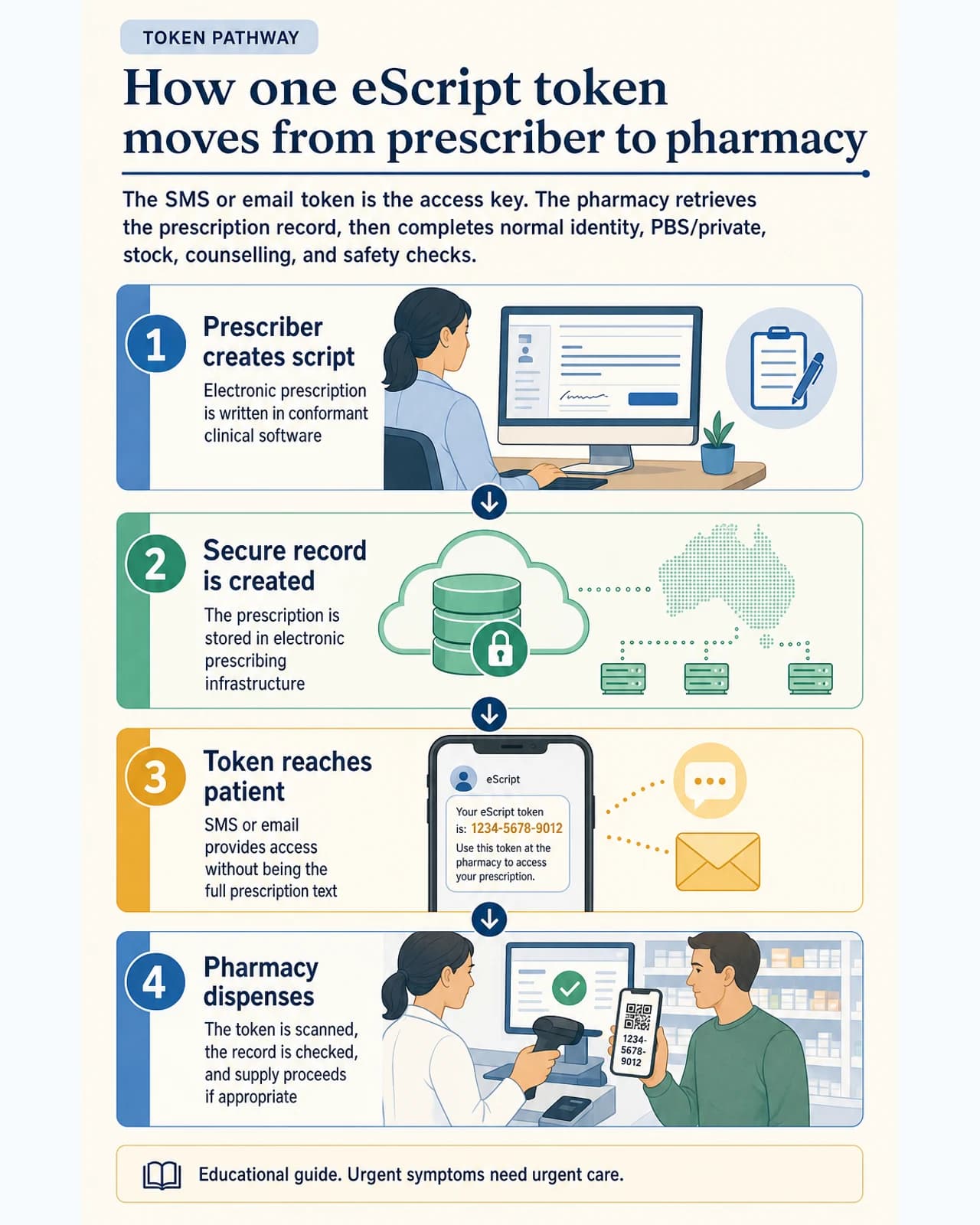
The token pathway is a sequence.
- 1
A prescriber creates an electronic prescription in conformant software.
- 2
A secure prescription record is created in the electronic prescribing infrastructure.
- 3
A unique token is sent to the patient by SMS or email.
- 4
The patient shows or shares the token with a pharmacy.
- 5
The pharmacy scans or enters the token.
- 6
The prescription is retrieved and checked.
- 7
The pharmacist dispenses if the prescription is valid and supply is appropriate.
The token is not a plain text copy of the whole prescription. It is the access mechanism the pharmacy uses to retrieve the prescription details.
What Happens At The Pharmacy
The pharmacy process is more than scanning a code.
The pharmacist or dispensing system may check:
- Patient identity
- Medicine, strength, form, directions, quantity, and repeats
- PBS or private prescription status
- Authority requirements if relevant
- Brand substitution options
- Stock availability
- Safety issues such as allergies, interactions, dose, or duplicate therapy
- Medicine-specific legal requirements
- Whether counselling is needed
A pharmacy can still pause, clarify, or decline supply if the prescription has a legal, clinical, stock, identity, or safety issue.
Repeats
Repeats on eScripts are managed electronically.
After a supply is dispensed:
Token vs ASL
Tokens suit simple prescription access. Active Script Lists reduce lost-token friction for people with several active prescriptions, but need registration and consent.
- The dispensing event is recorded.
- Remaining repeats are updated.
- A repeat token or ASL record may be used for the next supply.
- The prescription still expires under the relevant prescription rules.
Do not assume every digital prescription behaves exactly the same. Medicine type, PBS authority, jurisdiction rules, staged supply, and controlled-medicine requirements can change the workflow.
PBS And Private eScripts
The eScript format does not decide whether the medicine is subsidised.
PBS pricing depends on:
- Patient eligibility
- The medicine's PBS listing
- Approved indication
- Quantity and repeats
- Authority requirements
- Brand premiums or substitution
- Safety Net status
Private prescriptions can also be electronic. A private eScript may look similar as a token, but the pharmacy price is not the same as a PBS co-payment.
Active Script List
An Active Script List is a consolidated list of active prescriptions. It helps patients avoid hunting through SMS messages or emails for separate tokens.
ASL is useful when:
- You take multiple regular medicines.
- You have several repeats.
- You regularly use a pharmacy that supports ASL workflows.
- You want fewer lost-token problems.
- You use a compatible medicine-management app.
ASL requires registration and consent. Ask the pharmacy or prescriber what they can see, how access is granted, and how to change consent if needed.
Lost, Missing, Or Broken Tokens
If the token is missing, do not guess.
Check:
- Was it sent by SMS or email?
- Is the phone number or email correct?
- Is it in spam, archived messages, deleted messages, or another device?
- Was the prescription added to ASL instead?
- Has the token already been used?
- Has the prescription expired or been cancelled?
Possible fixes include asking the prescriber to resend the token, asking the pharmacy about ASL access if registered, or asking the prescriber to correct or replace the prescription if details are wrong.
Privacy And Sharing
Treat an eScript token as sensitive health information.
Good habits:
- Share it only with the pharmacy or a trusted person collecting medicine for you.
- Avoid sending screenshots through workplace accounts or shared devices.
- Keep your phone number and email current with prescribers.
- Ask how pharmacy apps store and use prescription data.
- Understand ASL consent before registering.
- Do not post token screenshots online.
A single token does not give a pharmacist your whole medical record. An Active Script List gives a broader view of active prescriptions after registration and consent, but it is still not a full clinical record.
Paper Prescriptions Still Matter
Paper prescriptions have not disappeared.
Paper or barcoded paper may still be used when:
Checks and fixes
A missing token, used repeat, expired prescription, unavailable medicine, or wrong detail each needs a different next step.
- A patient cannot receive SMS or email reliably.
- The prescriber or pharmacy system is not enabled.
- A specific medicine, jurisdiction, or workflow requires it.
- The patient prefers paper and it is available.
- A barcoded paper prescription is issued instead of a token.
The Australian Digital Health Agency notes that if a patient is given a barcoded paper prescription instead of an electronic prescription, the paper copy still needs to be brought to the pharmacy to be legally dispensed.
Controlled Medicines And Higher-Risk Prescribing
The eScript format does not relax prescribing rules.
Schedule 8 medicines and some other higher-risk medicines may involve:
- State or territory requirements
- Real-time prescription monitoring
- Specialist or authority requirements
- Additional identity or dispensing checks
- Shorter validity or stricter repeat rules
- Prescriber-pharmacy clarification
If a medicine has extra rules on paper, those rules do not disappear because the prescription is electronic.
The Bottom Line
eScripts reduce paper handling and make pharmacy supply more flexible, but they do not remove clinical or legal checks. A token is the access key for one prescription. An Active Script List is a broader consent-based list for active prescriptions.
Use tokens carefully, keep contact details current, ask before registering for ASL, and treat digital prescription information as sensitive health information.
Sources Used In This Guide
- Australian Digital Health Agency: Electronic prescriptions
- Australian Digital Health Agency: Active Script List
- Healthdirect: Electronic prescriptions (eScripts)
- Services Australia: Pharmaceutical Benefits Scheme (PBS)
- PBS: fees, patient contributions and Safety Net thresholds
Frequently Asked Questions
What is an eScript?
An eScript is an electronic prescription. It can be provided as a token, usually through SMS or email, or managed through an Active Script List after registration and consent.
Can I use an eScript at any pharmacy?
Electronic prescriptions are nationally available and most community pharmacies can dispense them. The pharmacy still needs enabled dispensing software and must complete normal identity, safety, PBS, and medicine-specific checks.
Does an eScript mean PBS pricing always applies?
No. The digital format does not decide subsidy. PBS pricing depends on Medicare eligibility, the medicine listing, indication, authority requirements, quantity, repeats, and other PBS rules. Private eScripts can also be issued.
Do eScripts expire?
Yes. Electronic prescriptions expire under the same prescribing and medicine rules that apply to that prescription type. Many are valid up to 12 months, but some medicines or circumstances have shorter validity or extra requirements.
Can a pharmacist see my full medical history from one token?
No. A token lets the pharmacy retrieve prescription information for that prescription. An Active Script List is broader because it lists active prescriptions after registration and consent, but it is still not the same as giving access to your full medical record.
Can controlled medicines be eScripts?
Some controlled medicines can be prescribed electronically in certain circumstances, but Schedule 8 and other higher-risk medicines have extra federal, state, territory, monitoring, and prescribing requirements. The eScript format does not remove those rules.
InstantMed Medical Team
Related Articles
8 min read
How to Get a Repeat Prescription Online in Australia
Running low on your regular medication? Learn how to get a repeat prescription online through an Australian telehealth doctor, including what medications qualify and how eScripts work.
InstantMed Medical Team
8 min read
How to Get a Prescription Online in Australia
Online prescriptions are legal and safe when issued by AHPRA-registered doctors following Australian prescribing standards. This guide covers the full process, from submitting your request to filling your eScript at any pharmacy.
InstantMed Medical Team
8 min read
Medications That Cannot Be Prescribed Online
Telehealth can prescribe most common medications for established patients. Schedule 8 controlled drugs, new medications requiring examination, and several other categories require in-person assessment. Here is the complete picture.
InstantMed Medical Team