Loading article
Back to Health Guides
Medical Certificates for Centrelink
Which evidence fits temporary incapacity, when the SU415 form matters, and why DSP and complex claims need more than a short certificate.
8 min read
·Updated 10 May 2026
·Doctor Reviewed
AHPRA Verified
In this article
- 1Standard Certificates vs Centrelink-Specific Forms
- 2JobSeeker and Mutual Obligations
- 3What a Non-Centrelink Certificate Must Include
- 4The SU415: Centrelink's Medical Certificate Form
- 5Youth Allowance, Study, and Parenting Obligations
Medical information only. This article is for general information and does not constitute medical advice. Treatment decisions are made by an AHPRA-registered doctor after reviewing your circumstances.
Review
InstantMed Clinical Team
Clinical governance review for guide content
Updated
10 May 2026
General information only, not personal medical advice.
Jump to section
1Standard Certificates vs Centrelink-Specific Forms2JobSeeker and Mutual Obligations3What a Non-Centrelink Certificate Must Include4The SU415: Centrelink's Medical Certificate Form5Youth Allowance, Study, and Parenting Obligations6DSP Evidence Is Different7Carer Payment and Carer Allowance8Uploading the Certificate9Tips for Getting Documentation Right First Time10What If the Certificate Is Rejected?11Sources
Not all Centrelink situations use the same medical evidence. A short certificate for a missed appointment is not the same as a Centrelink Medical Certificate form, Disability Support Pension evidence, carer evidence, or a formal review submission.
The practical question is: what decision is Centrelink trying to make? Temporary incapacity, mutual obligations, DSP eligibility, carer support, study participation, and review of a rejected decision all need different evidence.
Standard Certificates vs Centrelink-Specific Forms
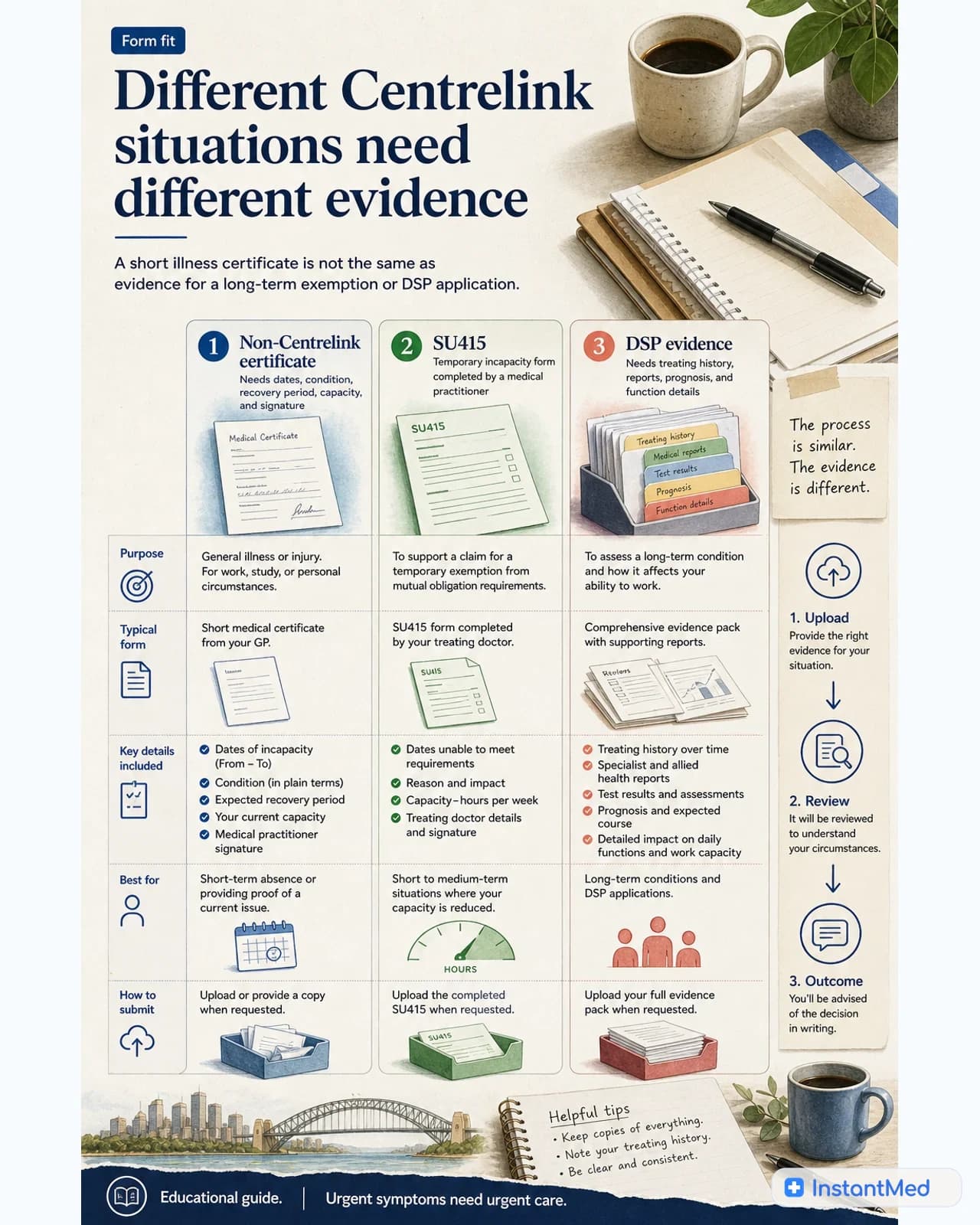
For Centrelink purposes, medical evidence usually falls into three practical groups.
A non-Centrelink medical certificate may be considered in some situations when it includes the required details. Services Australia tells health professionals that an authorised medical doctor can complete their own certificate if it includes the completion date, the illness, injury or disability, expected recovery time, the period the person is unable to work, participate or study, the doctor's signature, and capacity details.
The Centrelink Medical Certificate form (SU415) is the official form for temporary incapacity when a person cannot meet requirements because of a medical condition. Services Australia states that only medical practitioners may complete and sign the SU415.
Complex evidence packs are needed when Centrelink is assessing longer-term function or eligibility. DSP, carer payments, job capacity assessments, employment services assessments, and medical reviews often require treating history, specialist reports, investigations, prognosis, and day-to-day functional impact.
The distinction comes down to purpose. Short incapacity evidence answers "could this person meet this requirement during this period?" DSP evidence answers "how does this condition affect long-term work capacity under the medical rules?" Those are different questions.
JobSeeker and Mutual Obligations
If you receive JobSeeker, Youth Allowance, Parenting Payment, or another payment with participation requirements, illness can affect appointments, reporting, job search requirements, study obligations, or provider activities.
For short disruption, Centrelink may need evidence that covers the specific period you could not work, participate, attend, report, or study. For a temporary incapacity decision, the SU415 or an equivalent certificate with standard document details may be needed.
Notify Centrelink or your employment services provider as early as possible if illness affects a required activity. Late notification is a common source of payment problems because the evidence may be clinically valid but administratively late.
Key Information
If you miss an obligation due to illness, the first step is not guessing which document will work. Ask Centrelink or your provider what evidence category they need, then make sure the certificate dates and capacity details match that request.
What a Non-Centrelink Certificate Must Include
Services Australia says a non-Centrelink medical certificate must include required details to be accepted. In plain terms, the document should answer:
- When was the certificate completed?
- What illness, injury, or disability is being certified?
- How long is recovery expected to take?
- What period is the person unable to work, participate, or study?
- How many hours can the person work, study, or participate each week, or are they unable to do so for at least 8 hours per week?
- Has the doctor signed it?
That is more specific than many workplace certificates. A generic note saying "unfit for work" may be too thin if Centrelink needs participation or study-capacity information.
The SU415: Centrelink's Medical Certificate Form
The SU415 is the Centrelink Medical Certificate form for temporary incapacity. It is intended for use when a patient cannot meet requirements because they are temporarily incapacitated due to a medical condition.
The form matters because it asks for Centrelink-specific information rather than ordinary workplace sick-leave wording. It can include:
- The medical condition or diagnosis
- Functional capacity and limitations
- Expected duration
- Work, study, or participation capacity
- Whether the condition is temporary, permanent, or an exacerbation of an existing condition
- Doctor details and signature
Only medical practitioners may complete and sign the SU415. Health professionals can also submit a Centrelink Medical Certificate through Health Professional Online Services (HPOS), using the SU683 process where available.
For complex or recurrent issues, your regular GP is usually better placed than a clinician seeing you for the first time. The form is not just about naming the illness. It asks how the condition affects capacity, and that is stronger when the doctor understands your history.
Youth Allowance, Study, and Parenting Obligations
Youth Allowance and Parenting Payment can involve different requirements depending on your situation. Illness may affect study load, job search, parenting-related participation, appointments, or reporting.
If illness affects study, Centrelink and the education provider may need different evidence. Centrelink may care about payment eligibility, study load, or participation. The university, TAFE, or training provider may care about academic progression, placements, extensions, or attendance rules.
Evidence stack
Treating GP reports, specialist letters, investigations, and function history matter for complex claims.
Do not assume one document solves both systems. A university special consideration form and a Centrelink medical certificate may need different wording.
DSP Evidence Is Different
Disability Support Pension has a much higher evidence burden than temporary incapacity. Services Australia states that a medical certificate may not be enough to assess a DSP condition. It needs detailed evidence or reports.
DSP medical evidence commonly needs to show:
- Diagnosed condition or conditions
- Past, current, and planned treatment
- Prognosis
- Day-to-day functional impact
- Names and contact details of treating doctors or health professionals
- Specialist evidence for some conditions
- Whether the condition is diagnosed, reasonably treated, and stabilised, unless manifest medical rules apply
Services Australia lists examples of evidence including medical history records, specialist medical reports, psychologist reports, medical imaging reports, physical examination reports, hospital records, compensation and rehabilitation reports, special school reports, physiotherapy reports, and audiology reports.
Some conditions need specific evidence. For example, Services Australia says mental health conditions may need psychiatrist diagnosis or psychologist support for a treating doctor's diagnosis. Ear conditions affecting hearing or balance may need diagnosis by a qualified medical practitioner plus audiologist or ENT support.
Important Warning
A single short certificate is not a DSP evidence pack. DSP evidence is about diagnosis, treatment history, prognosis, and functional capacity over time.
Carer Payment and Carer Allowance
Carer Payment and Carer Allowance focus on the care needs of the person being cared for. The evidence question is not only "does this person have a condition?" It is also "what care is required, how often, and why?"
Relevant evidence may include:
- Treating doctor reports
- Specialist reports
- Functional assessments
- Hospital or clinic letters
- Medication and treatment history
- Behavioural, mobility, communication, supervision, or daily-care details
- Child-specific assessment tools where required
As with DSP, established treating evidence is usually stronger than a one-off certificate.
Uploading the Certificate
Services Australia provides separate upload steps for a Centrelink Medical Certificate form and a non-Centrelink medical certificate. The SU415 upload path uses "Centrelink Form" and form code SU415. A non-Centrelink medical certificate is uploaded as "Other documents" and then "Medical certificate."
Before uploading:
Submission
A rejected certificate may need clearer dates, the right form, or a formal review rather than another generic note.
- Check the doctor has signed it.
- Confirm the dates match the period affected.
- Use the correct document type.
- Keep a copy of every file submitted.
- Save any upload receipt or confirmation.
- If the form has a barcode, follow the app instructions for scanning or uploading.
Uploading the wrong document type does not always mean the evidence is medically wrong. It can still create processing friction, so use the category Services Australia asks for.
Tips for Getting Documentation Right First Time
- Ask Centrelink directly what form or evidence they need before booking a doctor. This avoids providing the wrong document and having to repeat the process.
- If Centrelink requests the SU415, make sure a medical practitioner completes and signs it.
- For recurrent, chronic, or complex conditions, use your regular treating doctor where possible.
- For DSP, build the evidence with your treating team before lodging the claim.
- Ask the doctor to describe functional capacity, not only diagnosis.
- Keep copies of every certificate, report, form, upload confirmation, and Centrelink message.
- If evidence is rejected, ask what specific detail was missing.
What If the Certificate Is Rejected?
If Centrelink rejects your medical evidence:
- Request specific written advice on what is missing or insufficient
- Ask whether the wrong evidence category was used
- Check whether the dates, hours, capacity, diagnosis, or signature are missing
- Ask whether the SU415, a non-Centrelink certificate, DSP medical evidence, or specialist evidence is required
- For complex situations, consider asking your regular GP to write a detailed letter addressing the specific gaps Centrelink has identified
- Keep a record of who you spoke to and when
Centrelink decisions are reviewable. Services Australia says you can ask for an explanation or apply for a formal review. An Authorised Review Officer can review the decision. If you disagree with that outcome, you may be able to apply to the Administrative Review Tribunal.
Sources
- Services Australia: Centrelink Medical Certificate form (SU415)
- Services Australia: Complete a medical certificate for Centrelink
- Services Australia: Medical evidence for Disability Support Pension
- Services Australia: DSP medical evidence rules for health professionals
- Services Australia: How to upload a medical certificate
- Services Australia: Explanations and formal reviews of a Centrelink decision
Frequently Asked Questions
Will Centrelink accept a regular medical certificate?
Sometimes. Services Australia says authorised medical doctors can complete their own non-Centrelink medical certificate if it includes the required details. For temporary incapacity, Centrelink may ask for the official SU415 form. For DSP or complex capacity decisions, a short certificate is usually not enough.
What is the SU415 form?
The SU415 is the Centrelink Medical Certificate form. Services Australia says it is used when a medical practitioner has a patient who cannot meet requirements because they are temporarily incapacitated due to a medical condition. Only medical practitioners may complete and sign it.
How long can a medical certificate cover for Centrelink?
It depends on the payment, requirement, condition, and form being used. The important issue is whether the evidence covers the period you could not work, participate, or study, and whether it answers the specific details Services Australia needs.
Is a Centrelink medical certificate enough for DSP?
Usually not. Services Australia says a medical certificate may not be enough for Disability Support Pension assessment. DSP evidence generally needs current medical evidence from treating doctors or health professionals, including diagnosis, treatment, prognosis, and functional impact.
What if Centrelink rejects my medical certificate?
Ask for an explanation of what was missing or why the decision was made. You may need a different form, clearer dates, functional-capacity detail, treating history, or specialist evidence. If you disagree with the decision, Services Australia has a formal review pathway through an Authorised Review Officer and, after that, the Administrative Review Tribunal.
InstantMed Medical Team
Related Articles
8 min read
Are Online Medical Certificates Valid in Australia?
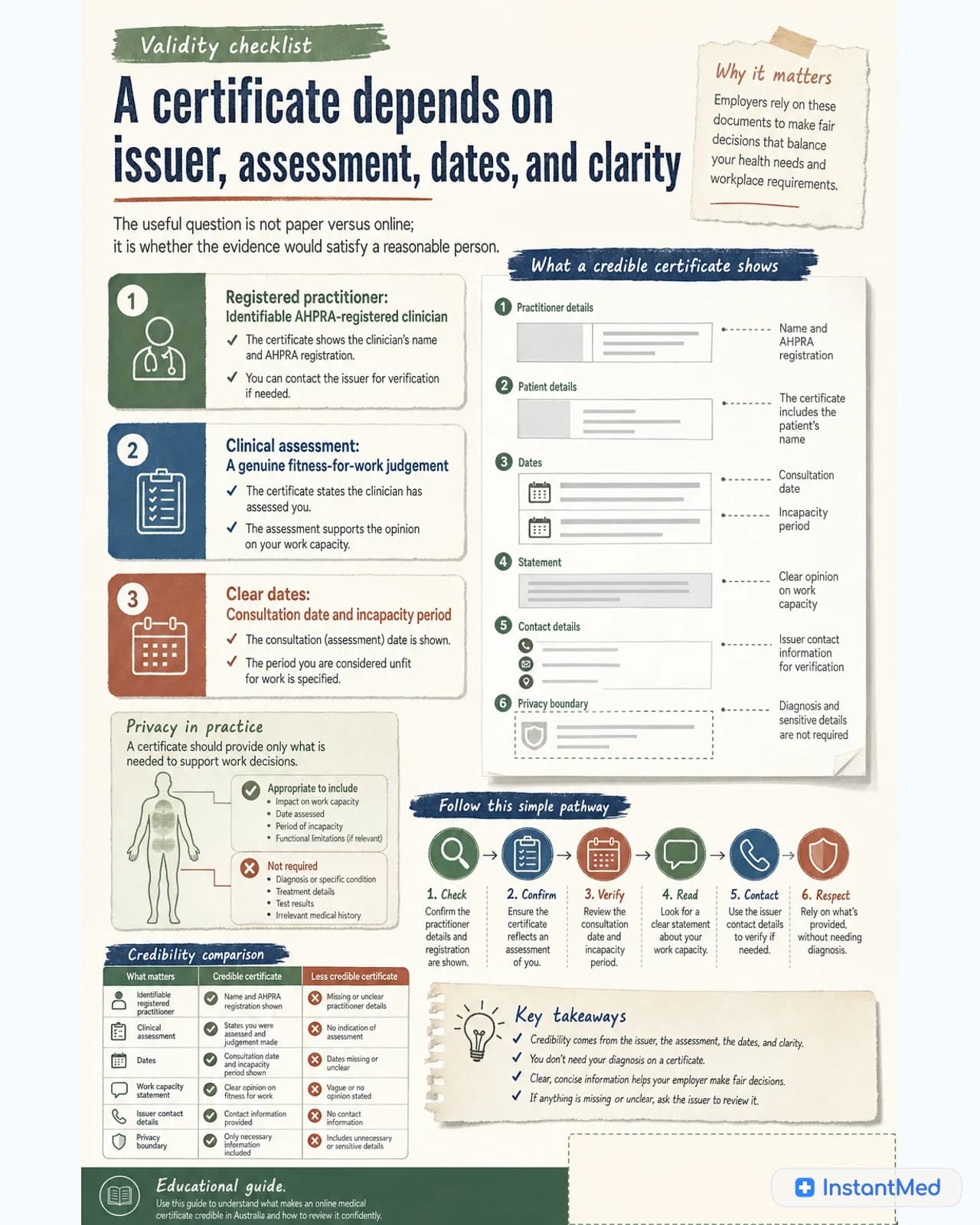
Online medical certificates from AHPRA-registered practitioners can be valid evidence in Australia when they follow a genuine assessment and contain clear details. This guide explains the Fair Work standard and common employer questions.
InstantMed Medical Team
13 min read
Doctor's Note for Work Australia: What Counts?
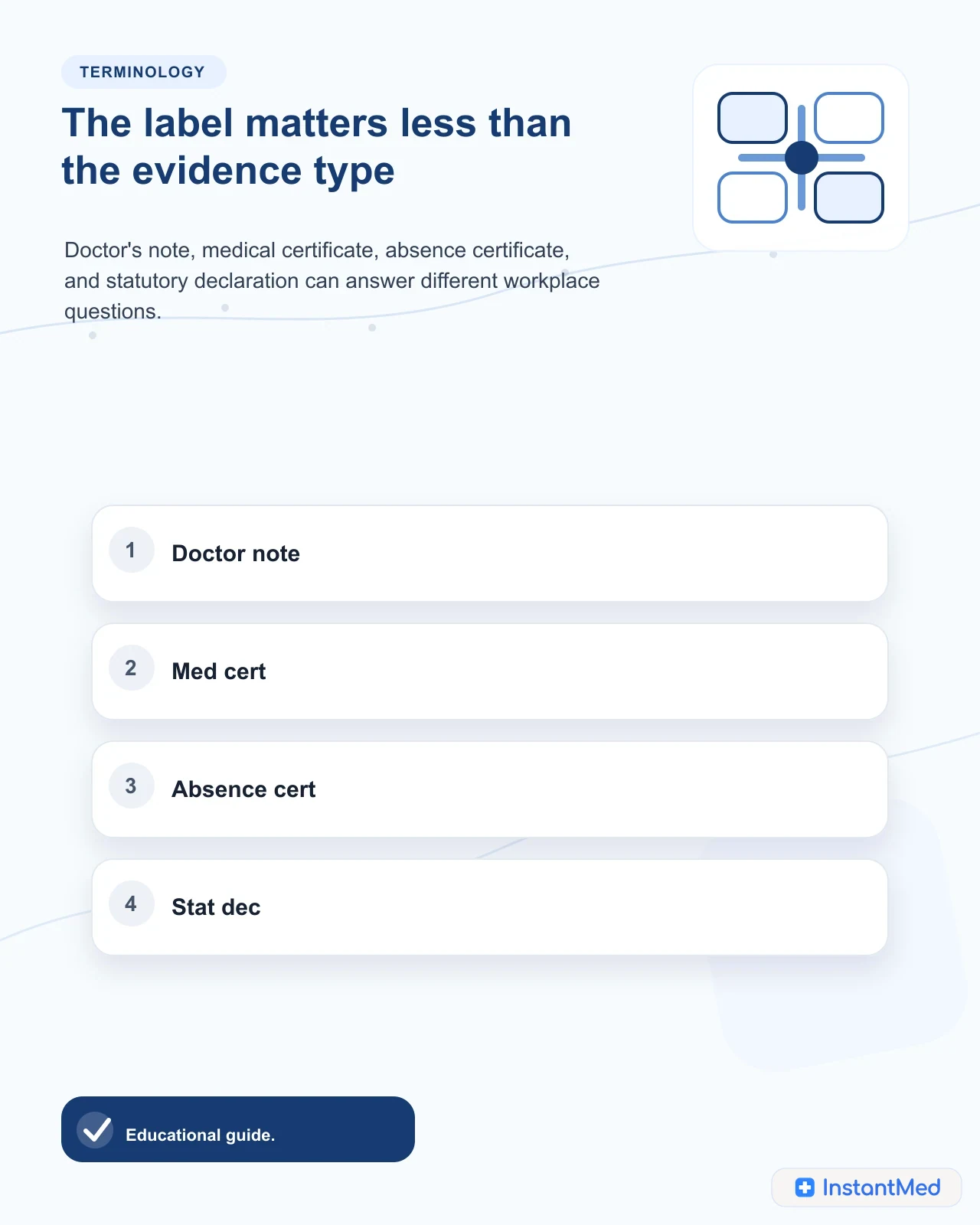
A doctor's note for work in Australia usually means a medical certificate, but sick notes, absence-from-work certificates, and statutory declarations can also matter. Learn what counts as evidence, what a strong certificate includes, and when a workplace may ask questions.
InstantMed Medical Team
10 min read
How Long Can a Medical Certificate Cover?
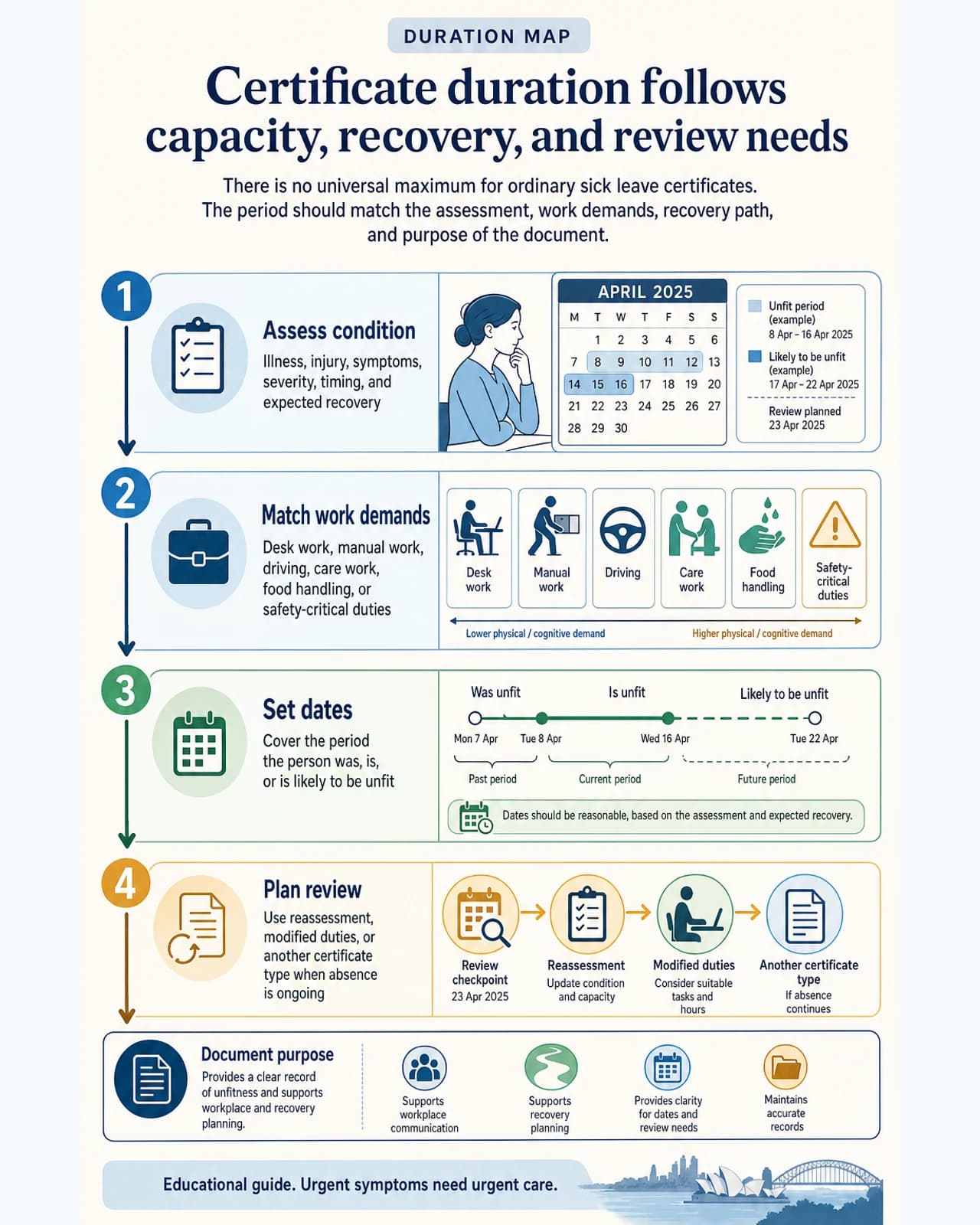
Medical certificate duration depends on clinical judgment, work capacity, workplace evidence rules, and the purpose of the certificate. Learn what can be covered, what cannot be assumed, and when a different certificate type is needed.
InstantMed Medical Team