Loading article
Back to Health Guides
What Is Telehealth? How Online Healthcare Works in Australia
A practical explanation of remote healthcare, Medicare eligibility, online doctor review, safety limits, privacy, and how to check whether a service is legitimate.
11 min read
·Updated 7 July 2026
·Doctor Reviewed
AHPRA Verified
In this article
- 1The practical definition
- 2How telehealth works in Australia
- 3What changes compared with a clinic visit
- 4What the clinical standard means
- 5What telehealth can help with
Medical information only. This article is for general information and does not constitute medical advice. Treatment decisions are made by an AHPRA-registered doctor after reviewing your circumstances.
Review
InstantMed Clinical Team
Clinical governance review for guide content
Updated
7 July 2026
General information only, not personal medical advice.
Jump to section
1The practical definition2How telehealth works in Australia3What changes compared with a clinic visit4What the clinical standard means5What telehealth can help with6What telehealth is not7Medicare, bulk billing, and private fees8Certificates, prescriptions, and referrals9When telehealth should redirect care10Privacy and records11How to check a telehealth service12How to prepare for a telehealth consultation13Common misconceptions14Related guides15Sources
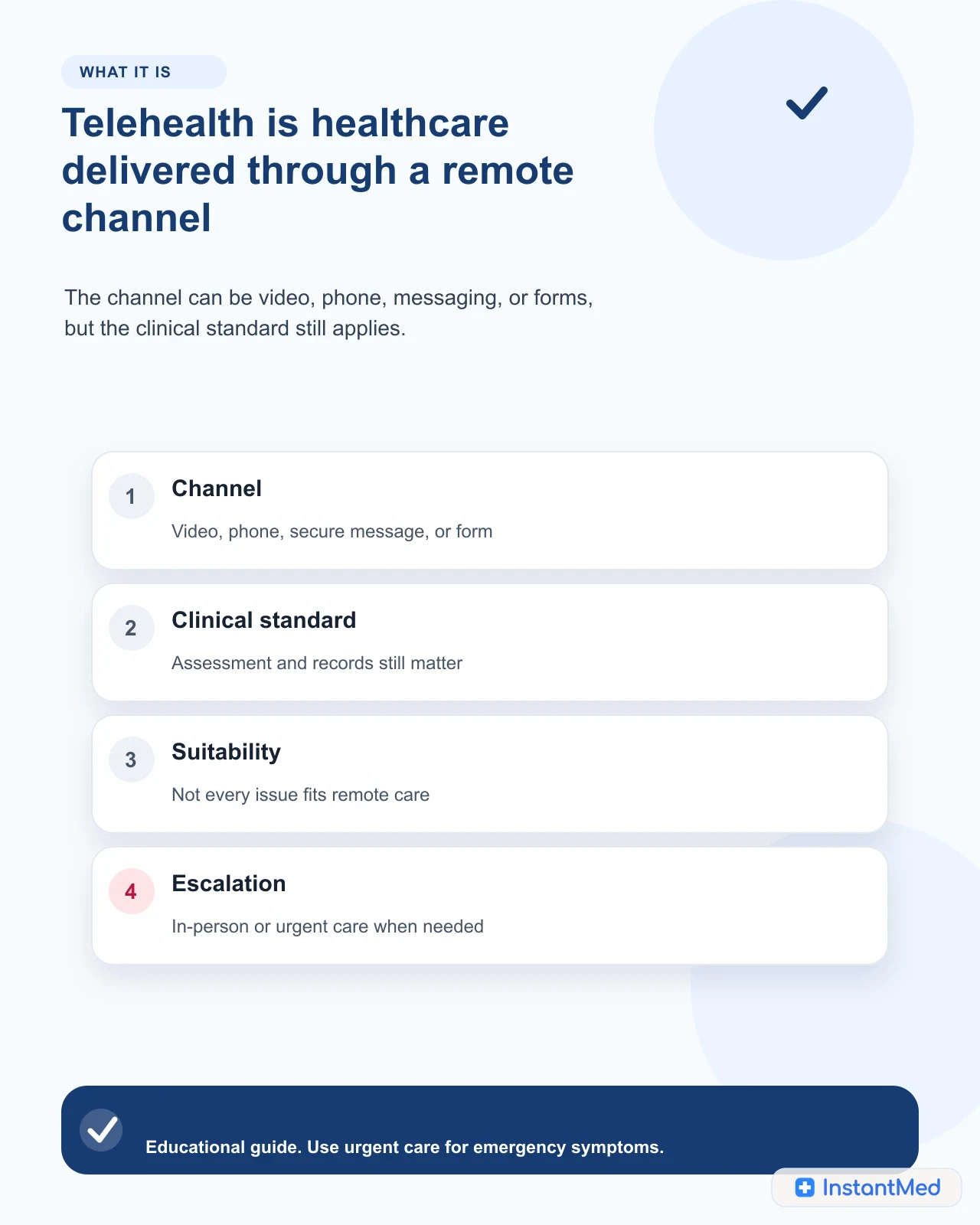
Telehealth means healthcare delivered when the patient and practitioner are not in the same room. The consultation may happen by phone, video, secure message, uploaded information, or a structured online form.
The practical point is this: telehealth changes the channel. It does not remove the need for identity, consent, history, clinical judgment, privacy, records, and a safe next step.
The practical definition
Telehealth is a consultation method. It can be synchronous, where you speak with a practitioner in real time, or asynchronous, where you submit information and a practitioner reviews it later.
Common telehealth channels include:
| Channel | How it works | What it can be useful for | Main limit |
|---|---|---|---|
| Video | Real-time consultation with sight and sound | More interactive review, visual observations, follow-up, mental health, some skin issues | Still cannot replace hands-on examination |
| Phone | Real-time voice consultation | Advice, follow-up, medication questions, triage, simple history-based issues | No visual cues or physical examination |
| Secure form | Structured symptoms, history, medicines, allergies, and consent | Routine requests where written information may be enough | Poorly designed forms can miss risk |
| Secure message | Written follow-up or clarification | Extra questions, results discussion, administrative follow-up | Not suitable for urgent symptoms |
| Hybrid | A mix of forms, images, records, phone, or video | Problems that need more than one source of information | The practitioner may still need in-person care |
The best format depends on the clinical question. A low-risk certificate request, a repeat medicine review, and a new severe symptom do not need the same kind of information.
How telehealth works in Australia
A typical telehealth pathway has several checkpoints.
- 1
The patient provides identity and contact details.
- 2
The patient explains symptoms, timing, severity, history, medicines, allergies, and relevant context.
- 3
The patient consents to the remote process and understands privacy and cost information.
- 4
The practitioner reviews whether remote assessment is suitable.
- 5
The practitioner may ask follow-up questions, use phone or video, review records, or request more information.
- 6
The outcome may be advice, a document, a prescription, a referral, a request for tests, a decline, or a recommendation to seek in-person care.
- 7
The consultation and decision are recorded.
This is why telehealth should not be treated as a vending machine for certificates, prescriptions, or referrals. The outcome comes after assessment.
What changes compared with a clinic visit
The biggest change is the information available to the practitioner.
In a clinic, a GP can examine you, take observations, inspect an ear or throat, check a rash directly, feel an abdomen, listen to your chest, perform a procedure, arrange immediate tests in some settings, and build continuity over time.
In telehealth, the practitioner relies on the information that can be gathered remotely: your history, answers, medication list, allergies, past records, images, voice, video, and follow-up questions.
That can be enough for some issues. It is not enough for every issue.
What the clinical standard means
The Medical Board of Australia expects doctors using telehealth to identify themselves, confirm the patient's identity to the best of their ability, obtain informed consent, protect privacy and confidentiality, keep appropriate records, and keep assessing whether telehealth remains suitable.
That standard matters because the phrase "online doctor" can sound informal. In a safe service, the doctor is still responsible for the clinical decision. The online channel does not make symptoms less serious, make medicines lower risk, or make a document automatically appropriate.
What telehealth can help with
Telehealth often works best when the decision is mostly history-based, follow-up based, or supported by clear records.
Examples may include:
- routine advice for low-risk symptoms
- triage about whether GP, pharmacy, urgent care, or emergency care is the next step
- repeat medicine review when the medicine is established and the history is clear
- some short-illness or carer's leave evidence where remote assessment is enough
- mental health check-ins where risk is low and the patient can communicate safely
- follow-up after a previous consultation
- reviewing non-identifying images when the service has a secure process
- medication side-effect or interaction questions
The safe pattern is not "telehealth can treat X." It is "the practitioner has enough reliable information for this specific decision."
What telehealth is not
Telehealth is not a shortcut around clinical judgment.
It is not:
How it works
Identity, consent, history, and outcome sit inside a proper remote-care process.
- an automatic approval service
- a replacement for emergency care
- a workaround when a doctor has already recommended in-person review
- a way to avoid physical examination when examination is needed
- a guarantee that a certificate, prescription, referral, or test request will be issued
- a substitute for your usual GP when continuity, chronic disease monitoring, or complex medicines matter
Medicare, bulk billing, and private fees
Telehealth and Medicare are related, but they are not the same thing.
MBS-funded telehealth is available for many services when the consultation type, provider, and patient eligibility rules are met. For GP telehealth, eligibility often depends on an established relationship with the practice, with limited exceptions.
Private telehealth is different. A private service may operate outside Medicare and charge a clear out-of-pocket fee. That does not automatically make it lower quality or unlawful. It means the service is not processing that consultation as a Medicare-billed item.
The useful patient questions are:
- What will this consultation cost?
- Is a Medicare rebate available for this specific consultation?
- Who is providing the care?
- What happens if the request is declined or redirected?
- Is this the right care route for the problem?
Certificates, prescriptions, and referrals
A telehealth consultation can sometimes lead to a certificate, eScript, referral, pathology request, or written advice. Those outcomes are not separate from the consultation. They depend on whether the practitioner can safely support that outcome.
For example:
- a certificate needs a credible assessment and dates that fit the evidence being requested
- a repeat prescription needs medicine history, safety screening, contraindication checks, and suitability
- a referral needs enough clinical context to explain why another service is being asked to review you
- a pathology request needs a clinical reason and a plan for follow-up
Be cautious with services that sell documents or medicines as products before assessment. The proper order is information first, clinical review second, outcome third.
When telehealth should redirect care
Decision guide
Where telehealth fits
May fit telehealth
- The problem is low risk, the history is clear, no urgent symptoms are present, and the practitioner can get enough information remotely.
- The service can ask follow-up questions, document the assessment, and redirect you if remote review is not enough.
Needs in-person care
- The decision depends on examination, observations, pathology, imaging, procedures, immunisation, complex medicine changes, or continuity from a usual GP.
- Identity, history, symptoms, medicine details, or the requested document standard are too uncertain for remote review.
Urgent care
- Chest pain, severe breathing trouble, stroke signs, collapse, severe allergic reaction, uncontrolled bleeding, poisoning, overdose, major injury, or immediate self-harm risk should bypass routine telehealth.
- Call 000 or use local urgent care for emergency symptoms.
Privacy and records
Telehealth often asks for sensitive information through forms, uploads, messages, or video. That means privacy and record handling matter.
Before submitting health information, check whether the service explains:
- what information it collects
- why the information is needed
- who can access it
- how records, images, prescriptions, and documents are handled
- how to contact the service about privacy concerns
- what complaints pathway exists
- whether urgent or in-person care may be needed
Avoid sending health details through public comments, ordinary social media messages, workplace accounts, or unsecured channels when a safer healthcare pathway exists.
How to check a telehealth service
A legitimate service should make the healthcare process understandable before you enter sensitive information or pay.
Look for:
Safety boundary
Some problems fit remote review; others need examination, continuity, urgent care, or emergency support.
- a real Australian business name and contact pathway
- clear pricing before payment
- privacy, terms, refund, and complaints information
- meaningful questions about symptoms, history, medicines, allergies, pregnancy, risk, and red flags where relevant
- practitioner accountability for clinical decisions
- a way for the practitioner to ask follow-up questions
- plain information that a request may be declined or redirected
- no guarantees about certificates, prescriptions, diagnosis, or approval
Ahpra's public Register of practitioners is the right place to check practitioner registration when a practitioner name or registration number is provided. Registration is a starting point, not the whole quality check.
How to prepare for a telehealth consultation
Telehealth works better when the information is organised.
Before you start, have ready:
- your symptoms and when they started
- severity and whether symptoms are improving or worsening
- current medicines, allergies, and recent antibiotics
- pregnancy or breastfeeding status where relevant
- relevant medical conditions
- recent test results or discharge summaries if you have them
- your usual GP or pharmacy details if continuity matters
- clear photos if the service specifically asks for images and has a secure upload process
For urgent symptoms, preparation is not the priority. Use emergency or urgent care first.
Common misconceptions
"Telehealth is always less safe." Not true. Remote care can be safe when the problem fits the channel and the service redirects when it does not.
"Telehealth is the same as in-person care." Also too broad. The professional standard still applies, but the available tools are different.
"Medicare rebate means good care." Medicare funding is a billing pathway, not a full quality signal.
"Private fee means less legitimate." Private services can be legitimate, but they should be transparent about fees, clinical review, privacy, and decline pathways.
"An online form means no doctor reviewed it." A structured form can be part of a real assessment. The question is whether a practitioner reviews enough information and can ask for more when needed.
Related guides
- Is telehealth safe in Australia?
- How telehealth safety screening works
- Telehealth vs GP: what is actually different?
- How to verify an online doctor
Sources
- Australian Government Department of Health, Disability and Ageing: Telehealth
- MBS Online: MBS Telehealth Services
- Medical Board of Australia: Telehealth consultations with patients
- Ahpra: Patient safety paramount in updated telehealth guidance
- Ahpra: Register of practitioners
- Healthdirect: Virtual care clinics
- Healthdirect: Calling triple zero (000)
- OAIC: Health information
Frequently Asked Questions
What is telehealth?
Telehealth is healthcare delivered remotely, often by phone, video, secure messaging, or a structured online form. It is a consultation channel, not a separate kind of medicine. The practitioner still needs enough information to decide whether remote care is safe and suitable.
Is telehealth real medical care?
Yes, when it is provided by an appropriately registered practitioner through a proper clinical process. The Medical Board expects telehealth care to be safe and, as far as possible, meet the same standard as in-person care. Telehealth is not suitable for every problem.
Is telehealth covered by Medicare in Australia?
Some telehealth consultations are Medicare-funded when the relevant MBS item and eligibility rules are met. Other services operate privately and charge an out-of-pocket fee. Medicare funding and clinical legitimacy are separate questions.
Can telehealth doctors issue certificates or eScripts?
A telehealth doctor may issue a certificate, prescription, referral, or advice when they have enough information and the outcome is clinically appropriate. The online channel does not guarantee that a document or prescription will be issued.
When should I not use telehealth?
Do not use routine telehealth for emergency symptoms, severe deterioration, major injury, or problems that need immediate hands-on assessment. Call 000 for emergencies. Telehealth may also be unsuitable when examination, observations, tests, procedures, or continuity from your usual GP are needed.
How do I know a telehealth service is legitimate?
Check for a real Australian business, clear pricing, privacy and complaints information, meaningful clinical screening, practitioner accountability, and a willingness to ask follow-up questions, decline unsafe requests, or redirect care. You can check practitioner registration through Ahpra's public register.
InstantMed Medical Team
Related Articles

11 min read
Is Telehealth Safe in Australia?
Telehealth can be safe when the service is regulated, the doctor has enough information, and there is a clear path to in-person or urgent care when remote review is not enough.
InstantMed Medical Team
11 min read
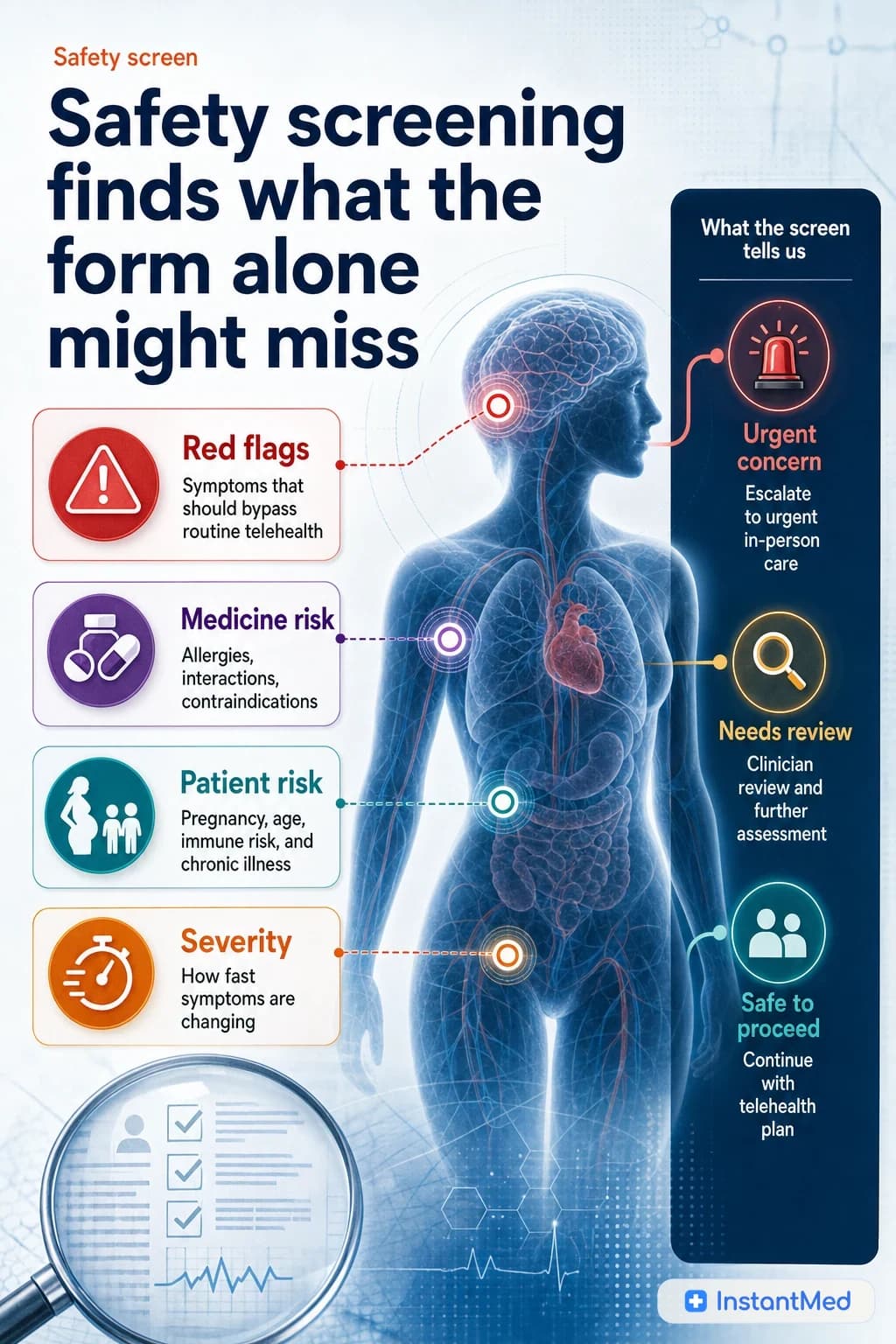
How Telehealth Safety Screening Works
Telehealth safety screening is the clinical filter that decides whether remote care is suitable. It checks symptoms, red flags, medical history, medicines, identity, privacy, and escalation needs before an online outcome is given.
InstantMed Medical Team
11 min read
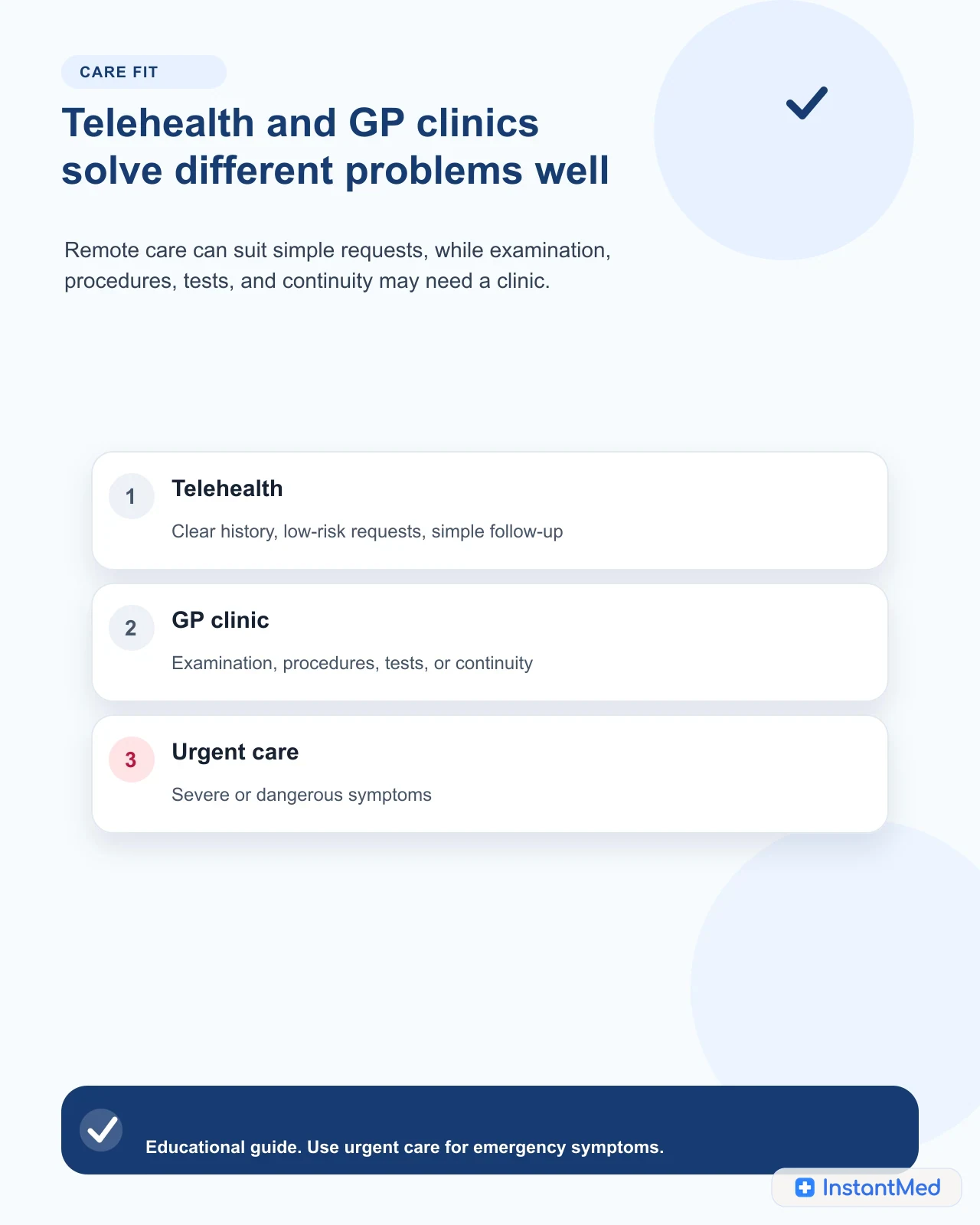
Telehealth vs GP: What's Actually Different in Australia?
Telehealth and in-person GP care are not rivals. Telehealth can be useful for suitable remote assessment, while GP clinics remain essential for examination, continuity, procedures, tests, and complex care.
InstantMed Medical Team