Loading article
Back to Health Guides
Medical Certificates for University: Academic Documentation and Extensions
What documentation Australian universities actually require, how academic consideration works, and the timing factors that determine whether your application succeeds.
8 min read
·Updated 11 June 2026
·Doctor Reviewed
AHPRA Verified
In this article
- 1The Regulatory Framework
- 2When You Might Need Documentation
- 3University vs Workplace: Key Differences
- 4Getting the Timing Right
- 5Academic Documentation: How It Works
Medical information only. This article is for general information and does not constitute medical advice. Treatment decisions are made by an AHPRA-registered doctor after reviewing your circumstances.
Review
InstantMed Clinical Team
Clinical governance review for guide content
Updated
11 June 2026
General information only, not personal medical advice.
Jump to section
1The Regulatory Framework2When You Might Need Documentation3University vs Workplace: Key Differences4Getting the Timing Right5Academic Documentation: How It Works6What the Documentation Should Include7Mental Health Documentation8Remote Assessment and Institution Forms9Common Pitfalls10A Practical Evidence Checklist11If Your Application Is Rejected12Sources
Medical documentation for university is not the same as a workplace sick note. An employer usually needs evidence that you were unfit for work on certain dates. A university may need to decide whether illness, injury, disability, bereavement, or other serious circumstances affected a specific assessment, placement, attendance requirement, or academic progression decision.
That difference matters. A certificate that is acceptable for work may be too vague for academic consideration, while a university form may ask for functional impact that a workplace certificate would not usually include. The goal is not to write more private medical detail than necessary. The goal is to match the evidence to the university decision being made.
The Regulatory Framework
Australian higher education providers operate under the Higher Education Standards Framework (Threshold Standards) 2021. The framework includes standards for learning outcomes and assessment, wellbeing and safety, diversity and equity, and student grievance and complaint handling. It does not prescribe a single national medical certificate format for academic consideration.
This is why each university has its own policy, forms, deadlines, evidence rules, and review pathway. The common pattern is simple: the institution needs evidence that is timely, relevant to the affected assessment, and specific enough to justify the academic outcome requested.
For ongoing disability, chronic illness, or mental health conditions, the Disability Standards for Education 2005 are also relevant. Those standards explain education providers' obligations to support students with disability to access and participate in education on the same basis as students without disability. For students with recurrent or long-term conditions, proactive registration with accessibility or disability services is usually stronger than repeated last-minute special consideration applications.
When You Might Need Documentation
Medical documentation may be required for:
- Missed assessment: An exam, practical, performance, clinical placement, lab, presentation, or timed task you could not complete
- Short extension: Additional time for an assignment or take-home task where the course allows it
- Special consideration or academic consideration: A formal request to account for serious circumstances affecting assessment performance
- Placement absence: Missed clinical, professional, teaching, fieldwork, or industry placement hours
- Withdrawal without academic or financial penalty: Leaving a unit after key dates because continuing was not reasonable
- Leave of absence or reduced study load: Documenting why study capacity has changed
- Accessibility adjustments: Supporting an ongoing plan for disability, chronic illness, or mental health conditions
Each of these typically has different documentation requirements and deadlines.
University vs Workplace: Key Differences
Who signs it: Workplace evidence usually comes from an AHPRA-registered doctor or another acceptable health practitioner. University evidence varies more. Depending on the institution and pathway, documentation may come from a doctor, nurse practitioner, psychologist, counsellor, physiotherapist, hospital, or other registered professional.
What it must say: Workplace evidence usually focuses on being unfit for work for a defined period. University evidence often needs to explain how the condition affected study capacity, assessment performance, placement attendance, or submission timing.
Diagnosis detail: Workplace certificates usually do not need a diagnosis. University forms sometimes ask for the nature, severity, or functional impact of the condition. That does not always mean a private diagnosis must be disclosed.
Timing: Workplace evidence may be accepted after the fact if it is reasonable. University evidence is more likely to be scrutinised when it is created after the affected assessment period.
Institution forms: Workplace forms are uncommon. University forms are common, and they often ask exactly what the reviewer needs to decide the application.
Remote assessment: Workplace evidence is usually judged by practitioner registration and evidence quality. University evidence is policy-specific. Some institutions add rules for timed assessments, exams, or longer impact periods.
Getting the Timing Right
The most common reason medical documentation fails for university purposes is poor timing. Universities are experienced at reviewing these applications and are alert to certificates obtained retrospectively with no contemporaneous evidence.
Best practice is to seek documentation while you are actually affected, before or during the assessment period. If you are too unwell to arrange documentation immediately, create another contemporaneous record: contact the student portal, email the course coordinator if policy allows, record symptoms, keep pharmacy receipts, or document why you could not seek review earlier.
Key principles:
- A certificate dated after an exam, submission deadline, or placement absence will be scrutinised more closely.
- The relevant period is usually the assessment period, not just the day you were assessed by a practitioner.
- Some institutions have very short deadlines. UNSW, for example, tells students to submit Special Consideration as soon as possible within 3 working days of the assessment due date.
- If delay was unavoidable, the application should explain the delay and include whatever contemporaneous evidence exists.
Helpful Tip
If you are not well enough to attend an exam or submit an assessment, start by checking the university's own process. Some assessments have short extension portals, some require special consideration, and some timed assessments have strict "fit to sit" rules.
Academic Documentation: How It Works
Academic consideration is the formal process by which universities account for circumstances beyond your control that affected assessment performance. It is different from a short extension, a casual email agreement, a disability access plan, or a complaint.
Most Australian universities follow a similar framework:
Timing
Late documentation can be rejected even when the illness was real.
- 1
Identify the correct pathway: Short extension, special consideration, placement absence, withdrawal, accessibility adjustment, or appeal.
- 2
Submit within the deadline: Usually through a student portal or faculty form.
- 3
Attach evidence: Medical certificate, professional authority form, psychologist letter, hospital discharge summary, pharmacy evidence, death notice, statutory declaration, or other permitted documentation.
- 4
Faculty or central review: The university checks eligibility, timing, evidence quality, and the link between the circumstances and the affected assessment.
- 5
Outcome: Possible outcomes include an extension, supplementary assessment, deferred exam, no penalty for absence, alternative assessment, withdrawal approval, adjustment plan, or rejection.
Academic consideration does not guarantee a better mark, a supplementary exam, or an amended result. It gives the university a structured way to assess whether the evidence supports an academic remedy.
What the Documentation Should Include
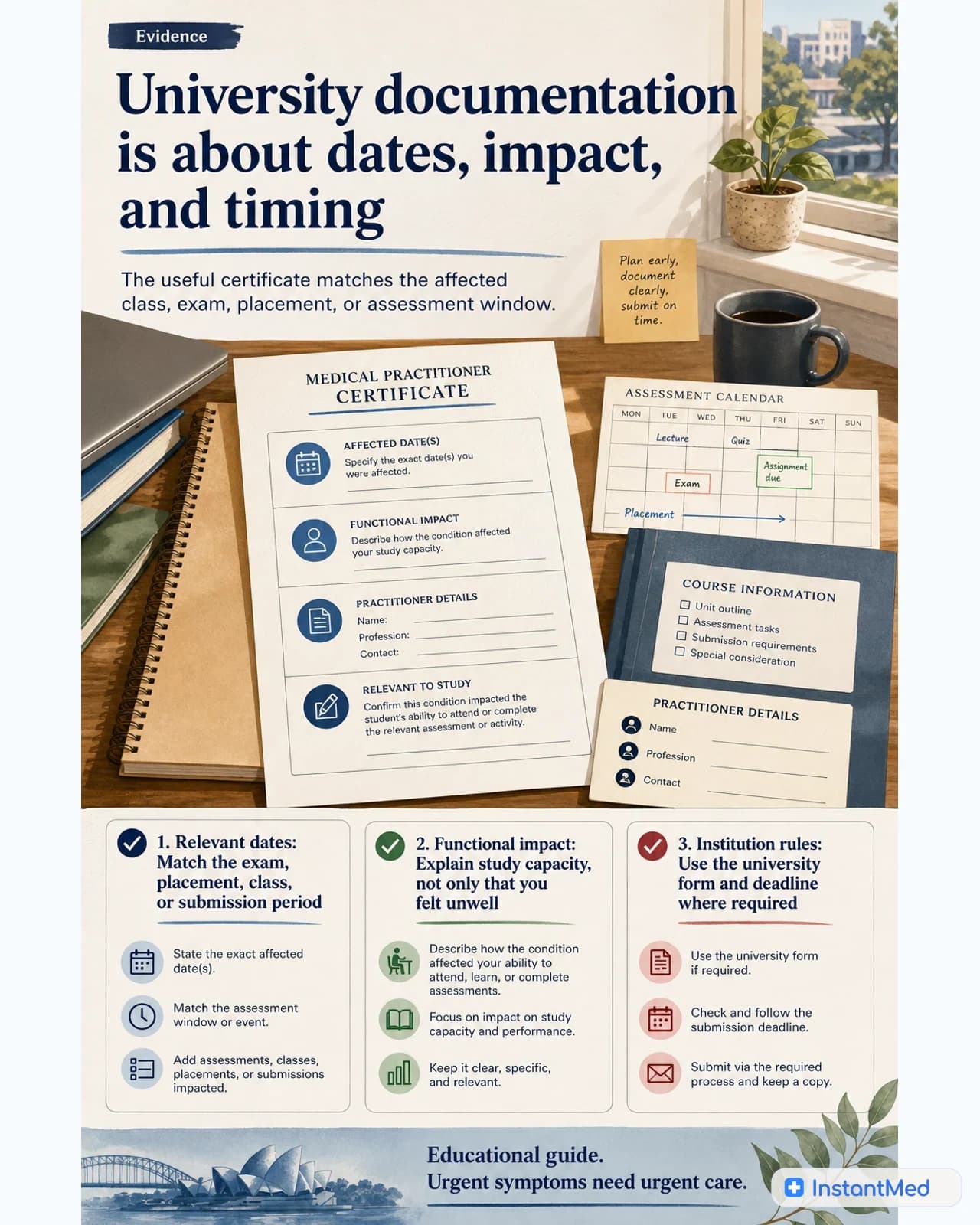
A medical certificate or professional authority form for university purposes usually needs to answer four questions.
Who assessed you? The document should identify the practitioner, profession, registration details where relevant, date of assessment, and contact or clinic details. Ahpra's public register lets people check whether a health practitioner is registered to practise in Australia and whether conditions or limits are listed.
When were you affected? The certificate should cover the dates or time period relevant to the assessment. For an exam, this may be a specific date. For a major assignment, the relevant period may include the days immediately before submission if the illness affected preparation and completion.
How were you affected? University evidence is often capacity-based. Useful wording may explain that symptoms impaired concentration, attendance, mobility, stamina, sleep, placement participation, or ability to complete academic tasks. The exact language should match the institution's form.
Does the evidence match the requested outcome? A one-day illness may support missing a single exam or a short extension. It may not support a month-long withdrawal request unless there is additional evidence. A generic note saying "unfit for work" may be acceptable in some contexts, but it can fail when the university needs study-specific functional impact.
Many universities provide their own professional authority form. Use it where possible. Institution forms are often better than generic certificates because they ask the questions the reviewer actually needs answered.
Mental Health Documentation
Mental health conditions - anxiety, depression, acute psychological distress - are among the most common grounds for academic consideration. Universities are required under the Disability Standards for Education 2005 (made under the Disability Discrimination Act 1992) to make reasonable adjustments for students with disability, which includes mental health conditions.
Documentation from a psychologist, psychiatrist, or GP may be accepted, depending on the university policy and the type of application. The key is not simply the profession. It is whether the practitioner can explain the functional impact on academic performance and the relevant dates.
For acute episodes, academic consideration may be the right pathway. For ongoing anxiety, depression, ADHD, autism, PTSD, eating disorders, bipolar disorder, chronic pain, migraine, inflammatory bowel disease, endometriosis, or another continuing condition, accessibility or disability services are usually more appropriate. They can create a support plan before the next crisis rather than requiring you to prove the same condition repeatedly.
Remote Assessment and Institution Forms
Some university policies accept documentation from a remote clinical assessment. Others add extra requirements, especially for timed assessments, final exams, or impact periods longer than a few days. For example, UNSW sets extra evidence rules for certain remotely issued medical certificates and may require proof that the appointment involved real-time phone or video assessment.
The practical rule is simple: do not assume acceptance because a document is digital, and do not assume rejection because the assessment was remote. Check:
- Whether the practitioner type is accepted
- Whether the university requires a specific form
- Whether the assessment had to be real-time phone, video, or in person
- Whether final exams, timed assessments, placements, or long absences have stricter evidence rules
- Whether proof of appointment, clinical summary, or practitioner letter is required
The document should never be backdated to pretend an assessment happened earlier than it did. A practitioner can describe reported symptoms and the period they consider clinically supported, but the date of assessment should remain accurate.
Common Pitfalls
Waiting until results are released: Applying for academic consideration after receiving a poor result looks like an attempt to explain a bad grade rather than a genuine health impact. Apply promptly after the affected assessment.
Certificate doesn't cover the right dates: Ensure the certificate explicitly covers the date(s) of the affected assessment, not just the day you saw the doctor.
If rejected
Written reasons, deadlines, student advocacy, and internal review decide the next step.
Using a workplace-style certificate: A certificate that only says "unfit for work for 2 days" may not satisfy a university requirement for information about academic capacity. Use the university form where possible.
Not registering with disability services: Students with ongoing conditions who repeatedly apply for academic consideration are better served by proactive accommodation through disability services. One application to the service provides ongoing support without repeated documentation requirements.
Missing the deadline: Late academic consideration applications are frequently rejected. If you miss the deadline, explain the reason for the delay and provide any evidence of why you could not apply sooner.
Sitting the assessment when you are unfit: Some universities apply "fit to sit" or "fit to submit" rules. If you start or submit the assessment, the university may treat that as a declaration that you were fit unless an exception applies.
Over-disclosing private information: More detail is not always better. If the form asks for functional impact, the answer can often focus on capacity rather than naming a sensitive diagnosis.
A Practical Evidence Checklist
Before submitting, check whether your evidence answers these points:
- Does the document identify the practitioner and the date of assessment?
- Does it cover the affected assessment date, placement date, or submission period?
- Does it explain study impact, not only "unfit for work"?
- Does it match the university's own form or evidence category?
- Does the application explain any delay?
- Have you included the assessment name, course code, due date, and the remedy requested?
- If the issue is ongoing, have you contacted accessibility or disability services?
If Your Application Is Rejected
Universities have formal review and appeal processes. If your academic consideration application is rejected and you believe this is incorrect:
- 1
Request written reasons for the rejection
- 2
Review the university's appeals policy (usually in the academic regulations)
- 3
Check the review deadline, which may be only a few working days
- 4
Add missing evidence rather than resubmitting the same material
- 5
Ask your student union, student association, or advocacy service for help
- 6
Use the internal appeal or complaint pathway before escalating externally
TEQSA guidance expects providers to have grievance and complaint processes that address advocacy and support for students, timeliness, confidentiality, fairness, and access to an independent third party where needed. The National Student Ombudsman can also receive escalated complaints from higher education students about higher education providers, including complaints involving reasonable adjustments or special circumstances.
An appeal is not a place to vent. It should identify the specific error: wrong date interpreted, evidence overlooked, policy misapplied, disability adjustment not considered, deadline extension not considered, or new evidence now available.
Sources
- Federal Register of Legislation: Higher Education Standards Framework (Threshold Standards) 2021
- TEQSA: Guidance note, grievance and complaint handling
- Australian Government Department of Education: Disability Standards for Education 2005
- Australian Government Department of Education: National Student Ombudsman
- Ahpra: Register of practitioners
- UNSW Sydney: Special consideration and short extensions
Frequently Asked Questions
Will my university accept a certificate from a remote assessment?
Often, but it depends on the institution's policy and the circumstances. Some universities accept documentation from registered health practitioners, while others require a specific university form, treating-practitioner evidence, or more detail about functional impact. Always check the policy for your course and assessment type.
What should a medical certificate for academic consideration say?
It should cover the dates of the affected assessment period and explain how illness or injury affected your capacity to study, sit an exam, attend placement, or submit work. Some universities require their own form, so check the policy before you seek documentation.
Can I get a certificate after I have already recovered?
Retrospective evidence is more likely to be scrutinised. Some institutions allow limited retrospective documentation, while others prefer evidence created during the affected period. If you were too unwell to seek help at the time, explain that and include any contemporaneous evidence you have.
What if my university has its own form?
Use the university form where possible. Institution forms usually ask for the affected dates, practitioner details, functional impact, and whether the condition affected exams, placements, attendance, or assessment submission. A generic certificate may not answer those questions.
What if my academic consideration application is denied?
Appeal through your university's formal review process and provide any additional documentation available. Student union advocacy officers provide free assistance with appeals and know the process well. Most universities have a second-tier review that considers new information.
InstantMed Medical Team
Related Articles
9 min read
How to Get a Mental Health Certificate for Work
Mental health-related illness can support sick leave evidence in Australia. Learn what a certificate usually says, what employers can ask for, and when to seek urgent support.
InstantMed Medical Team
9 min read
Medical Certificates for Work: Complete Australian Guide
A work medical certificate is evidence that you were unfit for work, not a public explanation of your diagnosis. This Australian guide explains employer evidence rules, privacy, telehealth, stat decs, and return-to-work issues.
InstantMed Medical Team
8 min read
Are Online Medical Certificates Valid in Australia?
Online medical certificates from AHPRA-registered practitioners can be valid evidence in Australia when they follow a genuine assessment and contain clear details. This guide explains the Fair Work standard and common employer questions.
InstantMed Medical Team