Loading article
Back to Health Guides
How to Get a Mental Health Certificate for Work
What Fair Work evidence rules say, what your employer needs, and when mental health care should come before paperwork.
9 min read
·Updated 5 July 2026
·Doctor Reviewed
AHPRA Verified
In this article
- 1Mental health-related illness can support sick leave
- 2What workplace evidence needs to show
- 3What a mental health certificate usually says
- 4What the doctor is assessing
- 5Telehealth may fit some certificates, but not every case
Medical information only. This article is for general information and does not constitute medical advice. Treatment decisions are made by an AHPRA-registered doctor after reviewing your circumstances.
Review
InstantMed Clinical Team
Clinical governance review for guide content
Updated
5 July 2026
General information only, not personal medical advice.
Jump to section
1Mental health-related illness can support sick leave2What workplace evidence needs to show3What a mental health certificate usually says4What the doctor is assessing5Telehealth may fit some certificates, but not every case6Safety comes before a certificate7Burnout, stress and diagnosed conditions are different questions8Returning to work after a mental health absence9Longer-term support after the certificate10Sources
In Australia, a mental health-related illness can be a reason to use personal leave when you are not fit for work. A medical certificate for work usually does not need to name your diagnosis. It needs to support the practical point your employer is assessing: whether you were unfit for work for the relevant period.
The careful answer is that evidence rules still matter. You need to notify your employer as soon as possible, provide reasonable evidence if asked, and follow any award, enterprise agreement, contract, or workplace policy that applies. If you are in crisis, feel unsafe, or are having thoughts of self-harm, urgent support comes before any certificate.
Mental health-related illness can support sick leave
Fair Work frames sick and carer's leave as leave for personal illness or injury, caring responsibilities, or family emergencies. It is also called personal leave. The category is not limited to visible physical illness.
That matters because "mental health day" is not usually a separate employment entitlement. In most workplaces, the leave type is personal or sick leave. The reason is that your mental health, stress, anxiety, low mood, sleep loss, panic symptoms, or burnout-related symptoms may affect your ability to work safely or effectively.
This does not mean every stressful day automatically needs a certificate. It means the practical question is work capacity. If symptoms mean you cannot do your usual work, sick leave evidence may be appropriate.
What workplace evidence needs to show
Fair Work says employees need to tell their employer they are taking sick or carer's leave as soon as possible, and say how long they expect to be away if they can. Employers can ask for evidence that shows the employee was not able to work because of illness or injury. Medical certificates and statutory declarations are examples of acceptable evidence.
| Workplace question | Practical answer | Why it matters |
|---|---|---|
| Do I need to notify my employer? | Yes, as soon as possible. It can be after leave starts if that is the first practical time. | Notice is separate from medical evidence. |
| Can evidence be requested for one day? | Yes, Fair Work says evidence can be requested for as little as one day or less. | Do not assume one day is always evidence-free. |
| What evidence can be used? | A medical certificate or statutory declaration can be acceptable. | The evidence needs to satisfy a reasonable person. |
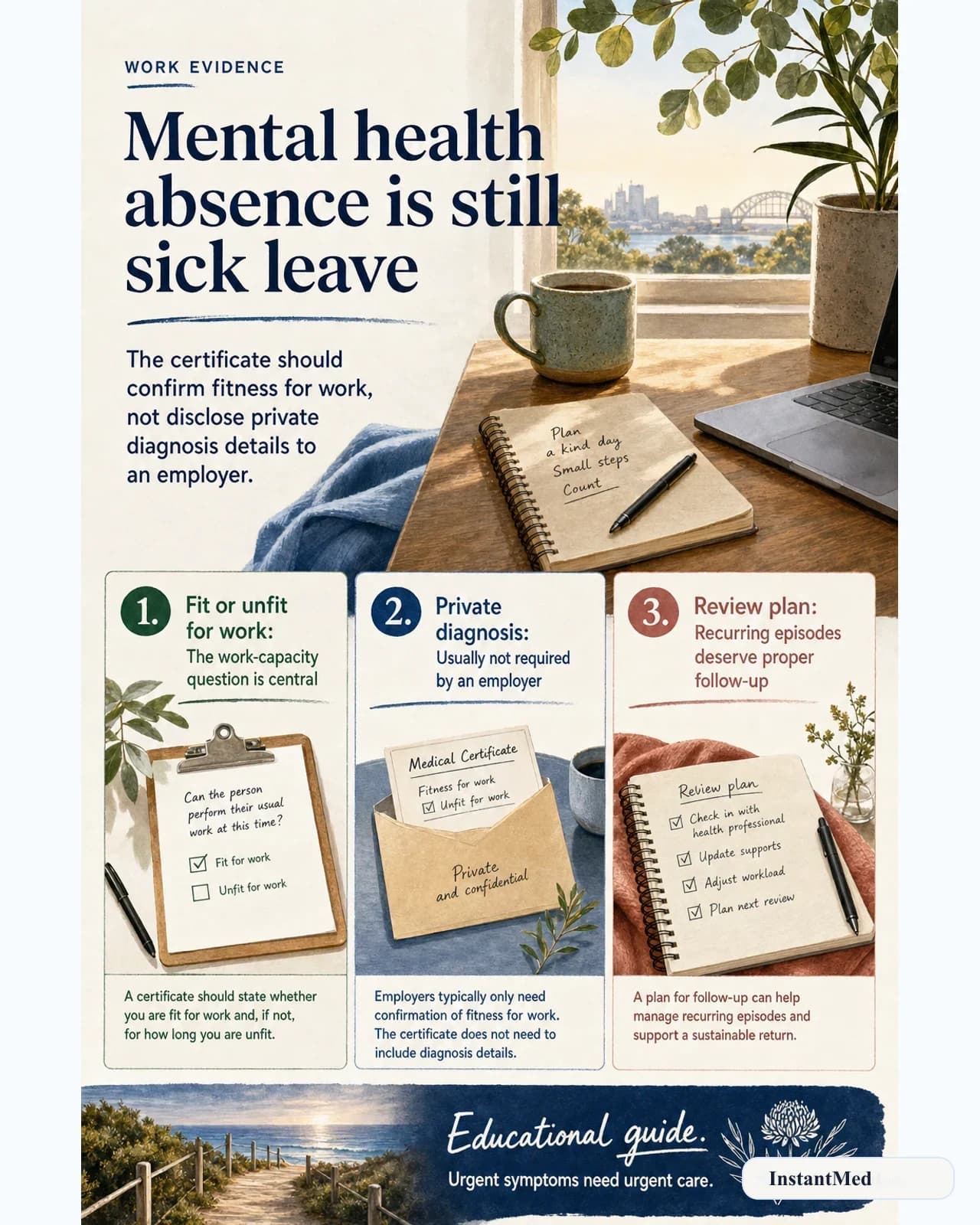
| Does the certificate need a diagnosis? | Usually no. Fitness for work and dates are usually the relevant points. | Diagnosis disclosure raises privacy and stigma concerns. |
| Can my employer contact my doctor? | Fair Work says it does not consider that reasonable unless the employee requests it. | Extra medical detail should not become routine. |
What a mental health certificate usually says
A work certificate usually keeps the clinical details minimal. It commonly confirms that a doctor assessed you, that you were unfit for work or usual duties, and the date or period covered. It should not turn into a mental health history.
That distinction protects both sides. Your employer gets evidence for leave administration. You do not have to disclose a diagnosis, treatment details, medication, therapy attendance, or the personal circumstances behind the absence unless you choose to share them or a separate process genuinely requires more.
Privacy can become more complex if you are asking for longer-term workplace adjustments, workers compensation, fitness-for-duty assessment, or a formal return-to-work plan. Those processes may involve more information, but that is different from a routine certificate for a short absence.
What the doctor is assessing
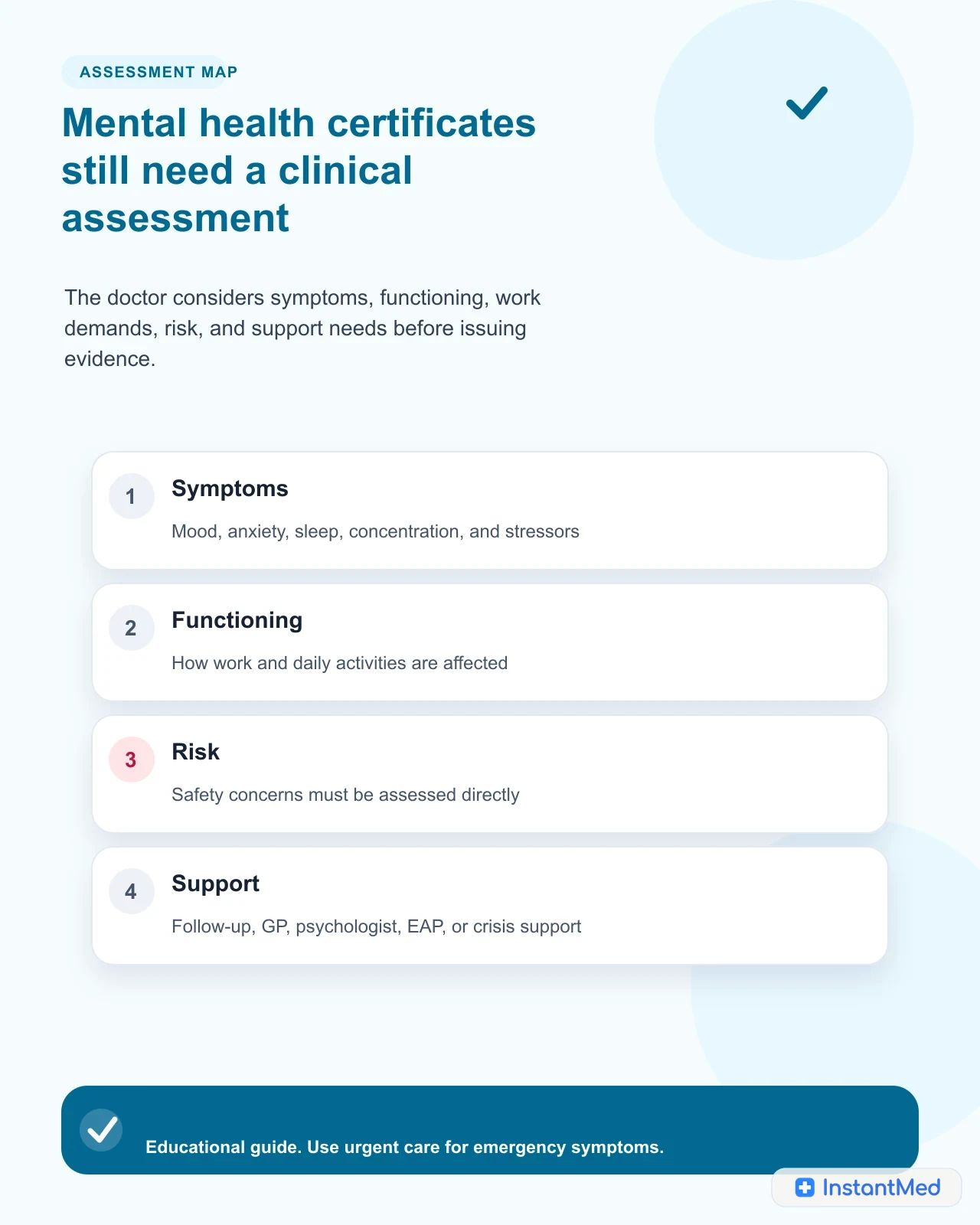
For a mental health-related certificate, the clinical question is not whether your situation is "bad enough" in a moral sense. The doctor is assessing whether your current symptoms and circumstances make your usual work unsafe, unreasonable, or clinically inappropriate for the period requested.
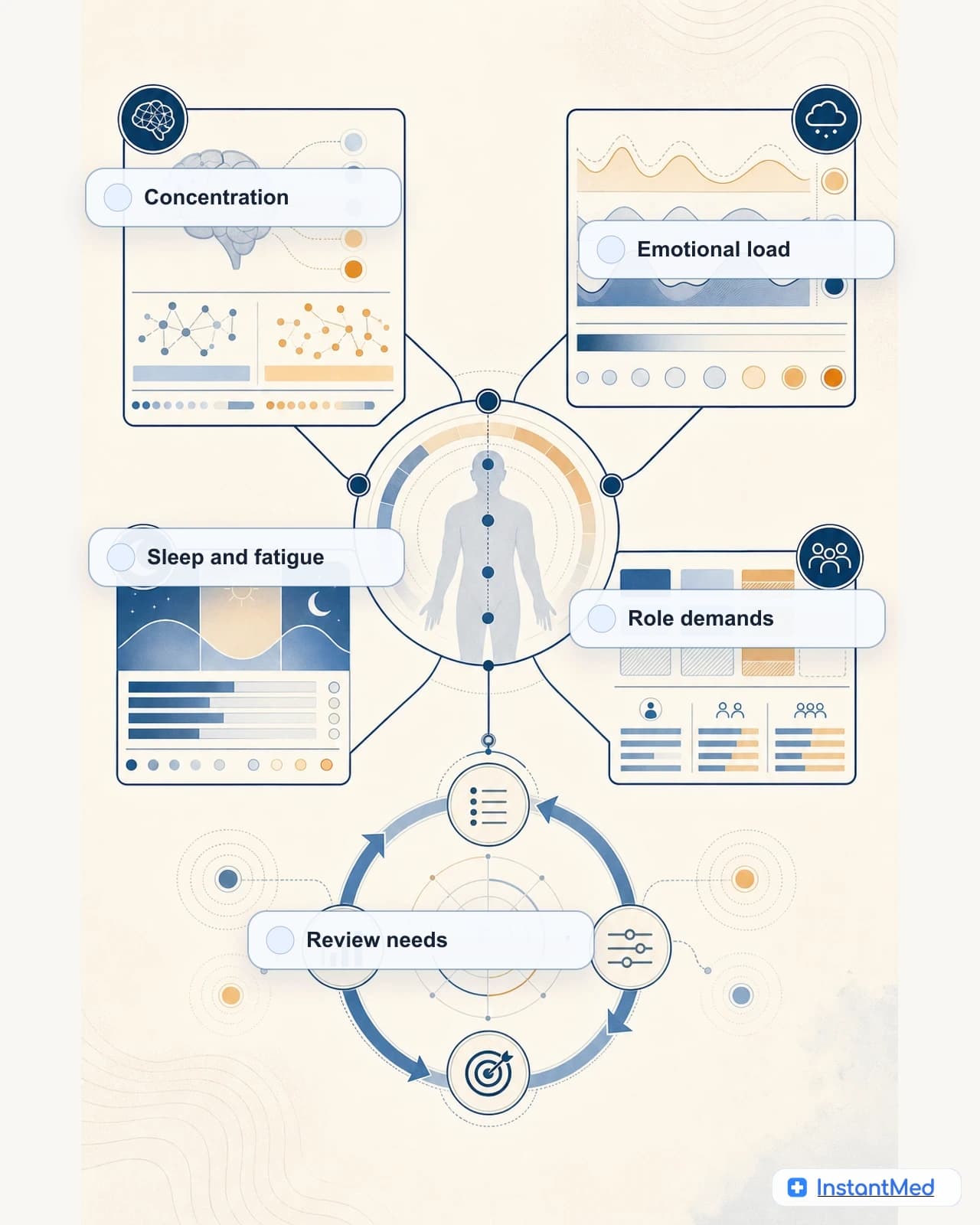
Common assessment points include:
Evidence and privacy
Notice, reasonable evidence, dates, privacy, and employer review are separate parts of the workplace pathway.
- symptoms such as panic, low mood, insomnia, exhaustion, intrusive thoughts, poor concentration, or emotional distress
- the effect on work tasks, including judgement, memory, communication, driving, machinery, public contact, or high-consequence decisions
- duration, including whether a short rest period is reasonable or whether longer review is needed
- safety, including self-harm thoughts, psychosis, severe agitation, substance risk, or inability to care for yourself
- support, including whether you need a GP review, psychologist, EAP, crisis service, or emergency care
Telehealth may fit some certificates, but not every case
Telehealth can be suitable for some work evidence because the assessment is often based on history, current symptoms, functional impact, risk screening, and the period of incapacity. It can be useful when leaving home would make symptoms worse.
The Medical Board and Ahpra also make the boundary clear: telehealth is only appropriate when it is safe, clinically appropriate, and suitable for the patient. The professional standard does not drop because the assessment is remote.
Decision guide
Where telehealth fits
May fit telehealth
- Short, straightforward work evidence where the doctor can assess symptoms, work capacity, risk, and dates remotely.
- Follow-up evidence where the situation is stable and remote review gives enough information.
Needs in-person care
- Severe, worsening, unclear, or complex symptoms where examination, observation, medication review, or ongoing treatment planning is needed.
- Fitness-for-duty, workers compensation, or formal return-to-work situations that need more detailed assessment.
Urgent care
- Immediate danger, self-harm thoughts with intent, psychosis, severe agitation, confusion, or inability to stay safe.
Safety comes before a certificate
A mental health certificate is workplace evidence. It is not crisis care, therapy, a Mental Health Treatment Plan, or a substitute for a regular GP when symptoms are ongoing.
If you are worried you may harm yourself or someone else, or someone is in immediate danger, call 000 or go to an emergency department. Healthdirect lists Lifeline on 13 11 14 and Beyond Blue on 1300 22 4636 as national crisis support options.
Burnout, stress and diagnosed conditions are different questions
People often use "stress leave", "mental health day", "burnout", "anxiety", and "depression" to describe overlapping experiences. They are not all the same clinically, but for short sick leave evidence the immediate question is often narrower: are you fit for work right now?
Burnout may describe work-related exhaustion and reduced functioning. Anxiety or depression may be diagnosed mental health conditions. Acute grief, panic, insomnia, or a major stressor may also affect capacity. A certificate does not have to label all of this. It can simply support that you were not fit for your usual duties for a defined period.
Where symptoms keep recurring, last longer, or affect your ability to function outside work, it is worth moving beyond one-off certificates. A GP can assess broader causes, check risk, consider treatment options, and discuss whether a Mental Health Treatment Plan or referral is appropriate.
Returning to work after a mental health absence
Returning to work is not always an all-or-nothing decision. Depending on your symptoms, role, and workplace, a doctor may consider a short absence, a staged return, modified duties, reduced exposure to a trigger, or a review date.
Possible return options include:
Safety boundary
Immediate danger, self-harm thoughts, psychosis, severe agitation, or inability to stay safe should move the person to urgent support.
- a short certificate covering the period you were unfit for work
- modified hours or duties where your role can safely adjust
- a review date if capacity may change quickly
- referral to your usual GP or a mental health professional when symptoms are ongoing
- urgent escalation if safety concerns appear
Employers also have obligations under disability discrimination law where a mental health condition meets the relevant definition of disability. Reasonable adjustments are fact-specific, and not every short absence needs a formal adjustment process. But if mental health is affecting work repeatedly, it is better to discuss support early than to rely on repeated same-day evidence.
Longer-term support after the certificate
A certificate can help with a work absence. It should not be the whole plan if mental health is repeatedly affecting your life.
Other support routes can include:
- your usual GP for assessment, risk review, and care planning
- a psychologist, counsellor, or other mental health professional
- an Employee Assistance Program if your workplace has one
- local public mental health services for urgent or complex needs
- Lifeline, Beyond Blue, or emergency care when safety is the issue
Sources
- Fair Work Ombudsman: Sick and carer's leave
- Fair Work Ombudsman: Notice and medical certificates
- OAIC: Health information
- Ahpra: Information for practitioners who provide virtual care
- Healthdirect: Mental health crisis support
- Australian Government Department of Health, Disability and Ageing: Better Access initiative
- Australian Human Rights Commission: Workers with mental illness, knowing the law
Frequently Asked Questions
Can I use sick leave for mental health in Australia?
Yes, when a mental health condition or stress-related illness means you are not fit for work. Fair Work treats sick leave as personal leave for illness or injury; there is not a separate mental health leave category for ordinary paid personal leave.
Do I have to tell my employer my mental health diagnosis?
Usually, no. A medical certificate normally needs to support that you were unfit for work for the relevant period. It does not usually need to name anxiety, depression, burnout, or another diagnosis unless you choose to disclose more or a separate workplace process requires it.
Can my employer ask for evidence for one mental health day?
Fair Work says an employer can ask for evidence for as little as one day or less off work, but the request and the type of evidence need to be reasonable in the circumstances. Awards, enterprise agreements, contracts, and workplace policies can also set evidence rules.
Can a telehealth doctor issue a mental health certificate for work?
A telehealth doctor may issue work evidence when the remote assessment is clinically suitable. Telehealth is not suitable for every situation, especially if there are urgent safety concerns, severe symptoms, or a need for an in-person examination or ongoing treatment plan.
What if I am having thoughts of self-harm or do not feel safe?
Work paperwork can wait. If you or someone else is in immediate danger, call 000 or go to an emergency department. For crisis support, call Lifeline on 13 11 14 or Beyond Blue on 1300 22 4636.
InstantMed Medical Team
Related Articles
7 min read
Mental Health Certificate Online: Taking a Mental Health Day
Need a mental health day? Learn how to get a medical certificate online for mental health reasons, your rights as an employee, and when to seek additional support.
InstantMed Medical Team
8 min read
Medical Certificates for Mental Health Days
Mental health is valid sick leave in Australia. What your certificate says, how to notify your employer, same-day vs next-day certificates, and when to get ongoing support.
InstantMed Medical Team

8 min read
Burnout vs Stress: How to Tell the Difference
Stress and burnout overlap, but they are not the same. Learn the practical differences, common warning signs, workplace drivers, recovery steps, and when to seek professional support.
InstantMed Medical Team