Loading article
Back to Health Guides
Medical Certificates for Work: Complete Australian Guide
When work can ask for evidence, what a certificate should say, what stays private, and how sick leave documentation changes by role and absence length.
9 min read
·Updated 3 June 2026
·Doctor Reviewed
AHPRA Verified
In this article
- 1When can an employer ask for evidence?
- 2What a work certificate should say
- 3What your employer can and cannot ask
- 4Medical certificate, stat dec, or other evidence?
- 5Telehealth certificates for work
Medical information only. This article is for general information and does not constitute medical advice. Treatment decisions are made by an AHPRA-registered doctor after reviewing your circumstances.
Review
InstantMed Clinical Team
Clinical governance review for guide content
Updated
3 June 2026
General information only, not personal medical advice.
Jump to section
1When can an employer ask for evidence?2What a work certificate should say3What your employer can and cannot ask4Medical certificate, stat dec, or other evidence?5Telehealth certificates for work6Single-day, multi-day, and extended absences7Return-to-work clearance is a separate issue8Role-specific examples9If work disputes the certificate10Sources
A medical certificate for work is evidence about capacity, not a confession of every health detail. Its job is to support that you were unfit for work, or unfit for your usual duties, for a defined period. It should help your employer administer leave without dragging private medical information into the workplace.
The highest-friction disputes usually come from three misunderstandings: employees think certificates are only needed after several days, employers ask for more detail than they usually need, and both sides confuse a sick certificate with a return-to-work clearance. This guide separates those issues.
When can an employer ask for evidence?
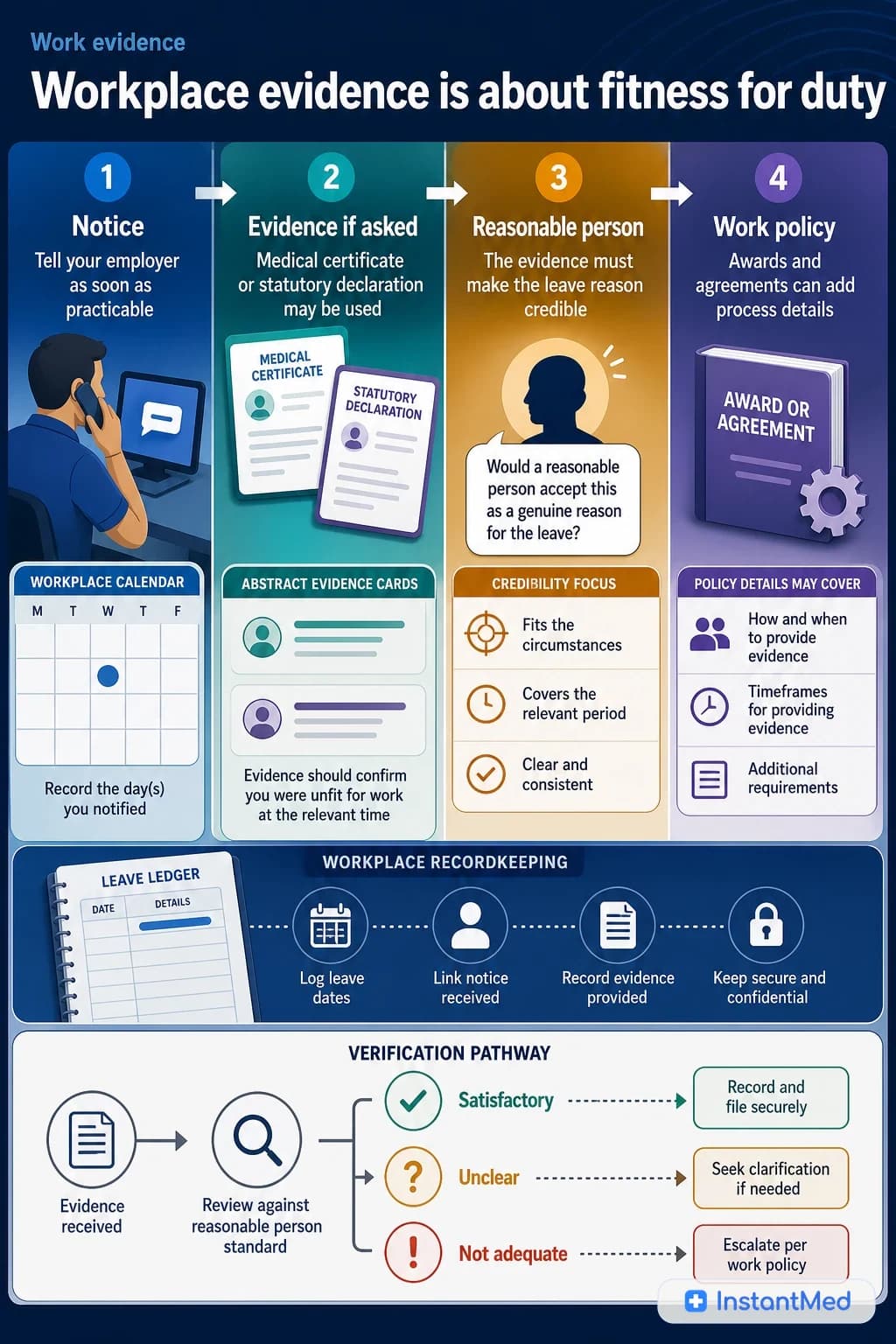
Under the Fair Work Ombudsman's guidance, an employer can ask an employee to provide evidence for sick or carer's leave, including for as little as one day or less. The evidence needs to show that the employee was unable to work because of illness or injury, or needed to provide care or support to an immediate family or household member.
Many workplaces only ask after two consecutive days, around weekends or public holidays, or where a pattern of absence appears. That is a policy choice, not the outer limit of the law. Awards, enterprise agreements, contracts, and workplace policies can add detail about when evidence is requested and what type is expected.
The important qualifier is reasonableness. The evidence requested must be reasonable in the circumstances. A short self-limiting illness in an office role is not the same as an extended absence, a safety-critical job, or a workplace injury.
What a work certificate should say
A certificate should be clear enough for payroll or HR to process without extra detective work.
Useful details usually include:
- your full name
- the date of assessment
- the dates you were unfit for work
- whether you were unfit for work or unfit for usual duties
- the practitioner's name and registration details
- the practice or service contact details
- signature, digital signature, or equivalent attestation
It does not usually need to list your diagnosis. A statement that you were unfit for work due to a medical condition is commonly enough for ordinary sick leave evidence. If you work in a role where the actual condition affects workplace safety, infection control, or legal clearance, the documentation question can become more specific.
What your employer can and cannot ask
Your employer can ask for evidence, ask how long you expect to be away, ask when you expect to return, and manage attendance patterns using a fair process. They can also ask for more structured fitness information after extended absence or in safety-sensitive roles.
They usually should not demand your diagnosis for routine sick leave. They should not contact your doctor for further information without appropriate consent. They should not treat every telehealth certificate as invalid merely because the review occurred online. They should not turn a certificate validity question into a fishing expedition for private health details.
If there is a genuine concern, ask for the concern in writing. Is the certificate missing dates? Is the practitioner's registration unclear? Is the requested period inconsistent with the absence? Those are concrete problems. "We do not like online certificates" is much weaker than a specific defect in the evidence.
Medical certificate, stat dec, or other evidence?
The Fair Work Ombudsman lists medical certificates and statutory declarations as examples of acceptable forms of evidence. Neither is magic on its own. The evidence still needs to convince a reasonable person that the leave was genuinely taken for the claimed reason.
A medical certificate is usually the strongest document when you were assessed by a health practitioner. A statutory declaration may be useful when you were briefly unwell, could not reasonably access a practitioner, and your workplace rules allow that kind of evidence. Some employers or awards may prefer or require medical certificates in particular circumstances.
Privacy boundary
Useful evidence can confirm unfitness and dates while keeping private medical details out of the workplace file.
Other documents can sometimes support the picture: hospital discharge paperwork, appointment letters, test attendance records, or specialist letters. Be cautious with privacy. Give the minimum information required to support the leave.
Telehealth certificates for work
Telehealth can be appropriate for work certificates when the clinical issue can be assessed safely from history and remote information. Common examples include short acute illnesses where the symptoms, timing, severity, and work impact are clear.
Telehealth is less suitable when a physical examination, test, imaging, procedure, or urgent assessment is needed. It is also less suitable where a workplace injury requires a compensation certificate, because those systems often have specific forms and capacity wording.
The Medical Board's telehealth guidance is clear that telehealth is not a lower-standard version of care. The standard of care must be safe and appropriate. A good telehealth review should ask for more information or redirect to in-person care when remote assessment is not enough.
Single-day, multi-day, and extended absences
A one-day absence is mostly an evidence and policy question. If your workplace asks for evidence for the day, a certificate or statutory declaration may support the absence.
A multi-day illness needs date clarity. The certificate should cover the whole relevant period, and the requested duration should fit the clinical history. A one-day cold and a three-day gastro illness are different documentation scenarios.
If you are still unwell when the certificate expires, do not simply stretch the old document beyond its wording. A follow-up assessment may be needed. For longer absences, your employer may ask for updated evidence, capacity information, or return planning.
Absence longer than several weeks creates a different risk profile. The question shifts from "Were you sick?" to "What work can you safely do, when, and with what restrictions?"
Return-to-work clearance is a separate issue
A sick certificate says you were unfit for work for a period. A return-to-work clearance says something about your capacity to resume work.
Clearance becomes more relevant after extended absence, injury, surgery, infectious illness in high-risk roles, or safety-critical work such as driving, operating machinery, clinical care, childcare, or working at heights. It may include restrictions such as modified duties, reduced lifting, shorter shifts, or no driving.
Do not assume the original sick certificate answers return-to-work questions. If your employer needs capacity information, ask exactly what duties need to be considered and what form they require.
Role-specific examples
Office work usually focuses on whether symptoms prevented attendance or normal duties.
Food handling can require stricter infection-control timing after vomiting, diarrhoea, or certain infections. A simple "unfit today" certificate may not answer return-to-food-handling questions.
Return pathway
A single day, multi-day illness, extension, and return-to-work clearance are not the same documentation problem.
Healthcare, aged care, and childcare roles may require extra caution around respiratory illness, gastroenteritis, rashes, and exposure risks.
Transport, mining, construction, and machinery roles can involve fatigue, medication effects, physical restrictions, and site-specific clearance requirements.
Workers compensation is different again. If the illness or injury is work-related, standard sick leave evidence may not be the correct pathway.
If work disputes the certificate
Start with the document. Check name, dates, practitioner details, and legibility. Confirm whether the issue is a missing field, a policy requirement, or a broader objection to telehealth.
Then ask for the concern in writing. Keep your response factual and privacy-conscious. If the issue is practitioner registration, you can point to the public Ahpra register. If the issue is diagnosis, ask why diagnosis is required for ordinary sick leave evidence.
If the dispute affects pay or disciplinary action, get advice from the Fair Work Ombudsman, your union, a workplace adviser, or an employment lawyer. Do not ignore formal workplace correspondence.
Sources
- Fair Work Ombudsman: Notice and medical certificates
- Fair Work Ombudsman: Sick and carer's leave and compassionate leave fact sheet
- Fair Work Ombudsman: Long periods of sick leave
- Medical Board of Australia: Telehealth consultations with patients
- Ahpra: Register of practitioners
Frequently Asked Questions
Can work ask for a medical certificate for one day?
Yes. The Fair Work Ombudsman says employers can ask for evidence for as little as one day or less off work. Awards, agreements, contracts, and workplace policies can set more specific process rules, but the evidence requested must be reasonable in the circumstances.
Does my employer need to know my diagnosis?
Usually no. For ordinary sick leave evidence, a certificate can state that you were unfit for work for the relevant period without naming the condition.
Is a statutory declaration enough instead of a medical certificate?
It can be, depending on the circumstances and workplace rules. Fair Work lists medical certificates and statutory declarations as examples of acceptable evidence, but the evidence still needs to satisfy a reasonable person.
Can my employer contact my doctor?
The Fair Work Ombudsman says it does not generally consider it reasonable for an employer to contact the employee's doctor for further information. Health information should not be disclosed without appropriate consent.
When is a return-to-work clearance different from a sick certificate?
A sick certificate explains that you were unfit for work for a period. A return-to-work clearance addresses whether you are fit to resume duties, sometimes with restrictions, and is more common after extended absence or in safety-critical roles.
InstantMed Medical Team
Related Articles
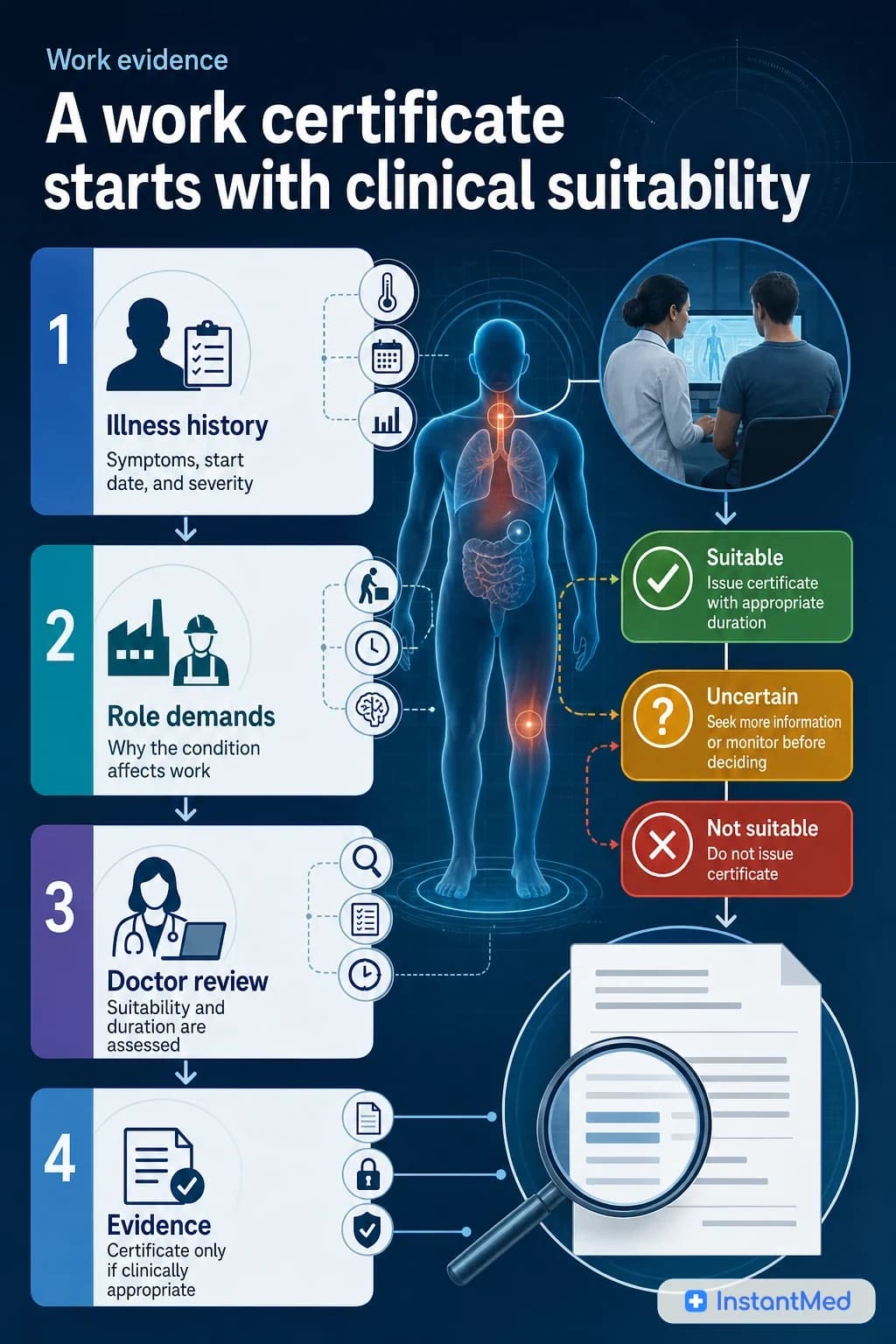
10 min read
Online Doctor Certificate for Work: What Counts as Evidence
Need a doctor certificate for work but cannot visit a clinic? Learn when online certificates can be used, what details matter, and where the limits sit.
InstantMed Medical Team
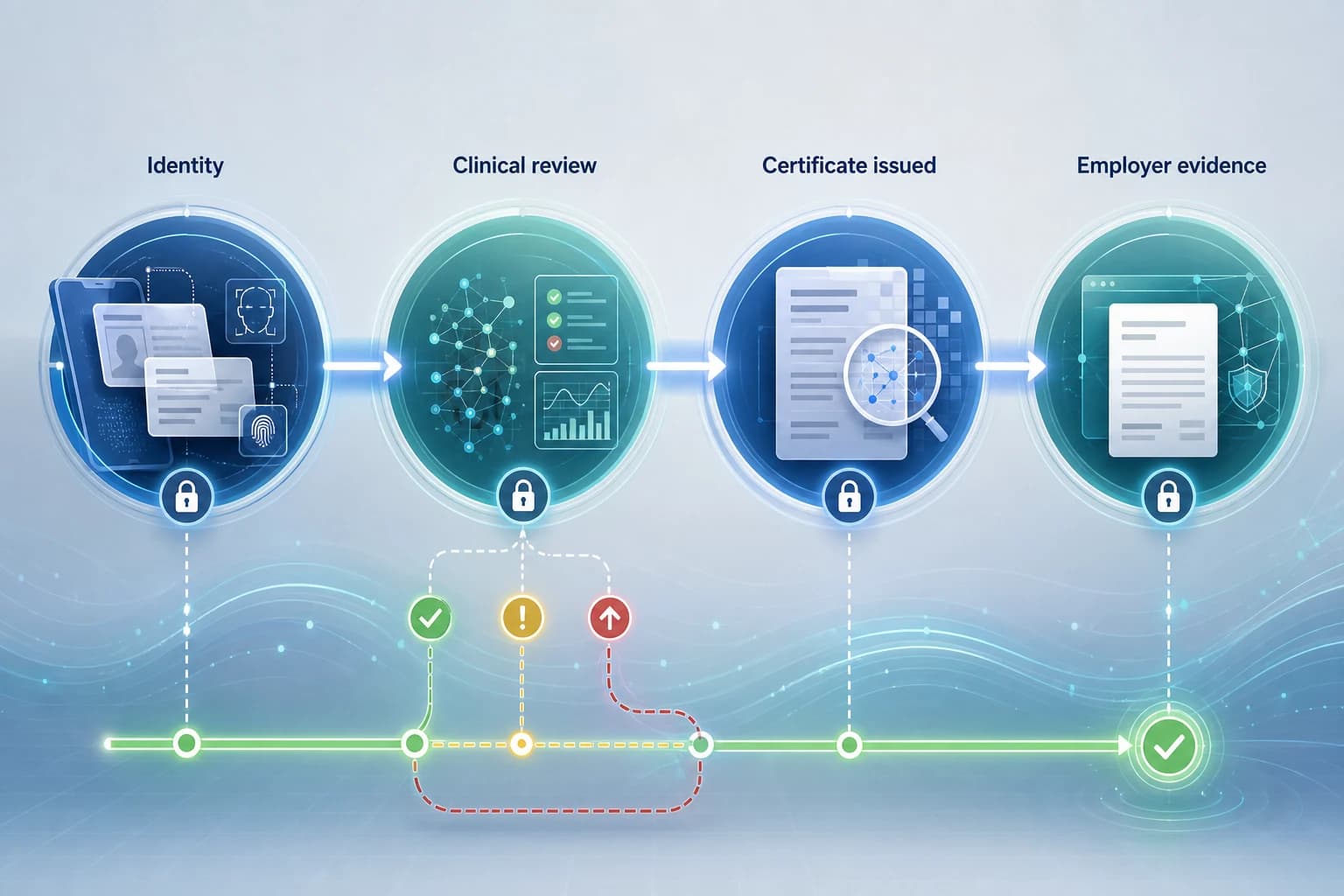
9 min read
How to Get a Medical Certificate Online in Australia
Online medical certificates can be valid workplace evidence in Australia when issued after an appropriate clinical review by a registered practitioner. Learn what matters, what to prepare, and where the limits are.
InstantMed Medical Team
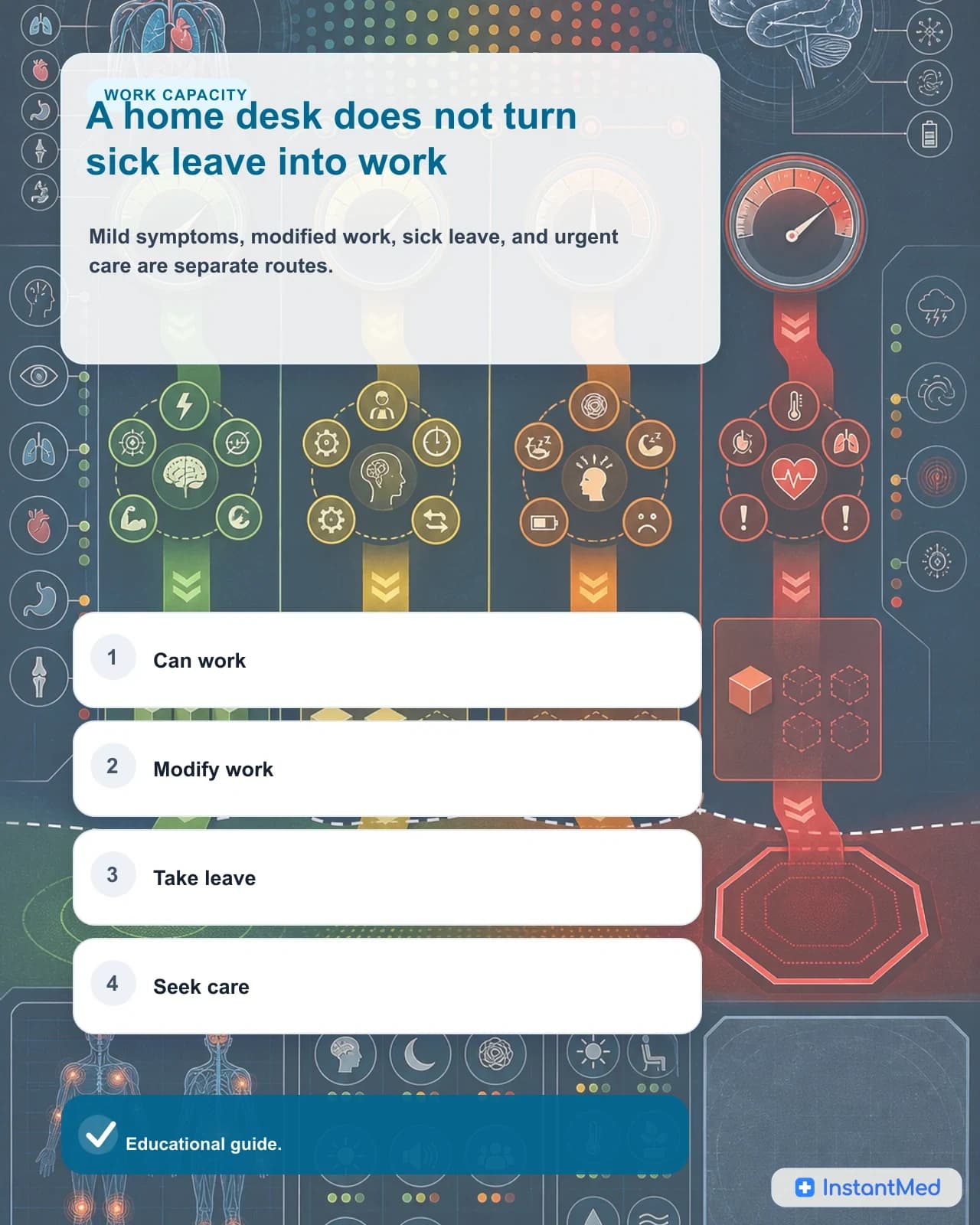
11 min read
Medical Certificate Says Unfit for Work: Can You WFH?
If a medical certificate says you are unfit for work, working from home is still work. Learn when WFH, modified duties, sick leave, and evidence rules differ.
InstantMed Medical Team