Loading article
Back to Health Guides
Same-Day Medical Certificate: How It Works
How to get a medical certificate the day you are sick, what information you need, how long it takes, and whether same-day certificates are accepted by employers.
7 min read
·Updated 10 May 2026
·Doctor Reviewed
AHPRA Verified
In this article
- 1When a Same-Day Certificate Is Appropriate
- 2What Information You Need to Provide
- 3The Review Process
- 4What the Certificate Contains
- 5Legal Standing of Telehealth Certificates
Medical information only. This article is for general information and does not constitute medical advice. Treatment decisions are made by an AHPRA-registered doctor after reviewing your circumstances.
Review
InstantMed Clinical Team
Clinical governance review for guide content
Updated
10 May 2026
General information only, not personal medical advice.
Jump to section
1When a Same-Day Certificate Is Appropriate2What Information You Need to Provide3The Review Process4What the Certificate Contains5Legal Standing of Telehealth Certificates6How Quickly to Expect Your Certificate7Using the Certificate8When a Same-Day Certificate Is Not Appropriate9Sources Used In This Guide
Needing a medical certificate the day you are sick is one of the most common and frustrating situations in modern working life. Your regular GP has no appointments available, the local clinic has a two-hour wait, and you are unwell enough that leaving the house is genuinely difficult.
Asynchronous telehealth - where you submit your information online and a doctor reviews it - was built for this situation. A registered doctor assesses your case from the information you provide and, where clinically appropriate, issues a medical certificate to your email or phone the same day. Here is exactly how the process works and what to expect.
When a Same-Day Certificate Is Appropriate
A same-day telehealth certificate is appropriate when:
- You are genuinely unwell and unable to attend work
- The illness is your own (personal sick leave) or involves caring for an immediate family member
- Your condition can be adequately described in written form and does not require physical examination to assess
- You do not have symptoms suggesting a medical emergency
Common conditions suitable for same-day telehealth certification include upper respiratory tract infections, gastroenteritis, significant headache, anxiety episodes, menstrual pain, back pain, and other conditions where your description of symptoms is the primary clinical information.
Key Information
A medical certificate is not automatic. The reviewing doctor makes a clinical judgment about whether your symptoms are consistent with an inability to attend work. Providing thorough, accurate information gives the doctor what they need to make that assessment. Vague submissions ("I feel unwell") may result in follow-up questions or a request for more information.
What Information You Need to Provide
The quality and completeness of your submission directly affects how quickly your request can be assessed and how accurately the certificate will reflect your situation.
Essential information:
- Your full name and date of birth
- Current symptoms and when they started
- How the symptoms are affecting your ability to work
- How many days you need (today only, or anticipating further days)
- Any relevant medical history (existing conditions that context the current symptoms)
- Current medications if relevant to the symptoms
- Whether you have sought any treatment
Helpful additional information:
- Temperature if you have measured it (relevant for suspected infection)
- Whether other household members are ill with similar symptoms
- Whether your employer or award has any specific certificate requirements
The more specific you are, the more complete the clinical picture. A submission that says "I have had a fever of 38.7C since last night, chills, body aches, and a sore throat, and I cannot concentrate or sit upright for more than a few minutes" gives the doctor far more to work with than "I have a cold."
The Review Process
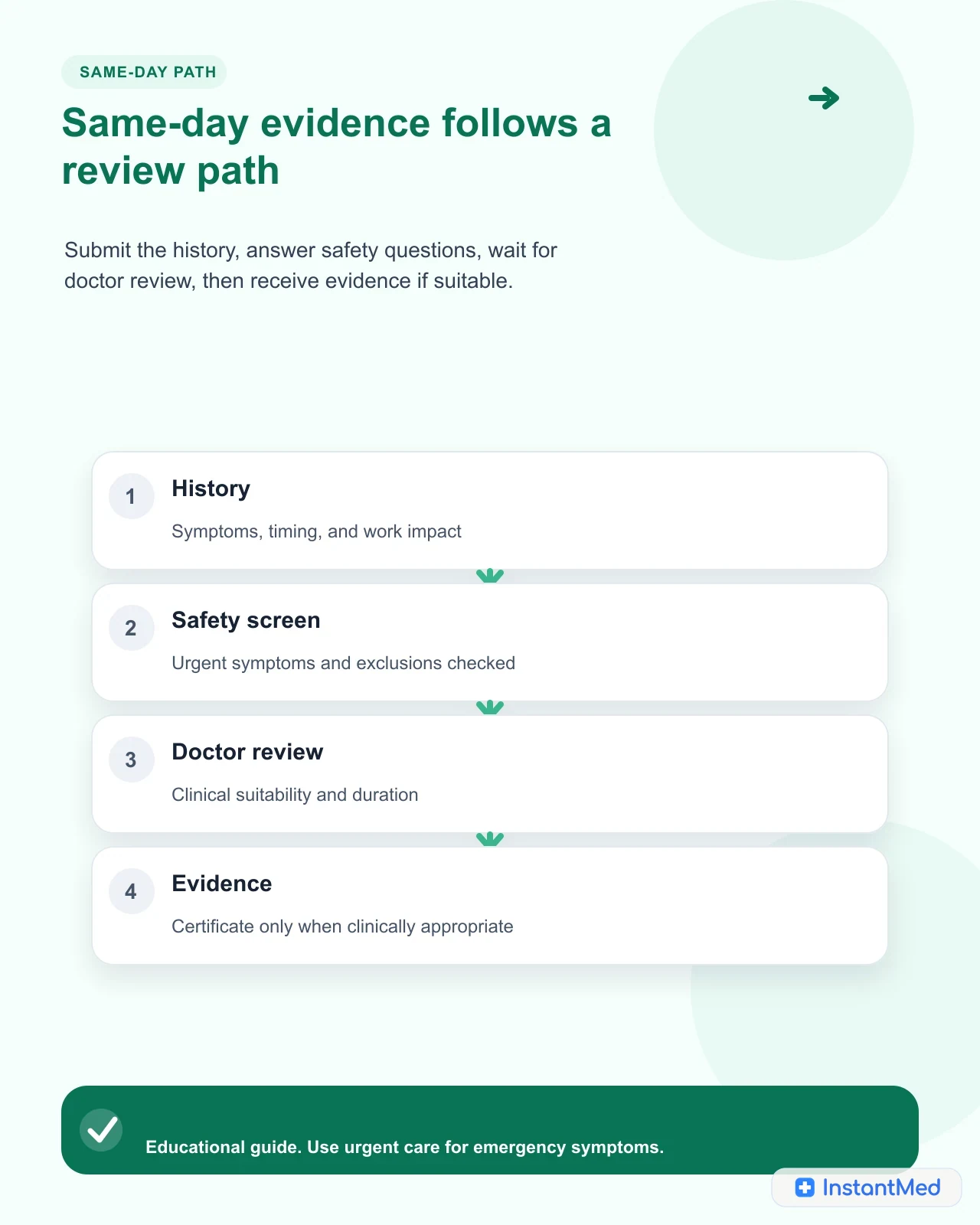
Your request is assessed for suitability based on your symptoms, relevant history and absence dates. You will receive an outcome or a request for more information. If online care is not suitable, you will be directed to a more appropriate service.
The assessment considers:
- Whether your symptoms are consistent with an inability to perform your work duties
- Whether the duration requested is appropriate to the presentation
- Whether there are any red flags suggesting the situation requires in-person assessment
- Whether any information provided raises clinical concerns that need follow-up
If everything is consistent, the doctor issues the certificate. If the doctor has questions, they may send a follow-up message requesting clarification before approving. If the clinical picture suggests in-person assessment is necessary - for example, symptoms that may indicate a more serious condition - the request will be declined with an explanation and a recommendation to seek in-person care.
According to the Medical Board of Australia's Good Medical Practice standards, this clinical decision process applies identically to telehealth and in-person consultations. A telehealth doctor cannot simply approve all requests - they are exercising a clinical judgment and bear professional accountability for it.
What the Certificate Contains
A medical certificate issued via telehealth includes:
- Patient's full name
- The date(s) the certificate covers
- That the patient attended a medical consultation (the date and time of the telehealth consultation)
- The clinical reason for the absence (described appropriately - typically "suffering from a medical condition" rather than a diagnosis, unless relevant)
- The prescribing doctor's name and AHPRA registration number
- The date the certificate was issued
The certificate is issued as a PDF, typically delivered by email. It can be forwarded directly to your employer or HR department.
Legal Standing of Telehealth Certificates
Under the Fair Work Act 2009 (Cth), section 107(3), an employee may be required to provide evidence of personal leave that "would satisfy a reasonable person" of the entitlement. The Act specifically references evidence from a "person registered or licensed to practise in a medical profession."
AHPRA-registered doctors are legally registered medical practitioners. A certificate from an AHPRA-registered doctor via telehealth satisfies the legal standard for evidence under the Fair Work Act.
The Fair Work Ombudsman has confirmed in guidance that telehealth medical certificates have equal standing with in-person certificates for personal leave purposes. Employers who attempt to reject certificates solely because they were issued via telehealth are likely acting contrary to this guidance.
Some awards and enterprise agreements have specific certificate requirements - for example, requiring a "medical practitioner" rather than just a "registered health practitioner." An AHPRA-registered doctor is a medical practitioner and satisfies these requirements.
How Quickly to Expect Your Certificate
For asynchronous telehealth services:
| Time of submission | Typical review time |
|---|---|
| Business hours (8am-5pm weekdays) | 30-90 minutes |
| Evenings | 1-3 hours |
| Weekends and public holidays | 1-4 hours |
| Overnight | 1-4 hours |
Urgent boundary
Chest pain, stroke signs, severe breathing trouble, collapse, severe bleeding, or major injury need urgent care.
These are typical ranges, not guarantees. Demand at different times of year (flu season, public holiday returns) affects queue times. Services that display live queue estimates are more useful for time-sensitive requests.
If you need a certificate before you notify your employer in the morning, submit the request the evening before or early in the morning.
Using the Certificate
Once received, forward the PDF directly to your employer or HR contact. You do not need to print it unless specifically required.
If your employer requests the certificate in a particular format, note this when you submit your request - some services can adjust the format or wording within clinical boundaries.
For absences longer than one day, some services allow a certificate to cover an anticipated absence period. Others may issue a certificate for one or two days and note that the patient should seek further review if the illness continues. An absence that extends beyond the initial certificate period requires a new or extended certificate.
When a Same-Day Certificate Is Not Appropriate
Same-day telehealth certification is not appropriate for:
- Conditions that require physical examination to diagnose or assess (severe abdominal pain, chest pain, a rash requiring visual assessment, ear or eye symptoms in a child)
- Situations where you believe you need emergency care - seek that first
- Backdating certificates for an absence that has already passed without contact - retrospective certification is a separate process
- Situations where you are requesting a certificate for an absence longer than the clinical evidence supports
If you have significant doubt about whether your symptoms require in-person assessment, call Healthdirect on 1800 022 222 for free nurse triage advice before deciding between telehealth and in-person care.
Sources Used In This Guide
- PBS: fees, patient contributions and Safety Net thresholds
- Services Australia: PBS Safety Net thresholds
- Healthdirect: medicines information
- Medical Board of Australia: telehealth consultations with patients
- AHPRA: Register of practitioners
- TGA: advertising a health service
Frequently Asked Questions
Can a same-day telehealth certificate be used for work?
Yes, when clinically appropriate. A certificate issued by an AHPRA-registered doctor via telehealth can be used as routine workplace evidence. Employers assess evidence under their own policy and the Fair Work reasonable-person standard.
How quickly can I get a same-day certificate?
For asynchronous telehealth services, the typical review time is 1-4 hours, and often faster during the day. Some services offer priority review options. The certificate is delivered by email or SMS once approved.
Can a certificate cover today even if I submit late in the day?
Yes. You can submit a request at any time - InstantMed operates 24/7. The certificate will cover the day you were unwell, not just from the time of submission. If you submit at 7pm for an illness that started that morning, the certificate can cover the full day.
What if the doctor declines to issue a certificate?
A doctor may decline if the information provided is insufficient, if the described symptoms are inconsistent with the requested absence period, or if the situation requires in-person assessment. If declined, you will typically receive an explanation and a recommendation for appropriate next steps.
Does my employer have to accept a certificate from a telehealth service?
Yes, if issued by a registered medical practitioner. The Fair Work Act 2009 (Cth) requires that evidence of personal leave be from a 'person registered or licensed to practise in a medical profession.' AHPRA-registered doctors qualify. An employer cannot require that a certificate come specifically from an in-person GP.
InstantMed Medical Team
Related Articles
8 min read
Are Online Medical Certificates Valid in Australia?
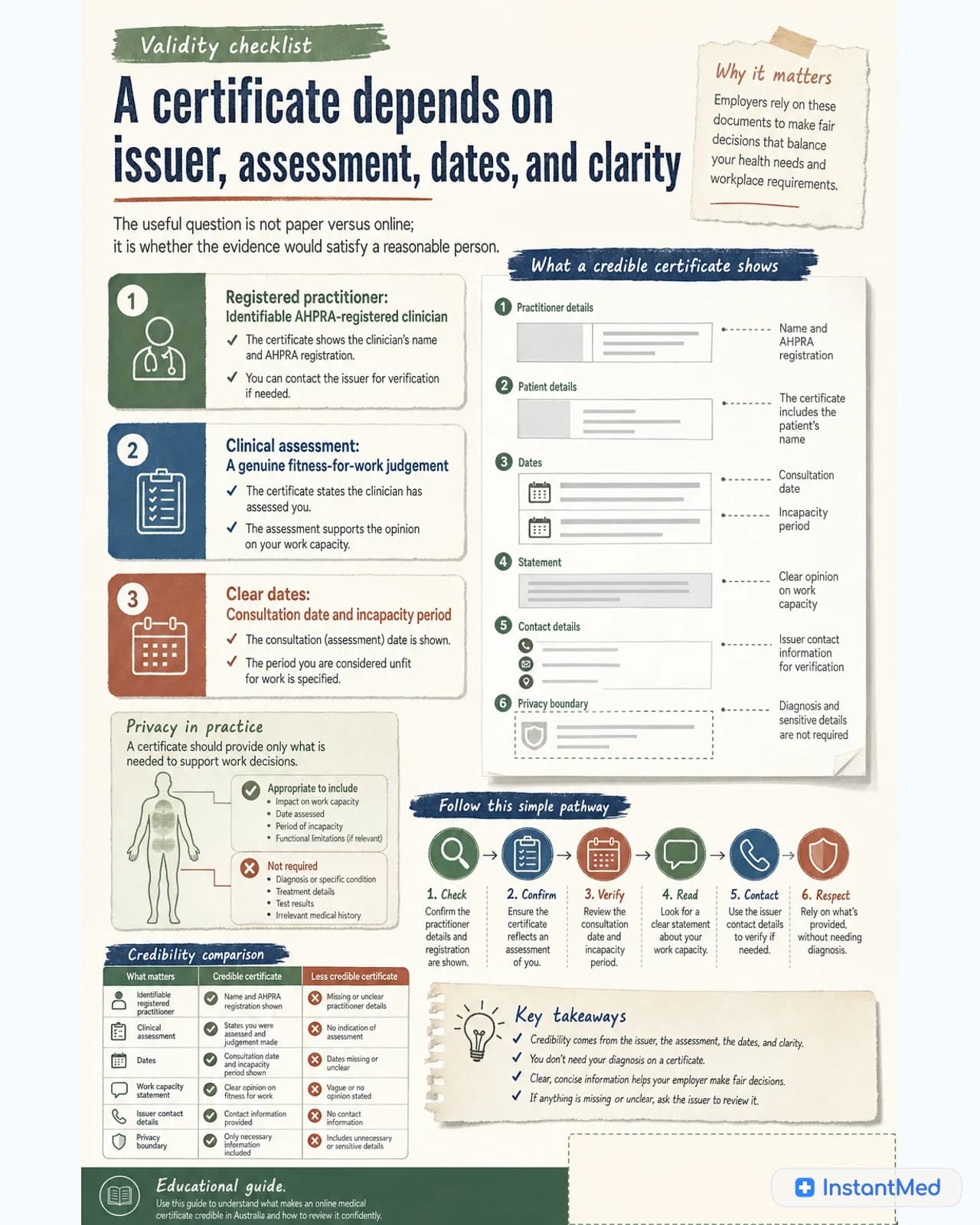
Online medical certificates from AHPRA-registered practitioners can be valid evidence in Australia when they follow a genuine assessment and contain clear details. This guide explains the Fair Work standard and common employer questions.
InstantMed Medical Team
13 min read
Doctor's Note for Work Australia: What Counts?
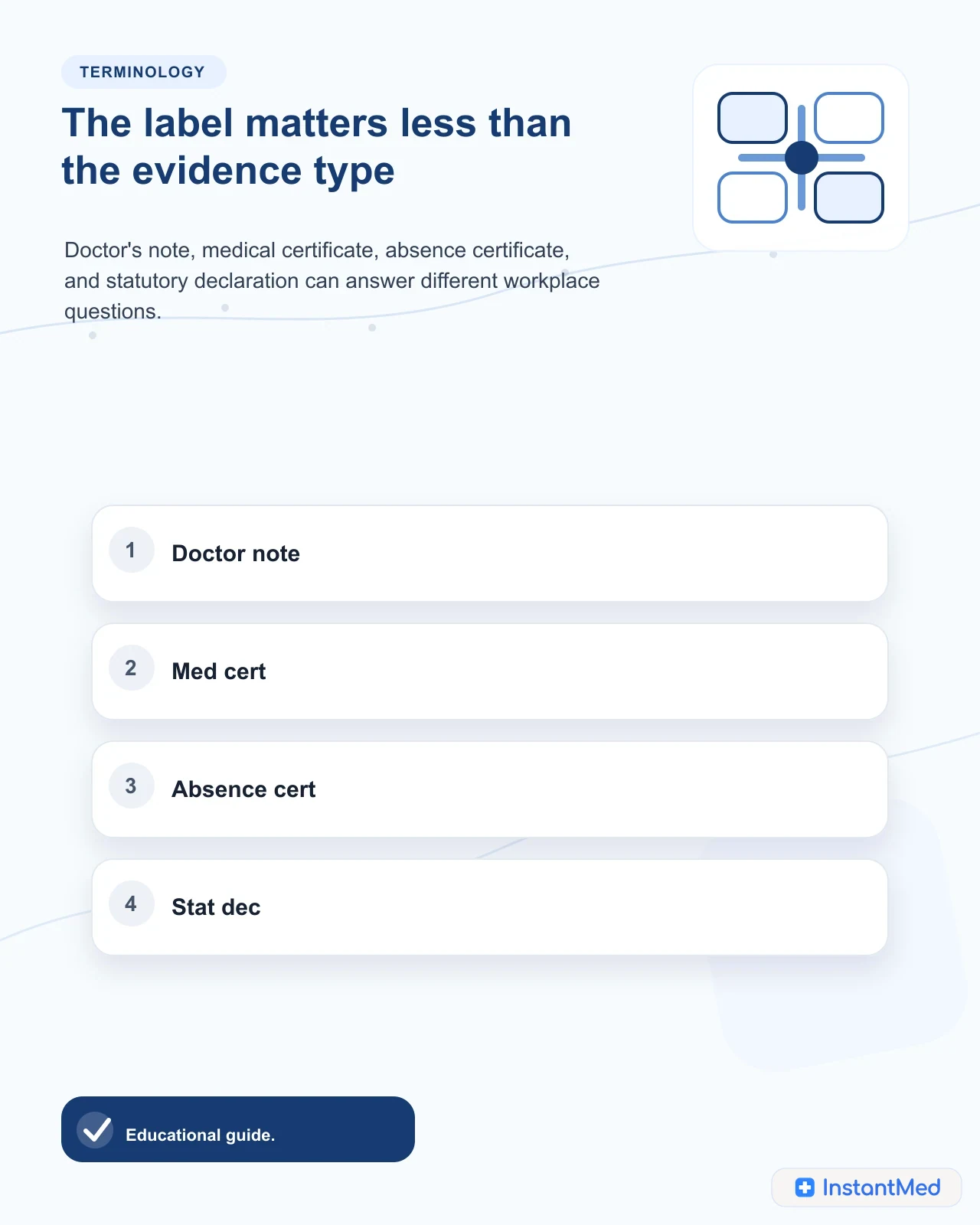
A doctor's note for work in Australia usually means a medical certificate, but sick notes, absence-from-work certificates, and statutory declarations can also matter. Learn what counts as evidence, what a strong certificate includes, and when a workplace may ask questions.
InstantMed Medical Team
10 min read
How Long Can a Medical Certificate Cover?
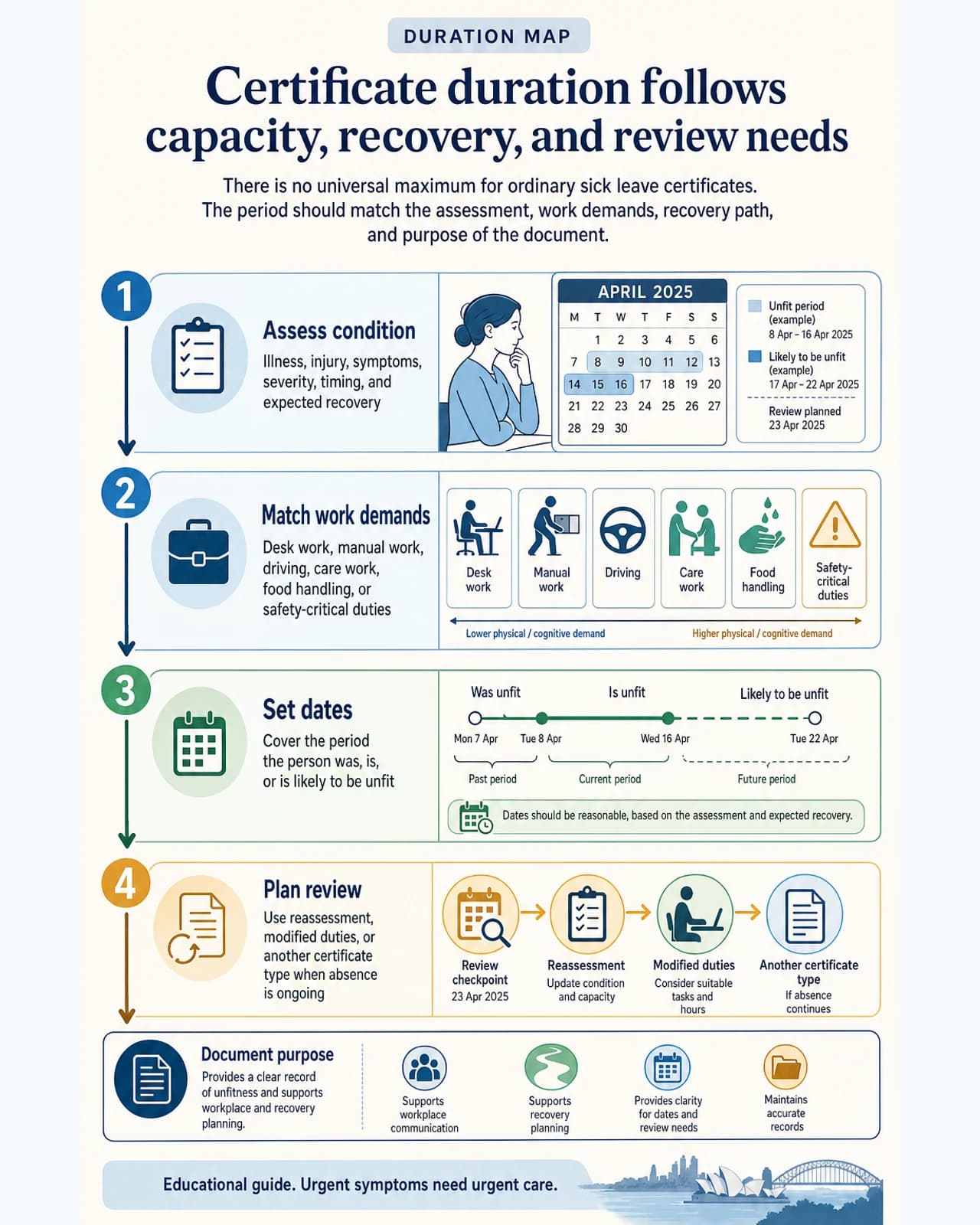
Medical certificate duration depends on clinical judgment, work capacity, workplace evidence rules, and the purpose of the certificate. Learn what can be covered, what cannot be assumed, and when a different certificate type is needed.
InstantMed Medical Team