Loading article
Back to Health Guides
Working From Home When Sick: Should You?
A practical Australian guide to deciding whether to work, modify duties, take personal leave, or seek care when illness meets remote work.
12 min read
·Updated 8 July 2026
·Doctor Reviewed
AHPRA Verified
In this article
- 1Start with capacity, not location
- 2Working lightly is different from taking sick leave
- 3Evidence rules do not disappear at home
- 4Mental health days are still sick days when you are unfit
- 5Role demands matter
Medical information only. This article is for general information and does not constitute medical advice. Treatment decisions are made by an AHPRA-registered doctor after reviewing your circumstances.
Review
InstantMed Clinical Team
Clinical governance review for guide content
Updated
8 July 2026
General information only, not personal medical advice.
Jump to section
1Start with capacity, not location2Working lightly is different from taking sick leave3Evidence rules do not disappear at home4Mental health days are still sick days when you are unfit5Role demands matter6WHS still applies to remote work7When to stop work and seek care8How to tell your manager9Returning after a sick WFH day10Choose the right route11Common mistakes to avoid12Related guides13Sources Used In This Guide
Working from home can blur a simple health boundary. You are at home, your laptop is nearby, and the day may not involve a commute. That does not mean you are fit for work.
The practical answer is: if illness or injury means you cannot do your work safely and effectively, take personal leave or agree a modified arrangement. If symptoms are serious or worsening, stop work and seek care.
Start with capacity, not location
The first question is not "can I sit near my laptop?" It is "can I perform my actual duties safely, accurately, and sustainably today?"
Remote work removes travel, exposure to colleagues, and some physical demands. It does not remove fever, pain, dehydration, medication side effects, brain fog, poor sleep, nausea, dizziness, anxiety, low mood, or the cognitive load of meetings and decisions.
| Situation | Better route | Why |
|---|---|---|
| Mild symptoms, clear thinking, low-stakes tasks | Modified work may fit | You may be able to reduce meetings, avoid deadlines, and rest between tasks |
| Fever, significant fatigue, vomiting, dizziness, severe pain, or poor concentration | Personal leave usually fits better | Work quality and recovery can be affected, even from home |
| Sedating medicine, safety-critical duties, complex decisions, client-facing calls, or regulated work | Personal leave or formal modification | Role risk matters as much as symptom severity |
| Symptoms are serious, sudden, or worsening | Urgent or emergency care | Health route comes before work route |
Working lightly is different from taking sick leave
There are three different states that often get mixed together in remote work:
| State | What it means | What to clarify |
|---|---|---|
| Normal work | You are fit for your usual duties | Normal availability and performance expectations apply |
| Modified work | You are somewhat unwell but can safely do reduced duties | Hours, meetings, deliverables, response times, and when you will reassess |
| Personal leave | You are not fit for work | You are on leave and should not be treated as generally available |
Modified work can be reasonable for a mild cold, a recovery day after a short illness, or a situation where reduced workload is genuinely safe. It becomes a problem when it is really sick leave in disguise: you are too unwell to work, but remote access creates pressure to keep responding.
If you are choosing modified work, make it explicit. For example: "I am unwell but can do two low-priority admin tasks this morning and will cancel calls. I will reassess after lunch." That is clearer than silently appearing online while not really functioning.
Evidence rules do not disappear at home
Working from home does not remove notice or evidence obligations. If you take sick or carer's leave, you still need to notify your employer as soon as possible and say how long you expect to be off if you can.
| Question | Practical answer |
|---|---|
| Can evidence be requested for one WFH sick day? | Yes, if the request is reasonable and fits the workplace context |
| Does working from home remove the need for evidence? | No |
| Do you need to share a diagnosis? | Usually the evidence needs to support fitness for work, not disclose every clinical detail |
| Can awards or agreements set extra rules? | Yes, they may specify when evidence is needed and what type |
| What kinds of evidence are commonly recognised? | Fair Work lists medical certificates and statutory declarations as examples |
This guide is not employment-law advice. Check your award, enterprise agreement, contract, and workplace policy if there is a dispute or unusual requirement.
Mental health days are still sick days when you are unfit
Remote work can make mental health leave harder to protect because the workplace is already inside the home. It can feel possible to answer messages while anxious, distressed, burnt out, grieving, or unable to concentrate.
The same capacity question applies. If a mental health condition means you cannot perform your role safely and effectively, the fact that you are at home does not make the absence less real.
Useful questions include:
- Can I concentrate well enough for the tasks expected today?
- Would meetings, messages, or decision-making worsen the situation?
- Am I safe, supported, and able to communicate if needed?
- Is this a modified-work day, or do I need proper leave?
- Do I need urgent support rather than a work-capacity decision?
If there is immediate risk of harm to yourself or someone else, work decisions stop. Seek urgent crisis support or emergency care.
Role demands matter
Some roles can absorb a quiet, low-output day. Others cannot. A remote role can still involve clinical, legal, financial, operational, driving, machinery, child-care, customer, or safety-sensitive decisions.
| Work demand | Why it matters when sick |
|---|---|
| Complex judgment | Fever, fatigue, anxiety, poor sleep, or medication can affect decisions |
| External meetings | You may be unable to communicate clearly or sustain attention |
| Safety-sensitive tasks | Reduced alertness can create risk even away from the office |
| Regulated or high-stakes work | Errors can affect patients, clients, finances, legal rights, or operations |
| Confidential work | Illness, stress, or working from an improvised location can affect privacy controls |
| Team dependency | Colleagues need to know whether you are available, unavailable, or on reduced duties |
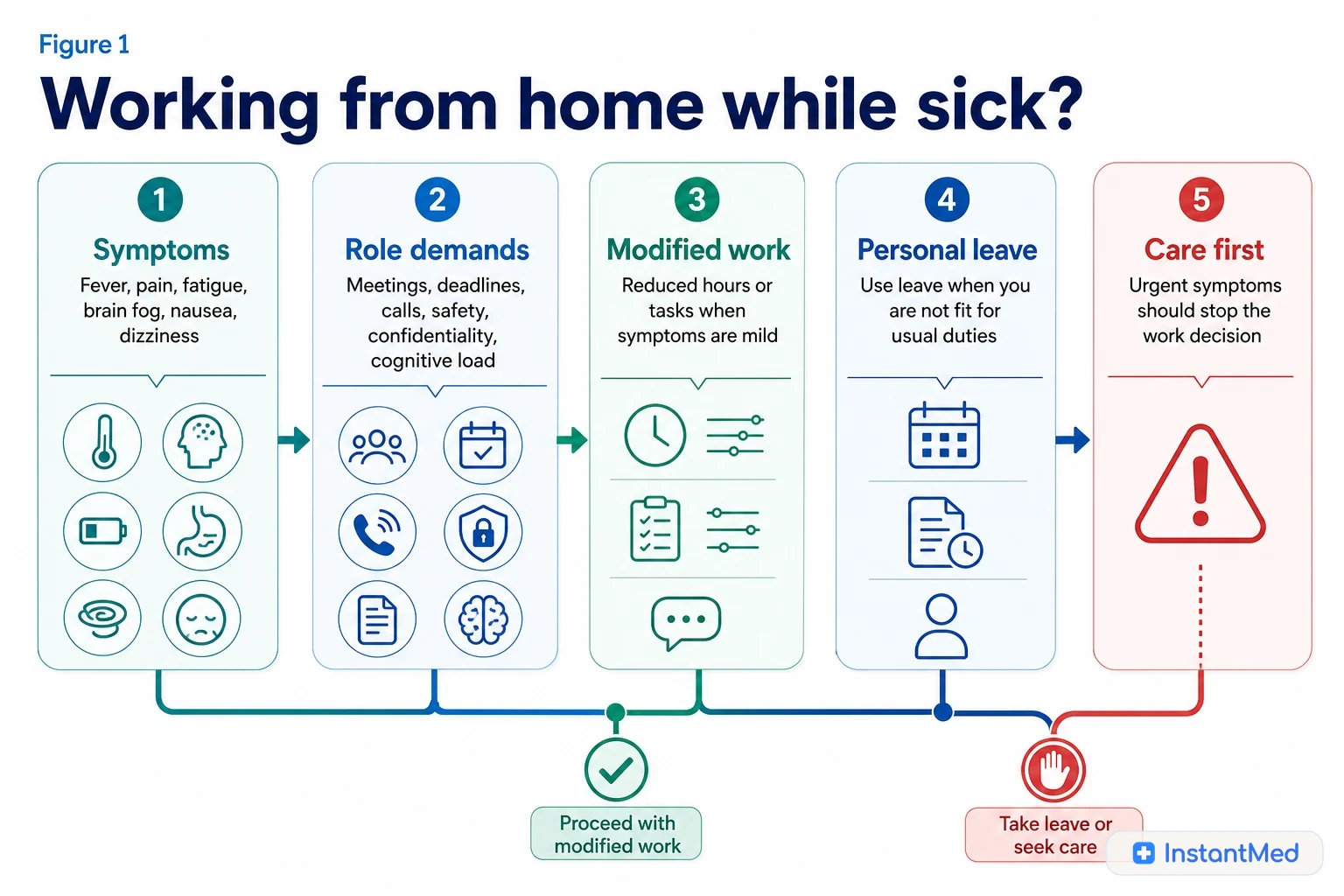
Figure 2
WFH changes the location. It does not remove notice, reasonable evidence, or the difference between modified work and personal leave.
The more your role relies on judgment, safety, confidentiality, or time-critical coordination, the lower the threshold for taking leave or formally modifying duties.
WHS still applies to remote work
Working from home is still work. Safe Work Australia says WHS laws apply when workers work from home just as they do in traditional workplaces, and business.gov.au says remote-work policies should cover incident reporting, safe home-office guidance, equipment, and mental health support.
That matters when illness affects your work environment. If you are dizzy, faint, vomiting, confused, exhausted, or in severe pain, a home office is not automatically safe. If you are trying to work from bed, a couch, a noisy shared space, or while caring for someone else, the issue may be both health and work-system safety.
Remote teams should make the status explicit:
| Status | What it should mean |
|---|---|
| Working normally | Usual duties and response expectations |
| Working modified | Reduced duties, reduced hours, fewer meetings, clear review point |
| On personal leave | Not working and not expected to respond |
| Seeking care | Health assessment comes first; work update can wait until safe |
When to stop work and seek care
Some symptoms should not be managed as a productivity question.
Stop work and seek urgent medical advice if symptoms are worsening, you cannot keep fluids down, you are dizzy on standing, confused, short of breath, in severe pain, or unable to function safely.
Emergency signals can include:
- chest pain or chest tightness
- severe breathing difficulty
- collapse, fainting, seizure, or new confusion
- possible stroke signs
- severe allergic reaction
- uncontrolled bleeding, major injury, poisoning, or overdose
- severe dehydration or inability to keep fluids down
- immediate self-harm risk or risk of harm to someone else
How to tell your manager
Keep the message short. You usually do not need to justify why being at home does not change your illness.
| Situation | Example wording |
|---|---|
| Taking personal leave | "I am unwell and not fit for work today. I will be taking personal leave and will update you if I expect to be away longer." |
| Modified work | "I am mildly unwell. I can handle low-priority written work this morning, but I need to cancel calls and reassess after lunch." |
| Seeking care | "My symptoms have worsened and I need medical advice. I will update when safe." |
| Evidence requested | "I will provide reasonable evidence in line with the policy/award requirements." |
Avoid offering to "just keep an eye on things" if you are taking leave. That creates ambiguity and can turn a sick day into an unpaid availability expectation.
Returning after a sick WFH day
When you return, close the loop in a way that protects both health and work.
Useful steps:
- 1
Confirm whether you are back to normal duties or still modified.
- 2
Move missed meetings or decisions rather than trying to compress everything into the first hour.
- 3
Share only the health detail needed for work planning.
- 4
Follow any medical advice about rest, infection control, medication side effects, or follow-up care.
- 5
If symptoms recur or worsen, reassess instead of pushing through because you are already home.
If the issue becomes prolonged or recurrent, involve your usual GP, workplace process, HR, or an appropriate workplace adviser. A one-day illness decision is different from an ongoing capacity, disability, workers compensation, or flexible-work arrangement.
Choose the right route
Decision guide
Work, modify, rest, or seek care
May fit telehealth
- Symptoms are mild, concentration is intact, duties are low risk, and reduced hours or remote tasks are clearly agreed.
- A remote clinician may also help when you need advice about whether symptoms can be managed at home or require another route.
Needs in-person care
- You are not fit for usual duties, symptoms affect concentration or safety, or a clinician has advised you not to work.
- Examination, observations, tests, or workplace-specific capacity assessment may be needed before returning to normal duties.
Urgent care
- Symptoms are serious, worsening, hard to assess, or include breathing trouble, chest pain, collapse, confusion, dehydration, severe pain, or immediate safety concerns.
- Use urgent or emergency care when symptoms require it.
Figure 3
Serious or worsening symptoms need care first. Remote work should not delay urgent assessment.
Common mistakes to avoid
- 1
Treating WFH as a reason to work through genuine illness.
- 2
Taking sick leave while still responding all day.
- 3
Agreeing to modified work without naming the reduced duties or review point.
- 4
Sharing unnecessary diagnosis details when a fitness-for-work statement is enough.
- 5
Ignoring medication side effects, poor sleep, fever, or brain fog because the tasks are "just online."
- 6
Waiting for routine work communication when urgent symptoms need care.
Related guides
- Telehealth for remote workers
- Work-from-home sick certificates
- Sick leave rights in Australia
- Mental health certificates for work
Sources Used In This Guide
- Fair Work Ombudsman: Sick and carer's leave
- Fair Work Ombudsman: Notice and medical certificates
- Fair Work Ombudsman: Flexible working arrangements
- Safe Work Australia: Working from home WHS guidance
- business.gov.au: Work health and safety
- Healthdirect: Flu symptoms and when to seek care
Frequently Asked Questions
Can I take sick leave if I work from home?
Yes. Fair Work says full-time and part-time employees can take paid sick leave when they cannot work because of personal illness or injury. The entitlement is about fitness for work, not whether the workplace is an office or home.
Does my employer need evidence for one WFH sick day?
They can ask for reasonable evidence even for as little as one day or less off work. Awards, agreements, contracts, or workplace policy may set evidence expectations, but the request still needs to be reasonable in the circumstances.
Should I do a few tasks if I am on sick leave?
Usually no. If you have taken personal leave because you are not fit for work, treat it as leave. A separate arrangement for modified work should be clear, agreed, and safe for your symptoms and duties.
Can I work lightly from home instead of taking leave?
Sometimes. Light or modified work may make sense when symptoms are mild, duties are low risk, concentration is intact, and your manager agrees to the reduced scope. It is different from taking sick leave.
Are mental health days different when I work remotely?
No. If a mental health condition means you are not fit for work, the location of your laptop does not make the absence less real. Mental health leave should be treated as personal leave when the legal and workplace requirements are met.
When should I stop working and seek medical care?
Stop work and seek urgent care for serious or worsening symptoms such as trouble breathing, chest pain, collapse, confusion, dehydration, severe pain, or immediate self-harm risk. Call triple zero (000) for serious and urgent symptoms.
InstantMed Medical Team
Related Articles
12 min read
Telehealth for Remote Workers
A practical Australian guide to telehealth for remote, hybrid, regional, FIFO, and work-from-home workers: sick leave evidence, location checks, role demands, eScripts, workplace safety, and when online care is not enough.
InstantMed Medical Team
11 min read
Medical Certificate Says Unfit for Work: Can You WFH?
If a medical certificate says you are unfit for work, working from home is still work. Learn when WFH, modified duties, sick leave, and evidence rules differ.
InstantMed Medical Team
9 min read
Sick Leave Rights in Australia: What You Are Entitled To
Full-time employees accrue 10 days of paid personal leave per year under the NES. It rolls over, covers mental health, and your employer cannot demand your diagnosis. Here is exactly what the law says.
InstantMed Medical Team