Loading article
Back to Health Guides
Medical Certificate Says Unfit for Work: Can You WFH?
The practical Australian distinction between working from home, modified work, sick leave evidence, and an unfit-for-work certificate.
11 min read
·Updated 5 July 2026
·Doctor Reviewed
AHPRA Verified
In this article
- 1The practical rule: working is not leave
- 2What Fair Work says about sick leave evidence
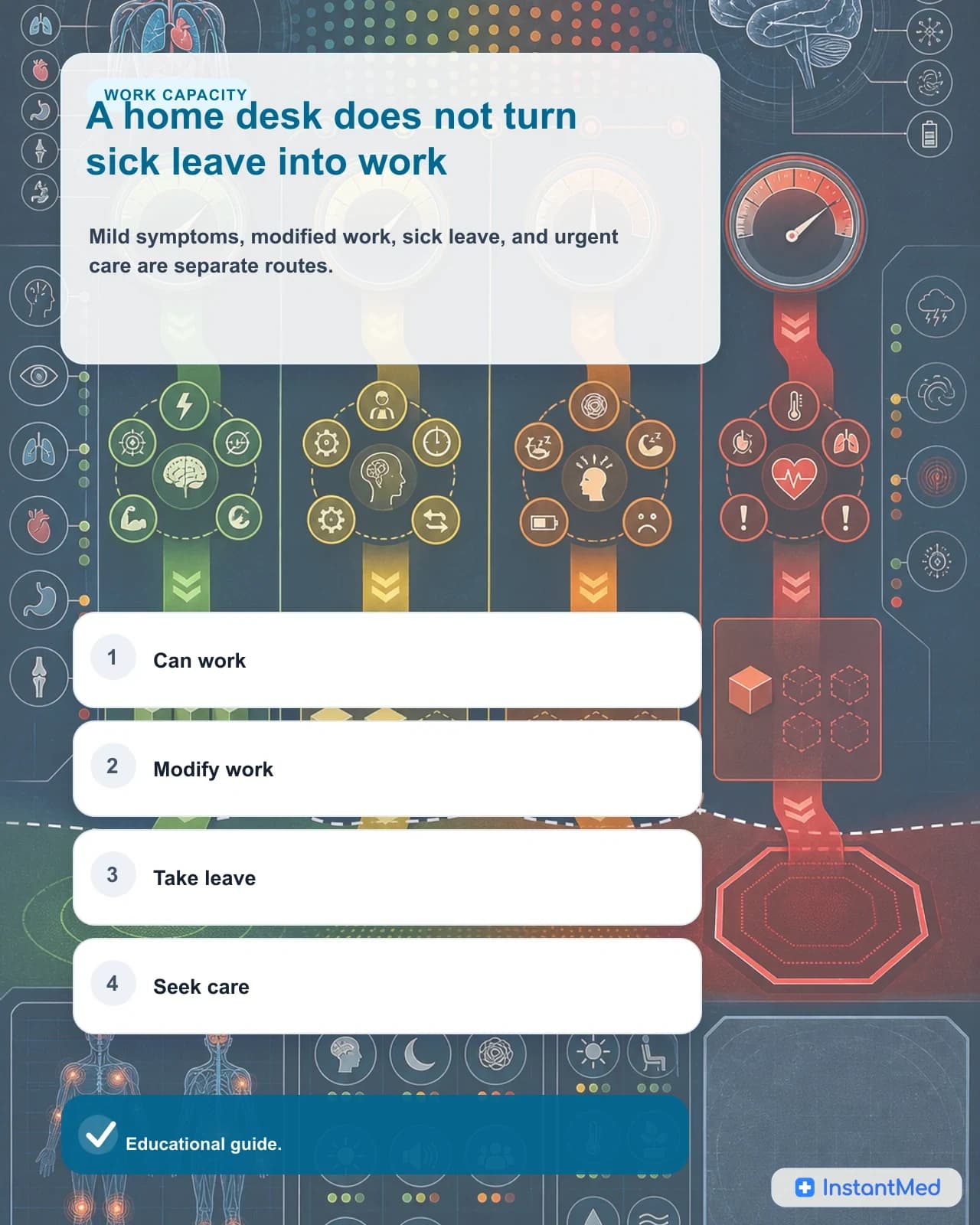
- 3WFH, modified work, and sick leave are different choices
- 4When a certificate may be needed
- 5What an employer can ask for
Medical information only. This article is for general information and does not constitute medical advice. Treatment decisions are made by an AHPRA-registered doctor after reviewing your circumstances.
Review
InstantMed Clinical Team
Clinical governance review for guide content
Updated
5 July 2026
General information only, not personal medical advice.
Jump to section
1The practical rule: working is not leave2What Fair Work says about sick leave evidence3WFH, modified work, and sick leave are different choices4When a certificate may be needed5What an employer can ask for6How telehealth evidence fits7When not to work from home while sick8How to message your manager clearly9What to prepare if you need evidence10Related guides11Sources
If you are sick but still working from home, you usually do not need a medical certificate for that day. You are working, not taking sick leave.
A certificate becomes relevant when you stop working and take paid sick leave, personal leave, or carer's leave, and your employer asks for reasonable evidence or your workplace rules require it. If a medical certificate says you are unfit for work, working from home is still work and may need a separate agreement about modified duties. The key question is not whether your laptop is at home. The key question is whether you were fit to work.
The practical rule: working is not leave
Remote work makes the boundary feel blurry, but the workplace category is still simple.
If you are answering messages, attending meetings, completing tasks, and being paid for ordinary work time, you are working. You may be unwell, and your employer may have agreed that home is the safer or more practical place to work that day, but it is not sick leave.
If you are too unwell to perform your duties, you are not working. That is when paid sick leave, unpaid sick leave, or another leave type may become relevant.
That distinction matters because a medical certificate usually supports an absence from work. It does not exist to prove that you had a mild cold while still completing your ordinary duties.
What Fair Work says about sick leave evidence
Fair Work describes paid sick leave as leave an employee can take when they cannot work because of a personal illness or injury. Full-time and part-time employees are entitled to paid sick and carer's leave under the National Employment Standards. For full-time employees, the yearly entitlement is 10 days, with pro rata entitlement for part-time employees. Casual employees do not get paid sick leave under the National Employment Standards.
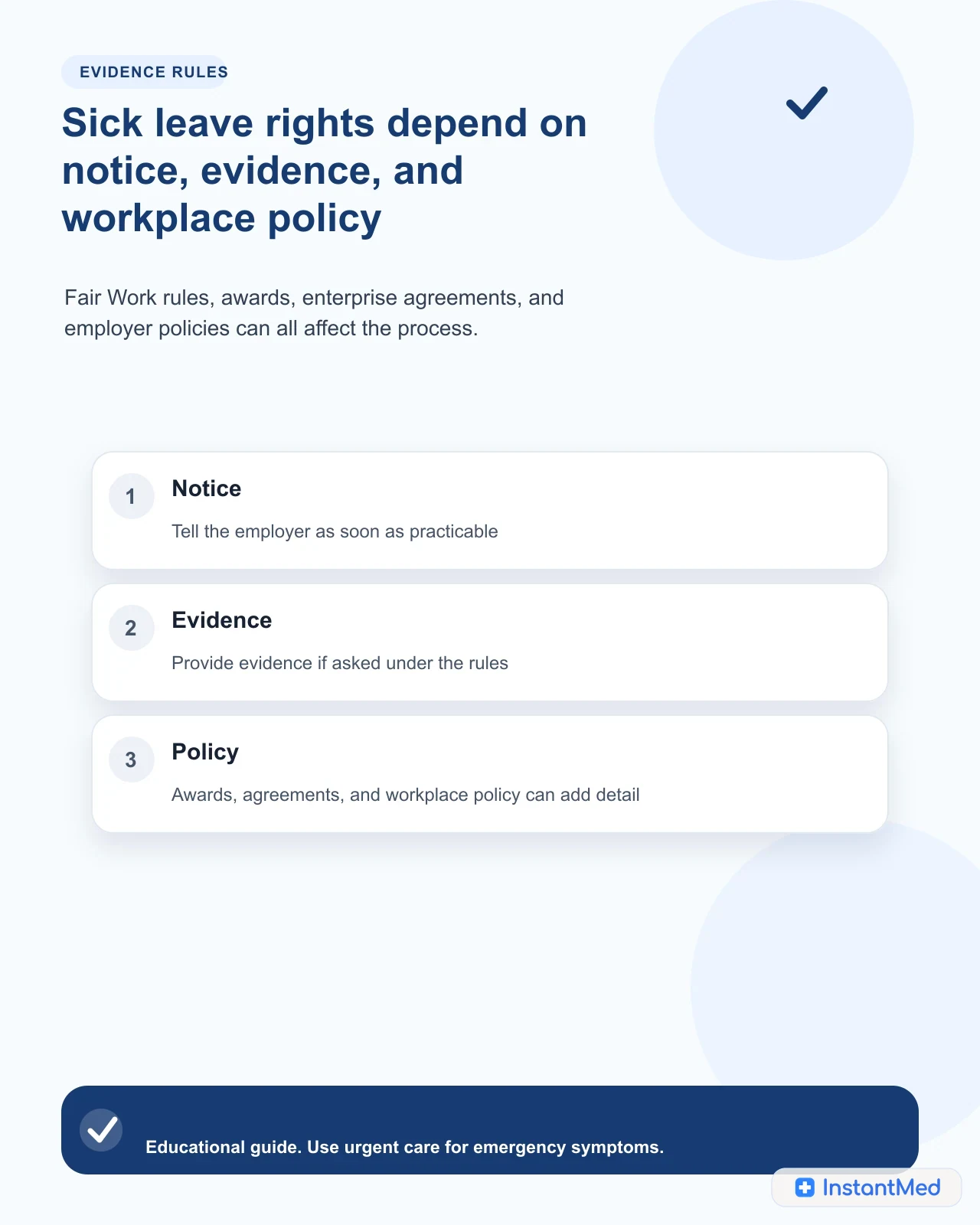
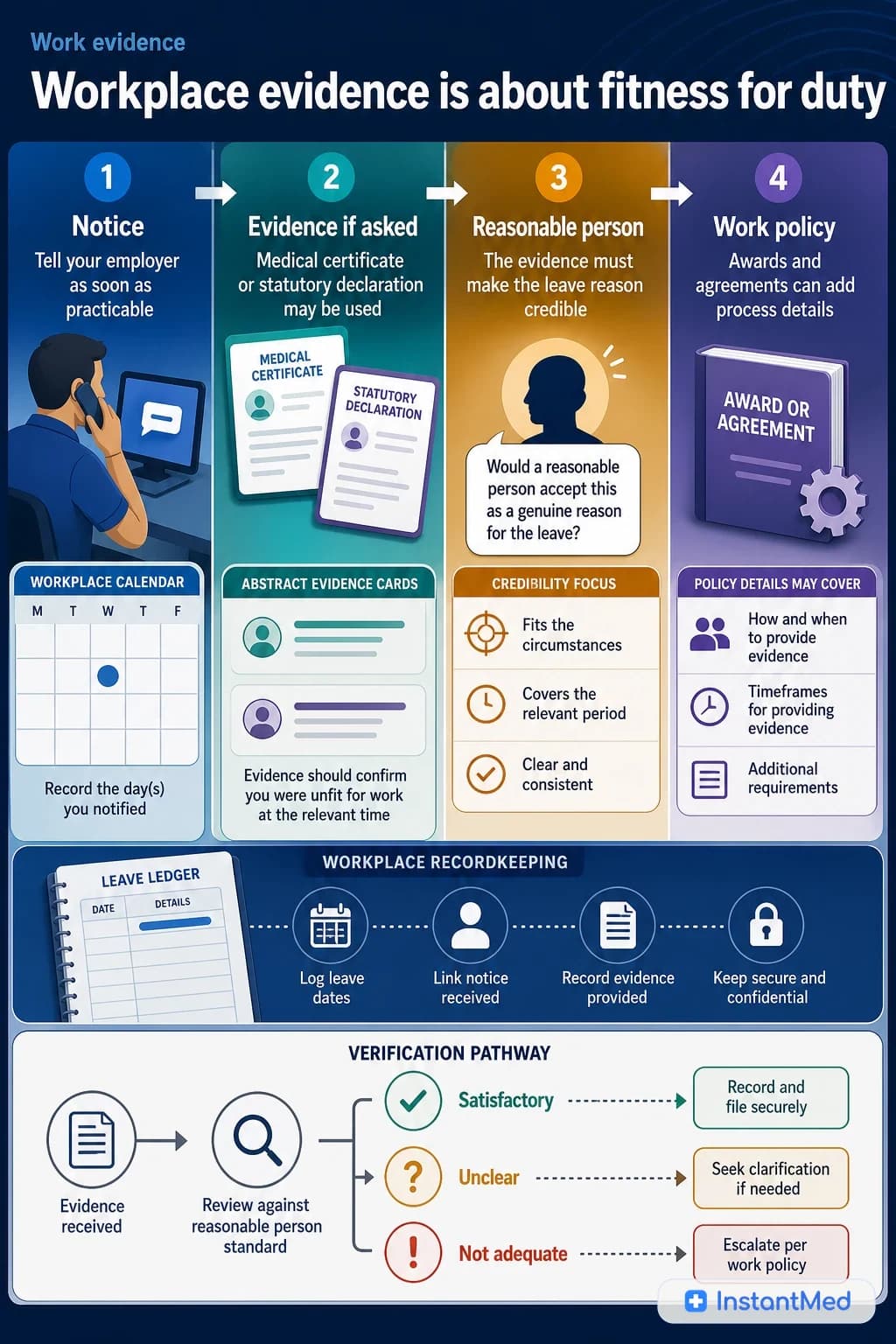
Fair Work also says an employee may need to give notice and evidence to get paid for sick or carer's leave. Evidence is not limited to long absences. An employer can ask for evidence for even one day or less, as long as the type of evidence requested is reasonable in the circumstances.
For most workers, the practical workflow is:
- 1
Tell your employer as soon as practicable that you are unwell.
- 2
Be clear whether you are working, working modified duties, or taking leave.
- 3
Check your workplace evidence rule if you are taking leave.
- 4
Provide reasonable evidence if asked or required.
- 5
Seek care first if the illness is clinically concerning.
WFH, modified work, and sick leave are different choices
The cleanest way to avoid disputes is to name the category you are using.
| Situation | What it usually means | Certificate question |
|---|---|---|
| Working from home while mildly unwell | You can still perform your normal duties, and home avoids spreading illness or commuting while sick | Usually not needed because you are not taking leave |
| Modified WFH | You can do some work, but hours, meetings, tasks, or intensity need changing | May need manager agreement. Certificate may help if reduced capacity needs documenting |
| Sick leave for the day | You are not fit to work that day | Evidence may be requested under Fair Work, award, agreement, contract, or workplace policy |
| Part-day sick leave | You worked for part of the day, then stopped because illness worsened | Evidence depends on the policy and whether the employer asks |
| Urgent or in-person care | Symptoms are severe, unclear, worsening, or need examination | Medical care comes first. Workplace evidence can wait |
Do not call a day "WFH" if you are actually in bed, unable to focus, missing meetings, and not completing work. That creates confusion for you and your manager. If you cannot work, call it sick leave.
When a certificate may be needed
There is no universal Australian rule that says every worker needs a certificate after exactly two days. Many workplaces use a two-day threshold, but Fair Work's evidence rule is broader than that.
You may need a certificate or other evidence when:
- your employer asks for evidence
- your award or enterprise agreement requires evidence
- your contract or workplace policy requires evidence
- the absence falls around a public holiday, rostered day, key shift, or repeated pattern and your workplace policy asks for evidence
- the absence is safety-sensitive, operationally high impact, or linked to return-to-work planning
- you need documentation for part-day incapacity, modified duties, or a staged return
A statutory declaration can also be evidence in some circumstances. Whether it is enough depends on the rule that applies to your workplace and whether it would satisfy a reasonable person that you were entitled to the leave.
If you are unsure, ask HR or your manager for the exact policy wording. The useful question is: "What evidence do you require for this absence, and by when?"
What an employer can ask for
An employer can ask for notice and reasonable evidence. They can also ask practical questions such as when you expect to return, whether work needs to be handed over, and whether any urgent deadlines need coverage.
They should not need a detailed diagnosis for ordinary sick leave. Some roles are different. Healthcare, transport, childcare, food handling, heavy machinery, emergency services, and other safety-sensitive work can have stricter return-to-work or infection-control requirements.
Evidence pathway
Notice, policy, reasonable evidence, and workplace review sit after the worker decides they are not fit for work.
| Employer request | Usually reasonable | Watch the boundary |
|---|---|---|
| "Are you working or taking sick leave?" | Yes, this clarifies pay and availability | Answer plainly. Do not promise WFH if you are not fit |
| "Please provide evidence for the absence" | Yes, Fair Work allows evidence requests | Ask what evidence type and deadline the policy requires |
| "How long do you expect to be away?" | Often reasonable for planning | You can give an estimate without sharing diagnosis details |
| "What is your diagnosis?" | Often unnecessary for ordinary sick leave | More detail may be relevant only in specific safety or return-to-work contexts |
| "Can you do reduced duties from home?" | Sometimes reasonable to discuss | It still needs your agreement and real capacity to work |
If pressure continues after you have clearly said you are not fit to work, keep the communications in writing and seek workplace advice. Fair Work, a union, a community legal service, or an employment lawyer may be appropriate depending on the seriousness. This guide is general information, not legal advice.
How telehealth evidence fits
Telehealth can be suitable for some short illness documentation, especially when the question is whether symptoms and work impact make ordinary duties unreasonable for a defined period.
The doctor still needs enough information to make a clinical judgment. That includes what symptoms started, how severe they are, how they affect your role, what dates are involved, and whether any red flags suggest you need in-person assessment.
Medical Board guidance says telehealth should meet the same standard of care as in-person care as far as possible. It also says telehealth is not appropriate for every consultation and that doctors should arrange in-person care when needed.
Telehealth is weaker if you need a physical examination, observations, wound care, a chest examination, neurological assessment, dehydration assessment, or urgent treatment. In those situations, the safer answer may be in-person care rather than remote paperwork.
When not to work from home while sick
WFH is useful when the problem is the commute, office exposure, or mild symptoms that do not stop you doing the job. It is not useful when work itself will delay recovery, create safety risk, or hide a condition that needs care.
Decision guide
Where a sick WFH day fits
May fit telehealth
- Mild symptoms, stable condition, and you can still perform your ordinary duties.
- You need short evidence for a simple absence and have no urgent symptoms.
- The doctor can assess the work impact safely from your history.
Needs in-person care
- You need examination, observations, testing, wound care, or a return-to-work assessment.
- Symptoms are unclear, worsening, recurrent, or affecting safety-critical duties.
- Your workplace requires specific clearance beyond ordinary sick leave evidence.
Urgent care
- Chest pain, trouble breathing, fainting, confusion, blue lips, severe weakness, or rapid deterioration.
- Severe dehydration, severe pain, possible sepsis, or a mental health crisis.
- Call 000 for emergency symptoms.
Trying to work through a serious illness can create two problems at once. You may not recover properly, and your employer may assume you were available because you said you were working.
How to message your manager clearly
Most disputes start with vague language. The fix is to make your status explicit.
Use wording like:
Stop work
Chest pain, breathing trouble, fainting, confusion, dehydration, and rapid worsening should redirect to care.
- "I am unwell but able to work. I will work from home today and attend the scheduled meetings."
- "I am unwell and not fit to work today. I am taking sick leave and will provide evidence if required."
- "I can work from home for the morning, but I may need to switch to sick leave if symptoms worsen."
- "I am too unwell for meetings or focused work. I will take sick leave today and update you tomorrow."
- "I can do low-intensity admin work for two hours, but I cannot safely do client calls today. Please let me know whether modified duties are useful or whether you prefer I take sick leave."
Avoid wording like "I will try to work from home" if you already know you cannot work. It sounds helpful, but it leaves everyone guessing whether you are available, paid as working, or on leave.
What to prepare if you need evidence
If you need a medical certificate or other evidence, prepare the facts the clinician or workplace actually needs:
- 1
Date symptoms started.
- 2
Main symptoms and how they affect work.
- 3
Whether you can work at all, work modified duties, or need complete rest.
- 4
Dates or part-days you need covered.
- 5
Any safety-sensitive duties, driving, machinery, food handling, childcare, healthcare, or infection-risk duties.
- 6
Any urgent symptoms such as chest pain, breathing trouble, fainting, confusion, severe dehydration, severe pain, or rapid worsening.
- 7
Your workplace evidence deadline if you know it.
The more precise the work impact, the cleaner the evidence. "I have fever, dizziness, and cannot safely drive or concentrate for meetings today" is more useful than "I feel awful."
Related guides
- Sick leave rights in Australia
- Medical certificates for work
- Can an employer reject a medical certificate?
- Carer's leave medical certificates
- Working from home when sick
Sources
- Fair Work Ombudsman: Sick and carer's leave
- Fair Work Ombudsman: Paid sick and carer's leave
- Fair Work Ombudsman: Notice and medical certificates
- Fair Work Ombudsman: Flexible working arrangements
- Medical Board of Australia: Telehealth consultations with patients
- Healthdirect: COVID-19 symptoms and urgent care
- Healthdirect: Sepsis
Frequently Asked Questions
Do I need a medical certificate if I work from home while sick?
Usually no, because you are still working rather than taking leave. A certificate becomes relevant when you take sick leave or personal/carer's leave and your employer asks for reasonable evidence, or when your award, agreement, contract, or workplace policy requires evidence.
Can my employer ask for a certificate for one day of sick leave?
Yes. Fair Work says an employer can ask for evidence that would satisfy a reasonable person that the employee was entitled to sick or carer's leave, including for short absences. The evidence request still needs to be reasonable in the circumstances.
Can my employer make me work from home instead of taking sick leave?
If you are not fit to work because of illness or injury, WFH is not a substitute for sick leave. Your employer can discuss whether modified duties or remote work are practical, but sick leave is about capacity to work, not whether you can avoid the commute.
Can I take sick leave for part of a WFH day?
Yes. If you start working from home and become too unwell to continue, you can stop work and take personal leave for the relevant period if you are entitled to it. Evidence rules depend on your workplace policy, award, agreement, or employer request.
Does a certificate need to say my diagnosis?
Usually no. Workplace evidence commonly focuses on whether you were unfit for work and the relevant dates. Some safety-sensitive roles, return-to-work processes, or workplace policies may ask for more detail, but diagnosis information is private health information and should not be included unless genuinely needed.
Is a telehealth certificate different from an in-person certificate?
The channel is different, but the doctor still needs to make a proper assessment. Medical Board guidance says telehealth should meet the same standard of care as in-person care where possible, and the doctor should arrange in-person care if remote assessment is not appropriate.
When should I stop trying to work and seek care?
Stop work and seek urgent care for symptoms such as chest pain, breathing trouble, fainting, confusion, severe weakness, blue lips, severe dehydration, or rapid deterioration. Call 000 for emergency symptoms.
InstantMed Medical Team
Related Articles
9 min read
Sick Leave Rights in Australia: What You Are Entitled To
Full-time employees accrue 10 days of paid personal leave per year under the NES. It rolls over, covers mental health, and your employer cannot demand your diagnosis. Here is exactly what the law says.
InstantMed Medical Team
9 min read
Medical Certificates for Work: Complete Australian Guide
A work medical certificate is evidence that you were unfit for work, not a public explanation of your diagnosis. This Australian guide explains employer evidence rules, privacy, telehealth, stat decs, and return-to-work issues.
InstantMed Medical Team

9 min read
Can an Employer Reject a Medical Certificate in Australia?
An employer should not reject a credible medical certificate simply because it came from telehealth, but they can ask reasonable questions if evidence is incomplete or inconsistent. Learn the practical boundaries.
InstantMed Medical Team