Loading article
Back to Health Guides
Telehealth for Remote Workers
How to prepare when your workplace, GP, pharmacy, or urgent-care backup is not nearby.
12 min read
·Updated 7 July 2026
·Doctor Reviewed
AHPRA Verified
In this article
- 1Remote work does not change the basic leave question
- 2What a clinician needs to know
- 3Location, privacy, and technology still matter
- 4Regional, FIFO, DIDO, and travelling workers
- 5eScripts and pharmacy handoff
Medical information only. This article is for general information and does not constitute medical advice. Treatment decisions are made by an AHPRA-registered doctor after reviewing your circumstances.
Review
InstantMed Clinical Team
Clinical governance review for guide content
Updated
7 July 2026
General information only, not personal medical advice.
Jump to section
1Remote work does not change the basic leave question2What a clinician needs to know3Location, privacy, and technology still matter4Regional, FIFO, DIDO, and travelling workers5eScripts and pharmacy handoff6Workplace safety and home-office injury boundaries7When telehealth may fit, and when it should not wait8After the consultation9Common mistakes to avoid10FAQ11Sources Used In This Guide
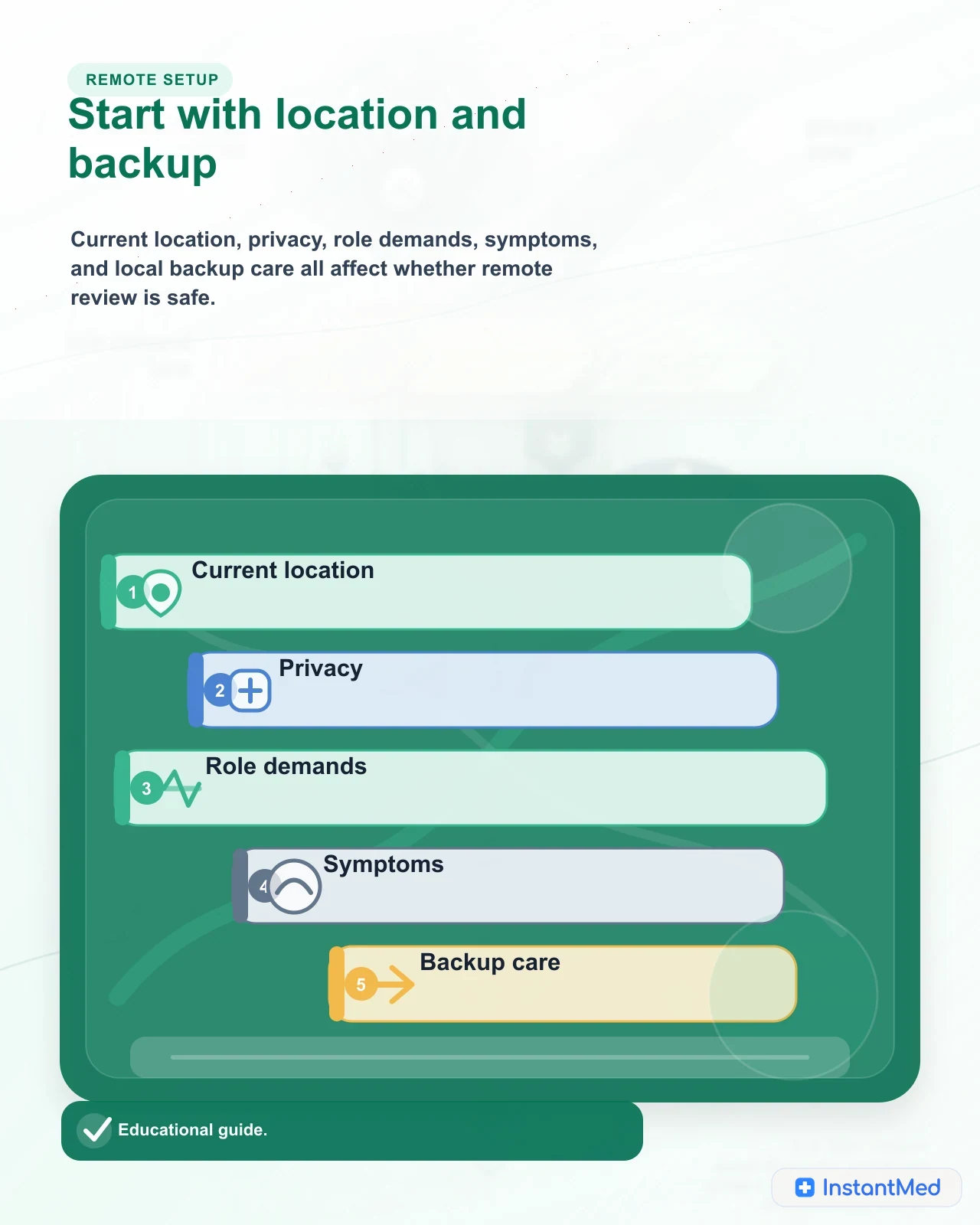
Remote workers can often use telehealth, but the safest consultation is not just "a video call from home". The doctor still needs to know where you are, what changed, what your job requires, whether you can be assessed remotely, how follow-up or pharmacy access will work, and what you would do if symptoms need urgent or in-person care.
The practical answer is simple: remote work may remove the commute to a clinic, but it does not remove clinical suitability, privacy, sick-leave evidence rules, workplace safety duties, or urgent-care boundaries.
Remote work does not change the basic leave question
Working from home changes the setting, not the underlying question. If you are too unwell or injured to work safely or reasonably, sick leave may still be relevant. If you can do modified work safely, your employer's policy, award, agreement, and the practical realities of your role may matter.
Fair Work describes paid sick leave as leave employees can take when they cannot work because of personal illness or injury. Full-time employees have 10 days per year, and part-time employees receive a pro-rata amount. Employees may need to give notice and evidence if requested.
| Situation | What to clarify | Why it matters |
|---|---|---|
| Work from home but unwell | What symptoms stop you working safely or reasonably | Remote access to a laptop does not prove fitness for work |
| Hybrid worker | Whether office, home, travel, or site duties are affected | Duties may differ by location |
| Safety-sensitive role | Driving, equipment, supervision, fatigue, medication effects, or decision risk | Some remote tasks still carry safety consequences |
| Carer or household illness | Whether you are unwell yourself or caring for someone else | Sick leave and carer's leave have different factual bases |
| Employer asks for evidence | What evidence was requested, by when, and under which policy | The doctor can document clinical fitness, not decide every workplace dispute |
What a clinician needs to know
For a remote worker, "I am sick and I work from home" is not enough clinical context. A better telehealth history links symptoms to work capacity and to the available care options where you are.
Prepare:
- your current location and whether you can access urgent care if needed
- your symptoms, when they started, and whether they are improving or worsening
- temperature, pain severity, hydration, breathing, rash photos, or other observations when relevant
- medicines, allergies, pregnancy or breastfeeding status where relevant, and important medical history
- what your job requires today: meetings, concentration, driving, physical duties, supervision, equipment, or travel
- what evidence or workplace form was requested
- your usual GP, nearby pharmacy, and whether follow-up or tests are practical from your location
| Work demand | Why it changes the assessment |
|---|---|
| Long screen time | Migraine, vertigo, eye symptoms, fever, fatigue, or medication sedation may make screen work unrealistic |
| Customer calls or meetings | Voice loss, vomiting, severe cough, pain, anxiety, or cognitive slowing may matter |
| Driving or site travel | Drowsy medicines, fainting, dizziness, pain, or infection risk may make travel unsafe |
| Manual or safety duties | Injury, weakness, fever, medication effects, or impaired concentration may create risk |
| Solo remote location | The threshold for in-person or urgent care may be lower if backup is limited |
Location, privacy, and technology still matter
The Medical Board says telehealth is not appropriate for all consultations, should not be treated as a routine substitute for in-person care, and should meet the same standards as in-person care as far as possible. It also expects reliable technology, privacy, a backup process if technology fails, and patient awareness of alternatives.
For remote workers, this means the consultation setup should cover more than internet speed.
| Setup item | Practical check |
|---|---|
| Current location | Are you at home, in another state, on site, in a camp, at a hotel, or travelling? |
| Privacy | Can others hear the consultation or see health information on screen? |
| Connection | Can you load forms, receive SMS or email, and answer a call if video fails? |
| Backup care | What is the nearest urgent care, emergency department, site medic, GP clinic, or pharmacy? |
| Documents | Where should certificates, summaries, referrals, or requests arrive? |
| Support person | Does someone need to help with technology, communication, transport, or collection? |
Regional, FIFO, DIDO, and travelling workers
Remote work is not one situation. A home-based software worker in Melbourne, a regional sole trader, a FIFO worker on site, a DIDO worker between towns, and a digital worker travelling interstate have different care constraints.
| Worker context | What to prepare |
|---|---|
| Home-based worker | Job demands, privacy, employer evidence request, pharmacy delivery or pickup plan |
| Regional worker | Nearest GP/pharmacy, travel distance, local urgent-care option, internet reliability |
| FIFO or DIDO worker | Site medic access, roster, return-to-town date, pharmacy access, phone backup |
| Travelling within Australia | Current location, where you can receive documents or tokens, what local care is available |
| Overseas worker | Australian telehealth may not be suitable or available; use local urgent care when needed |
Avoid the old mistake of describing telehealth as "works anywhere". The safer statement is that telehealth may help when you are in Australia and the clinician can assess you safely with the information, privacy, technology, and follow-up options available today.
eScripts and pharmacy handoff
Electronic prescriptions can help remote and regional workers, but the token handoff must be deliberate. Healthdirect explains that an eScript is sent by SMS or email as a link to a token. The token can be shown to a pharmacy, forwarded to a pharmacy, or forwarded to a trusted person to help collect medicine. The Australian Digital Health Agency also notes that tokens can be forwarded to a pharmacy for collection or delivery if the pharmacy offers that service.
Before the consultation ends, confirm:
Work evidence
A doctor still considers illness, role demands, evidence, safety duties, and whether review is needed.
- the correct phone number or email for the token
- whether you can access that phone or inbox where you are
- which pharmacy can dispense the medicine
- whether delivery, collection by a trusted person, or pickup after travel is realistic
- what to do if the SMS or email token is deleted or sent to the wrong place
- whether repeats, usual GP follow-up, monitoring, or tests are needed
An eScript token is a dispensing pathway after a prescription is issued. It does not mean every medicine is suitable for online prescribing, or that a doctor can safely prescribe without enough history, monitoring, identity, or follow-up information.
Workplace safety and home-office injury boundaries
Safe Work Australia says work health and safety laws apply when workers work from home just as they do in traditional workplaces. A person conducting a business or undertaking must ensure worker health and safety so far as reasonably practicable when working from home.
That does not mean a telehealth guide can decide workers compensation, employer liability, modified duties, or whether an incident is compensable. It does mean remote workers should document health concerns clearly and use the right care route when injury, pain, fatigue, mental strain, or unsafe work conditions are part of the problem.
| Issue | Telehealth may help with | May need another pathway |
|---|---|---|
| Minor illness affecting work | Fitness-for-work assessment, advice, evidence, self-care plan | Urgent care if red flags appear |
| Home-office strain | Initial symptom history and next-step advice | Physiotherapy, GP examination, workplace report, ergonomic review |
| Workplace injury | Document symptoms and decide whether urgent care is needed | Employer incident process, workers compensation insurer, state/territory regulator |
| Psychosocial risk | Discuss symptoms, capacity, safety concerns, and follow-up | Employer WHS process, usual GP, mental health plan, urgent crisis care |
| Safety-sensitive duties | Assess whether symptoms or medicines could impair work | Employer risk controls, modified duties, in-person assessment |
When telehealth may fit, and when it should not wait
The right care route depends on symptoms, risk, location, and what the doctor needs to assess.
Decision guide
Choose the safest care route as a remote worker
May fit telehealth
- The issue is non-urgent, you can describe symptoms clearly, and the doctor can assess work capacity or the health question from history, records, photos when appropriate, or video.
- You can receive follow-up, documents, or eScript tokens, and you have a pharmacy or usual GP plan if needed.
- You have privacy, a reliable connection or phone backup, and a clear current location.
Needs in-person care
- The problem needs physical examination, vital signs, wound care, injury assessment, neurological examination, pathology, imaging, or procedures.
- Symptoms are unclear, worsening, recurrent, related to a workplace injury, or not safely assessed from a form, phone call, photos, or video.
- Your location, privacy, communication, or follow-up access makes remote care unsafe today.
Urgent care
- Chest pain, severe breathing difficulty, stroke symptoms, collapse, severe allergic reaction, severe bleeding, seizure, serious head injury, or severe sudden pain.
- Severe dehydration, confusion, fainting, rapidly worsening infection, major injury, suicidal thoughts, unsafe home circumstances, or any situation where waiting for routine telehealth could increase risk.
After the consultation
Remote work creates follow-up friction. You may not have a printer, a local pharmacy, a regular GP appointment, or easy transport. Clarify the plan before the consultation ends.
| Follow-up item | What to check |
|---|---|
| Work evidence | What the document says, who receives it, and whether your employer needs anything else from you |
| Medicine | Token location, pharmacy, delivery or collection, repeats, side effects, and monitoring |
| Usual GP | Whether a summary should be shared or a follow-up appointment booked |
| Tests or imaging | Where you can attend and who follows up results |
| Warning signs | What change means in-person or urgent care |
| Work duties | Whether you should avoid driving, safety-sensitive work, heavy tasks, or screen time |
Handoff loop
Tokens, pharmacy access, trusted collection, GP follow-up, and urgent signs need a clear owner.
Common mistakes to avoid
Do not say "I work from home" as if that explains your capacity. Say what the work requires and what symptoms prevent. Do not hide your current location if you are travelling, regional, on site, or away from usual care. Do not assume a pharmacy can dispense or deliver without checking. Do not use telehealth to delay urgent care because the clinic is far away.
Also avoid turning the consultation into a workplace argument. A clinician can assess health, work capacity, and clinical suitability. They usually cannot determine every employer policy question, compensation issue, or duty dispute inside a short telehealth interaction.
FAQ
Can remote workers use telehealth?
Remote, hybrid, regional, FIFO, and DIDO workers can often use telehealth for non-urgent issues when the doctor can assess the problem safely from the history, records, photos when appropriate, or video. Your current location, privacy, technology, pharmacy access, and urgent-care backup still matter.
Do I need sick leave if I work from home?
Working from home does not automatically make you fit for work. If illness or injury means you cannot work safely or reasonably, sick leave may be relevant. Your employer can ask for reasonable evidence according to Fair Work rules, awards, agreements, and workplace policy.
What should I tell a telehealth doctor if I work remotely?
Explain your current location, main symptoms, timing, severity, role demands, safety-sensitive duties, medicines, allergies, relevant medical history, what evidence your employer asked for, and what local care or pharmacy access you have if follow-up is needed.
Can a home office injury be handled by telehealth?
Telehealth may help document symptoms and decide the next care step, but injury, workers compensation, and employer reporting rules vary. Pain, weakness, suspected fracture, head injury, neurological symptoms, severe swelling, or loss of function may need in-person or urgent care.
Can FIFO or regional workers use eScripts?
Electronic prescription tokens can be sent by SMS or email and taken to a pharmacy that can dispense eScripts. A token may be forwarded to a pharmacy or trusted person if collection or delivery is available, but the doctor still decides whether prescribing is clinically appropriate.
Sources Used In This Guide
- Fair Work Ombudsman: Sick and carer's leave
- Fair Work Ombudsman: Paid sick and carer's leave
- Fair Work Ombudsman: Notice and medical certificates
- Safe Work Australia: Working from home
- Medical Board of Australia: Telehealth consultations with patients
- Healthdirect: eScript electronic prescription
- Australian Digital Health Agency: Electronic prescriptions
Frequently Asked Questions
Can remote workers use telehealth?
Remote, hybrid, regional, FIFO, and DIDO workers can often use telehealth for non-urgent issues when the doctor can assess the problem safely from the history, records, photos when appropriate, or video. Your current location, privacy, technology, pharmacy access, and urgent-care backup still matter.
Do I need sick leave if I work from home?
Working from home does not automatically make you fit for work. If illness or injury means you cannot work safely or reasonably, sick leave may be relevant. Your employer can ask for reasonable evidence according to Fair Work rules, awards, agreements, and workplace policy.
What should I tell a telehealth doctor if I work remotely?
Explain your current location, main symptoms, timing, severity, role demands, safety-sensitive duties, medicines, allergies, relevant medical history, what evidence your employer asked for, and what local care or pharmacy access you have if follow-up is needed.
Can a home office injury be handled by telehealth?
Telehealth may help document symptoms and decide the next care step, but injury, workers compensation, and employer reporting rules vary. Pain, weakness, suspected fracture, head injury, neurological symptoms, severe swelling, or loss of function may need in-person or urgent care.
Can FIFO or regional workers use eScripts?
Electronic prescription tokens can be sent by SMS or email and taken to a pharmacy that can dispense eScripts. A token may be forwarded to a pharmacy or trusted person if collection or delivery is available, but the doctor still decides whether prescribing is clinically appropriate.
InstantMed Medical Team
Related Articles
11 min read
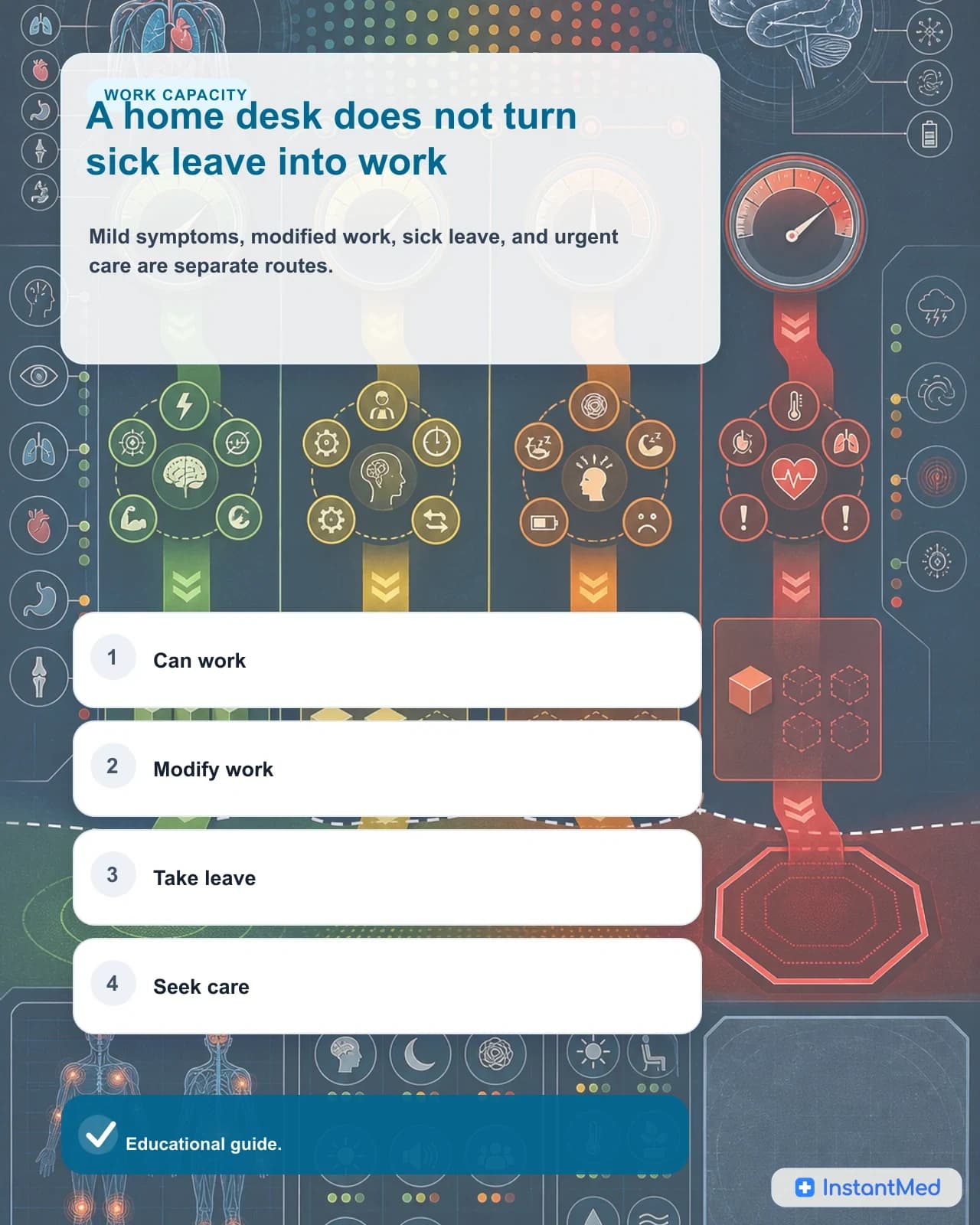
Medical Certificate Says Unfit for Work: Can You WFH?
If a medical certificate says you are unfit for work, working from home is still work. Learn when WFH, modified duties, sick leave, and evidence rules differ.
InstantMed Medical Team
12 min read
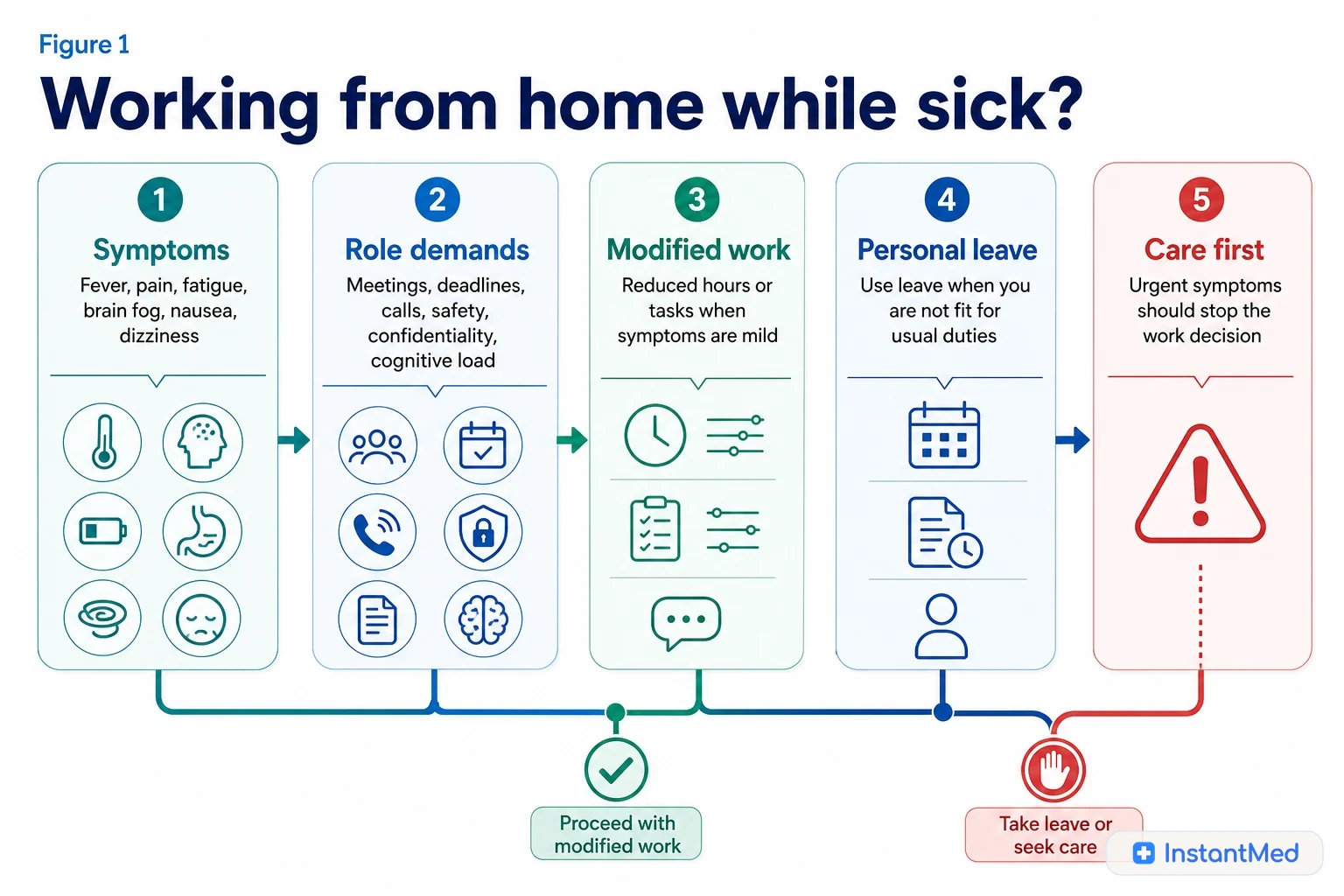
Working From Home When Sick: Should You?
Working from home does not remove sick leave. If you are not fit for work, location does not change that. This guide explains capacity, evidence, urgent symptoms, and safer communication.
InstantMed Medical Team
12 min read
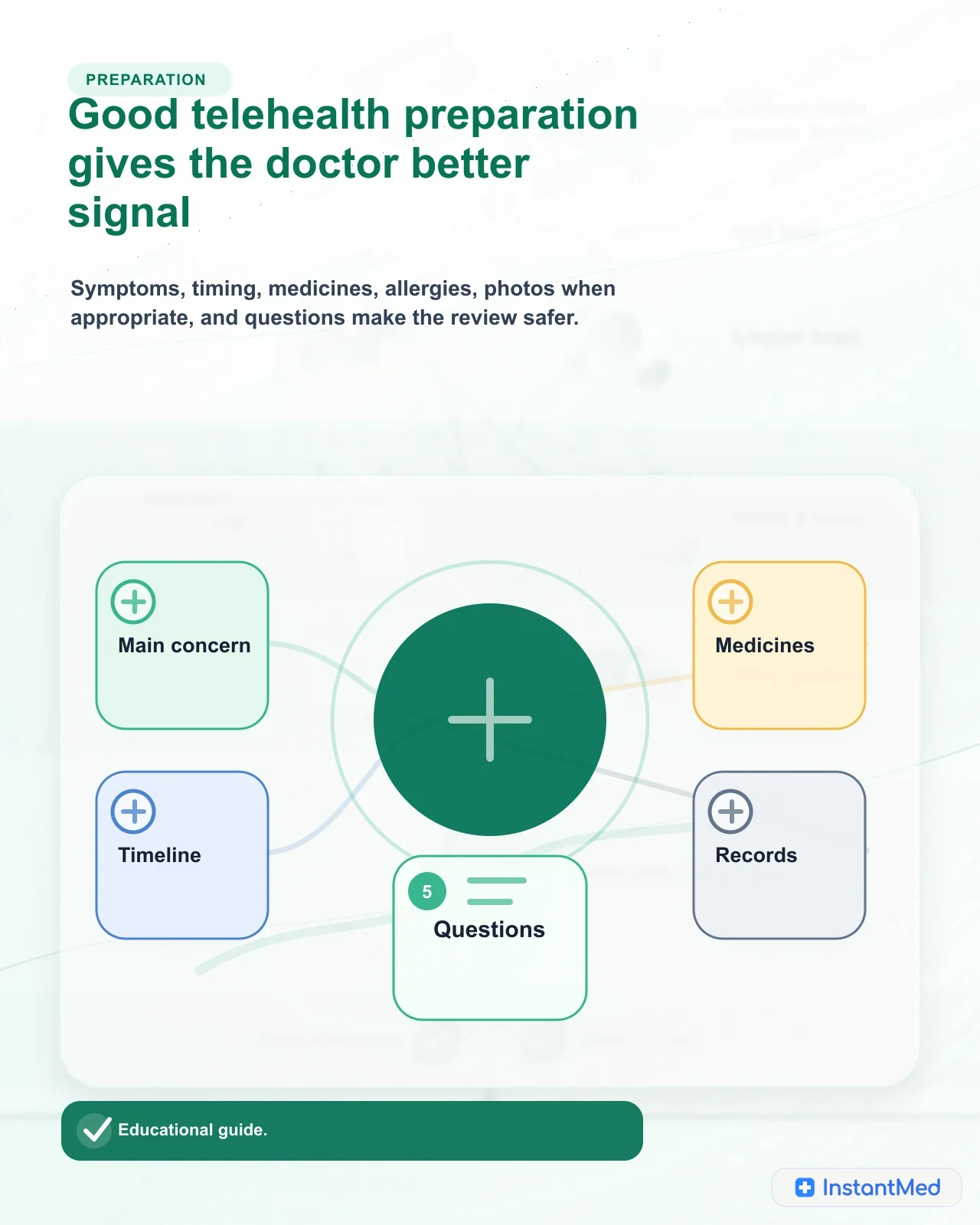
How to Prepare for a Telehealth Consultation
A practical Australian checklist for preparing for telehealth: symptoms, medicines, allergies, records, privacy, support people, questions, follow-up, and urgent-care boundaries.
InstantMed Medical Team