Loading article
Back to Health Guides
Can an Employer Reject a Medical Certificate in Australia?
What reasonable evidence means, when employers can ask questions, and how to respond if a certificate is challenged.
9 min read
·Updated 11 June 2026
·Doctor Reviewed
AHPRA Verified

In this article
- 1The Fair Work Evidence Standard
- 2Why Telehealth Is Not The Problem By Itself
- 3What A Strong Certificate Usually Includes
- 4When An Employer Can Ask Reasonable Questions
- 5What Employers Should Be Careful About
Medical information only. This article is for general information and does not constitute medical advice. Treatment decisions are made by an AHPRA-registered doctor after reviewing your circumstances.
Review
InstantMed Clinical Team
Clinical governance review for guide content
Updated
11 June 2026
General information only, not personal medical advice.
Jump to section
1The Fair Work Evidence Standard2Why Telehealth Is Not The Problem By Itself3What A Strong Certificate Usually Includes4When An Employer Can Ask Reasonable Questions5What Employers Should Be Careful About6Common Scenarios7Step-By-Step Response8A Note On Fraudulent Certificates9How to Make a Certificate Harder to Reject10The Bottom Line11Sources Used In This Guide
Key Information
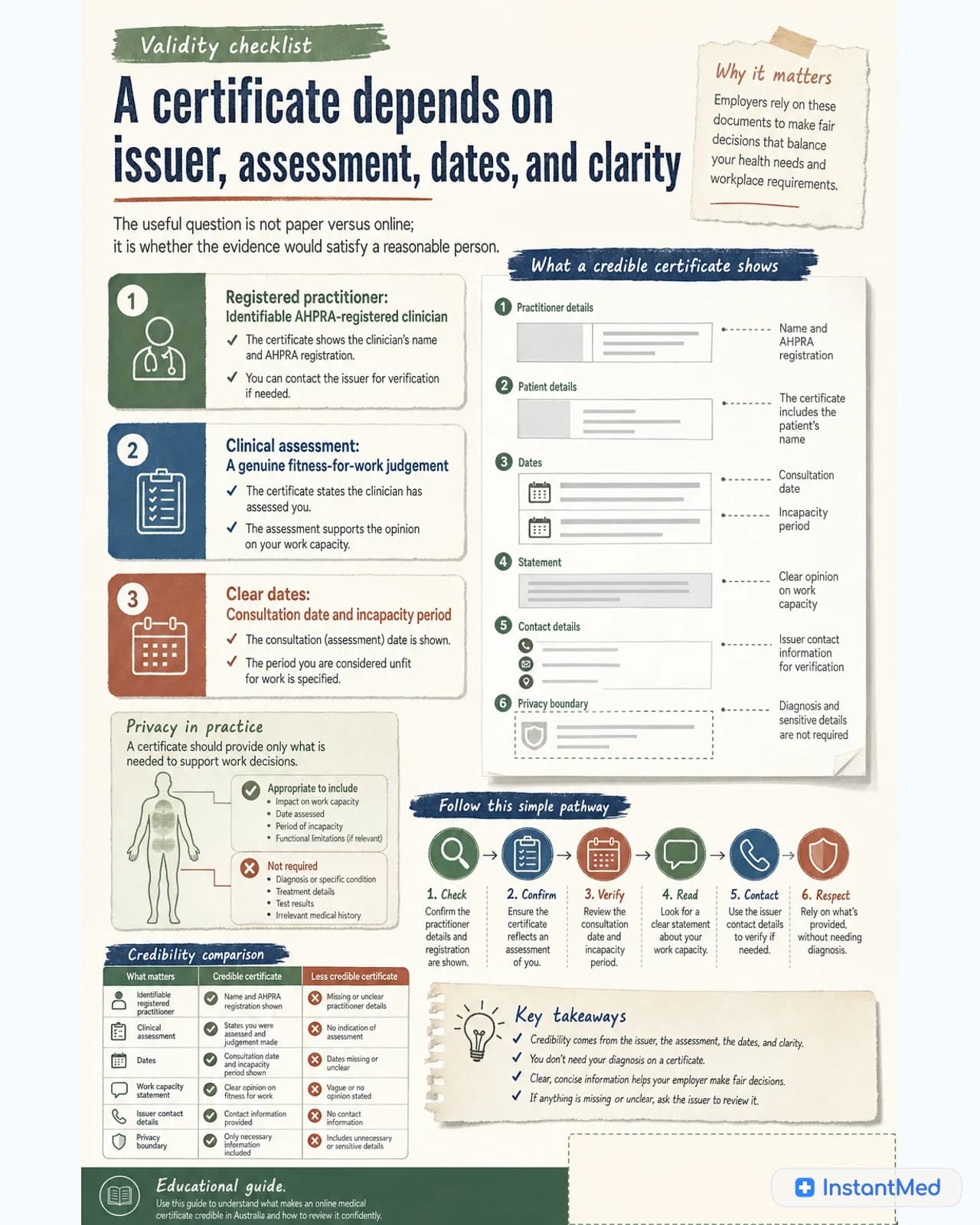
The key test is not paper versus online. The key test is whether the evidence would satisfy a reasonable person that the absence was due to illness, injury, or the relevant caring responsibility.
When an employer pushes back on a medical certificate, it is tempting to reduce the issue to a simple yes or no. Real workplace situations are usually more specific.
An employer generally should not reject a credible certificate just because it came from telehealth, because the doctor was not the employer's preferred doctor, or because the certificate does not disclose a diagnosis. But employers can ask reasonable questions when evidence is incomplete, inconsistent, altered, outside policy requirements, or does not cover the absence.
The practical question is: what exactly is the employer rejecting?
The Fair Work Evidence Standard
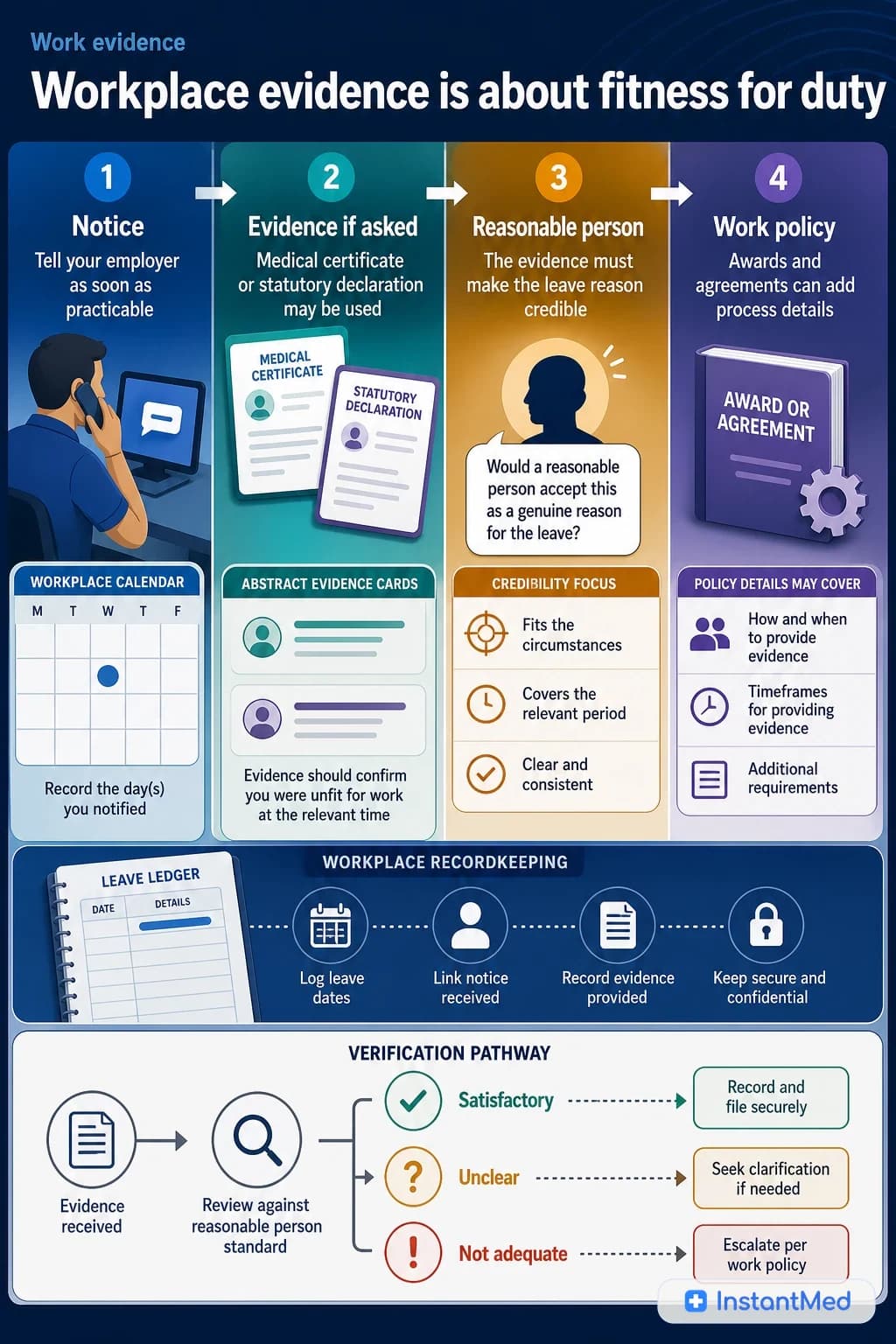
For most national system employees, the Fair Work Act allows an employer to require evidence for paid sick and carer's leave. The evidence must be enough to satisfy a reasonable person that the employee was entitled to the leave.
Fair Work guidance recognises medical certificates and statutory declarations as common evidence. It does not say every certificate must be paper-based, issued in person, or disclose the diagnosis.
That means the strength of a certificate usually depends on:
- Who issued it
- Whether the practitioner is appropriately registered
- Whether there was a genuine assessment
- Whether the certificate covers the absence dates
- Whether the document is complete and authentic
- Whether the workplace has additional lawful evidence requirements
A certificate is evidence. It is not an automatic shield against every workplace question, and it is not worthless just because it was issued online.
Why Telehealth Is Not The Problem By Itself
Telehealth is an accepted way to deliver healthcare in Australia when it is clinically appropriate. The Medical Board of Australia's telehealth guidelines require doctors to meet professional standards, assess whether telehealth is suitable, keep records, and redirect care when remote assessment is not enough.
For ordinary sick leave evidence, a certificate issued after a genuine telehealth assessment can be credible evidence. The consultation method alone is usually a weak reason to reject it.
Better employer questions are:
- Does the certificate identify the practitioner?
- Is the practitioner registered?
- Does the certificate cover the absence dates?
- Is there evidence the document was altered?
- Does the certificate match the employee's stated absence?
- Is this an extended absence needing follow-up evidence?
Those are evidence questions. "We do not accept online certificates" is usually too broad.
What A Strong Certificate Usually Includes
A workplace medical certificate is usually stronger when it includes:
- Your full name
- The date of assessment
- The period you were unfit for work or unfit for usual duties
- The issuing practitioner's name
- The practitioner's profession and registration details
- The practice or service contact details
- Signature or secure digital equivalent
It usually does not need to list your diagnosis. For many absences, "unfit for work due to a medical condition" or similar wording is enough. Your diagnosis is health information and should not be disclosed to an employer unless there is a specific reason and you consent or a lawful process requires it.
Helpful Tip
If your certificate is challenged, check the basics first: name spelling, date of assessment, dates covered, practitioner name, registration details, and whether the certificate actually covers the shift or period in dispute.
When An Employer Can Ask Reasonable Questions
Employers can question evidence in a targeted way. That is different from rejecting it because they dislike telehealth or want private medical details.
Reasonable questions may arise when:
- The certificate is missing the practitioner's details
- The dates do not cover the absence
- The employee submitted the certificate late and policy requires notice as soon as practicable
- The document appears altered
- The name does not match employment records
- The certificate is from an overseas practitioner not registered for Australian practice
- There are clear inconsistencies between the certificate and other information
- The absence is long enough that return-to-work or fitness-for-duty information is needed
In those cases, the best response is usually to ask for the concern in writing and correct the evidence if there is a genuine defect.
What Employers Should Be Careful About
Employers should be careful about:
- Rejecting a certificate solely because it was issued by telehealth
- Demanding diagnosis details for ordinary sick leave
- Contacting a doctor for clinical information without consent
- Treating one certificate dispute as proof of dishonesty without evidence
- Withholding pay without checking entitlement and evidence
- Turning a reasonable evidence query into bullying or adverse treatment
Fair Work pathway
A certificate, statutory declaration, or follow-up evidence may be relevant depending on the absence and policy.
This does not mean employers can never manage attendance patterns. Attendance management, long absence management, and fitness-for-work processes can be legitimate. They just need to be handled through the right process and not confused with a blanket rejection of a particular certificate.
Common Scenarios
"My employer says online certificates are not accepted"
Ask for the written policy and the specific legal or enterprise agreement basis. If the objection is only that the assessment was online, the employer's position is likely weak. If the issue is missing practitioner details, dates, or authenticity, fix that specific issue.
"My manager wants to know the diagnosis"
For ordinary sick leave evidence, a diagnosis is usually not required. You can say the certificate addresses fitness for work and the covered dates. If the employer says more detail is required, ask them to identify the policy, award, agreement, or safety reason.
"The certificate does not show an AHPRA number"
Ask the issuing practitioner or service for an updated certificate or confirmation of registration details. You can also search the Ahpra public register if you have the practitioner's name.
"The employer wants an independent medical examination"
For long absences, safety-sensitive roles, or return-to-work planning, an independent medical examination may be requested in some circumstances. That is different from refusing your initial certificate. If the request feels unreasonable, get advice before refusing.
"Pay has been withheld"
Ask for the reason in writing. If you are entitled to paid personal leave and have provided reasonable evidence, withholding pay may become an underpayment dispute. Keep records and seek advice from Fair Work, a union, HR, or an employment lawyer.
Step-By-Step Response
- 1
Ask for the specific reason in writing.
- 2
Check whether the certificate has the correct name, dates, practitioner details, and coverage.
- 3
If something is missing, request an amended certificate or supporting confirmation.
- 4
If the objection is telehealth only, ask which law, award, agreement, or policy excludes telehealth evidence.
- 5
Keep your response factual and brief.
- 6
Save copies of certificates, emails, rosters, and pay records.
- 7
Escalate to HR if the issue is with a direct manager.
- 8
Seek advice if pay, discipline, termination, bullying, discrimination, or long absence issues are involved.
A Note On Fraudulent Certificates
Using a false or altered certificate is serious and can justify disciplinary action. Employers can take authenticity concerns seriously, especially if a document appears altered or the practitioner cannot be verified.
Do not edit dates, remove details, reuse old certificates, or buy documents from services that do not conduct a genuine assessment. A legitimate certificate protects you far better than a shortcut.
Privacy boundary
Fitness for work and dates are usually the relevant details; diagnosis is private unless a specific process requires more.
How to Make a Certificate Harder to Reject
Most of the strength of a certificate is decided before any dispute, by the quality of the document itself. If you want evidence that holds up, a few things matter:
- The practitioner is identifiable and registered. A certificate that names the practitioner and shows their profession and registration details lets an employer confirm legitimacy on the public Ahpra register. Anonymous or unsigned documents invite questions.
- The assessment is genuine. Evidence issued after a real clinical assessment is far stronger than anything from a service that produces documents without one. Employers are increasingly alert to instant, no-assessment certificates, and those are the ones that attract scrutiny.
- The dates are correct and cover the absence. A simple date mismatch is one of the most common reasons a certificate is challenged. Check that the certificate covers the exact shift or period you were away.
- The document can be verified. Some services issue certificates with a unique reference number or QR code that an employer can check directly, confirming the document is authentic without you disclosing any diagnosis. A certificate an employer can independently verify is much harder to dismiss as fake.
None of this requires you to share private health information. It simply means choosing evidence that is complete, traceable to a registered practitioner, and checkable, so that if anyone does raise a question, the answer is already on the page.
The Bottom Line
An employer should not reject a credible medical certificate simply because it was issued after telehealth. But they can ask reasonable, specific questions about whether the evidence is complete, authentic, and relevant to the absence.
The safest response is not an argument. It is a paper trail: ask for the concern in writing, check the certificate, correct any genuine issue, and seek advice if the employer moves from a reasonable evidence question into pay withholding or disciplinary action.
Sources Used In This Guide
- Fair Work Ombudsman: Notice and medical certificates
- Fair Work Ombudsman: Sick and carer's leave
- Medical Board of Australia: Telehealth consultations with patients
- Ahpra: Register of practitioners
- Fair Work Commission: Modern awards
Frequently Asked Questions
Can an employer reject a telehealth medical certificate?
An employer should not reject credible evidence solely because the consultation happened by telehealth. The Fair Work standard focuses on whether the evidence would satisfy a reasonable person. A certificate from an identifiable registered practitioner after a genuine assessment will usually be strong evidence.
Can an employer ask questions about a medical certificate?
Yes, if the questions are reasonable and directed to the evidence. They may ask about missing details, dates, authenticity, or whether the certificate covers the absence. That is different from demanding private diagnosis information.
Does a certificate need to include my diagnosis?
Usually no. For ordinary sick leave evidence, the certificate normally needs to explain fitness for work and the period covered. A diagnosis is private health information and is not usually required unless a specific workplace process or legal setting requires more detail.
What if my employer says online certificates are not accepted?
Ask for the policy and the reason in writing. A blanket refusal based only on telehealth is weak because registered practitioners can provide care through telehealth when clinically appropriate. If the dispute affects pay or disciplinary action, consider Fair Work, union, HR, or legal advice.
Can my employer withhold sick leave pay while they question the certificate?
It depends on the facts, entitlement, and evidence. If you are entitled to paid personal leave and have provided evidence that satisfies the workplace requirement, withholding pay may create an underpayment issue. Seek advice if pay is withheld.
InstantMed Medical Team
Related Articles
8 min read
Are Online Medical Certificates Valid in Australia?
Online medical certificates from AHPRA-registered practitioners can be valid evidence in Australia when they follow a genuine assessment and contain clear details. This guide explains the Fair Work standard and common employer questions.
InstantMed Medical Team
13 min read
Doctor's Note for Work Australia: What Counts?
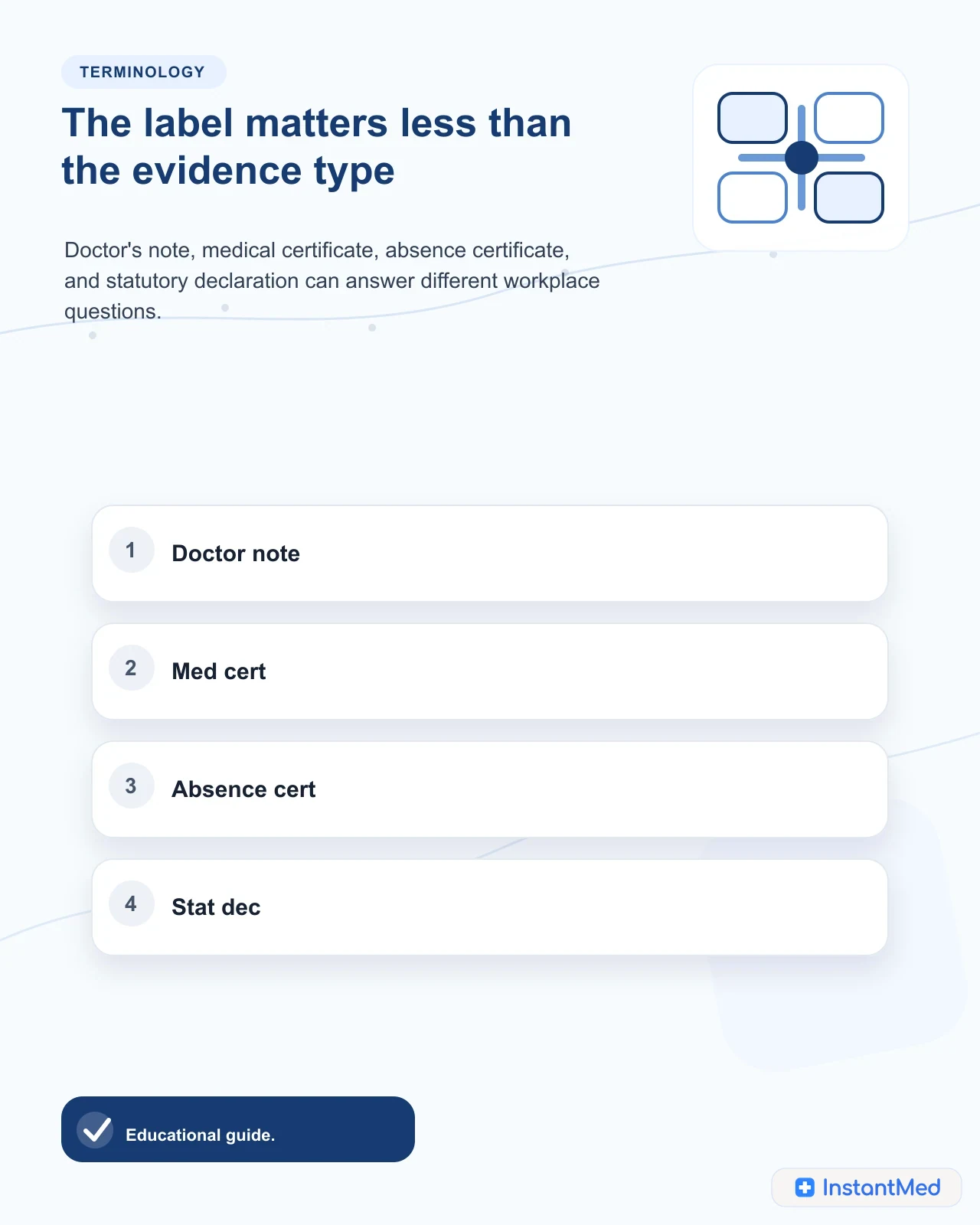
A doctor's note for work in Australia usually means a medical certificate, but sick notes, absence-from-work certificates, and statutory declarations can also matter. Learn what counts as evidence, what a strong certificate includes, and when a workplace may ask questions.
InstantMed Medical Team
9 min read
Medical Certificates for Work: Complete Australian Guide
A work medical certificate is evidence that you were unfit for work, not a public explanation of your diagnosis. This Australian guide explains employer evidence rules, privacy, telehealth, stat decs, and return-to-work issues.
InstantMed Medical Team