Loading article
Back to Health Guides
Emergency vs Telehealth: When to Go to ED and When Not To
A practical Australian route guide for choosing triple zero, emergency department, urgent care, GP, healthdirect, or telehealth.
12 min read
·Updated 8 July 2026
·Doctor Reviewed
AHPRA Verified
In this article
- 1Start with danger signs
- 2What emergency departments are for
- 3When urgent care or a GP may be safer than telehealth
- 4Where telehealth fits
- 5Use healthdirect when the route is unclear
Medical information only. This article is for general information and does not constitute medical advice. Treatment decisions are made by an AHPRA-registered doctor after reviewing your circumstances.
Review
InstantMed Clinical Team
Clinical governance review for guide content
Updated
8 July 2026
General information only, not personal medical advice.
Jump to section
1Start with danger signs2What emergency departments are for3When urgent care or a GP may be safer than telehealth4Where telehealth fits5Use healthdirect when the route is unclear6Children, older adults, pregnancy, and frailty lower the threshold7Mental health crises are emergencies too8What each care route can do9If telehealth redirects you, follow it10Choose the right route11Common mistakes to avoid12Related guides13Sources Used In This Guide
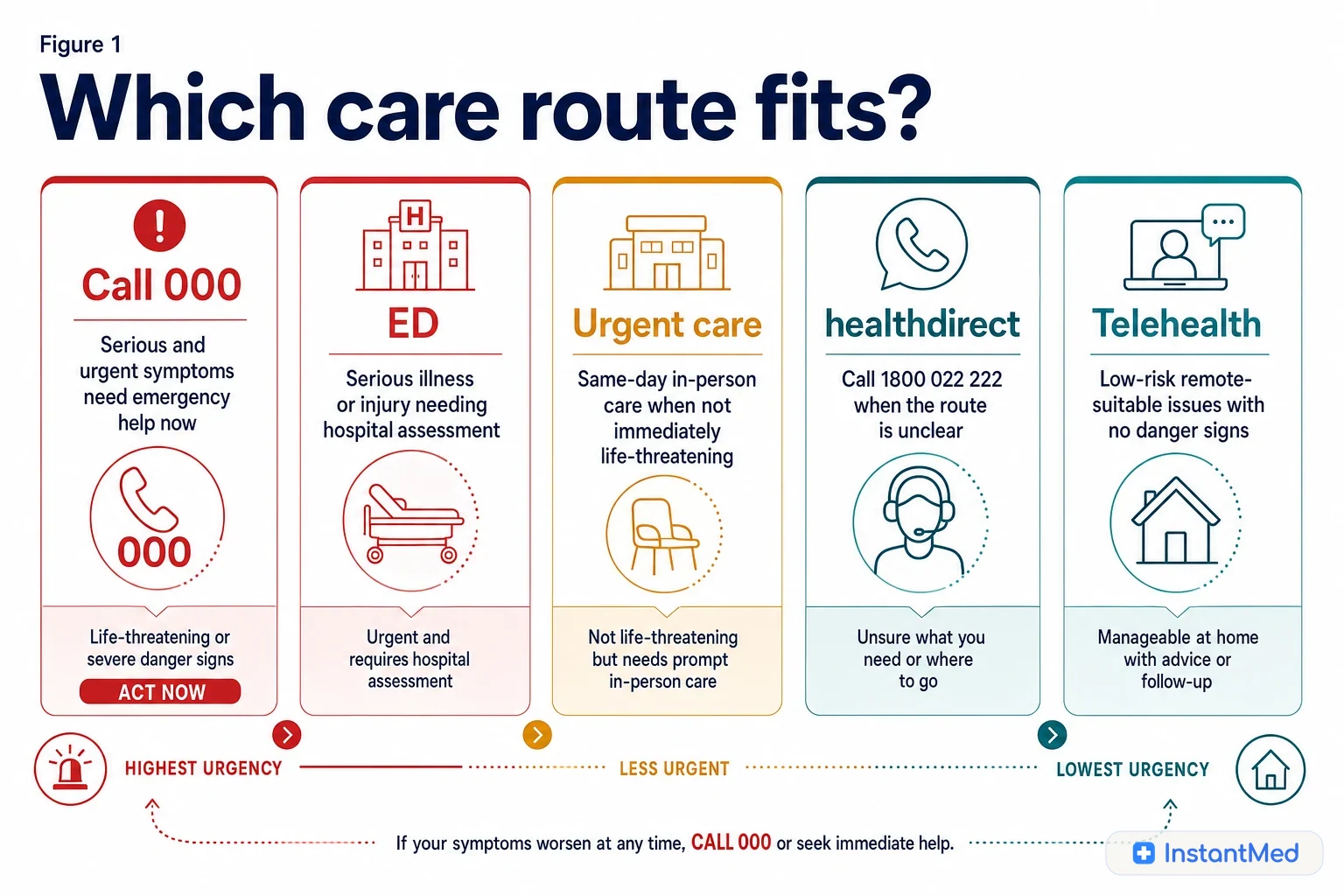
Use emergency care when the situation is serious and urgent. Use telehealth only when the problem can be assessed safely from history, images, video, records, or conversation, and when waiting for remote review will not delay urgent treatment.
The safest rule is simple: danger signs bypass routine telehealth.
Start with danger signs
Do not start with convenience, wait time, cost, or whether you can get an online appointment. Start with whether the symptom could be serious or time-critical.
| Symptom pattern | Safer first route | Why |
|---|---|---|
| Chest pain, chest tightness, severe breathing difficulty, collapse, seizure, stroke signs, severe bleeding, poisoning, overdose, major injury | Call 000 | Ambulance and emergency care may be needed now |
| Serious but able to travel safely, such as severe pain, serious injury, fever in an infant, loss of consciousness, severe mental health concern | Emergency department | Hospital triage and urgent assessment may be needed |
| Same-day but not immediately life-threatening, such as worsening infection, moderate injury, dehydration concern, or pain needing examination | Urgent care, after-hours GP, or GP clinic | Examination, observations, tests, or treatment may be needed |
| Mild, stable, low-risk issue with clear history | Telehealth may fit | Remote review may be enough if no urgent features are present |
| Unsure and not clearly life-threatening | healthdirect 1800 022 222 | A registered nurse can help choose the care route |
What emergency departments are for
Emergency departments are built for urgent medical assessment, triage, treatment, and escalation. They can monitor people, run urgent tests, perform procedures, manage deterioration, and involve hospital teams.
Healthdirect says emergency departments are open 24 hours for serious medical conditions and that a triage nurse assesses how urgently each person needs treatment. People are not seen in arrival order when someone else is more urgent.
Examples that often fit ED or 000 include:
- chest pain, chest pressure, or symptoms that could be a heart attack
- stroke signs, such as face droop, arm weakness, speech trouble, sudden vision change, or sudden balance problems
- severe breathing difficulty
- collapse, loss of consciousness, first seizure, or prolonged seizure
- uncontrollable bleeding, major injury, serious fall, car accident, assault, or severe burn
- poisoning or overdose
- severe abdominal pain, severe headache unlike usual, or rapidly worsening severe pain
- fever in very young infants or a child who is difficult to wake, not drinking, not breathing normally, or looks very unwell
- immediate self-harm risk, risk of harm to others, severe psychosis, extreme agitation, or a mental health crisis with immediate danger
When urgent care or a GP may be safer than telehealth
Some problems are not emergencies but still need hands-on assessment. They may be better suited to urgent care, an after-hours GP clinic, a usual GP, or a local clinic than routine telehealth.
| Problem | Why in-person may fit |
|---|---|
| Injury, suspected fracture, deep cut, burn, or wound | Examination, imaging, wound care, dressing, or procedure may be needed |
| Fever with worsening pain, dehydration, confusion, or a very unwell appearance | Observations and same-day review may change the plan |
| Ear pain in a young child | The eardrum may need to be examined |
| Abdominal, pelvic, testicular, chest, or severe back pain | Examination and urgent tests may be needed |
| Pregnancy-related pain, bleeding, severe vomiting, or reduced fetal movement | Pregnancy assessment, ultrasound, pathology, or hospital care may be needed |
| Mental health symptoms without immediate danger but needing same-day support | GP, crisis line, mental health triage, or urgent mental health service may fit better |
If the route is unclear but not immediately life-threatening, healthdirect can help. If it may be life-threatening, call 000 first.
Where telehealth fits
Telehealth may fit when symptoms are low risk, stable, clearly described, and the clinician can make a safe decision remotely.
Examples can include:
- advice for mild cold or flu symptoms without breathing difficulty, dehydration, confusion, severe pain, or high-risk features
- low-risk certificate or work-capacity questions when no urgent symptoms are present
- repeat medicine review where the medicine history and safety context are clear
- follow-up after a recent GP or hospital review when the plan is already known
- triage about whether the next step should be GP, urgent care, pharmacy, pathology, imaging, or ED
Telehealth is not a way to avoid emergency care. It is a care route for problems where remote assessment gives enough information.
Use healthdirect when the route is unclear
The healthdirect helpline exists for the middle zone: not obviously an emergency, but not obviously safe to wait either.
The Australian Government describes the healthdirect helpline as a service where you can speak to a registered nurse about health concerns. It can help if you are not sure whether to see a doctor or manage the condition at home, and it is open 24 hours a day, 7 days a week.
Figure 2
Chest pain, stroke signs, breathing trouble, collapse, seizure, severe bleeding, major injury, poisoning, or overdose should not wait.
| Situation | healthdirect may help with |
|---|---|
| You are unsure whether symptoms can wait | Choosing home care, GP, urgent care, ED, or 000 |
| You are away from your usual GP | Finding the safest local route |
| Symptoms are uncomfortable but not clearly dangerous | Deciding whether same-day care is needed |
| A child or older person is unwell and you are unsure | Triage advice about urgency |
| You need after-hours advice | 24/7 nurse advice |
If the nurse thinks emergency care is needed, follow that advice.
Children, older adults, pregnancy, and frailty lower the threshold
Some people can become seriously unwell faster or show less typical symptoms. Telehealth can still be useful in selected low-risk situations, but the threshold for in-person or urgent care is lower.
Be cautious with:
- babies under 3 months with fever
- any child with breathing difficulty, poor feeding, drowsiness, dehydration, blue or grey colour, seizure, non-fading rash, or a parent who says the child is not acting normally
- pregnancy symptoms such as pain, bleeding, fever, severe vomiting, or reduced fetal movement
- older, frail, immunocompromised, or medically complex people
- people who cannot explain symptoms clearly or are confused, intoxicated, alone, unsafe, or unsupported
| Person or context | Safer bias |
|---|---|
| Baby or young child with fever or breathing concern | In-person or urgent care |
| Older or frail person with sudden decline | In-person or urgent care |
| Pregnancy-related concerning symptoms | In-person, maternity, urgent, or emergency pathway |
| Immunocompromised person with fever or worsening symptoms | Same-day medical advice |
| Immediate danger to self or others | 000 |
Mental health crises are emergencies too
Mental health crisis symptoms can require emergency care. Healthdirect says if someone is having suicidal thoughts and is in immediate danger, call triple zero (000), and lists Lifeline, Beyond Blue, and Suicide Call Back Service as national crisis supports.
| Mental health situation | Safer route |
|---|---|
| Immediate risk of self-harm, harm to others, severe agitation, hallucinations, delusions, or unsafe behaviour | Call 000 or emergency care |
| Suicidal thoughts without immediate intent or plan, or intense distress where safety is maintained | Lifeline 13 11 14, Beyond Blue 1300 22 4636, Suicide Call Back Service 1300 659 467, GP or local crisis service |
| Ongoing anxiety, depression, burnout, medication review, certificate, or referral needs without immediate danger | GP or telehealth may fit |
If you are supporting someone in crisis, do not put yourself at risk. If there is immediate danger, call 000.
What each care route can do
| Route | Can do | Cannot safely replace |
|---|---|---|
| 000 ambulance | Emergency dispatch, urgent advice, paramedic care, transport | Routine advice or non-urgent medical review |
| Emergency department | Triage, monitoring, urgent tests, procedures, specialist escalation | Routine certificates, repeat scripts, low-risk advice |
| Urgent care or after-hours GP | Same-day examination and many non-life-threatening urgent problems | Major emergencies or hospital-level deterioration |
| Regular GP | Continuity, examination, chronic care, certificates, referrals, medicines | Immediate ambulance-level emergencies |
| healthdirect | Registered nurse triage and route advice | Emergency dispatch if danger is immediate; call 000 first |
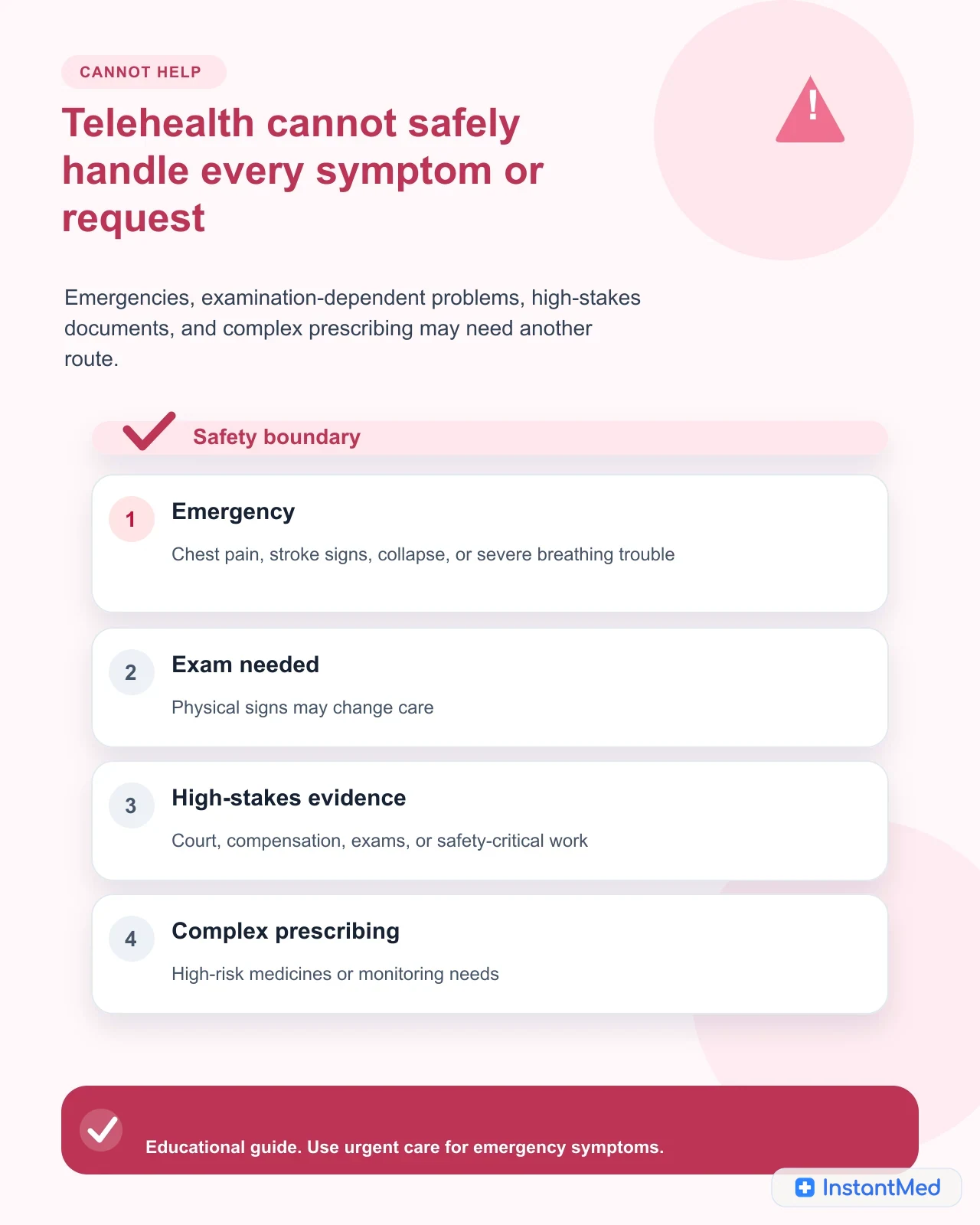
| Telehealth | Remote assessment for suitable low-risk issues and triage | Emergencies, examination-heavy problems, procedures, urgent monitoring |
If telehealth redirects you, follow it
A redirect from telehealth to ED, urgent care, GP, pathology, imaging, or 000 is not a failure. It means the clinician has judged that the remote channel does not provide enough safety for the symptoms.
Follow the advice, especially when:
- symptoms are worsening during the consultation
- the clinician says examination or observations are needed
- a child, pregnant person, older person, or medically complex patient is involved
- mental health safety becomes uncertain
- the advice includes a timeframe such as "today", "now", or "call 000"
Choose the right route
Decision guide
Emergency, in-person care, or telehealth
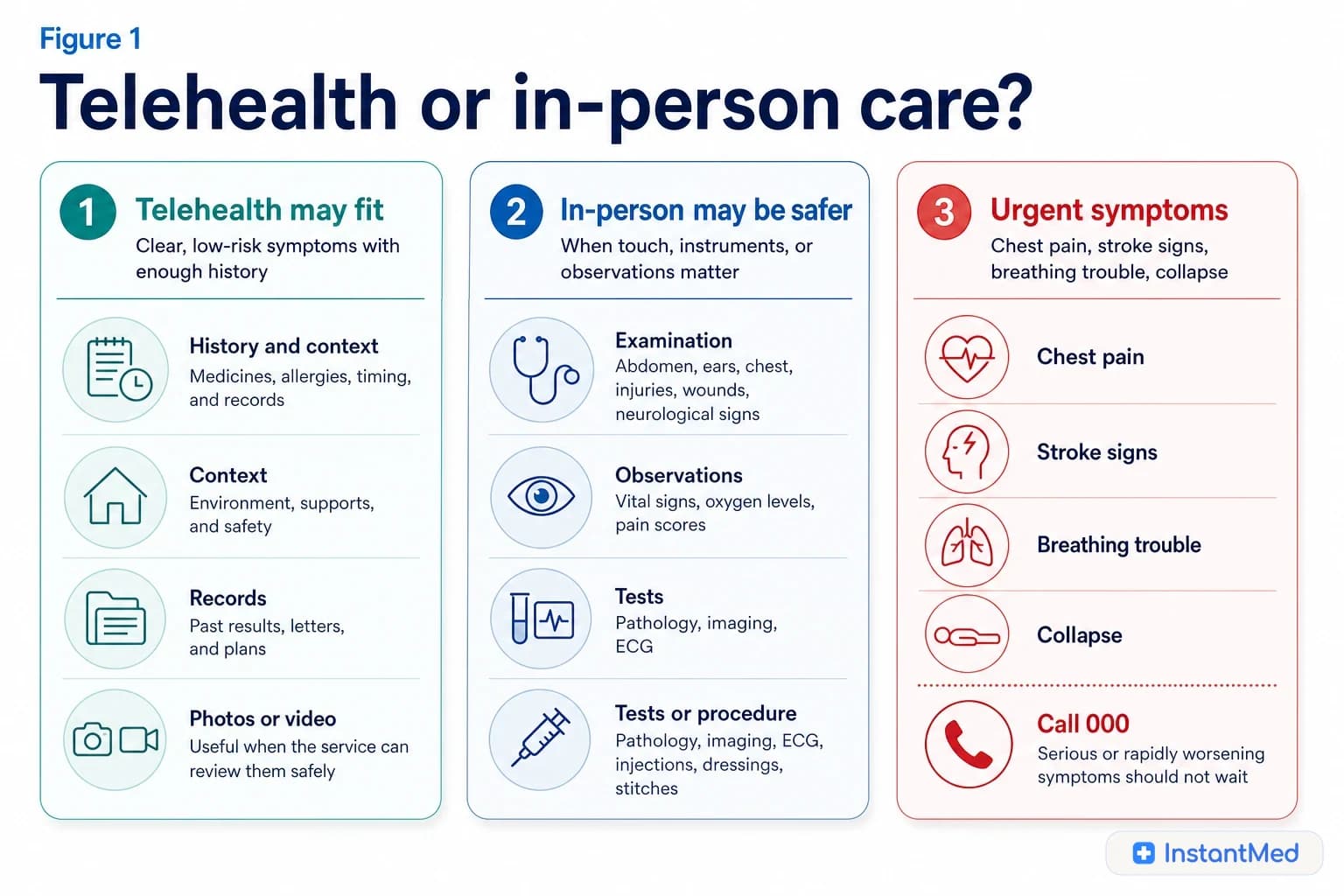
May fit telehealth
- Symptoms are low risk, stable, clearly described, and no danger signs are present.
- The clinician can ask follow-up questions and redirect if remote assessment is not enough.
Needs in-person care
- Examination, observations, tests, imaging, procedures, pregnancy assessment, child assessment, or same-day review may change the plan.
- The patient is very young, older, frail, immunocompromised, pregnant with concerning symptoms, confused, unsupported, or medically complex.
Urgent care
- Chest pain, stroke signs, severe breathing difficulty, collapse, seizure, severe bleeding, poisoning, overdose, major injury, immediate self-harm risk, or rapid worsening should bypass routine telehealth.
- Call 000 for serious and urgent symptoms.
Figure 3
If it may be serious, call 000. If it is not clearly life-threatening but you are unsure, call healthdirect for nurse advice.
Common mistakes to avoid
- 1
Waiting for routine telehealth when symptoms are severe or getting worse.
- 2
Driving yourself when ambulance care is needed.
- 3
Assuming ED works by arrival order rather than triage urgency.
- 4
Using ED for routine documents or low-risk issues when safer alternatives exist.
- 5
Treating a telehealth redirect as optional.
- 6
Underestimating risk in babies, pregnancy, frailty, immunocompromise, or mental health crisis.
Related guides
- When telehealth cannot help
- Telehealth vs in-person doctor
- Is telehealth safe in Australia?
- How telehealth safety screening works
Sources Used In This Guide
- Healthdirect: Calling triple zero (000)
- Healthdirect: Hospital emergency departments
- Australian Government Department of Health, Disability and Ageing: healthdirect helpline
- Healthdirect: Contact healthdirect
- Healthdirect: Mental health crisis support
- Medical Board of Australia: Telehealth consultations with patients
Frequently Asked Questions
When should I call triple zero instead of using telehealth?
Call triple zero (000) for serious and urgent symptoms, including chest pain, stroke signs, severe breathing difficulty, sudden collapse, seizure, uncontrollable bleeding, major trauma, severe burns, poisoning, overdose, or immediate danger from self-harm or harm to others.
When is the emergency department the right place?
ED fits serious illness or injury that needs urgent hospital assessment, monitoring, imaging, procedures, specialist input, or emergency treatment. Healthdirect says EDs are open 24 hours for serious medical conditions and triage nurses decide urgency.
What if I am not sure whether it is an emergency?
If you think it may be serious and urgent, call 000. If it is not immediately life-threatening but you are unsure where to go, call healthdirect on 1800 022 222 for registered nurse advice, 24 hours a day, 7 days a week.
Can telehealth tell me to go to ED?
Yes. A safe telehealth clinician should keep assessing whether remote care is appropriate and arrange or recommend in-person care when needed. A redirect is a safety feature.
Are children suitable for telehealth?
Some mild, low-risk child health questions may be suitable, but babies, young children, breathing difficulty, dehydration, fever in very young infants, drowsiness, poor feeding, seizures, or a parent who feels the child is very unwell should lower the threshold for urgent or in-person care.
What about mental health crisis symptoms?
If someone is in immediate danger, call triple zero (000). Healthdirect lists Lifeline 13 11 14, Beyond Blue 1300 22 4636, and Suicide Call Back Service 1300 659 467 for crisis support, but immediate danger needs emergency help.
InstantMed Medical Team
Related Articles
11 min read
When Telehealth Cannot Help: Knowing the Limits
Telehealth can be safe and useful when the problem fits remote assessment. It cannot replace emergency care, a physical examination, monitoring, or continuity when those are needed. This guide explains the limits and safer next steps.
InstantMed Medical Team
12 min read
Telehealth vs In-Person Doctor: When to Use Each
Telehealth and in-person care answer different clinical questions. This guide explains when remote review may fit, when a physical examination or tests matter, and when urgent symptoms should bypass routine care.
InstantMed Medical Team

11 min read
Is Telehealth Safe in Australia?
Telehealth can be safe when the service is regulated, the doctor has enough information, and there is a clear path to in-person or urgent care when remote review is not enough.
InstantMed Medical Team