Loading article
Back to Health Guides
Is Telehealth Safe in Australia?
What makes online care safe, when remote review is not enough, and how to check a service before you use it.
11 min read
·Updated 7 July 2026
·Doctor Reviewed
AHPRA Verified

In this article
- 1What makes telehealth safe
- 2The doctor still has to meet the same standard
- 3What a safe online review checks
- 4When telehealth is a good fit
- 5When telehealth is not enough
Medical information only. This article is for general information and does not constitute medical advice. Treatment decisions are made by an AHPRA-registered doctor after reviewing your circumstances.
Review
InstantMed Clinical Team
Clinical governance review for guide content
Updated
7 July 2026
General information only, not personal medical advice.
Jump to section
1What makes telehealth safe2The doctor still has to meet the same standard3What a safe online review checks4When telehealth is a good fit5When telehealth is not enough6Privacy and records still matter7Prescribing and certificates need extra care8Red flags for unsafe telehealth services9What to do if something goes wrong10How to decide before using a telehealth service11Related guides12Sources
Telehealth can be safe in Australia when the service is real healthcare, not a shortcut around healthcare. The doctor still needs enough information to assess you, the service still needs to protect your health information, and the outcome still needs to be clinically appropriate.
The safest way to judge telehealth is not "online or in-person". It is whether the problem fits remote care, whether the practitioner is accountable, and whether the service is willing to redirect you when telehealth is not enough.
What makes telehealth safe
Telehealth is a consultation channel. It can use video, phone, secure forms, messaging, uploaded images, or a mix of these. The channel changes how information is gathered. It does not remove the doctor's duty to make a safe clinical decision.
The Medical Board of Australia says telehealth can be used for triage, diagnosis, treatment, prescribing, and preventive health services, but it is not suitable for every consultation. It also says the standard of care should be safe and, as far as possible, meet the same standard as in-person care.
That means safe telehealth needs several things to line up:
- the issue can be assessed remotely
- the patient can be identified clearly enough for care
- the doctor can get enough history and context
- the service protects privacy and clinical records
- the doctor can arrange follow-up or redirect care
- the patient knows when remote review is not enough
The doctor still has to meet the same standard
A safe telehealth service should make the responsible practitioner clear. If a doctor is reviewing your request, the service should be able to identify that doctor and the clinical outcome should show enough practitioner detail to be checkable where appropriate.
In Australia, Ahpra keeps the public Register of practitioners. The register lets people check whether a health practitioner is registered to practise, and whether visible conditions or restrictions apply. For medical care, the relevant profession is Medical Practitioner.
Registration is not the whole safety test. A registered doctor can still make a poor decision, and an online service can still be badly designed. But a practitioner who cannot be identified or checked is a serious warning sign.
What a safe online review checks
Good telehealth depends on good clinical signal. Without a physical examination, the doctor needs the right information before making a decision.
Common safety checks include:
| Safety check | What it tells the doctor | Why it matters |
|---|---|---|
| Identity and contact details | Who the patient is and how they can be contacted | Records, prescriptions, certificates, and follow-up need to match the right person |
| Symptoms and timing | What is happening, when it started, and whether it is changing | Duration, severity, and progression shape the likely next step |
| Red flags | Features that suggest urgent or in-person care | Some symptoms should bypass routine telehealth |
| Medical history | Conditions that change risk or treatment choices | Diabetes, immune suppression, kidney disease, pregnancy, and other factors can change the plan |
| Current medicines | Possible interactions or duplicate treatment | Prescribing without medicine context is unsafe |
| Allergies and reactions | What should be avoided | "Rash" and "anaphylaxis" carry different risk |
| Photos or documents | Visual or record evidence where useful | Skin, eye, certificate, and previous-treatment contexts can need supporting detail |
If a form asks detailed questions, that is not necessarily friction. It is often the assessment. The risky service is the one that asks for a name, payment, and desired outcome, then approves everything.
When telehealth is a good fit
Telehealth is often useful when the main task is history, review, advice, documentation, medication review, or follow-up that does not need hands-on examination.
It may fit:
- routine medical certificate requests where symptoms and dates can be assessed remotely
- some repeat medication requests when the history is stable and monitoring needs are clear
- follow-up questions after previous care
- straightforward advice where red flags are absent
- privacy-sensitive concerns where a structured form helps the patient explain the problem
- remote or time-sensitive situations where access would otherwise be delayed
It is also useful for triage. A telehealth doctor may not solve the whole problem online, but they may help identify the right next step.
When telehealth is not enough
The limit is not whether the doctor is smart enough. The limit is whether the doctor has enough reliable information without examining you.
Telehealth may not be enough when the decision depends on:
Same standard
Safe telehealth still needs consent, privacy, records, follow-up, and a decision to change channel when needed.
- listening to the chest or heart
- feeling the abdomen, lymph nodes, joints, or injury site
- checking vital signs such as oxygen level, blood pressure, pulse, or temperature
- performing a procedure, swab, urine test, pathology, imaging, or eye examination
- assessing a young child or a person who could deteriorate quickly
- monitoring a pregnancy complication
- deciding fitness for safety-critical work, driving, flying, court, insurance, workers compensation, or formal return-to-duty
Decision guide
Where telehealth fits
May fit telehealth
- Routine or low-risk issues where history, photos, records, or follow-up questions can give the doctor enough information.
- Administrative documentation or medication review where the doctor can verify identity, context, safety factors, and scope.
Needs in-person care
- Symptoms that need examination, vital signs, pathology, imaging, procedures, or continuity from a treating clinician.
- Requests where the doctor cannot be clinically confident from the information available remotely.
Urgent care
- Chest pain, severe breathing trouble, stroke signs, collapse, severe bleeding, severe allergic reaction, confusion, severe dehydration, or rapidly worsening symptoms.
- Call 000 or use urgent local care for emergency symptoms.
Privacy and records still matter
Health information is sensitive information under Australian privacy law. A telehealth service should explain what it collects, why it collects it, how it stores it, who can access it, and how you can contact the service about privacy concerns.
Practical safety signals include:
- HTTPS on the website and secure forms
- a clear privacy policy
- clear consent before collecting clinical information
- limited staff access to health records
- audit trails or access logging for clinical systems
- secure handling of prescriptions, certificates, referrals, images, and messages
- a way to access or correct your health information
- a complaint pathway if something goes wrong
Be cautious with services that push you into ordinary email, social media messages, unencrypted uploads, or public comments for clinical information. A service may use email or SMS for notifications, but the clinical detail should be handled carefully.
Prescribing and certificates need extra care
Prescriptions and medical certificates are common telehealth reasons, but they are also where unsafe services can do the most damage.
For prescribing, a safe review should consider the condition, requested medicine, allergies, other medicines, pregnancy or breastfeeding where relevant, medical history, previous response, monitoring needs, and whether the medicine is appropriate for telehealth. A safe outcome can be approval, more questions, a different plan, decline, or referral.
For certificates, the doctor still needs to decide whether the history supports the requested dates and purpose. A routine sick leave certificate is different from a workers compensation report, court document, fitness-for-duty assessment, or exam deferral. The higher the stakes, the more likely a different assessment pathway is needed.
| Request type | Safer telehealth signal | Caution signal |
|---|---|---|
| Medical certificate | Clear symptoms, recent dates, routine work or study evidence | Old dates, unclear history, high-stakes use, disputed capacity |
| Repeat prescription | Stable medicine history, known dose, clear monitoring context | New symptoms, high-risk medicine, interactions, missing identity or history |
| Acute symptom advice | Mild to moderate symptoms without red flags | Severe, worsening, unusual, or examination-dependent symptoms |
| Photos or uploads | Clear, relevant images used as supporting context | Diagnosis made from poor images without history or escalation |
Red flags for unsafe telehealth services
Unsafe services usually make the same mistakes. They hide who is responsible, promise an outcome before assessment, or treat the form as a purchase order.
Be cautious if a service:
- does not identify the responsible practitioner
- does not explain practitioner registration or service ownership
- promises a prescription, certificate, or outcome before review
- says no doctor contact can ever be needed for prescribing
- skips medical history, allergies, current medicines, and red-flag questions
- advertises controlled drugs, prescription-only medicines, or guaranteed treatment outcomes
- has no clear privacy policy, complaints process, ABN, or Australian contact details
- uses fake urgency or pressure tactics to make you pay quickly
- refuses to redirect care when symptoms sound urgent or unsuitable for remote assessment
The safest service is not the one that approves the most. It is the one that can say no when the information or clinical situation does not support a safe online outcome.
What to do if something goes wrong
Start with the service if the issue is administrative: a wrong name, wrong date, payment issue, document problem, or missing message. Keep records of what happened and when.
For clinical safety concerns, use the relevant health complaints pathway. Ahpra handles concerns about registered practitioners in many states and territories. New South Wales and Queensland have state-based arrangements for some complaints. Privacy complaints can go to the Office of the Australian Information Commissioner. Immediate danger should go through emergency or urgent medical care first, not a complaint form.
When not remote
Chest pain, severe breathing trouble, stroke signs, collapse, severe bleeding, or severe allergic reaction need urgent care.
Useful information to keep includes:
- the service name and URL
- the practitioner's name or registration number if provided
- the date and time of the consultation or request
- copies of messages, certificates, prescriptions, receipts, and advice
- what outcome you expected and what happened instead
How to decide before using a telehealth service
Use a quick check before entering sensitive information:
- 1
Can you identify the service, business, privacy policy, and complaints contact?
- 2
Can the practitioner be identified and checked where relevant?
- 3
Does the service ask enough clinical questions for the type of care requested?
- 4
Does it explain that a doctor may ask for more information or redirect care?
- 5
Does it avoid guaranteed outcomes and pressure tactics?
- 6
Does the requested problem sound suitable for remote review?
If the answer is no on identity, privacy, clinical screening, or escalation, choose another pathway.
Related guides
- How safety screening works in telehealth consultations
- How to verify an online doctor
- Telehealth privacy and security
- Is telehealth legal in Australia?
Sources
- Medical Board of Australia: Telehealth consultations with patients
- Ahpra: Patient safety paramount in updated telehealth guidance
- Ahpra: Register of practitioners
- RACGP: Medical Board and Ahpra telehealth guidance
- OAIC: Health information
- Healthdirect: Telehealth
Frequently Asked Questions
Is telehealth safe in Australia?
Telehealth can be safe in Australia when it is provided by an appropriately registered practitioner, the clinical problem is suitable for remote assessment, privacy and records are handled properly, and the doctor redirects the patient to in-person or urgent care when telehealth is not enough.
Is telehealth as safe as seeing a doctor in person?
It depends on the problem. For suitable issues, telehealth can meet the same professional standard. For symptoms that need examination, vital signs, procedures, imaging, pathology, or emergency care, in-person assessment is safer.
How do I know if an online doctor is legitimate?
Check that the practitioner is identifiable, registered on Ahpra's public Register of practitioners, and operating through a service with clear privacy, pricing, complaints, and escalation processes. Be cautious if the service hides the clinician, promises an outcome, or skips clinical history.
What are telehealth red flags?
Emergency red flags include chest pain, severe breathing trouble, stroke signs, collapse, severe bleeding, severe allergic reaction, confusion, severe dehydration, or rapidly worsening symptoms. These should not wait for routine telehealth.
Can telehealth prescribe safely?
Only when the doctor has enough information and the medicine is appropriate for remote prescribing. A safe prescribing review considers identity, medical history, allergies, other medicines, pregnancy or breastfeeding where relevant, contraindications, monitoring needs, and whether in-person assessment is required.
What privacy protections apply to telehealth?
Health information is sensitive information under Australian privacy law. Health services must handle it carefully, use appropriate safeguards, and explain how it is collected, used, disclosed, and accessed.
InstantMed Medical Team
Related Articles
11 min read
How Telehealth Safety Screening Works
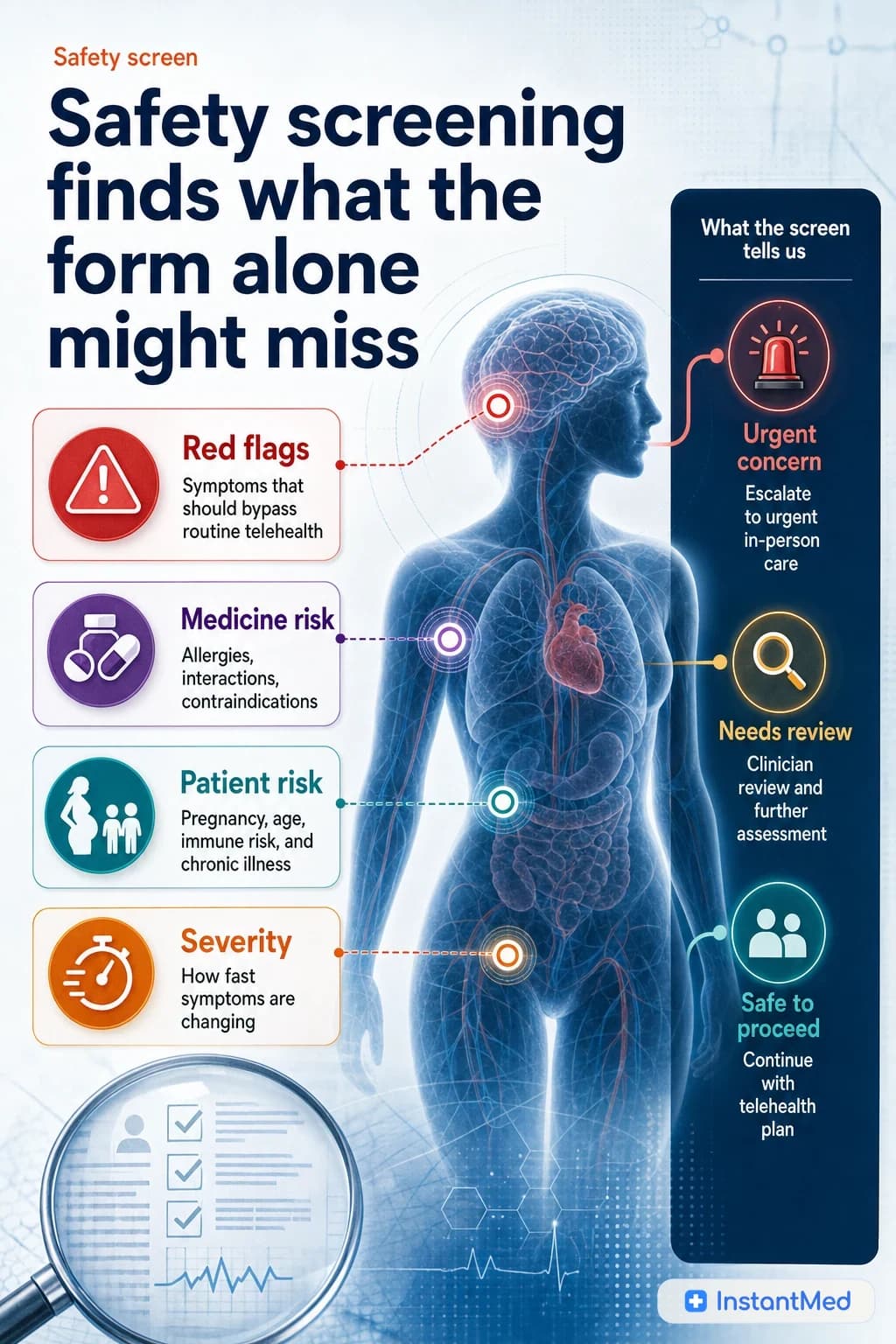
Telehealth safety screening is the clinical filter that decides whether remote care is suitable. It checks symptoms, red flags, medical history, medicines, identity, privacy, and escalation needs before an online outcome is given.
InstantMed Medical Team
11 min read
How to Verify an Online Doctor in Australia
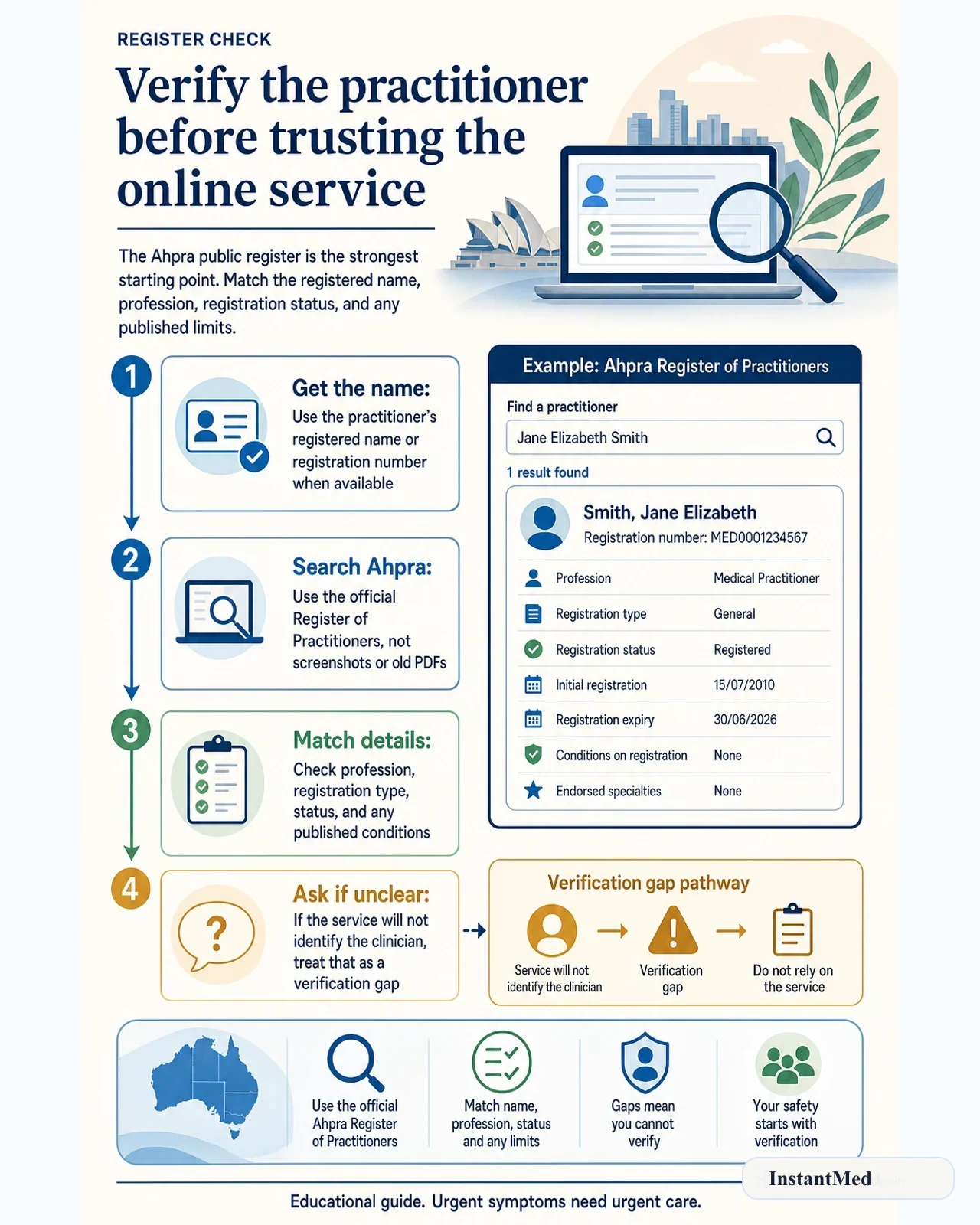
Before using an online doctor or relying on a telehealth document, check the practitioner, the service, the clinical process, and the document. This guide explains how to verify legitimacy without relying on badges or polished PDFs.
InstantMed Medical Team
12 min read
Telehealth Privacy and Security in Australia
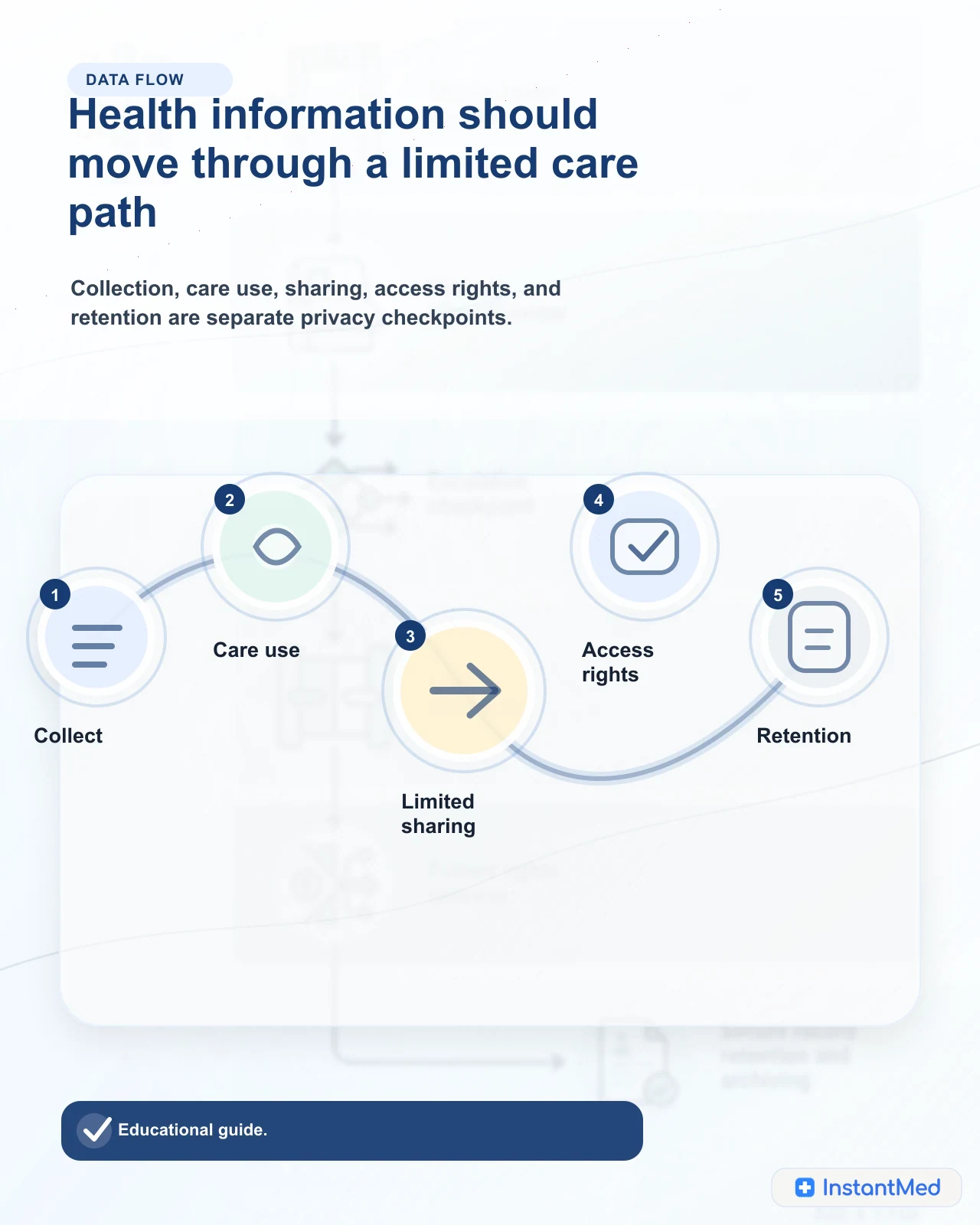
Telehealth privacy depends on law, clinical governance, security controls, and patient-side habits. Learn what to check before sharing health information with an online doctor service in Australia.
InstantMed Medical Team