Loading article
Back to Health Guides
When Telehealth Cannot Help: Knowing the Limits
A practical Australian guide to emergency red flags, in-person assessment needs, prescribing limits, document boundaries, and what to do when online care is not the right first step.
11 min read
·Updated 7 July 2026
·Doctor Reviewed
AHPRA Verified
In this article
- 1Start with the care route, not the convenience
- 2Call 000 for emergency symptoms
- 3In-person assessment is needed when examination changes the decision
- 4Children, pregnancy, and frailty lower the threshold
- 5Prescribing is not just a medicine request
Medical information only. This article is for general information and does not constitute medical advice. Treatment decisions are made by an AHPRA-registered doctor after reviewing your circumstances.
Review
InstantMed Clinical Team
Clinical governance review for guide content
Updated
7 July 2026
General information only, not personal medical advice.
Jump to section
1Start with the care route, not the convenience2Call 000 for emergency symptoms3In-person assessment is needed when examination changes the decision4Children, pregnancy, and frailty lower the threshold5Prescribing is not just a medicine request6Documents have limits too7A safe decline is a useful clinical outcome8Use Healthdirect when the route is unclear9Match the problem to the right place10Information that helps a doctor decide11Where telehealth helps and where it stops12Related guides13Sources
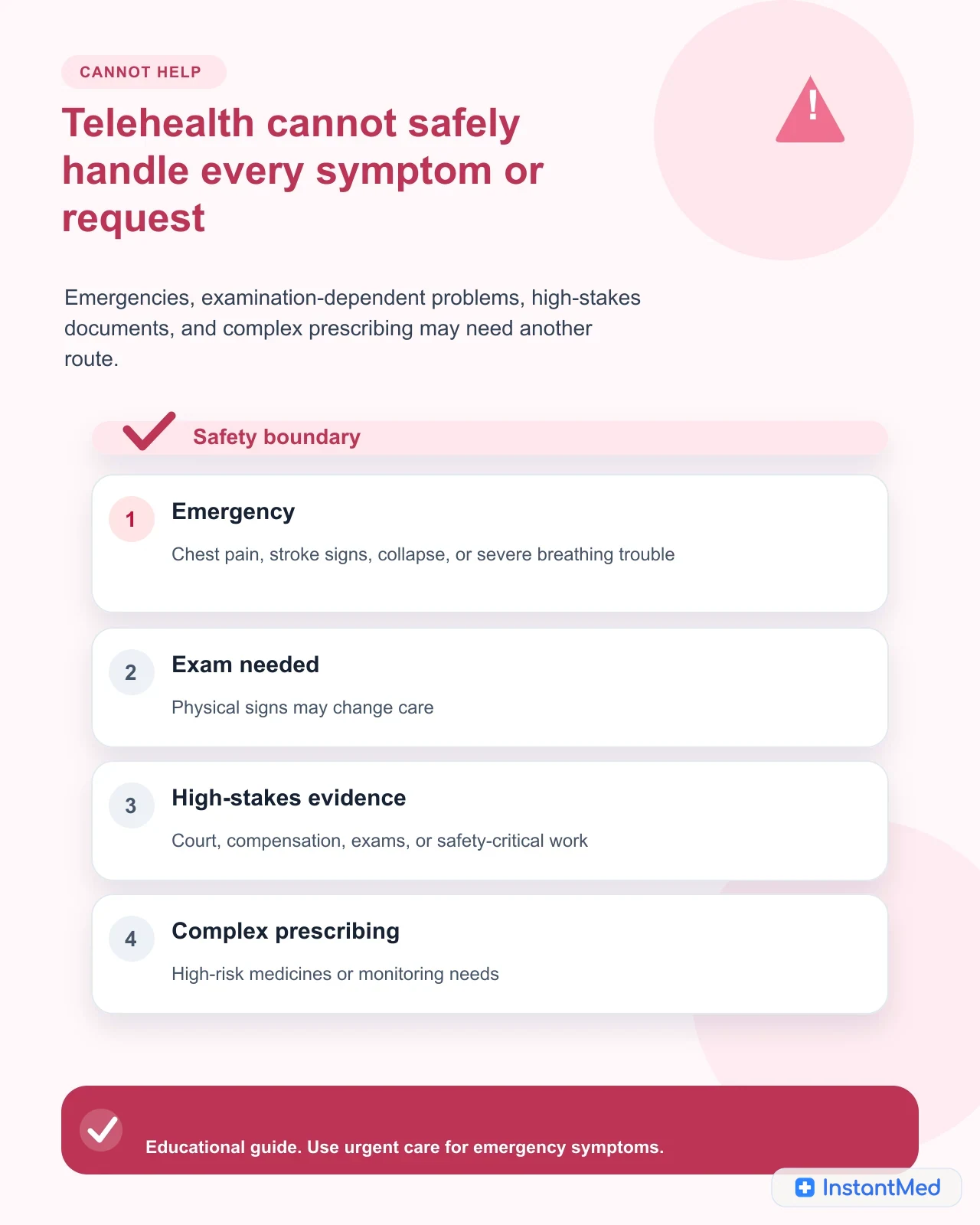
Telehealth is useful when the clinical question can be assessed safely from history, images, video, records, or a real-time conversation. It is not useful when remote assessment would delay emergency care, miss a physical sign, hide a medicine risk, or create a document the doctor cannot support.
The practical rule is simple: if the safe decision depends on hands-on examination, immediate treatment, urgent monitoring, or a clinician who already knows the full history, telehealth may be the wrong first step.
Start with the care route, not the convenience
The question is not "can this happen online?" It is "can this be assessed safely through this channel, with the information available now?"
That matters because telehealth has real limits. The Medical Board of Australia says telehealth is not appropriate for all medical consultations and should not be treated as a routine substitute for in-person care. It also says telehealth care must be safe and, as far as possible, meet the same standards as in-person care.
Call 000 for emergency symptoms
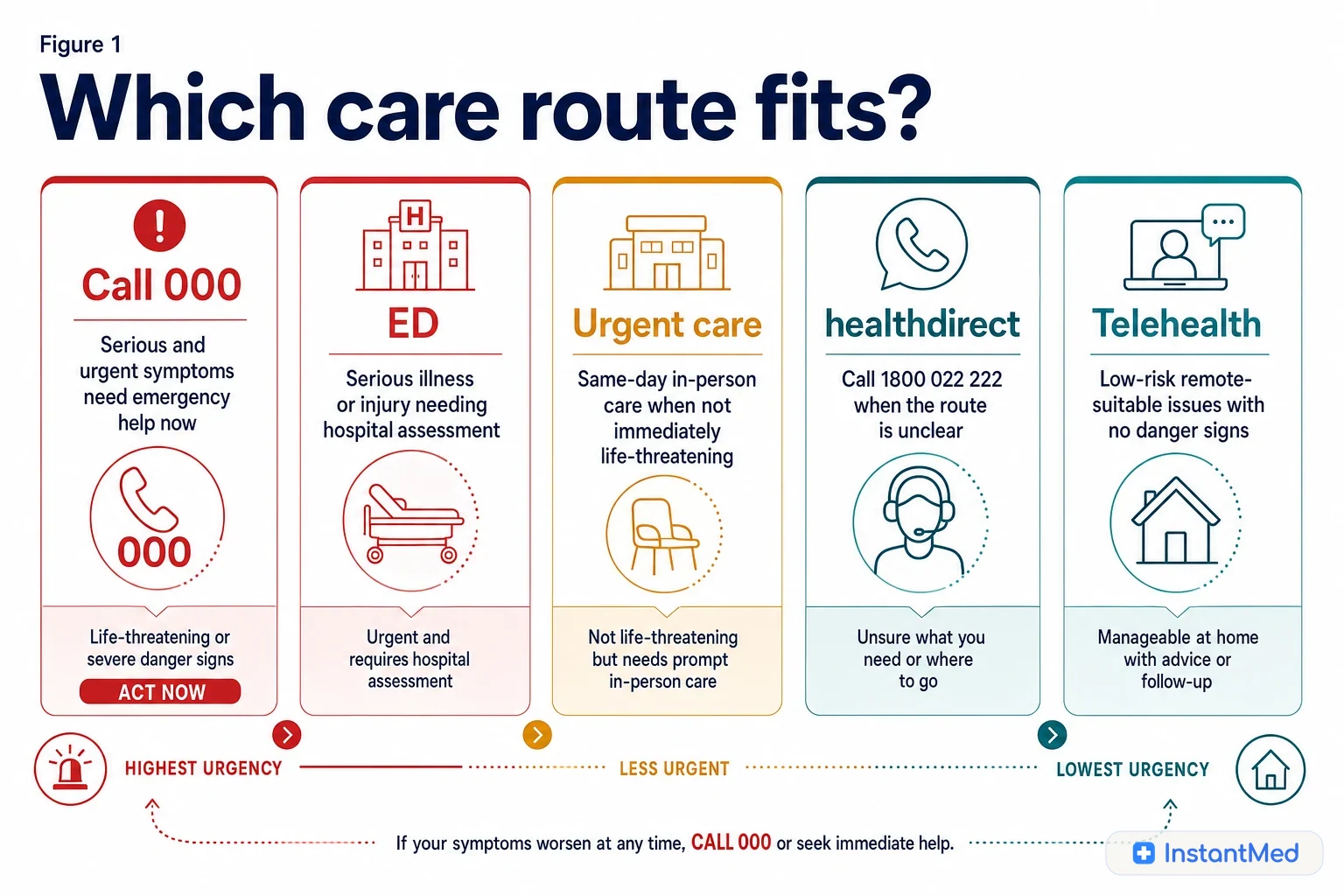
Some symptoms should bypass telehealth. In Australia, triple zero (000) is for serious and urgent situations. Ask for an ambulance if someone needs urgent medical help.
Emergency red flags include:
- chest pain, chest tightness, or symptoms that could be a heart attack
- sudden face, arm, or leg weakness, trouble speaking, or other possible stroke signs
- severe breathing difficulty
- collapse, loss of consciousness, or an unexplained fall
- seizure, especially a first seizure or a prolonged seizure
- uncontrollable bleeding
- severe burns
- major trauma, fall from height, or serious car accident
- severe allergic reaction with breathing, throat, tongue, voice, dizziness, or collapse symptoms
- poisoning, overdose, or a person who is unresponsive or not breathing normally
- suicidal thoughts with immediate danger, or risk of harm to self or others
In-person assessment is needed when examination changes the decision
Telehealth works best when the doctor can make a safe decision from history, records, uploaded images, video, or a phone discussion. It becomes weaker when the important clue is a physical finding.
Examples where in-person assessment may be needed include:
- abdominal pain where the doctor needs to examine tenderness, guarding, swelling, or severity
- chest symptoms where the doctor may need observations, oxygen level, or lung examination
- ear pain in younger children where the eardrum needs to be seen
- eye pain, reduced vision, injury, or possible serious eye inflammation
- injuries where range of motion, deformity, circulation, sensation, or fracture risk must be assessed
- new lumps, suspicious skin lesions, breast changes, or changing moles
- pelvic, genital, rectal, or internal symptoms that require examination
- fever with rash, confusion, dehydration, severe pain, or a very unwell appearance
- pregnancy-related symptoms where examination, ultrasound, pathology, or fetal assessment may be needed
Children, pregnancy, and frailty lower the threshold
Telehealth can be useful for some paediatric, pregnancy-related, older-person, or disability-related care when the service is designed for it and the issue is clearly suitable. But the threshold for redirecting can be lower because risk can change faster or be harder to judge remotely.
Be cautious with telehealth first when the patient is:
- an infant or young child with fever, poor feeding, dehydration, breathing difficulty, drowsiness, or a parent who says the child is not acting normally
- pregnant with pain, bleeding, severe vomiting, fever, reduced fetal movement, possible infection, or worsening symptoms
- older, frail, immunocompromised, or living with complex chronic disease and cannot self-monitor well
- unable to communicate symptoms clearly without support
- alone, unsafe, confused, intoxicated, or acutely distressed
This does not mean telehealth is never possible. It means the doctor may need more context, a support person, video, observations, or an in-person route.
Prescribing is not just a medicine request
An online prescription request is still a medical decision. A doctor may need to know the diagnosis, indication, current medicines, allergies, pregnancy or breastfeeding status where relevant, kidney or liver context, side effects, interactions, monitoring, and whether the medicine is legally suitable to prescribe remotely.
Telehealth may not be able to help when:
Alternative routes
Depending on the issue, the next step may be emergency care, urgent clinic, regular GP, pathology, or specialist review.
- the medicine is for a new undiagnosed condition
- the request involves controlled, dependence-forming, high-risk, or closely monitored medicines
- the patient has not had a real-time consultation where one is clinically needed
- the dose, diagnosis, monitoring, or current medication list is unclear
- recent blood pressure, pathology, imaging, or examination is needed first
- the request conflicts with state, territory, or medicine-scheduling requirements
- the safest plan is review by the usual GP, specialist, emergency department, or local clinic
The Medical Board says prescribing or providing care without a real-time direct consultation is not good practice when it is based only on text, email, live chat, or an online questionnaire and the practitioner has never spoken with the patient. Ahpra's updated 2025 guidance also highlights poor practice concerns around prescribing that relies on text, email, or questionnaires instead of face-to-face, video, or telephone consultation.
Documents have limits too
Telehealth can support routine documents when the doctor can assess the request and make a defensible statement. It cannot create evidence that the doctor does not have.
Requests may need another pathway when they involve:
- workers compensation or workplace injury claims
- court, tribunal, jury, or legal process evidence
- Centrelink capacity forms or insurance forms
- fitness to drive, operate machinery, return to safety-critical work, or perform regulated duties
- backdated periods the doctor cannot clinically verify
- prolonged absence without enough history, records, or treating-clinician context
- specialist certificates, formal impairment opinions, or detailed functional capacity assessments
- study or exam evidence where the institution requires specific wording or direct assessment
The key distinction is routine evidence versus high-stakes opinion. A brief certificate for a short illness is different from a legal, insurance, safety, or capacity statement.
A safe decline is a useful clinical outcome
If a telehealth service declines a request, that is not automatically a service failure. It can be the correct outcome.
A useful decline should tell you:
- why remote assessment is not enough
- whether the next step is emergency care, urgent clinic, regular GP, specialist, pathology, imaging, or more information
- how quickly to act
- whether you should bring medicines, records, photos, previous letters, or test results
- whether the issue can be reconsidered later if new information becomes available
Be careful about resubmitting the same request to multiple services until someone approves it. If the clinical reason has not changed, approval-shopping can increase risk.
Use Healthdirect when the route is unclear
When the problem is not obviously an emergency but you are unsure what to do, Healthdirect can help you choose the next step.
Healthdirect's Symptom Checker is designed for people in Australia. It can advise whether to see a doctor or care for yourself at home, but it cannot diagnose and is not a substitute for professional healthcare. Healthdirect also runs a 24-hour helpline on 1800 022 222.
Virtual care clinics may also be available in some states for urgent but not life-threatening conditions. Healthdirect notes that virtual care is only offered when safe and appropriate, and that the clinician may redirect you to emergency or in-person care if needed.
Match the problem to the right place
| Situation | Better first step | Why telehealth may not be enough |
|---|---|---|
| Life-threatening or serious urgent symptoms | Call 000 or emergency department | Treatment, monitoring, ambulance support, or rapid imaging may be needed |
| Urgent but not life-threatening problem | Urgent care clinic, after-hours GP, or virtual urgent care where available | Observations, examination, tests, or same-day escalation may be needed |
| Physical or internal examination needed | In-person GP or relevant clinic | The key finding cannot be checked reliably by history alone |
| Ongoing complex condition | Usual GP or specialist | Continuity, records, medication history, and monitoring matter |
| High-risk prescribing request | Usual GP, specialist, or in-person care | Legal, monitoring, interaction, dependence, or diagnostic risks may apply |
| Routine low-risk issue with clear history | Telehealth may fit | The doctor can assess remotely and redirect if needed |
| Unsure | Healthdirect 1800 022 222 or Symptom Checker | Triage can help choose emergency, urgent, GP, pharmacy, or self-care options |
Information that helps a doctor decide
If telehealth might be suitable, good information improves safety.
Have ready:
Remote limits
Examination, observations, tests, monitoring, or continuity may be needed before a doctor decides.
- 1
What started, when it started, and whether it is getting better or worse.
- 2
Current symptoms, severity, and anything that worries you.
- 3
Temperature, pulse, blood pressure, oxygen level, or glucose readings if you already have reliable devices.
- 4
Current medicines, allergies, pregnancy or breastfeeding status where relevant, and medical history.
- 5
Photos only if appropriate and privacy-safe.
- 6
What you need from the consultation, such as advice, certificate, repeat prescription review, referral, or next-step triage.
- 7
What you have already tried and whether it helped.
- 8
Any previous test results, discharge summaries, specialist letters, or regular GP advice.
If the doctor asks follow-up questions or redirects you, that is part of safe care rather than friction.
Where telehealth helps and where it stops
Decision guide
Where telehealth helps and where it stops
May fit telehealth
- The symptoms are low risk, the history is clear, the patient can communicate safely, and no urgent or in-person examination signs are present.
- The doctor can ask follow-up questions, review enough information, and redirect if the request is not suitable.
Needs in-person care
- Examination, observations, pathology, imaging, procedure, complex monitoring, continuity from a usual GP, or high-stakes documentation is needed.
- The patient is very young, frail, pregnant with concerning symptoms, unable to communicate safely, or the information is too incomplete to decide remotely.
Urgent care
- Chest pain, stroke signs, severe breathing trouble, collapse, seizure, severe allergy, severe bleeding, poisoning, overdose, major injury, or immediate self-harm risk should bypass routine telehealth.
- Call 000 for serious and urgent symptoms, or use local urgent care when same-day assessment is needed.
Related guides
- When to go to emergency vs telehealth
- Is telehealth safe in Australia?
- How telehealth safety screening works
- Telehealth vs GP in Australia
Sources
- Healthdirect: Calling triple zero (000)
- Healthdirect: Symptom Checker
- Healthdirect: Virtual care clinics
- Healthdirect: Mental health crisis support
- Medical Board of Australia: Telehealth consultations with patients
- Ahpra: Patient safety paramount in updated telehealth guidance
- RACGP: Guidance for appropriate use of telephone and video consultations
Frequently Asked Questions
How do I know if I need emergency care instead of telehealth?
If symptoms are severe, sudden, rapidly worsening, or involve chest pain, stroke signs, breathing difficulty, collapse, seizure, uncontrolled bleeding, severe allergic reaction, major injury, poisoning, overdose, or immediate self-harm risk, use emergency care first. In Australia, call triple zero (000) for an ambulance when the situation is serious and urgent.
What should I do if telehealth declines my request?
Follow the recommended next step. A decline can mean the doctor needs an examination, observations, tests, continuity from your usual GP, urgent care, or more information before it would be safe to decide remotely.
Can Healthdirect help me decide where to go?
Yes. Healthdirect's Symptom Checker is designed for people in Australia and can advise whether to see a doctor or care for yourself at home. You can also call healthdirect on 1800 022 222 for 24-hour nurse advice. It is not a diagnosis or a substitute for emergency care.
Are children suitable for telehealth?
Some older children and teenagers may be suitable for telehealth when the issue is low risk and the service is set up for children. Infants, very young children, fever in young babies, dehydration, breathing difficulty, severe pain, or a child who looks very unwell usually needs urgent or in-person assessment.
Why can prescribing be declined online?
Prescribing depends on diagnosis, medicine history, allergies, pregnancy or breastfeeding where relevant, interactions, monitoring, medicine scheduling, jurisdiction rules, and whether a real-time or in-person consultation is needed. A remote request may be declined when those checks cannot be done safely.
InstantMed Medical Team
Related Articles
12 min read
Emergency vs Telehealth: When to Go to ED and When Not To
Emergency symptoms should not wait for telehealth. This guide explains when to call 000, when ED fits, when urgent care or a GP may be safer, and when telehealth can help.
InstantMed Medical Team

11 min read
Is Telehealth Safe in Australia?
Telehealth can be safe when the service is regulated, the doctor has enough information, and there is a clear path to in-person or urgent care when remote review is not enough.
InstantMed Medical Team
11 min read
How Telehealth Safety Screening Works
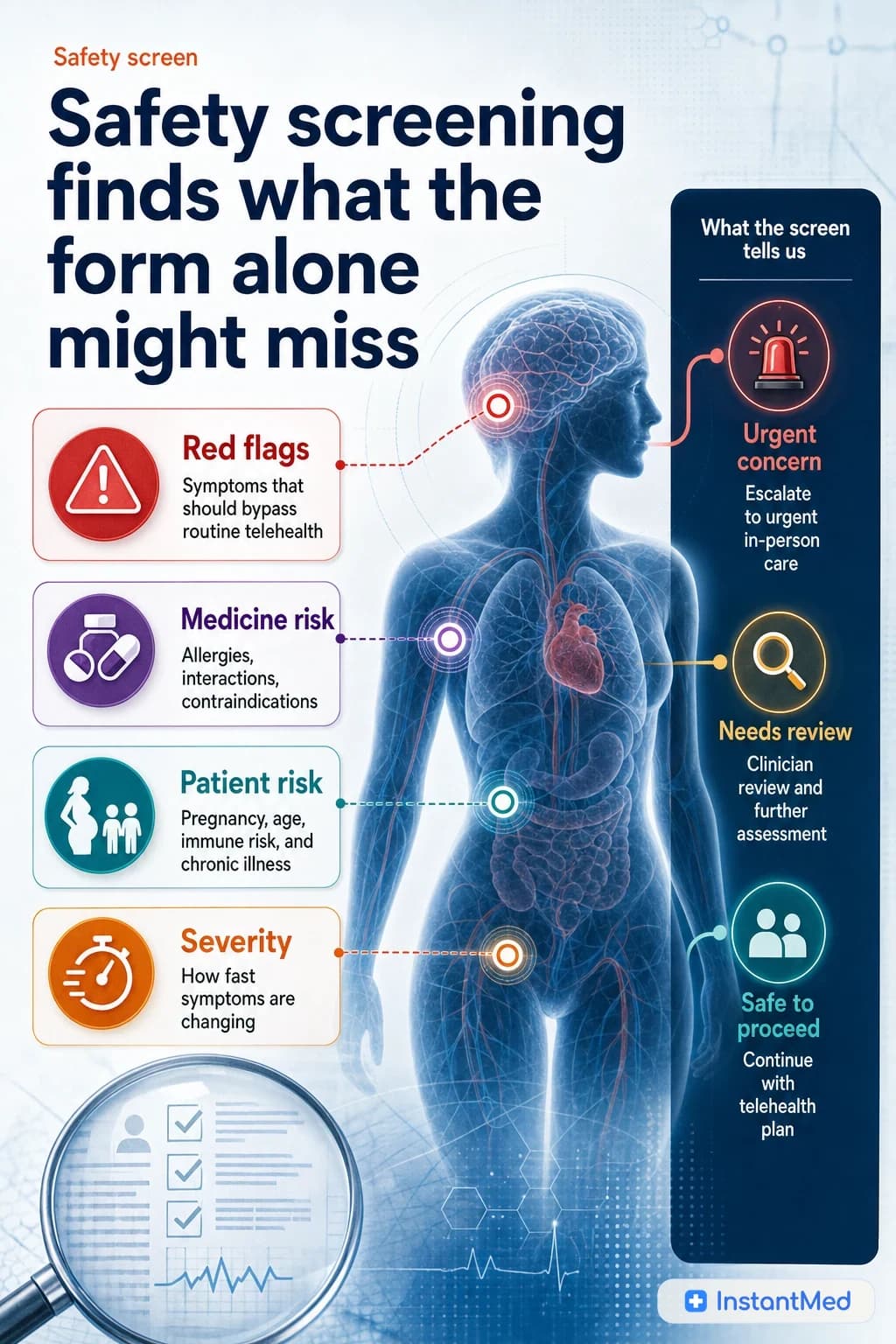
Telehealth safety screening is the clinical filter that decides whether remote care is suitable. It checks symptoms, red flags, medical history, medicines, identity, privacy, and escalation needs before an online outcome is given.
InstantMed Medical Team