Loading article
Back to Health Guides
Telehealth vs GP: What's Actually Different in Australia?
A balanced comparison of remote care and in-person general practice: what each does well, where each stops, how Medicare can differ, and how to choose the safer first step.
11 min read
·Updated 7 July 2026
·Doctor Reviewed
AHPRA Verified
In this article
- 1The practical difference
- 2Head-to-head comparison
- 3What telehealth does well
- 4What GP clinics do better
- 5Medicare and cost are not the same question
Medical information only. This article is for general information and does not constitute medical advice. Treatment decisions are made by an AHPRA-registered doctor after reviewing your circumstances.
Review
InstantMed Clinical Team
Clinical governance review for guide content
Updated
7 July 2026
General information only, not personal medical advice.
Jump to section
1The practical difference2Head-to-head comparison3What telehealth does well4What GP clinics do better5Medicare and cost are not the same question6Safety is the deciding factor7Quality depends on matching the channel to the problem8The hybrid model is usually strongest9Choosing the first step10Where each option fits11Related guides12Sources
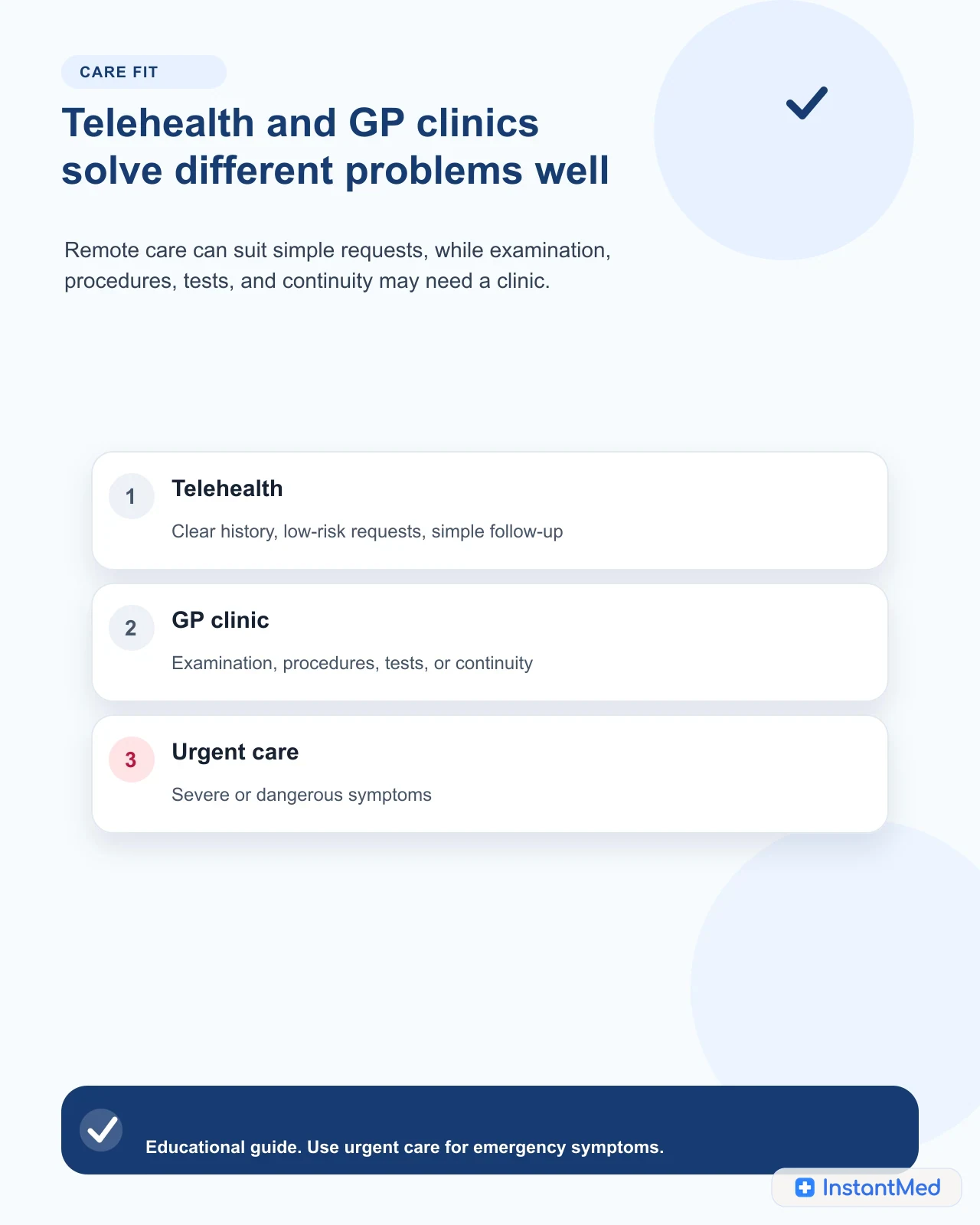
Telehealth is not better than seeing a GP in person. A GP clinic is not automatically better than telehealth. They answer different clinical questions.
The useful comparison is this: does the doctor have enough information to make a safe decision remotely, or does the problem need examination, tests, procedures, monitoring, continuity, or urgent care?
The practical difference
Telehealth changes the channel. It does not remove the doctor's responsibility to assess suitability, protect privacy, keep records, prescribe safely, and redirect when remote care is not enough.
In-person GP care gives the clinician more tools in the room: examination, observations, procedures, vaccination, pathology collection in some clinics, and a better chance of building long-term context.
Telehealth gives access and speed when the question is well suited to remote review. It is especially useful when the issue is clear, low risk, time-sensitive, or follow-up based.
Head-to-head comparison
| Factor | Telehealth may fit | GP clinic may fit better |
|---|---|---|
| Main strength | Access, convenience, follow-up, low-risk administrative or history-based care | Examination, continuity, procedures, complex decision-making |
| Clinical information | History, uploaded images, records, phone, video, medication list | Hands-on examination, observations, physical signs, clinic records |
| Common use cases | Repeat medicine review, simple certificates, advice, follow-up, low-risk triage | New or unclear symptoms, chronic disease, procedures, immunisations, injuries |
| Safety limit | Remote review may miss findings that need touch, instruments, or observations | Still needs escalation when symptoms are urgent or beyond GP scope |
| Relationship | Can be episodic or linked to a usual care plan | Best for longitudinal care and whole-person context |
| Medicare | Some MBS-funded telehealth is available when eligibility rules are met | Standard GP Medicare arrangements may apply, depending on billing and eligibility |
| Cost | Private telehealth may charge a transparent out-of-pocket fee | Bulk billing, mixed billing, or private billing can vary by clinic |
| Best result | Used for suitable remote problems and redirects when needed | Used for examination, continuity, investigations, and complex care |
What telehealth does well
Telehealth works best when the clinical decision mostly depends on history, context, records, images, or a conversation.
Examples can include:
- repeat prescription review where the medicine is established and the history is clear
- routine medical certificates where a short illness or carer's leave can be assessed remotely
- follow-up questions after a previous review
- low-risk advice where urgent symptoms are absent
- medication side-effect questions or interaction checks
- review of non-identifying photos when a service is set up to handle images safely
- mental health check-ins where the patient is safe, able to communicate, and already has an appropriate care plan
- triage to decide whether the next step should be GP, urgent care, pharmacy, pathology, or specialist review
The common feature is not convenience. It is information sufficiency. The doctor must have enough to decide.
What GP clinics do better
GP clinics are strongest when the problem needs examination, equipment, procedures, direct observation, or continuity.
Examples include:
- abdominal pain where tenderness, guarding, swelling, or severity matters
- chest symptoms where oxygen level, lung examination, or same-day escalation may be needed
- ear pain in young children where the eardrum needs to be seen
- injuries where movement, strength, sensation, circulation, or fracture risk must be assessed
- suspicious lumps, breast changes, changing skin lesions, or new growths
- immunisations, injections, wound care, stitches, dressings, and procedures
- chronic disease reviews needing trend data, pathology, physical checks, and whole-person context
- new mental health care planning, complex risk, or crisis presentations
- pregnancy symptoms, young babies, frailty, or complex disability support where remote assessment may be incomplete
Medicare and cost are not the same question
Cost comparisons can be misleading because there are several systems operating at once.
In Australia:
Decision factors
Convenience matters, but safety depends on whether the doctor can assess enough remotely.
- some GP telehealth services may be funded through Medicare when eligibility rules are met
- the Department of Health says GP telehealth eligibility generally requires a face-to-face consultation with that GP or another GP in the same practice in the previous 12 months, with limited exceptions
- MBS Online says ongoing telehealth arrangements remain in place for a wide range of phone and video services by qualified health practitioners
- private telehealth services may operate outside Medicare and charge their own fees
- in-person GP clinics may bulk bill, mixed bill, or privately bill depending on the clinic, patient eligibility, and appointment type
The practical question for patients is: what will this specific service cost me, and is this the right care route for the problem?
Safety is the deciding factor
Telehealth is safe when the problem fits remote assessment and the service can redirect when it does not. It becomes unsafe when convenience overrides clinical need.
For non-emergency but concerning symptoms, a GP clinic, urgent care clinic, virtual urgent care service, or Healthdirect triage may be a better first step.
Healthdirect says virtual care is only offered when safe and appropriate, and that the clinician may help arrange in-person or emergency care when virtual care is not suitable.
Quality depends on matching the channel to the problem
The question "is telehealth as good as a GP?" is too broad. For a suitable low-risk issue, telehealth can be an efficient way to reach a doctor. For a problem that needs examination or continuity, the clinic is better because it has the right tools.
Quality depends on:
- whether the patient can explain the issue clearly
- whether identity, consent, privacy, and records are handled properly
- whether the doctor can ask follow-up questions
- whether the request has enough clinical information
- whether the service is willing to decline or redirect
- whether urgent symptoms have been excluded
- whether the care plan links back to the usual GP when needed
Ahpra's updated telehealth guidance highlights practitioner accountability, necessary history, informed consent, patient identity, and the need to tell patients when telehealth may not meet their care needs.
The hybrid model is usually strongest
For many Australians, the best care pattern is not telehealth or GP. It is telehealth plus GP.
Use your regular GP for:
- chronic disease management
- preventive care and screening
- immunisations and procedures
- new or recurring symptoms that need examination
- complex medicine changes
- mental health care planning and high-risk mental health care
- long-term coordination across specialists, hospitals, and allied health
Use telehealth when:
- the issue is low risk and remote-suitable
- you need timely advice or a document that can be assessed from history
- you need a repeat medicine review and the medicine history is clear
- you are away from home and need triage about the next step
- access, travel, mobility, illness isolation, or work constraints make in-person care harder
Choosing the first step
| Situation | Better first step | Why |
|---|---|---|
| Severe or rapidly worsening symptoms | 000 or emergency care | Treatment and monitoring may be time-critical |
| Injury, severe pain, or possible fracture | GP, urgent care, or emergency depending on severity | Examination and imaging may be needed |
| Stable repeat medicine request | Telehealth may fit | The doctor can review history, safety, and current use remotely |
| New medicine for unclear symptoms | GP clinic may fit better | Diagnosis, examination, or tests may be needed first |
| Routine short illness certificate | Telehealth may fit | The decision may be history-based if no red flags are present |
| Chronic disease review | Usual GP | Trends, monitoring, examination, and continuity matter |
| Mental health check-in with existing plan | Telehealth may fit | Conversation-based care can work when risk is low and support exists |
| Mental health crisis or immediate self-harm risk | 000 or crisis support | Safety and urgent support come before routine consultation |
| Unsure where to go | Healthdirect 1800 022 222 or Symptom Checker | Triage can help choose GP, urgent care, pharmacy, telehealth, or emergency |
Hybrid care
Use each route for the work it handles best: remote review, clinic continuity, and urgent escalation.
Where each option fits
Decision guide
Where each option fits
May fit telehealth
- The issue is low risk, the history is clear, no urgent symptoms are present, and examination is unlikely to change the decision.
- The doctor can ask follow-up questions, document the assessment, and redirect you if remote review is not enough.
Needs in-person care
- The problem needs examination, observations, pathology, imaging, procedures, immunisation, complex medicine changes, or continuity from a usual GP.
- The patient is very young, frail, pregnant with concerning symptoms, unable to communicate safely, or the information is incomplete.
Urgent care
- Serious, sudden, or worsening symptoms should bypass routine telehealth and ordinary GP booking.
- Use 000 for emergencies, or local urgent care when same-day assessment is needed but it is not immediately life-threatening.
Related guides
- Is telehealth safe in Australia?
- When telehealth cannot help
- How telehealth safety screening works
- Is telehealth bulk billed in Australia?
Sources
- Australian Government Department of Health, Disability and Ageing: Telehealth
- MBS Online: MBS Telehealth Services
- Medical Board of Australia: Telehealth consultations with patients
- RACGP: Guidance for appropriate use of telephone and video consultations
- Healthdirect: Virtual care clinics
- Ahpra: Patient safety paramount in updated telehealth guidance
- Healthdirect: Calling triple zero (000)
Frequently Asked Questions
Is a telehealth doctor a real doctor?
Yes. A doctor providing telehealth in Australia must be registered to practise. The consultation channel is different, but the professional obligation to provide safe care remains.
Can telehealth replace my regular GP?
No. Telehealth can complement your regular GP for suitable issues, but it cannot replace continuity, physical examination, chronic disease management, procedures, immunisations, and complex care.
Is telehealth covered by Medicare?
Some telehealth services may be Medicare-funded when eligibility rules are met. The Department of Health says GP telehealth eligibility usually requires a face-to-face consultation with the GP or another GP in the same practice in the previous 12 months, with limited exceptions. Private telehealth services may charge their own fees.
When is a GP clinic better than telehealth?
A GP clinic is usually a better fit when the decision depends on examination, observations, pathology, imaging, procedures, immunisations, ongoing chronic disease management, complex medicines, or whole-person continuity.
When is telehealth a reasonable first step?
Telehealth may be a reasonable first step for low-risk issues where a clear history, images, records, or conversation gives the doctor enough information, and where the service can redirect you if remote review is not suitable.
What if I choose telehealth and the doctor says I need in-person care?
Follow the advice. A redirect to in-person, urgent, or usual-GP care is a safety feature, not a failure. It means the remote channel did not give enough information to make a safe decision.
InstantMed Medical Team
Related Articles

11 min read
Is Telehealth Safe in Australia?
Telehealth can be safe when the service is regulated, the doctor has enough information, and there is a clear path to in-person or urgent care when remote review is not enough.
InstantMed Medical Team
11 min read
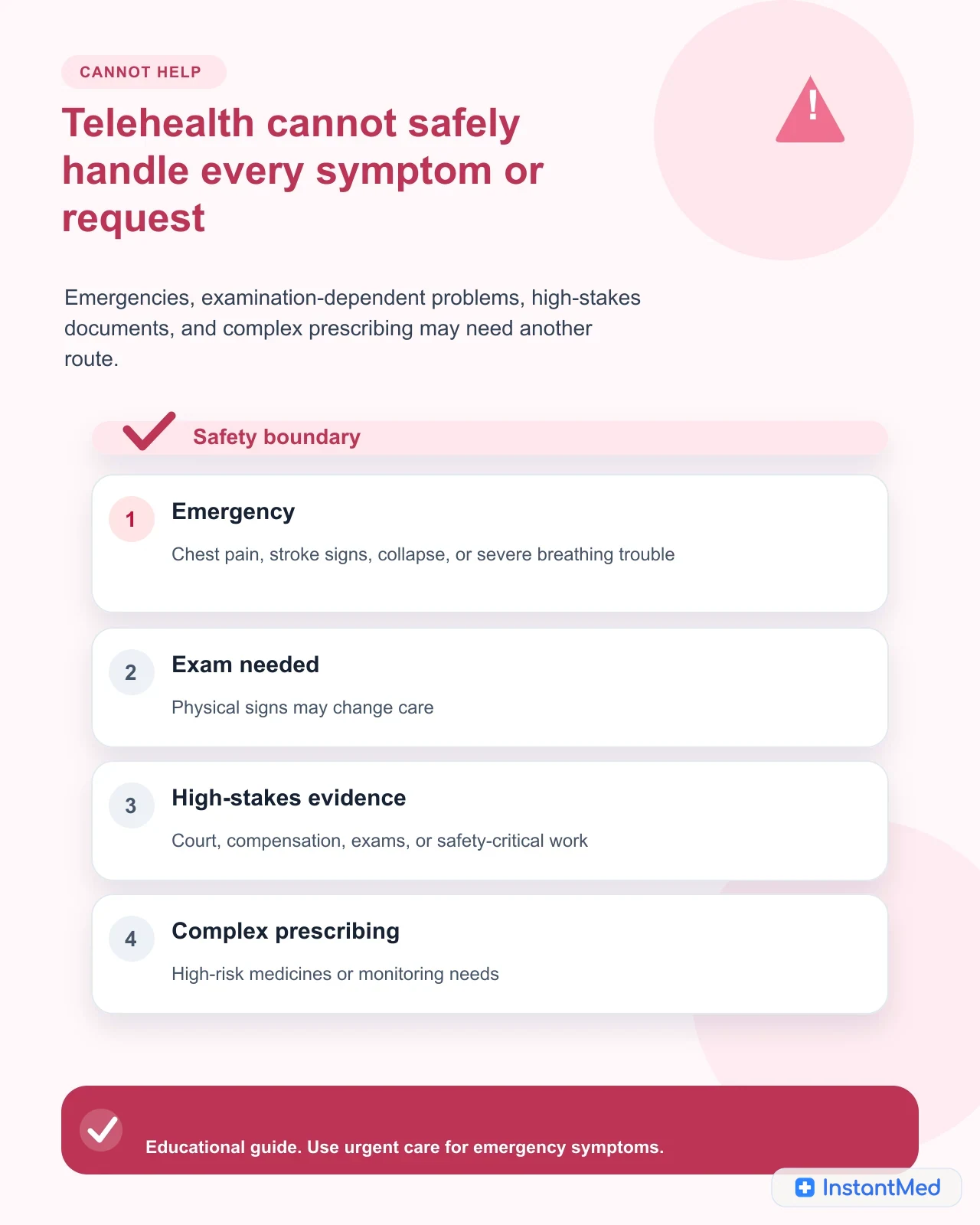
When Telehealth Cannot Help: Knowing the Limits
Telehealth can be safe and useful when the problem fits remote assessment. It cannot replace emergency care, a physical examination, monitoring, or continuity when those are needed. This guide explains the limits and safer next steps.
InstantMed Medical Team
11 min read
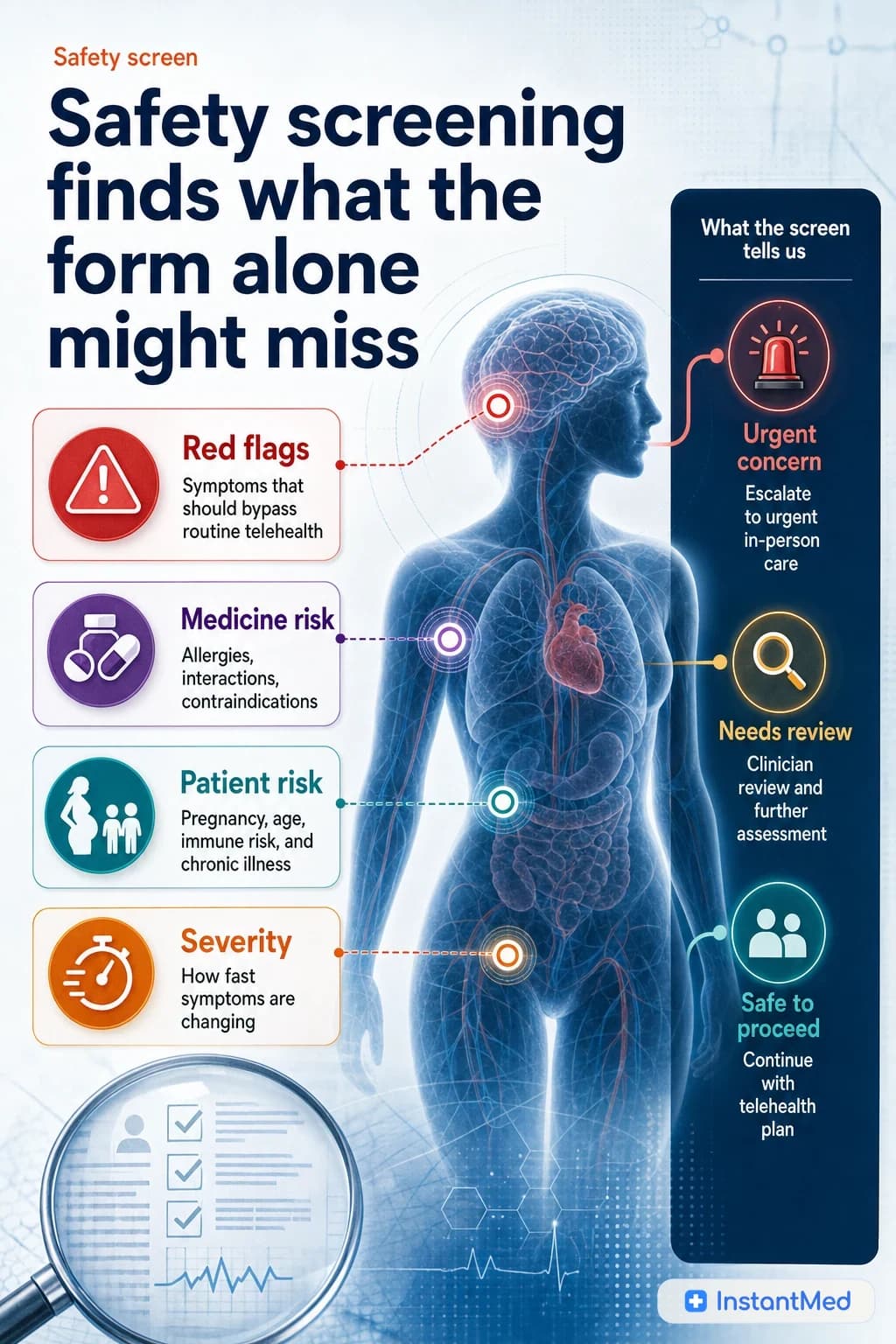
How Telehealth Safety Screening Works
Telehealth safety screening is the clinical filter that decides whether remote care is suitable. It checks symptoms, red flags, medical history, medicines, identity, privacy, and escalation needs before an online outcome is given.
InstantMed Medical Team