Loading article
Back to Health Guides
How Telehealth Safety Screening Works
What doctors check before deciding whether online care is safe, when they ask for more information, and when they redirect you to local or urgent care.
11 min read
·Updated 7 July 2026
·Doctor Reviewed
AHPRA Verified
In this article
- 1What safety screening means
- 2What gets checked before a doctor decides
- 3Why detailed forms can be safer
- 4The core screening pathway
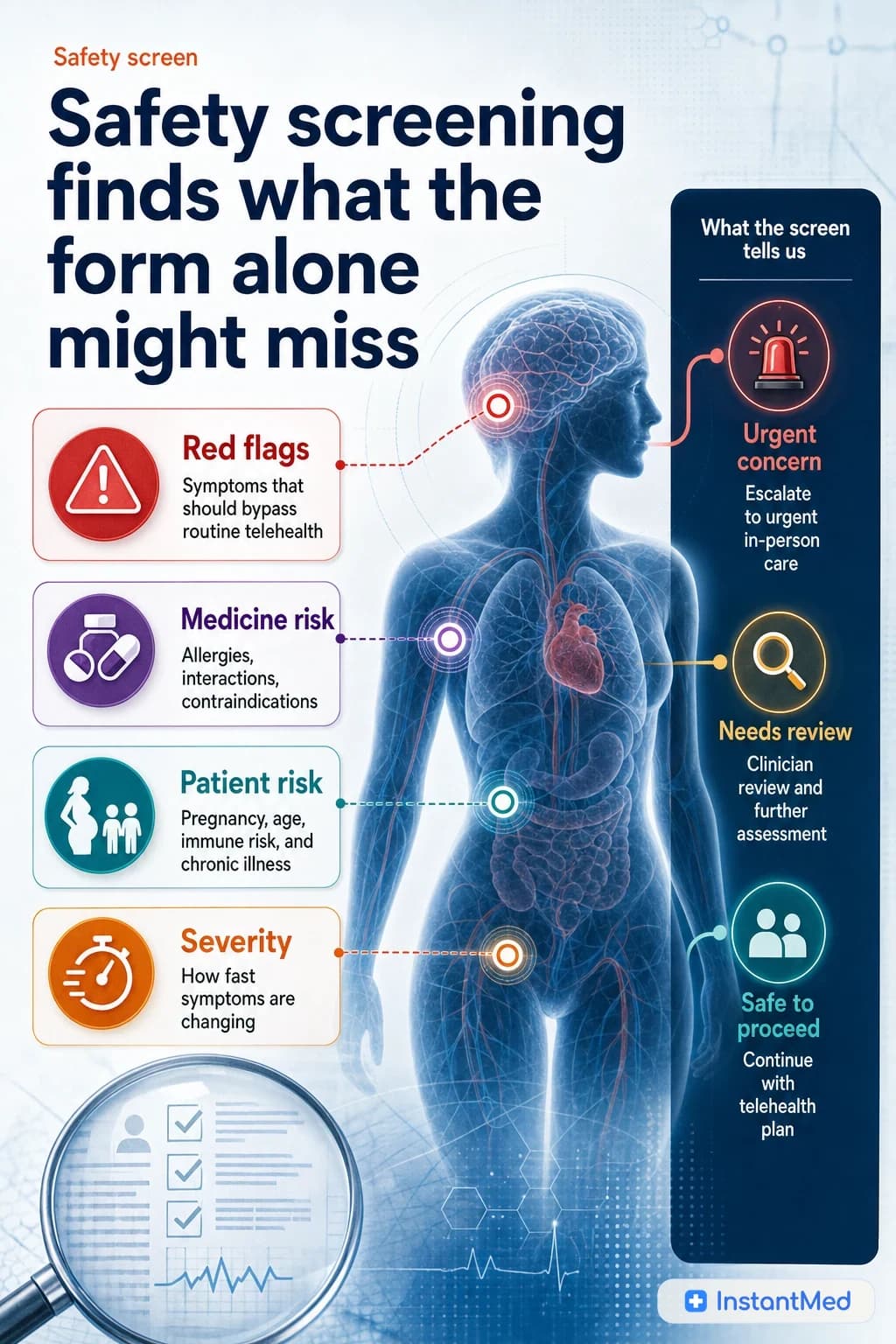
- 5Red flags that should bypass routine telehealth
Medical information only. This article is for general information and does not constitute medical advice. Treatment decisions are made by an AHPRA-registered doctor after reviewing your circumstances.
Review
InstantMed Clinical Team
Clinical governance review for guide content
Updated
7 July 2026
General information only, not personal medical advice.
Jump to section
1What safety screening means2What gets checked before a doctor decides3Why detailed forms can be safer4The core screening pathway5Red flags that should bypass routine telehealth6Prescription and certificate checks need extra care7What happens when information is missing8How to prepare for safety screening9When screening leads to referral or decline10How to assess a telehealth service's screening quality11Related guides12Sources
Telehealth safety screening is the step that decides whether remote care is suitable before an online outcome is given. It is not admin. It is part of the clinical assessment.
The screening process checks the problem, the person, the risk, the medicine context, and the limits of remote care. A safe result can be online advice, more questions, a prescription or document where clinically appropriate, a decline, local review, or urgent care.
What safety screening means
Telehealth changes the way information reaches the doctor. In a clinic, a doctor may observe you, examine you, take vital signs, or notice cues during the consultation. Online, some of that signal has to come from structured questions, uploaded information, conversation, secure records, or follow-up messages.
The Medical Board of Australia supports responsible telehealth, but says it is not suitable for every consultation and should not be treated as a routine substitute for in-person care. The same guidance says telehealth care must be safe and, as far as possible, meet the same standard as in-person care.
That is the point of screening. It helps decide whether the doctor has enough reliable information to continue remotely.
Good screening asks:
- what the patient is asking for
- what symptoms are present and how they are changing
- whether any emergency or high-risk features are present
- whether a physical examination, vital signs, tests, imaging, or procedures are needed
- whether medicines, allergies, pregnancy, breastfeeding, or medical history change the risk
- whether the patient can be identified and contacted
- whether the patient understands the process, privacy limits, cost, and next steps
What gets checked before a doctor decides
Screening is not one question. It is a set of signals that either support remote review or point away from it.
| Screening signal | What the patient provides | What the doctor is checking | Possible outcome |
|---|---|---|---|
| Identity and contact details | Legal name, date of birth, location, contact details | The record and outcome belong to the right person | Continue, clarify, or stop until identity is clear |
| Main problem | Symptoms, request type, timing, severity, photos where relevant | Whether the issue fits remote assessment | Continue, ask more, or redirect |
| Red flags | Severe, unusual, worsening, or dangerous symptoms | Whether urgent or in-person care is safer | Same-day local care or call 000 |
| Medical history | Chronic illness, immune risk, pregnancy or breastfeeding, recent care | Whether usual advice or medicine choices need to change | Continue, modify plan, or refer |
| Medicines and allergies | Current medicines, recent medicines, reactions | Interactions, contraindications, duplicate treatment, allergy severity | Continue, choose safer option, or decline |
| Examination need | What cannot be checked remotely | Whether vital signs, palpation, auscultation, tests, imaging, or procedures are needed | In-person review |
| Privacy and consent | Whether the patient understands and can use the channel privately | Whether the consultation can proceed safely and confidentially | Continue, change channel, or reschedule |
| Follow-up pathway | How the patient can receive advice, results, documents, or escalation | Whether the plan is clear if symptoms change | Online outcome, follow-up, or handover |
The riskier the request, the more important these signals become. A low-risk administrative document and a new medicine request should not be screened in the same way.
Why detailed forms can be safer
A long form can feel frustrating when the patient already knows what they want. But in telehealth, the form may be the first clinical history.
Useful answers are specific:
- "fever for two days, highest 38.6, improving today"
- "rash started after the second dose, no breathing symptoms"
- "taking warfarin and recently started antibiotics"
- "possible pregnancy, not yet tested"
- "chest tightness with shortness of breath"
Those details change the decision. They can separate a low-risk online request from a problem that needs a different pathway.
Poor answers create risk:
- vague timing
- omitted medicines
- incomplete allergy details
- minimised symptoms
- uploaded photos without context
- pressure for a specific medicine or certificate outcome
- inconsistent answers across the form
A safe service should slow down when answers are incomplete or inconsistent. Faster is not better if the doctor does not have enough signal.
The core screening pathway
Most telehealth screening leads to three broad routes, with clarification often sitting inside the online-care pathway before a final decision.
Decision guide
What screening can decide
May fit telehealth
- The issue is low risk, the history is clear, red flags are absent, and the doctor has enough information to make a safe remote decision.
- The doctor may first ask for clarification, a better photo, missing medicine details, allergy details, pregnancy or breastfeeding status, or a clearer symptom timeline.
Needs in-person care
- The problem may need examination, vital signs, pathology, imaging, a procedure, continuity from a usual GP, or same-day care.
Urgent care
- Emergency symptoms should bypass routine telehealth and go through 000, emergency department, urgent care, or local emergency pathways.
The important point is that these are all legitimate outcomes. A service that always approves the requested outcome is not safer than one that redirects when the risk profile changes.
Red flags that should bypass routine telehealth
Some symptoms are not a good fit for routine online review. They may need emergency assessment, hands-on examination, monitoring, or immediate treatment.
Urgent red flags include:
Escalation
The right result may be online care, more information, same-day local review, or emergency care.
- chest pain, pressure, or severe shortness of breath
- stroke signs such as face drooping, arm weakness, speech trouble, or sudden confusion
- collapse, fainting with ongoing symptoms, or severe weakness
- severe allergic reaction, swelling of the face or throat, or trouble breathing
- severe bleeding, head injury with concerning symptoms, or serious injury
- severe abdominal pain, stiff neck, or rapidly worsening pain
- fever with confusion, severe dehydration, or a very unwell appearance
- pregnancy symptoms that could indicate urgent risk
- symptoms in a baby, young child, frail older person, or high-risk patient where deterioration could be rapid
Prescription and certificate checks need extra care
Prescriptions and medical certificates can look simple from the patient's side. Clinically, they still need screening.
For prescriptions, screening may check:
- whether the medicine matches the problem
- whether the dose and medicine class are appropriate for the patient
- allergies and previous reactions
- interactions with current medicines
- pregnancy or breastfeeding where relevant
- kidney, liver, heart, immune, or other relevant medical history
- recent use of the same or similar medicine
- monitoring needs, including blood tests or blood pressure checks
- whether telehealth is appropriate for the medicine and request
For certificates, screening may check:
- the symptom timeline
- the requested dates and purpose
- whether the request is routine or high stakes
- whether the history supports the claimed incapacity
- whether backdating, workplace dispute, insurance, court, or safety-critical work changes the required pathway
What happens when information is missing
Missing information should not be treated as a minor form problem. It can change safety.
A doctor may ask for:
- a clearer symptom timeline
- the name and dose of current medicines
- the exact allergy reaction
- whether the patient could be pregnant or breastfeeding
- a better photo with scale and lighting
- details from a recent GP, hospital, pathology, or pharmacy record
- confirmation of identity, location, or contact details
- whether symptoms are worsening
If the answer still does not give enough clinical confidence, the safer result may be referral or decline.
This matters because telehealth is not a vending process. It is a clinical review with limits. The doctor has to decide what can be done safely with the information available.
How to prepare for safety screening
You can make the process smoother without trying to over-control it.
Before starting a telehealth request:
- 1
Write down when symptoms started and whether they are improving, stable, or worsening.
- 2
List current prescription medicines, non-prescription medicines, supplements, and recent medicines.
- 3
Note allergies and the reaction, not just the medicine name.
- 4
Include relevant medical history such as pregnancy, breastfeeding, immune suppression, kidney disease, heart disease, diabetes, or recent surgery.
- 5
Use clear photos only when they add useful context and the service asks for them.
- 6
Say if you have already seen another clinician or received treatment for the same issue.
- 7
Mention barriers to care, such as being remote, unable to travel, or needing communication support.
- 8
Use a private space where possible, and say if someone else can hear or is helping you.
Do not omit a detail because it might make approval less likely. The detail that changes the outcome may be the detail that protects you.
When screening leads to referral or decline
Referral or decline can feel disappointing, especially when the patient expected a fast online outcome. But clinically, it can be the correct result.
Common reasons include:
Information quality
Timing, severity, medicines, allergies, and prior care help a doctor decide what can happen remotely.
- emergency symptoms
- a problem needing examination
- vital signs, pathology, imaging, or procedures needed
- new or unexplained severe symptoms
- repeated treatment failure
- high-risk medicine request
- pregnancy, young age, frailty, immune risk, or complex medical history
- inconsistent answers or insufficient information
- a document request that needs a different evidence standard
The best telehealth services make this clear before payment or before a patient invests too much time. They should also explain the next step in plain language.
How to assess a telehealth service's screening quality
Before entering sensitive information, look for signs that the service treats screening as healthcare.
Safer signals include:
- clear service ownership, ABN, privacy policy, terms, and complaints contact
- clear practitioner accountability
- identity checks
- symptom and red-flag questions
- medicine, allergy, pregnancy, breastfeeding, and medical-history questions where relevant
- a way for the doctor to ask follow-up questions
- plain explanations for decline, referral, refund, or next steps
- secure handling of health information
- no pressure to pick a medicine or outcome before assessment
Warning signs include:
- approval promises before review
- no meaningful clinical questions
- no clear privacy or complaints pathway
- no ability to redirect to in-person or urgent care
- pressure tactics around payment
- unclear practitioner responsibility
- treating certificates, prescriptions, or referrals as products rather than clinical outcomes
Related guides
- Is telehealth safe in Australia?
- How to verify an online doctor
- Telehealth privacy and security
- When telehealth cannot help
Sources
- Medical Board of Australia: Telehealth consultations with patients
- Ahpra: Patient safety paramount in updated telehealth guidance
- RACGP: Guidance for appropriate use of telephone and video consultations
- RACGP: Principles for conducting telehealth consultations
- Healthdirect: Virtual care clinics
Frequently Asked Questions
What is telehealth safety screening?
Telehealth safety screening is the process of checking whether a health issue is suitable for remote assessment. It gathers symptom details, red flags, medical history, medicines, allergies, identity, privacy context, and escalation needs before a doctor decides what can safely happen online.
Why do online doctor forms ask so many questions?
The form is part of the clinical history. Without a physical examination, the doctor needs enough reliable information to decide whether remote care is appropriate, whether more information is needed, or whether the patient should be redirected to in-person or urgent care.
What happens if my answers trigger a safety concern?
A doctor may ask follow-up questions, decline the online request, recommend same-day local care, or advise urgent care depending on the risk. That is usually the screening process working as intended, not a service failure.
Can a questionnaire replace a doctor consultation?
A questionnaire can collect useful clinical information, but the doctor remains responsible for assessing that information and deciding whether telehealth is appropriate. Regulators warn against unsafe models that rely on text, email, or questionnaires without adequate consultation and clinical judgement.
What red flags should not wait for routine telehealth?
Chest pain, severe breathing trouble, stroke signs, collapse, severe bleeding, severe allergic reaction, confusion, severe dehydration, severe abdominal pain, or rapidly worsening symptoms should be treated as urgent. Call 000 for emergency symptoms.
How can I help the screening process?
Answer honestly, include timing and severity, list all current medicines and allergies, disclose pregnancy or breastfeeding where relevant, upload clear photos only when requested, and say if you are not in a private place or cannot safely use the technology.
InstantMed Medical Team
Related Articles

11 min read
Is Telehealth Safe in Australia?
Telehealth can be safe when the service is regulated, the doctor has enough information, and there is a clear path to in-person or urgent care when remote review is not enough.
InstantMed Medical Team
11 min read
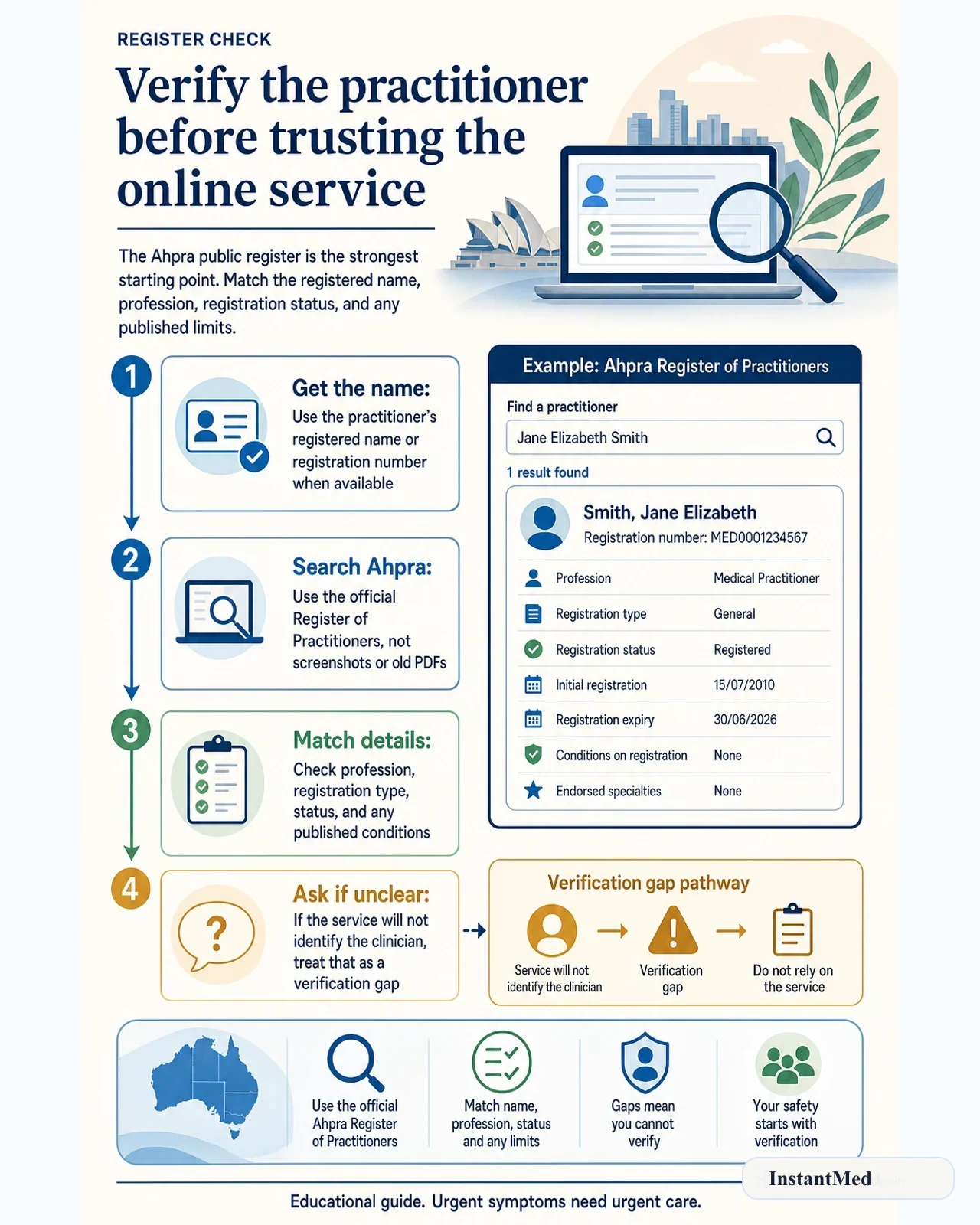
How to Verify an Online Doctor in Australia
Before using an online doctor or relying on a telehealth document, check the practitioner, the service, the clinical process, and the document. This guide explains how to verify legitimacy without relying on badges or polished PDFs.
InstantMed Medical Team
12 min read
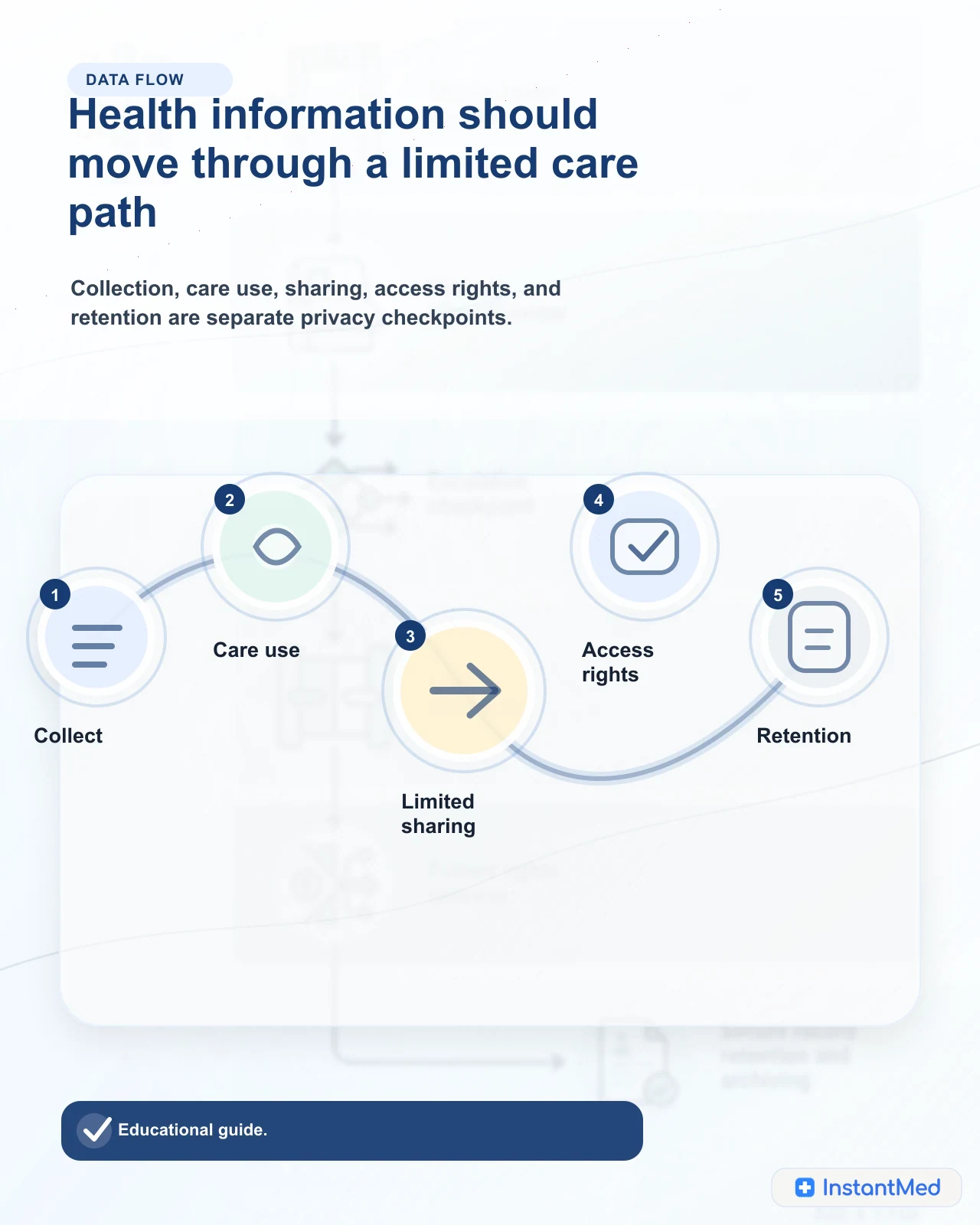
Telehealth Privacy and Security in Australia
Telehealth privacy depends on law, clinical governance, security controls, and patient-side habits. Learn what to check before sharing health information with an online doctor service in Australia.
InstantMed Medical Team