Loading article
Back to Health Guides
Telehealth Privacy and Security in Australia
What Australian privacy law protects, what a telehealth service should explain, and how to reduce privacy risk before sharing health information online.
12 min read
·Updated 7 July 2026
·Doctor Reviewed
AHPRA Verified
In this article
- 1What privacy law covers in telehealth
- 2How telehealth data should move
- 3Security is more than a lock icon
- 4What you can do on your side
- 5What happens if there is a data breach
Medical information only. This article is for general information and does not constitute medical advice. Treatment decisions are made by an AHPRA-registered doctor after reviewing your circumstances.
Review
InstantMed Clinical Team
Clinical governance review for guide content
Updated
7 July 2026
General information only, not personal medical advice.
Jump to section
1What privacy law covers in telehealth2How telehealth data should move3Security is more than a lock icon4What you can do on your side5What happens if there is a data breach6My Health Record is a separate system7How to check a service before sharing details8Your rights if something looks wrong9Common privacy mistakes to avoid10FAQ11Sources Used In This Guide
Telehealth privacy in Australia is protected by the same privacy and professional duties that apply to health services generally. Your symptoms, medicines, history, identity documents, certificates, messages, and consultation notes can all be health information, which is treated as sensitive information under Australian privacy law.
That protection is not automatic just because a website says "telehealth". A safe service still needs clear consent, a readable privacy policy, secure collection, limited staff access, good records, breach procedures, and a way for you to access or correct information. You also need a private device and setting if the consultation involves sensitive details.
What privacy law covers in telehealth
The Privacy Act 1988 and the Australian Privacy Principles (APPs) set the baseline for many Australian organisations and agencies that handle personal information. The OAIC describes the APPs as the core privacy framework for collection, use, disclosure, governance, security, access, and correction of personal information.
For telehealth, the practical point is simple: the service should collect only what it reasonably needs for the healthcare purpose, tell you what is happening, protect the information, and limit how it is used or shared.
| Privacy area | What it means for telehealth | What you can check |
|---|---|---|
| Open privacy governance | The service should publish a privacy policy and give a contact path for privacy questions | Look for a specific privacy policy, not a generic footer line |
| Collection and notice | Health information should be collected with consent and for a clear healthcare purpose | Check whether the form explains why sensitive details are needed |
| Use and disclosure | Information collected for care should not be repurposed casually | Look for clear sharing rules for doctors, support staff, pharmacies, labs, insurers, employers, or government systems |
| Security | The service must take reasonable steps to protect information from misuse, loss, and unauthorised access | Look for secure forms, account protections, and a serious breach process |
| Access and correction | You can request access to personal information and ask for incorrect information to be corrected | Look for a privacy contact or records request process |
| Data breaches | Eligible data breaches must be assessed and notified under the NDB scheme | Check whether the policy explains how the service handles breaches |
How telehealth data should move
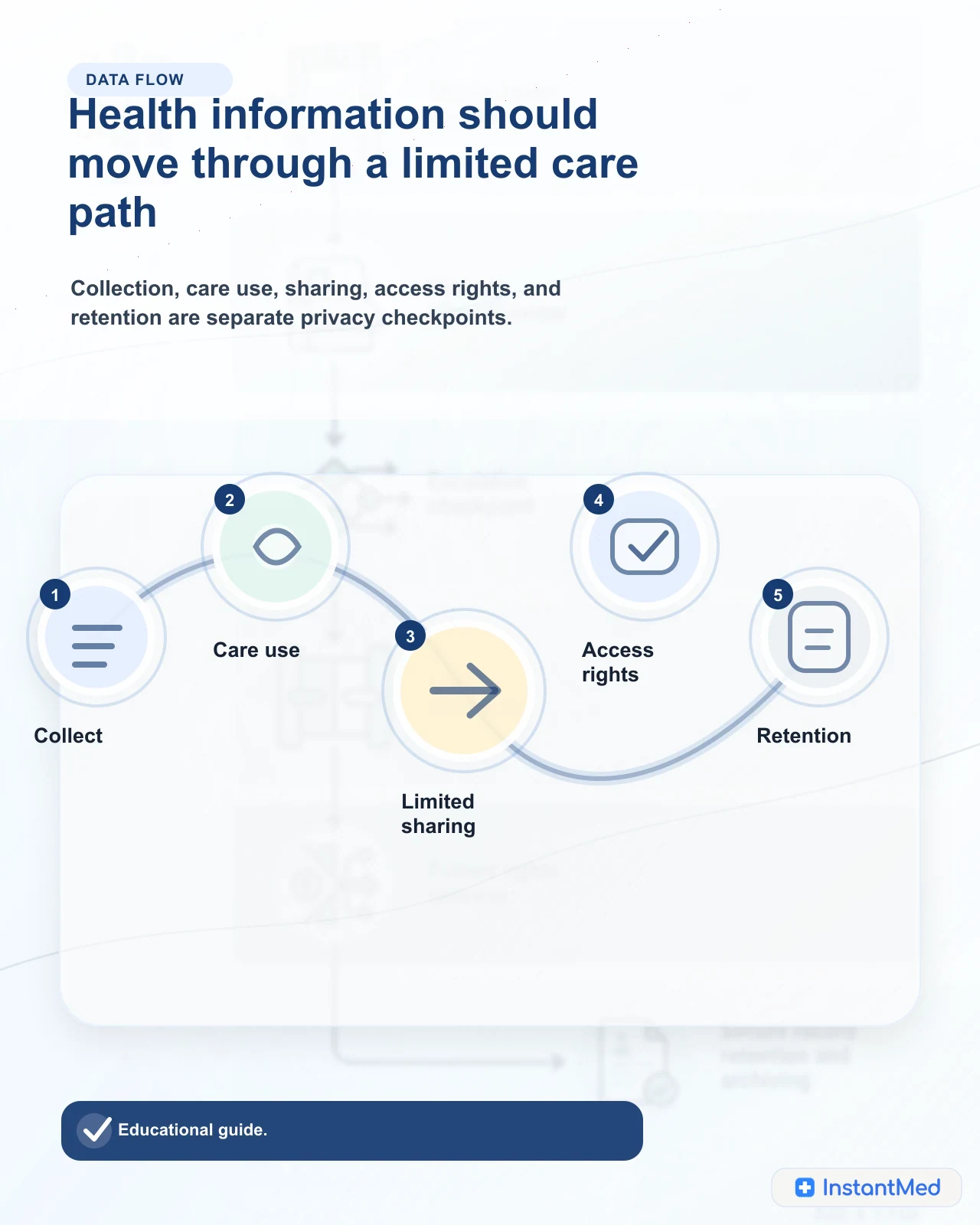
A telehealth consultation usually starts with collection: your identity, contact details, symptoms, medicines, allergies, medical history, documents, photos, or requested outcome. The service should make the purpose clear before asking for sensitive details.
After that, the information should move through a limited clinical path. An AHPRA-registered doctor may need it to assess the request. Support staff may need a narrower slice for payment recovery, identity checks, delivery issues, or complaint handling. A pharmacy, pathology provider, imaging provider, or usual GP may be involved only where clinically relevant and lawful.
The safest privacy design is straightforward: collect the right information once, route it to the right person, document what happened, and avoid unnecessary copies.
Security is more than a lock icon
The browser lock icon tells you the connection is encrypted. It does not prove the whole service is safe.
Good telehealth security is a set of controls working together:
- secure web forms and uploads rather than email attachments for sensitive documents
- encryption in transit and appropriate protection for stored records
- role-based access so staff only see the information needed for their role
- stronger authentication for clinicians and staff accounts
- audit logging so access to sensitive records can be reviewed
- secure deletion or archiving when information is no longer needed for lawful purposes
- breach response procedures that can contain, assess, notify, and reduce harm
Do not treat a technical claim as proof by itself. A privacy policy should still explain how information is handled in plain language, and the service should be able to answer reasonable privacy questions.
What you can do on your side
Some privacy risk comes from the patient environment rather than the service. That does not make it your fault, but it does mean a few small choices can reduce avoidable exposure.
Use a private setting if you are describing symptoms, medicines, sexual health, mental health, domestic safety, workplace conflict, or anything you would not want overheard. If you are using a shared phone or laptop, sign out afterwards and avoid saving PDFs or images where other people can see them. Check autofill details before submitting a form, especially email and mobile number.
Avoid sending health documents through ordinary email or messaging apps unless the service specifically tells you that is the approved process. If you need to upload photos, crop out unnecessary background details and do not include identity documents unless the service asks for them through a secure channel.
The privacy question is not only "Can hackers get in?" It is also "Who can see or hear this today?"
What happens if there is a data breach
A data breach can involve unauthorised access, unauthorised disclosure, or loss of personal information. Under the Notifiable Data Breaches scheme, organisations covered by the Privacy Act must notify affected individuals and the OAIC when a breach involving personal information is likely to result in serious harm.
The OAIC says organisations generally have 30 days to assess whether a breach is likely to result in serious harm. If notification is required, it should explain what happened, what kinds of information were involved, and what steps you should take.
Security controls
Secure collection, role-based access, audit trails, private settings, and breach plans each reduce a different risk.
For telehealth data, practical steps after a notification may include:
- following the service's specific recommendations
- changing affected account passwords
- checking whether identification documents were involved
- watching for scam calls, emails, or messages that use health or identity details
- asking the service whether records were accessed, changed, copied, or disclosed
- contacting the OAIC if the response is unclear or unresolved
Health information can create long-term harm because it is difficult to change once exposed. A serious breach response should be specific, not vague.
My Health Record is a separate system
My Health Record is Australia's national shared digital health record system. It is not the same thing as a telehealth provider's own clinical record.
Some healthcare providers can access or add information to My Health Record when they are connected to the system and have a lawful clinical reason. The Australian Digital Health Agency explains that people can manage privacy and access settings, see access history, set record access codes, restrict documents, and remove or hide some documents.
This means you may have two records to think about:
| Record type | Who controls it | What to ask |
|---|---|---|
| Telehealth provider record | The healthcare service that provided the consultation | How can I access or correct it? How long is it retained? Who can view it? |
| My Health Record | The national digital health record system, with patient access controls | Will anything be uploaded or viewed? Can I restrict access? What settings have I chosen? |
Not every telehealth consultation is automatically uploaded to My Health Record. If it matters to you, ask the provider what their process is.
How to check a service before sharing details
Before submitting sensitive information, do a quick legitimacy check. This is not about finding a perfect website. It is about making sure the basics are visible.
Look for:
- the business identity and Australian contact details
- a privacy policy that specifically covers health information
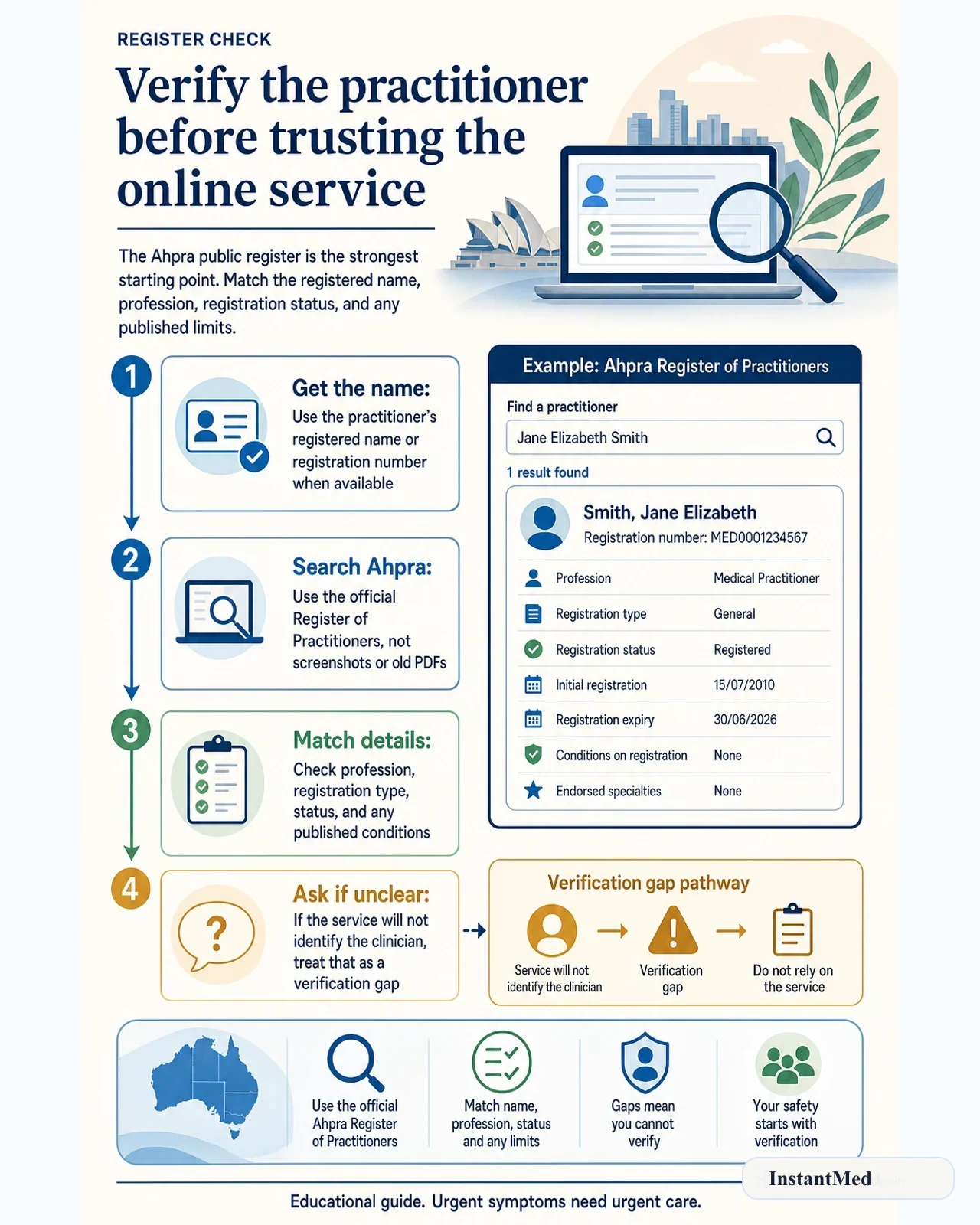
- AHPRA registration or a way to verify doctors through the Ahpra public register
- clear explanation of who reviews the request
- secure form or account workflow
- clear fees, refund rules, and complaint pathway
- a statement that care depends on clinical assessment
- no promise of guaranteed certificates, prescriptions, or outcomes
Decision guide
Choose the safest route before sharing details
May fit telehealth
- The issue is non-urgent, the service is identifiable, and the privacy policy explains health information handling.
- You can verify the doctor pathway and submit information through a secure form or account.
- You have a private device and setting for sensitive details.
Needs in-person care
- You cannot verify who owns or reviews the service, or the privacy policy is missing or generic.
- You need a hands-on examination, immediate observation, or continuity with a clinician who already knows your history.
- Shared-device or household privacy concerns mean an online form is not safe for you today.
Urgent care
- You have emergency symptoms such as chest pain, severe breathing difficulty, stroke symptoms, collapse, severe bleeding, or severe allergic reaction.
- There is an immediate safety risk, coercion, or family violence concern and using a shared device could increase danger.
- You are in crisis or cannot keep yourself safe. Use emergency or crisis support rather than routine telehealth.
Your rights if something looks wrong
If a telehealth record is inaccurate, out of date, incomplete, irrelevant, or misleading, you can ask for correction. If you want a copy of personal information the service holds about you, you can request access. There are exceptions, but a legitimate service should have a process for handling requests.
If you think information has been mishandled, start with the service's privacy contact or complaints process. If that does not resolve it, the OAIC handles privacy complaints. Depending on the issue, a state health complaints body or Ahpra notification may also be relevant.
If something goes wrong
Containment, assessment, notification, patient action, and complaint options are distinct steps.
Common privacy mistakes to avoid
The biggest mistakes are usually practical, not technical.
Do not upload more documents than requested. Do not leave downloaded certificates, scripts, test results, or photos in a shared downloads folder. Do not send screenshots of full medical records when a narrow excerpt would answer the question. Do not use a work email for private health matters if your employer controls the inbox.
Also be careful with family members. It may feel convenient to ask someone else to submit a form, receive an email, or store a PDF, but that can expose information you did not mean to share. If someone helps you, make the consent and contact details clear.
FAQ
Is telehealth less private than going to a clinic?
Not automatically. Telehealth can be private when the service has good controls and you use a private setting. It can be less private if you use shared devices, public spaces, ordinary email, or a service with weak governance.
Should a telehealth service ask for Medicare details?
Sometimes, but only when relevant to the service or billing pathway. If Medicare is not needed for the specific request, the service should not collect it casually.
Can support staff see my health information?
Support staff may need limited information for identity, delivery, payment recovery, or complaint handling. They should not have broad access to clinical records unless their role genuinely requires it.
Can I ask a service to delete my records?
You can ask, but health services may need to retain clinical records for legal and professional reasons. The service should explain retention, secure storage, and what can be corrected, de-identified, deleted, or restricted.
What if I used the wrong email or phone number?
Contact the service immediately. Ask them to pause delivery, update contact details, and confirm whether anything was already sent to the wrong recipient.
Sources Used In This Guide
- OAIC: Australian Privacy Principles
- OAIC: Health information
- OAIC: Notifiable data breaches
- OAIC: What is a notifiable data breach?
- OAIC: Guide to securing personal information
- Medical Board of Australia: Telehealth consultations with patients
- Ahpra: Register of practitioners
- Australian Digital Health Agency: My Health Record privacy and access
Frequently Asked Questions
Is telehealth private in Australia?
Legitimate Australian telehealth services must handle health information under privacy law and professional obligations, but privacy still depends on the service's systems, privacy policy, staff access controls, and your own device and location.
Can I access or correct telehealth records?
Yes. Australian Privacy Principles 12 and 13 give people rights to request access to personal information and correction of information that is inaccurate, out of date, incomplete, irrelevant, or misleading, subject to limited exceptions.
What should a telehealth privacy policy explain?
It should explain what information is collected, why it is collected, who may access or receive it, how it is protected, how long records are kept, how to request access or correction, and how to make a privacy complaint.
What should I do if I am told about a telehealth data breach?
Read the notification, follow the recommended steps, change affected passwords if relevant, watch for scams or identity misuse, and contact the service or the OAIC if the response is unclear or the issue is unresolved.
InstantMed Medical Team
Related Articles

11 min read
Is Telehealth Safe in Australia?
Telehealth can be safe when the service is regulated, the doctor has enough information, and there is a clear path to in-person or urgent care when remote review is not enough.
InstantMed Medical Team
11 min read
How to Verify an Online Doctor in Australia
Before using an online doctor or relying on a telehealth document, check the practitioner, the service, the clinical process, and the document. This guide explains how to verify legitimacy without relying on badges or polished PDFs.
InstantMed Medical Team
11 min read
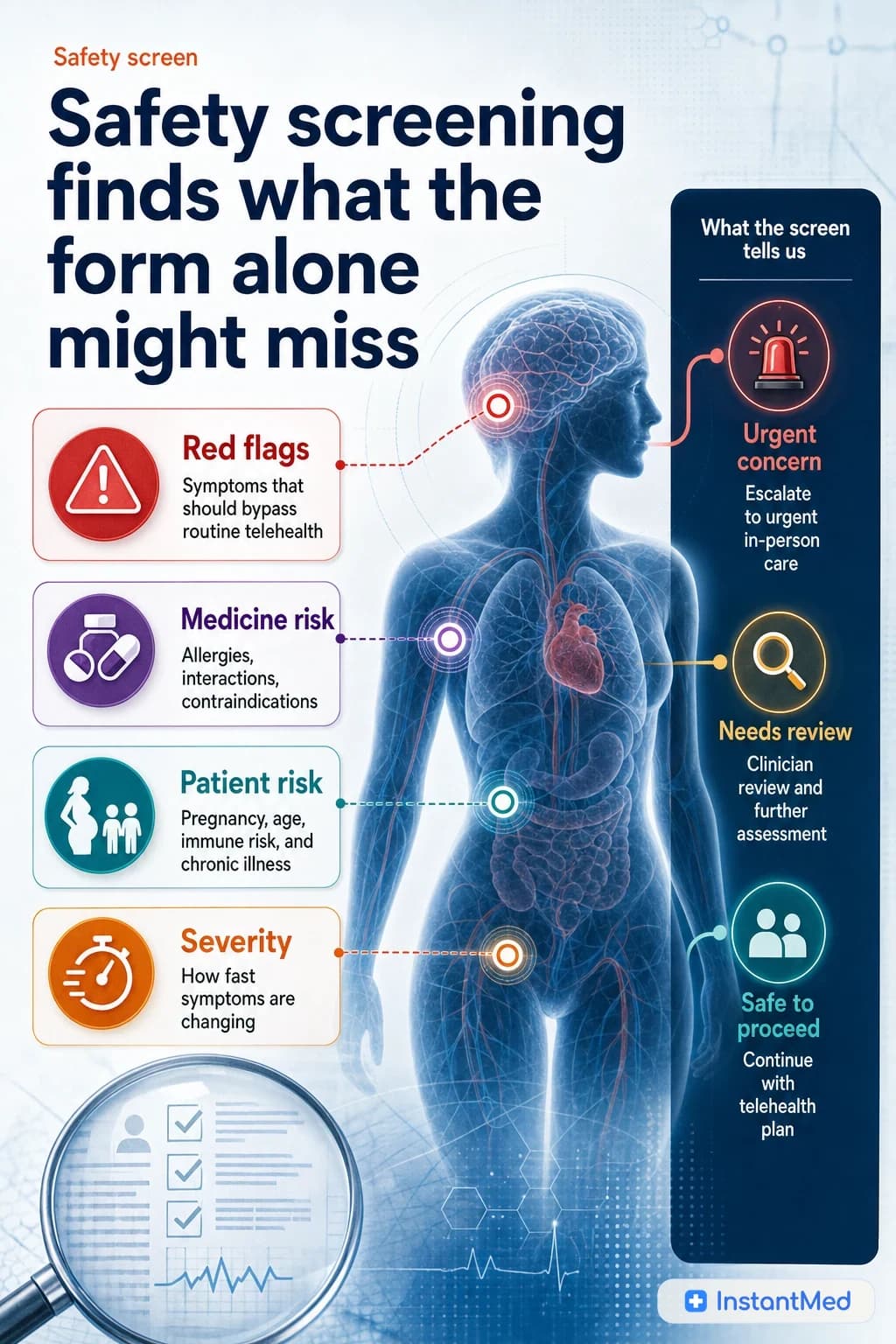
How Telehealth Safety Screening Works
Telehealth safety screening is the clinical filter that decides whether remote care is suitable. It checks symptoms, red flags, medical history, medicines, identity, privacy, and escalation needs before an online outcome is given.
InstantMed Medical Team