Loading article
Back to Health Guides
How to Verify an Online Doctor in Australia
A practical guide to checking Ahpra registration, service accountability, telehealth process quality, document details, privacy signals, prescribing red flags, and complaint pathways.
11 min read
·Updated 7 July 2026
·Doctor Reviewed
AHPRA Verified
In this article
- 1Start with the official register
- 2How to search the register
- 3What registration proves and does not prove
- 4Check the service, not just the doctor
- 5Telehealth standards still apply
Medical information only. This article is for general information and does not constitute medical advice. Treatment decisions are made by an AHPRA-registered doctor after reviewing your circumstances.
Review
InstantMed Clinical Team
Clinical governance review for guide content
Updated
7 July 2026
General information only, not personal medical advice.
Jump to section
1Start with the official register2How to search the register3What registration proves and does not prove4Check the service, not just the doctor5Telehealth standards still apply6Check documents like evidence, not receipts7Prescribing red flags8Privacy and data handling checks9When a hidden doctor is a warning sign10Where to report concerns11Where verification helps12Quick verification checklist13Related guides14Sources
Online healthcare can be legitimate, useful, and safe. It can also be easy to imitate badly. A polished website, quick checkout, or professional-looking PDF does not prove that a real registered practitioner assessed you.
The safest approach is to verify four things: the practitioner, the service, the clinical process, and the document or prescription outcome.
Start with the official register
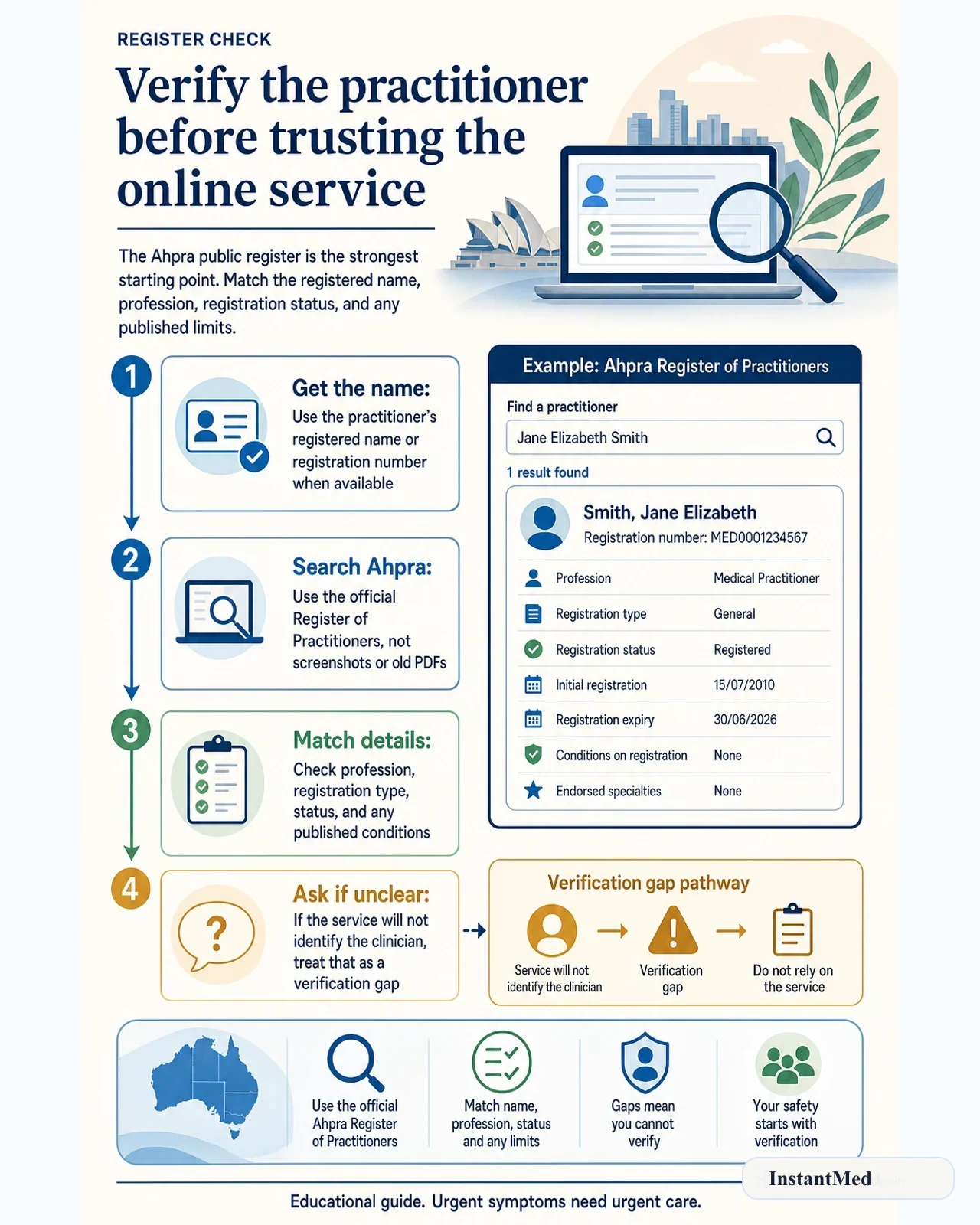
Ahpra keeps the public Register of practitioners for registered health practitioners in Australia. For an online doctor, you are usually checking whether the person is registered under medical practice.
The register can show:
- the practitioner's registered name
- profession
- registration type
- registration status
- registration number
- any published conditions, undertakings, notations, cautions, reprimands, or other limits
- public statements or warnings where applicable
Use the official register directly. A logo, testimonial, downloaded certificate, screenshot, or line on a website can be stale or altered.
How to search the register
Use a simple process.
- 1
Go to the Ahpra Register of practitioners.
- 2
Search by the practitioner's registered name or registration number.
- 3
Select the relevant profession, such as medical practitioner.
- 4
Match the result against the name shown by the service or document.
- 5
Check registration status and registration type.
- 6
Read any published conditions, undertakings, notations, cautions, or reprimands.
- 7
If the name does not match, ask the service for the practitioner's registered name and number.
Names can be tricky. A practitioner may use a shortened name, middle name, married name, or a different public-facing name. Do not assume fraud from one failed search, but do not ignore a mismatch either.
What registration proves and does not prove
Registration is a threshold check. It is not the whole safety check.
| Register result | What it tells you | What it does not prove |
|---|---|---|
| Registered medical practitioner | The person is registered to practise medicine within the published scope | That this specific online consultation was clinically appropriate |
| Specialist registration | The person has specialist registration in a listed specialty | That specialist care was required or provided for your request |
| Conditions or undertakings | There may be published limits or requirements on practice | That the practitioner is unsafe in every setting |
| No matching result | Your search did not find a matching registered practitioner | That fraud is proven; spelling, name use, or profession mismatch may need checking |
| Old certificate or screenshot | Someone once showed a registration-related document | Current registration status or current limits |
The practical standard is: register first, then check the process.
Check the service, not just the doctor
A registered practitioner can still work inside a poor process. A safe telehealth service should make the healthcare pathway understandable.
Look for:
- a real business name, ABN, contact pathway, privacy policy, terms, and complaints process
- clear pricing before payment
- a description of who provides clinical care
- meaningful clinical questions before any outcome
- a way for the clinician to ask follow-up questions
- a willingness to decline or redirect care
- secure handling of forms, images, prescriptions, messages, and records
- plain information about refunds, declines, or next steps
Weak signals include vague phrases like "doctor approved" or "medical team reviewed" without explaining who assessed the request, what profession they belong to, and how follow-up works.
Telehealth standards still apply
The Medical Board of Australia says telehealth is not suitable for every consultation and should not be treated as a routine substitute for in-person care. It expects telehealth care to be safe and, as far as possible, meet the same standard as in-person care.
Important telehealth expectations include:
- the practitioner should identify themselves
- the patient should be identified to the best of the practitioner's ability
- the patient should understand the process and consent
- privacy and confidentiality should be protected
- records, prescriptions, referrals, investigation requests, and images should be handled securely
- the practitioner should continuously assess whether telehealth remains appropriate
- in-person care should be arranged when remote care is not enough
Check documents like evidence, not receipts
If you receive a certificate, prescription-related document, referral, or letter, check it as evidence of care rather than proof by itself.
A credible clinical document should usually make clear:
Service signals
A real service makes clinical care, privacy, fees, and accountability easy to check.
- who issued it
- the practitioner's role and registration details where appropriate
- the patient name
- the date of consultation or issue
- the relevant date or period covered
- the purpose of the document
- contact or practice details
- signature or digital signing method
For routine sick leave certificates, diagnosis is often not needed and may be privacy-sensitive. What matters is whether the document supports the stated purpose and can be tied to a credible assessment.
Red flags include:
- no identifiable practitioner
- no issue date or impossible dates
- no service contact details
- claims that every request is approved
- a document issued instantly with no meaningful assessment
- visible alteration or inconsistent formatting
- a service that refuses to identify who made the clinical decision
Prescribing red flags
Prescribing raises the risk level because the doctor must consider diagnosis, indication, contraindications, interactions, monitoring, pregnancy or breastfeeding where relevant, allergies, medicine scheduling, state and territory rules, and whether in-person care is needed.
Be cautious if a service:
- promises a prescription before assessment
- lets patients choose restricted medicines from a menu without clinical review
- avoids asking about medicines, allergies, pregnancy, medical history, or monitoring
- does not explain when prescribing will be declined
- hides the prescriber
- uses questionnaire-only prescribing for decisions that need real-time contact
- ignores controlled-medicine, monitoring, or jurisdiction requirements
The safe question is not "can this happen online?" It is "can this be assessed safely through this specific online process?"
Privacy and data handling checks
Online health services handle sensitive health information. Before submitting private details, look for a privacy policy that explains health information, not only marketing data.
Check whether the service explains:
- how forms, images, messages, prescriptions, documents, and payments are handled
- who can access records
- whether third parties or overseas providers are involved
- how to contact the service about privacy concerns
- what happens if you need a correction or copy of your information
- whether uploads happen through a secure channel
Avoid sending medical images, certificates, prescriptions, or identity details through public comments, ordinary social media messages, workplace accounts, or unsecured channels when a safer option exists.
When a hidden doctor is a warning sign
Some services allocate a clinician after intake. That can be normal. The warning sign is not "the doctor was not shown in the hero section." The warning sign is that no accountable practitioner is ever disclosed.
A service should be able to explain:
- who reviews the request
- what profession they belong to
- how you can identify the practitioner after the consultation where relevant
- how follow-up questions are handled
- how to raise a complaint
- how documents or prescriptions show practitioner accountability
If the service will not answer those questions, slow down before using the outcome.
Where to report concerns
Different concerns go to different bodies. Keep screenshots, receipts, URLs, practitioner names, registration numbers, document copies, and message history where safe to do so.
| Concern | Possible pathway |
|---|---|
| Registered practitioner conduct | Ahpra or the relevant National Board |
| Health service complaint | State or territory health complaints organisation |
| Scam or suspicious contact | Scamwatch |
| Therapeutic goods or medicine advertising concern | TGA advertising report portal |
| Privacy concern | OAIC or the service's privacy contact |
| Immediate danger | Emergency services |
Red flags
Hidden clinicians, guaranteed outcomes, weak documents, and unclear privacy should trigger caution.
You do not need to prove the whole case before asking the relevant body for guidance. Provide the facts you have and avoid editing screenshots or documents.
Where verification helps
Decision guide
Where verification helps
May fit telehealth
- The practitioner is identifiable and registered, the service has a clear clinical process, the issue is suitable for remote review, and the document or prescription pathway is accountable.
- The service can ask follow-up questions and can redirect when the request is not suitable.
Needs in-person care
- The issue needs examination, vital signs, pathology, imaging, procedures, continuity from a treating clinician, or a document standard remote review cannot support.
- The practitioner or service cannot provide enough identity, clinical, privacy, or complaints information for you to rely on the outcome.
Urgent care
- Severe or rapidly worsening symptoms should bypass routine telehealth and verification checks.
- Call 000 or use local urgent care for emergency symptoms.
Quick verification checklist
Before relying on an online doctor service, ask:
- 1
Can I identify the practitioner where relevant?
- 2
Can I find the practitioner on Ahpra's public register?
- 3
Is the profession correct for the care being provided?
- 4
Are any published registration limits relevant?
- 5
Does the service explain how assessment works?
- 6
Can the clinician ask follow-up questions or redirect care?
- 7
Are fees clear before payment?
- 8
Is privacy explained properly?
- 9
Is there a complaints pathway?
- 10
Does the document contain enough detail to verify it?
If several answers are unclear, pause before submitting health information or relying on the document.
Related guides
- Is telehealth safe in Australia?
- How telehealth safety screening works
- Is telehealth legal in Australia?
- Are online medical certificates valid in Australia?
Sources
- Ahpra: Register of practitioners
- Medical Board of Australia: Telehealth consultations with patients
- Ahpra: Patient safety paramount in updated telehealth guidance
- Ahpra: Health complaints organisations
- Scamwatch: Report a scam
- TGA: Report non-compliant advertising
- OAIC: Health information
Frequently Asked Questions
Can I check whether an online doctor is registered?
Yes. Ahpra's public Register of practitioners is free to use and lists registered health practitioners in Australia, including medical practitioners. Search by registered name or registration number, then check the profession, registration type, status, and any published conditions or undertakings.
What if the doctor's name is not shown before I submit a form?
Some services allocate a clinician after intake, but the service should still explain who provides care, what profession reviews requests, how clinical review works, and how you can identify the practitioner after the consultation. If no identifiable registered practitioner is ever disclosed, treat that as a verification gap.
Does an online medical certificate prove the service is legitimate?
No. A PDF can be fabricated or incomplete. Check whether it names an identifiable practitioner where appropriate, includes relevant dates, contact details, and a credible assessment context, and matches a service with clear privacy and complaints pathways.
Are online doctors held to the same standard as in-person doctors?
The Medical Board of Australia expects telehealth care to be safe and, as far as possible, meet the same standards as in-person care. Telehealth is not suitable for every problem and should redirect care when remote assessment is not enough.
Where can I report a suspicious online health service?
Concerns about a registered practitioner can be raised with Ahpra or the relevant National Board. State and territory health complaints organisations may handle service complaints. Scam concerns can be reported to Scamwatch, and therapeutic-goods advertising concerns can be reported to the TGA.
InstantMed Medical Team
Related Articles

11 min read
Is Telehealth Safe in Australia?
Telehealth can be safe when the service is regulated, the doctor has enough information, and there is a clear path to in-person or urgent care when remote review is not enough.
InstantMed Medical Team
11 min read
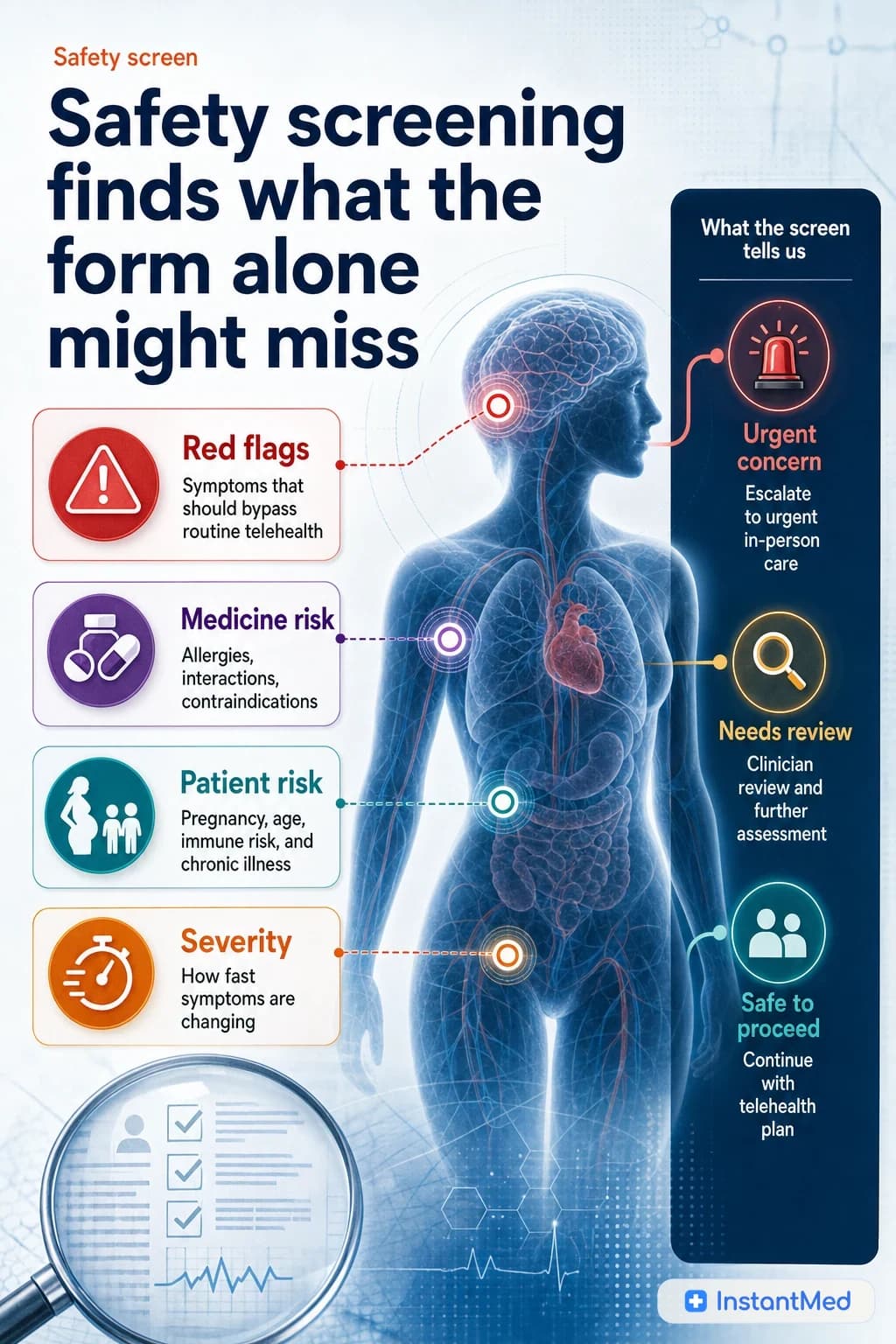
How Telehealth Safety Screening Works
Telehealth safety screening is the clinical filter that decides whether remote care is suitable. It checks symptoms, red flags, medical history, medicines, identity, privacy, and escalation needs before an online outcome is given.
InstantMed Medical Team
11 min read
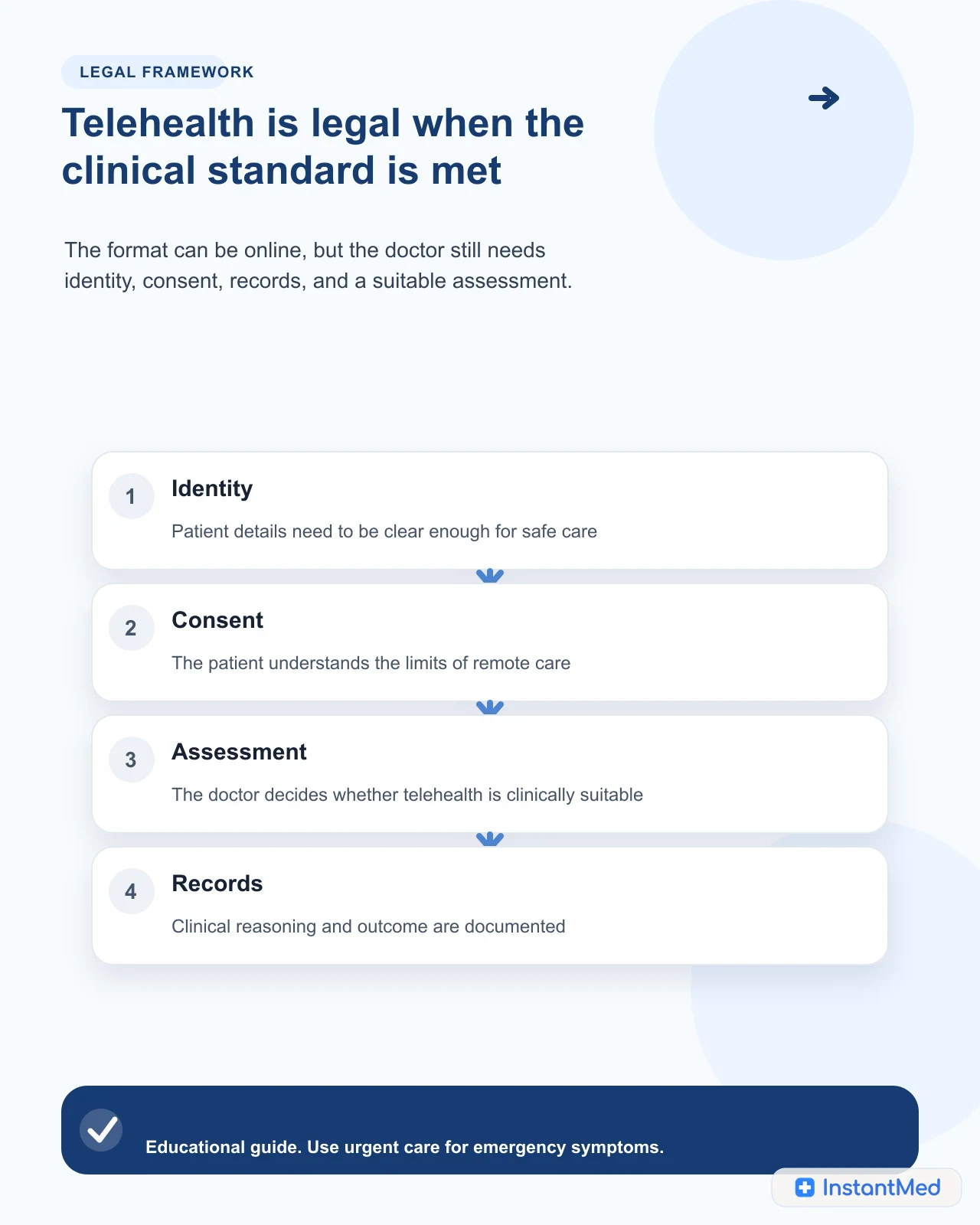
Is Telehealth Legal in Australia?
Telehealth is a lawful way to deliver healthcare in Australia when the practitioner is appropriately registered, the assessment is clinically suitable, privacy and records are handled properly, and prescribing or documentation rules are followed.
InstantMed Medical Team