Loading article
Back to Health Guides
Returning to Work After Illness: When You Are Ready
Medical readiness markers, contagion rules, clearance certificates, phased return, and what to do if you are pressured to come back too early.
7 min read
·Updated 11 June 2026
·Doctor Reviewed
AHPRA Verified
In this article
- 1General Markers of Readiness
- 2Recovery Timelines and Contagion by Illness Type
- 3When a Clearance Certificate Is Required
- 4Communicating With Your Employer
- 5Phased Return to Work
Medical information only. This article is for general information and does not constitute medical advice. Treatment decisions are made by an AHPRA-registered doctor after reviewing your circumstances.
Review
InstantMed Clinical Team
Clinical governance review for guide content
Updated
11 June 2026
General information only, not personal medical advice.
Jump to section
1General Markers of Readiness2Recovery Timelines and Contagion by Illness Type3When a Clearance Certificate Is Required4Communicating With Your Employer5Phased Return to Work6Presenteeism: The Hidden Cost of Returning Too Early7Mental Health Return: Different Markers8Telehealth for Return-to-Work Clearances9Sources Used In This Guide
Deciding when to return to work after illness is not purely a personal choice. It involves your own readiness, potential risk to colleagues, and for some roles, a formal medical clearance requirement. Going back too early has costs: your own recovery takes longer, relapse is more likely, and in contagious illness you may infect colleagues. Here is a clear guide to the markers of readiness, by illness type, and the steps for getting back smoothly.
General Markers of Readiness
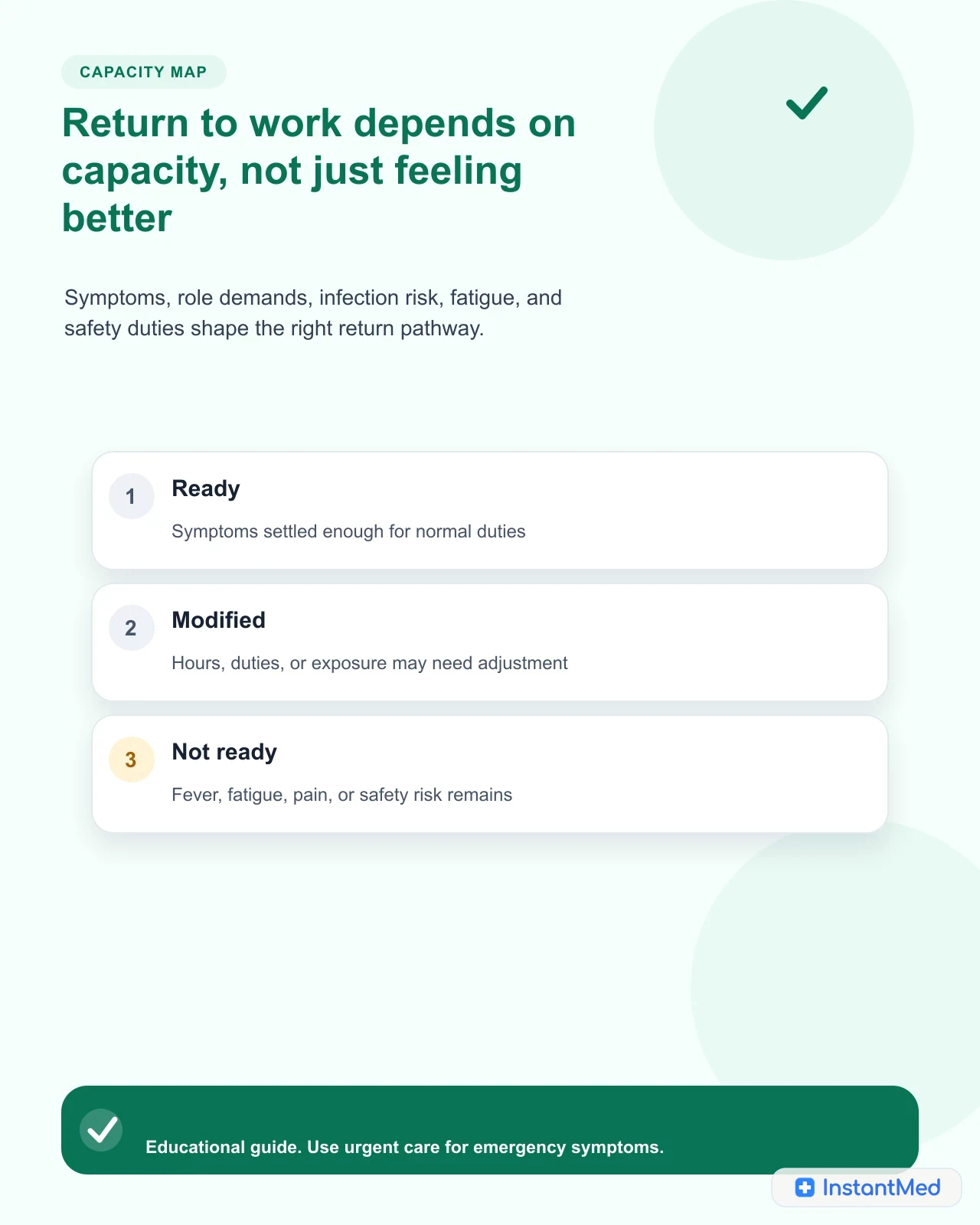
Before returning to work after any illness, assess these four factors:
Fever: You should be fever-free for at least 24 hours without the use of antipyretic medication (paracetamol or ibuprofen). Returning while febrile - even with medication masking the temperature - is a marker of active infection.
Functional capacity: Can you concentrate for sustained periods? Most work requires cognitive function - reading, communication, problem-solving. If your capacity is significantly impaired by fatigue, brain fog, or medication effects, you are not ready to work effectively.
Symptom severity: Symptoms should be at a level that allows you to function at work without constant distraction or need to manage them. Active vomiting, severe coughing, or significant pain is incompatible with most work.
Contagion risk: For infectious illness, consider whether you remain contagious and whether your workplace setting puts colleagues or clients at particular risk.
Key Information
Your medical certificate certifies the period the doctor assessed you as unfit. If you recover faster than expected, you can return before the stated end date. If your recovery takes longer, you will need an extension certificate. The certificate is an assessment, not a contract binding you to a fixed absence period.
Recovery Timelines and Contagion by Illness Type
| Illness | Typical absence | Return markers | Contagious until |
|---|---|---|---|
| Influenza (flu) | 5-7 days | Fever-free 24h, energy recovering | Fever-free 24h; generally 7 days from onset |
| COVID-19 | 5-10 days | Follow current guidelines | Per current public health advice |
| Gastroenteritis | 2-4 days | 48 hours symptom-free | 48 hours after last symptoms |
| Common cold | 3-7 days | Symptoms not affecting function | Days 2-4 most contagious; low risk after day 5 |
| Strep throat | 2-4 days | Fever-free, pain manageable | 24 hours after starting antibiotics |
| Tonsillitis | 3-7 days | Fever-free, able to eat and speak normally | While symptomatic |
| UTI | 1-3 days | Symptoms resolved or substantially improved | Not typically contagious |
| Minor surgery | Varies widely | Cleared by surgeon | Not typically contagious |
| Mental health | Varies | Functional capacity restored | Not applicable |
| Chest infection | 5-10 days | Fever-free, breathing comfortable | While producing purulent sputum |
These are general guides. Severity varies significantly. A mild flu may resolve in 3 days; a severe flu may take 10. Your own recovery trajectory, not the average, should guide your decision.
When a Clearance Certificate Is Required
A "clearance certificate" or "fitness for work certificate" is different from a sick leave certificate. The sick certificate documents your absence; the clearance certificate confirms you are fit to return. Most employers do not require clearance for routine absences. Clearance is specifically required for:
Safety-critical roles: Jobs involving operation of heavy machinery, vehicles, cranes, or high-risk work licences. If your condition affects reaction time, judgment, or physical capacity, your employer has a legitimate safety obligation to verify fitness before allowing you to operate equipment.
Food handling roles: Under Australian and state food safety regulations, food handlers who have had gastroenteritis, typhoid, hepatitis A, or other gastrointestinal infections must obtain clearance before returning to food handling duties. The clearance typically requires at least 48 hours symptom-free, and sometimes a negative stool test.
Healthcare and aged care: Nurses, aged care workers, and other clinical staff returning after respiratory illness or gastroenteritis may require clearance, particularly in aged care settings where residents are vulnerable to severe illness.
Extended absences: After absences of 4-6 weeks or longer, many employers request a return-to-work medical assessment. This is to verify fitness for your specific duties rather than just general fitness - the question is not "are you recovered from your illness" but "are you fit to return to this specific role."
Workers' compensation returns: If your absence relates to a workers' compensation claim, your return is typically governed by the Certificate of Capacity or Work Capacity Certificate system in your state. A treating GP, occupational physician, or the insurer may be involved in planning your return.
Your treating GP can issue a fitness for work certificate. If your employer requires an independent medical examination, this must be at their expense.
Communicating With Your Employer
Good communication before and during your return reduces friction and protects your interests:
When you know you are recovering: Let your employer know you expect to return on a specific date, even before the certificate expiry if you are recovering faster than expected. "I expect to be back on Thursday" is more useful to them than silence until you appear.
If you need more time: Contact your employer as early as possible and get an extension certificate from your doctor. Do not wait until the certificate expires if you already know you need more time.
What to say when returning: "I'm feeling well enough to return to work" is sufficient. You do not need to explain your condition, treatment, or recovery details.
If there is a return-to-work plan: For extended absences, your employer may have an HR or occupational health process. Engage with it cooperatively. These processes exist to support your return, not to create barriers.
Important Warning
If your employer is pressuring you to return before you are medically fit, do not do so simply to avoid conflict. If your doctor has certified you as unfit, you are entitled to that leave. An employer who pressures you to return early despite a current medical certificate may be acting unlawfully. Contact the Fair Work Ombudsman on 13 13 94 if you are facing this situation.
Phased Return to Work
A phased return involves gradually increasing hours or duties over a period of days or weeks. It is most commonly used after:
- Extended absences from serious illness or surgery
- Mental health conditions (burnout, severe depression, anxiety disorders)
- Physical conditions where full capacity returns gradually (back pain or injury, post-operative recovery)
- Workers' compensation return-to-work plans
A typical phased return structure:
- Week 1: 50% of hours (half days, or reduced days)
- Week 2: 75% of hours
- Week 3: 100% return
The exact schedule should be agreed between you, your doctor, and your employer. Your doctor can provide supporting documentation for the arrangement. Most employers are cooperative with phased returns for genuine medical reasons - it reduces the risk of another episode of leave and shows good faith from both sides.
Some awards and enterprise agreements specify how phased returns can be structured. Check yours, or ask your employer's HR team.
Presenteeism: The Hidden Cost of Returning Too Early
Presenteeism - being physically at work but not functioning properly - is estimated to cost Australian businesses significantly more than absenteeism. A study by PwC Australia estimated that presenteeism costs the Australian economy approximately $34 billion per year.
Going back to work before you are ready:
Review points
Ongoing fever, worsening symptoms, injury, mental health risk, or safety-sensitive work may need medical review.
- Impairs cognitive function, increasing errors
- Slows your own recovery, extending the total period of reduced capacity
- Increases risk of relapse, which may result in a longer subsequent absence
- Risks infecting colleagues (in contagious illness)
The pressure to return, whether external from an employer or internal from your own guilt, is often counterproductive. A full recovery before returning consistently produces better outcomes for both the employee and the employer than a premature return.
Mental Health Return: Different Markers
Returning to work after a mental health absence requires a different readiness assessment than physical illness:
- Not just "is the acute episode resolved" but "is the trigger situation manageable on return"
- Whether modifications to your role or environment are needed
- Whether the right support structures are in place (EAP, reduced hours, modified duties)
- Whether medication or therapy changes need time to stabilise
For extended mental health absences, a conversation with your GP or treating psychologist before returning - to develop a return-to-work plan - is more useful than simply waiting until you feel ready. That conversation can also identify whether workplace modifications should be requested (different reporting structure, reduced client contact, work-from-home arrangements), which your doctor can document to support the request.
Telehealth for Return-to-Work Clearances
For straightforward clearance certificates after short routine absences in non-safety-critical roles, telehealth is appropriate. The doctor assesses your current status, confirms recovery, and issues a clearance note.
For safety-critical roles, post-operative clearances, or return-to-work assessments after extended absences, an in-person assessment is generally more appropriate - the clinical picture is more complex and the consequences of an error in judgment are more significant.
Sources Used In This Guide
- Fair Work Ombudsman: Sick and carer's leave
- Safe Work Australia: Work health and safety
- Comcare: Recovery at work
- Healthdirect: Recovering from illness
- Medical Board of Australia: telehealth consultations with patients
Frequently Asked Questions
Do I need a certificate to return to work after being sick?
In most cases, no. A return-to-work clearance certificate is only required for specific situations: safety-critical roles (operating machinery, driving), healthcare and food handling after infectious illness, after extended absences (typically 4+ weeks), or when your employer's policy or award specifically requires one. A standard sick leave certificate does not require a 'clearance' for most jobs.
My employer says I need a fitness certificate before I can return. Is this legal?
For safety-critical roles and extended absences, this is a legitimate requirement. For short routine absences in most jobs, requiring a fitness certificate is unusual and may exceed what the award requires. Check your award or enterprise agreement. If unsure, contact the Fair Work Ombudsman.
When am I contagious after common illnesses?
Influenza: until fever-free for 24 hours and symptoms improving, generally 5-7 days. Gastroenteritis: until 48 hours after last symptoms. COVID-19: follow current public health guidelines. Strep throat: 24 hours after starting antibiotics. Cold (rhinovirus): most contagious days 2-3, generally safe after 5 days if well.
Can I go back to work before my medical certificate expires?
Yes. A medical certificate certifies the period you are expected to be unfit. If you recover faster than anticipated, you can return before the certificate end date. Let your employer know you are feeling better and returning early. There is no requirement to stay off until the exact expiry date.
What is a phased return to work?
A phased return involves gradually increasing your hours or duties over a period of days or weeks rather than returning full-time immediately. It is most commonly used after extended absences, serious illness, surgery, or mental health conditions. A phased return must generally be agreed with your employer and may require documentation from your treating doctor.
What if I return too early and my condition gets worse?
Take additional sick leave. If your condition worsens because you returned before you were fully recovered, you are still entitled to take personal leave. Get a new or extended certificate if needed. Returning too early is common - it does not affect your entitlement to further leave if recovery is incomplete.
InstantMed Medical Team
Related Articles
8 min read
Medical Certificate After Surgery
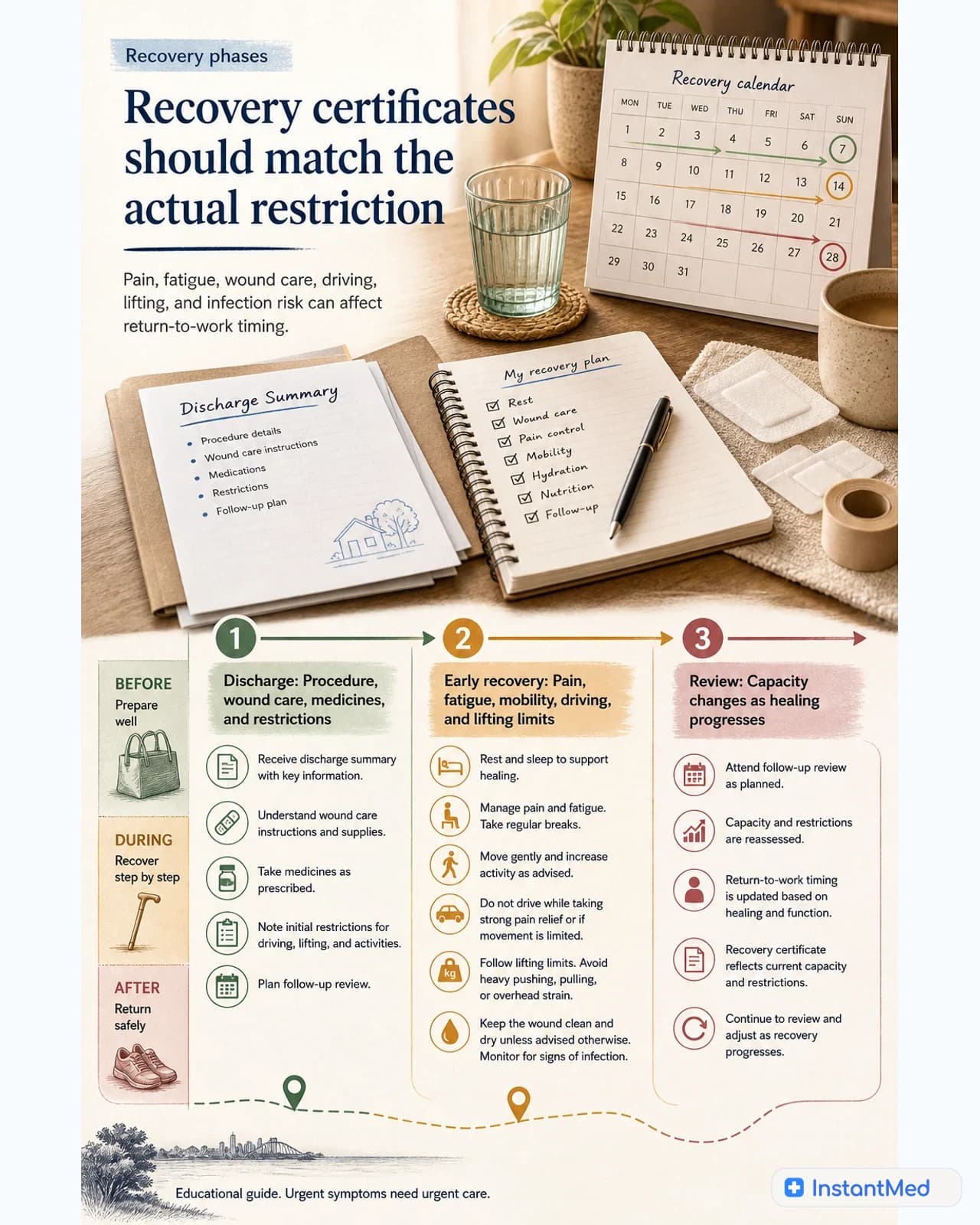
After surgery, a useful medical certificate should match the actual recovery restriction: pain, fatigue, wound care, driving, lifting, hours, and review date.
InstantMed Medical Team
9 min read
Sick Leave Rights in Australia: What You Are Entitled To
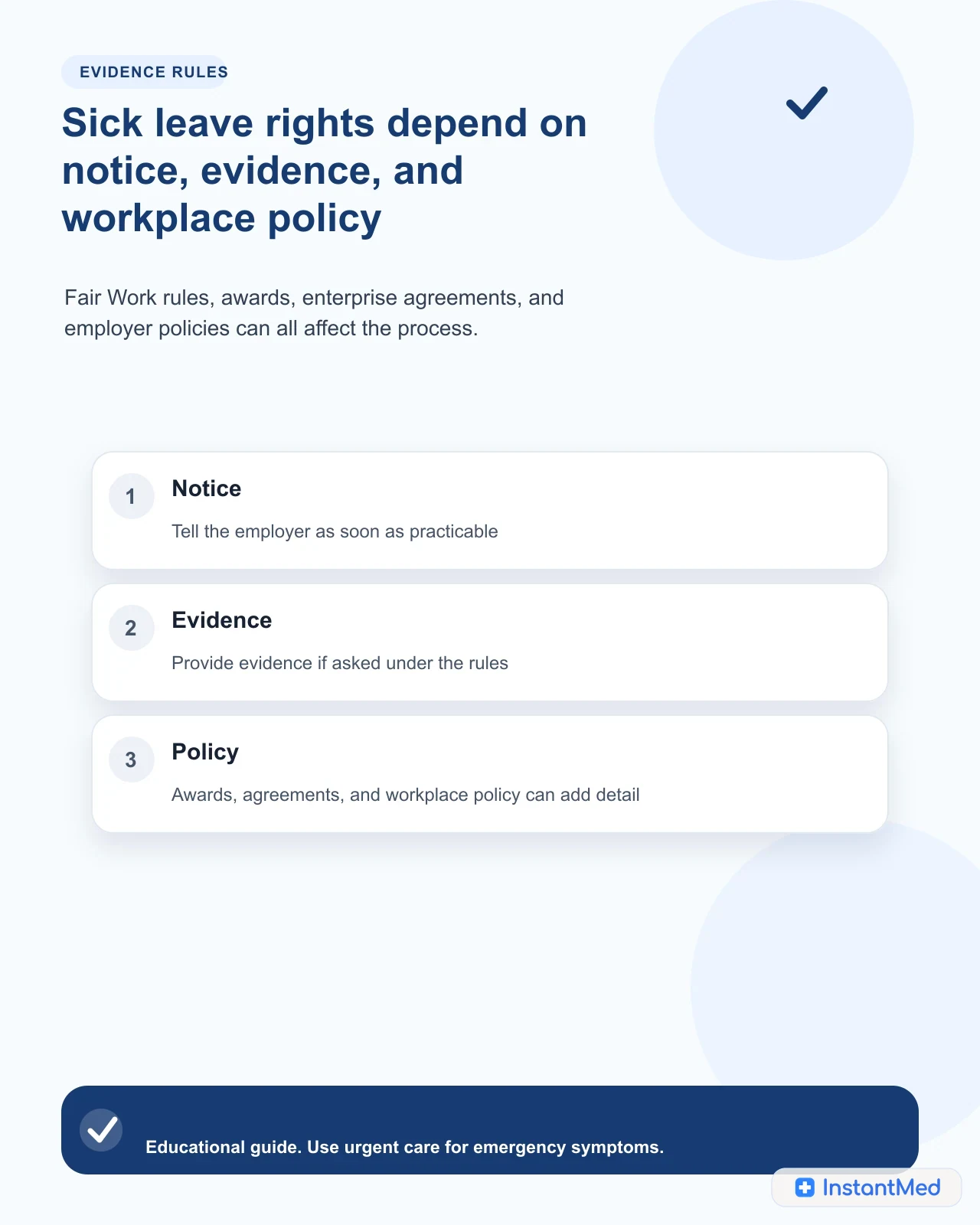
Full-time employees accrue 10 days of paid personal leave per year under the NES. It rolls over, covers mental health, and your employer cannot demand your diagnosis. Here is exactly what the law says.
InstantMed Medical Team
9 min read
Medical Certificates for Work: Complete Australian Guide
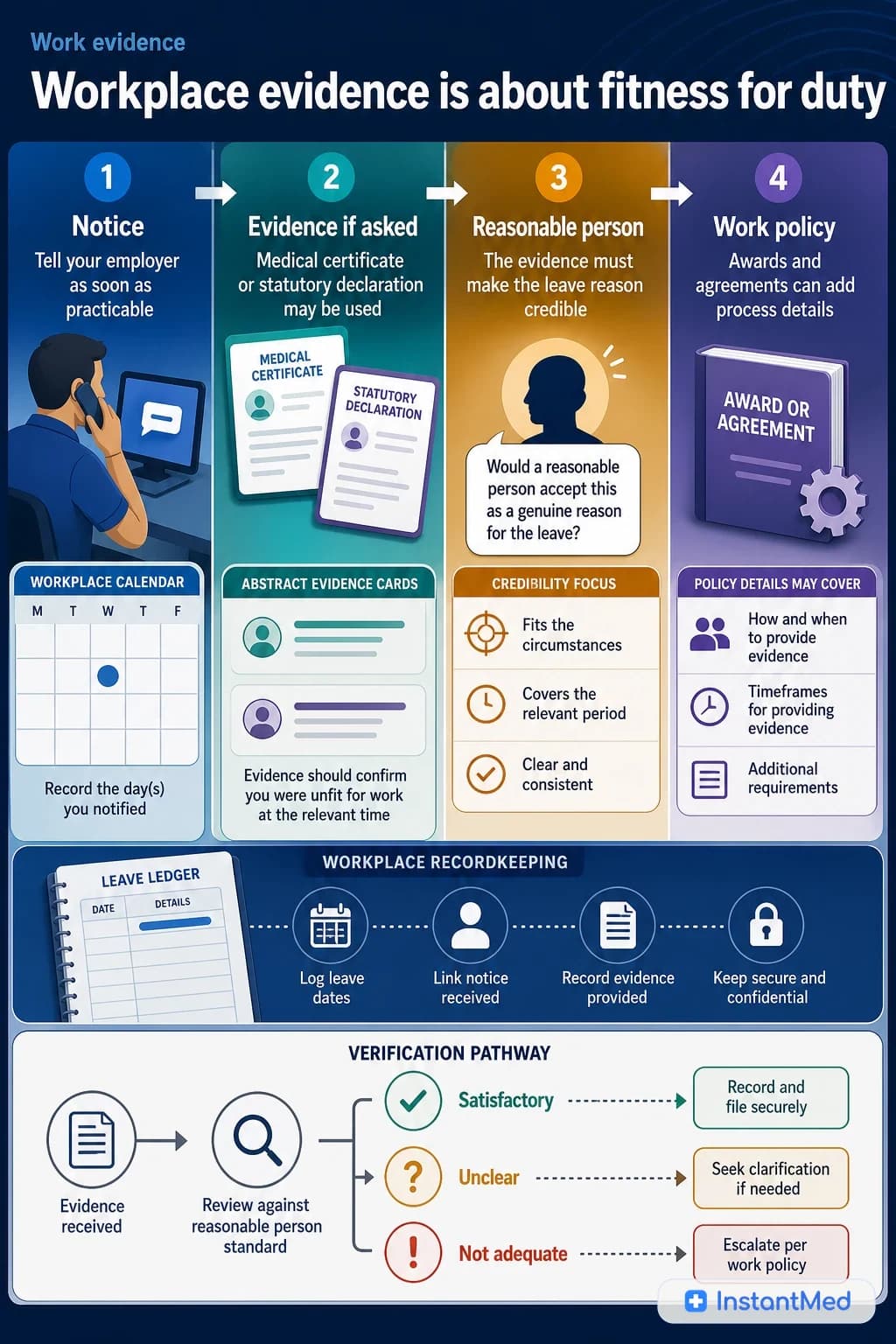
A work medical certificate is evidence that you were unfit for work, not a public explanation of your diagnosis. This Australian guide explains employer evidence rules, privacy, telehealth, stat decs, and return-to-work issues.
InstantMed Medical Team