Loading article
Back to Health Guides
Medical Certificate After Surgery
How surgery recovery evidence should reflect the procedure, restrictions, job demands, and whether workers compensation applies.
8 min read
·Updated 11 June 2026
·Doctor Reviewed
AHPRA Verified
In this article
- 1Start With the Discharge Information
- 2What a Useful Surgery Certificate Should Include
- 3Personal Leave vs Workers Compensation
- 4Recovery Timing Depends on the Job
- 5Anaesthetic and Driving Restrictions
Medical information only. This article is for general information and does not constitute medical advice. Treatment decisions are made by an AHPRA-registered doctor after reviewing your circumstances.
Review
InstantMed Clinical Team
Clinical governance review for guide content
Updated
11 June 2026
General information only, not personal medical advice.
Jump to section
1Start With the Discharge Information2What a Useful Surgery Certificate Should Include3Personal Leave vs Workers Compensation4Recovery Timing Depends on the Job5Anaesthetic and Driving Restrictions6Modified Duties and Graduated Return7Warning Signs During Recovery8If the Certificate Expires9Employer Communication10Sources
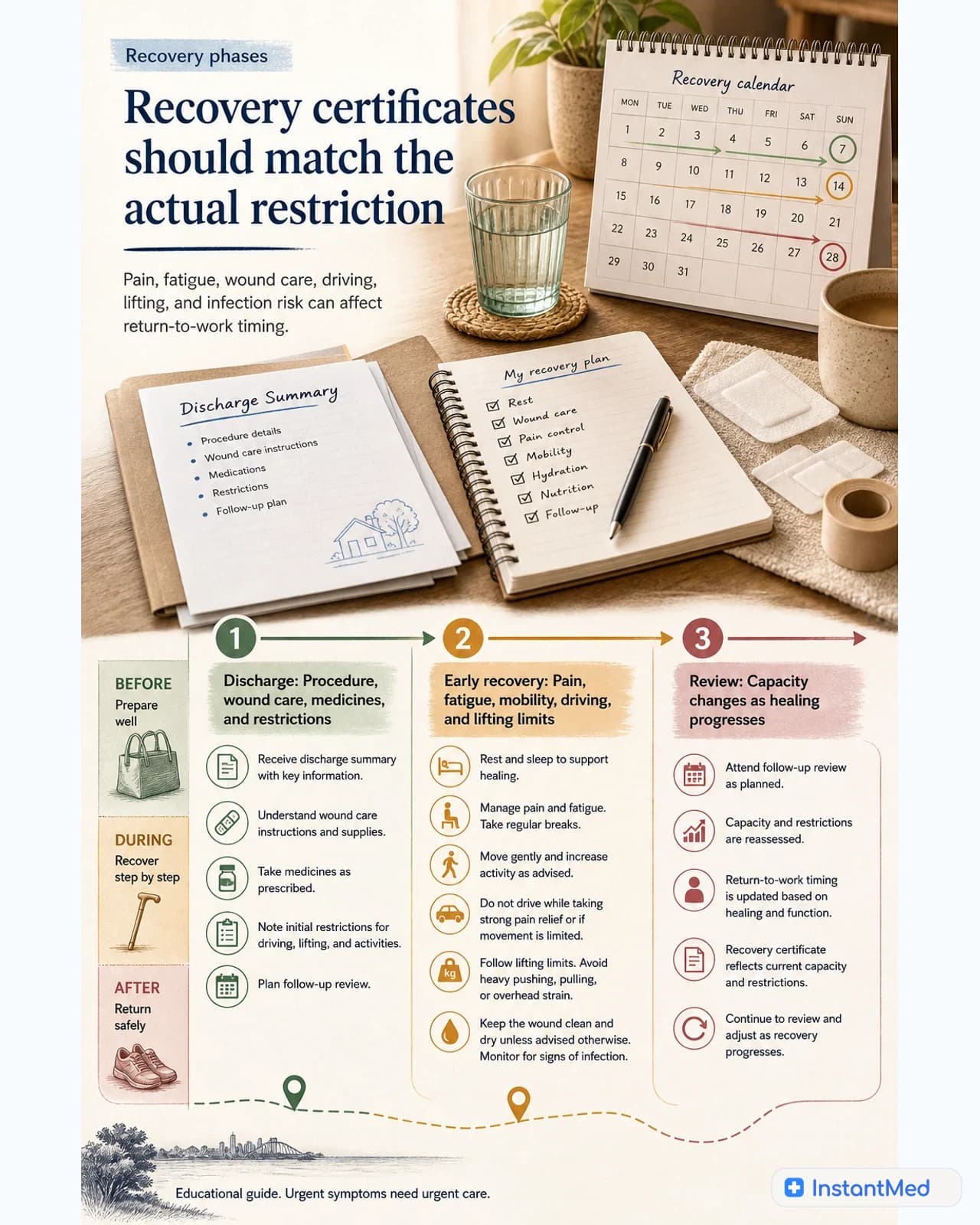
Surgery recovery evidence should answer a practical question: what can the person safely do during this recovery period? A strong certificate is not just a date range. It connects the procedure, current symptoms, wound care, medicines, driving limits, lifting limits, fatigue, job demands, and review date.
The certificate pathway also depends on why the surgery happened. Recovery from a non-work-related condition usually sits in the personal leave system. Surgery caused by a work-related injury or illness may sit in the workers compensation system, where a certificate of capacity or equivalent state document may be required.
Start With the Discharge Information
After surgery, the hospital or surgical team may provide several documents. Keep them together because they explain the context behind any later certificate.
- Discharge summary: procedure performed, diagnosis, complications, medicines, wound care, and follow-up plan.
- Operation or surgeon letter: detail about the procedure and expected restrictions.
- Initial medical certificate: the first estimated period away from work or normal duties.
- Activity instructions: lifting, driving, bathing, wound care, footwear, mobility aids, and physiotherapy instructions.
- Follow-up appointment details: when the surgeon, GP, nurse, or allied health professional should review recovery.
If a certificate was not provided at discharge, contact the surgical rooms, ward clerk, hospital medical records team, or treating GP. The safest follow-up certificate is based on documented surgery details, not memory alone.
What a Useful Surgery Certificate Should Include
Fair Work says an employer can ask for evidence that shows an employee took sick or carer's leave because they were unable to work due to illness or injury. For surgery recovery, the most useful evidence is specific enough to guide safe work planning without oversharing private details.
A certificate or capacity note may include:
- The date of assessment or actual examination
- The recovery period covered
- Whether the person is unfit for work or fit for modified duties
- Functional restrictions such as lifting, standing, walking, driving, wound exposure, or fatigue limits
- Whether reduced hours, seated duties, breaks, or remote tasks are appropriate
- A review date
- The clinician's name, provider details, signature, and date
The diagnosis does not always need to be disclosed to an employer. The key employment question is usually capacity: what duties are unsafe or not currently possible?
Personal Leave vs Workers Compensation
Personal or Sick Leave
Personal leave usually applies when surgery is unrelated to work. Examples include elective surgery, planned treatment for a non-work condition, emergency surgery for a non-work illness, or post-operative complications unrelated to employment.
In this pathway, the certificate supports paid personal leave or unpaid leave depending on the person's entitlement and employment status. The document usually needs to show that the person was not fit for work, or was fit only with restrictions, for the relevant period.
Workers Compensation
Workers compensation may apply when surgery is for a work-related injury or illness. The exact certificate name varies by jurisdiction and scheme. It may be called a certificate of capacity, work capacity certificate, certificate of fitness, or similar.
Comcare describes a certificate of capacity as a communication tool between the medical practitioner, employee, employer, and claims manager. It focuses on diagnosis or condition, capacity, functional impact, treatment, recovery timeline, review date, and adjustments needed for a safe return to work.
If surgery is work-related, do not assume a standard sick-leave certificate is enough for the claim pathway. The insurer or authority may need the relevant capacity certificate and return-to-work plan.
Recovery Timing Depends on the Job
Two people can have the same operation and need different certificates because their jobs are different. A desk-based worker may return with reduced hours while a nurse, warehouse worker, driver, chef, cleaner, teacher, or tradesperson may need longer restrictions.
Recovery timing depends on:
Work capacity
A useful plan distinguishes desk duties from physical duties and short shifts from full workload.
- Type of surgery and anaesthetic
- Complications, infection risk, and wound healing
- Pain level and medication side effects
- Mobility, balance, and ability to commute
- Driving restrictions
- Lifting, pushing, pulling, bending, kneeling, or standing demands
- Need for concentration or safety-critical decisions
- Follow-up appointments, physiotherapy, or dressing changes
Healthdirect notes that recovery after surgery depends on the person's age, health, type of surgery, and anaesthetic, and that some people may not be allowed to drive, lift heavy things, work, or look after themselves for a period after surgery.
Anaesthetic and Driving Restrictions
After sedation or general anaesthetic, the immediate certificate period may need to cover more than the operation itself. The Australian Society of Anaesthetists advises that after day surgery, a responsible adult usually needs to accompany the person home, and patients are commonly advised not to drive, operate equipment, or make important decisions for at least 24 hours because residual medicines may affect judgement.
Driving restrictions may last longer after:
- Leg, foot, abdominal, shoulder, or spinal surgery
- Opioid or sedating pain medicine use
- Reduced mobility or delayed reaction time
- Casts, braces, slings, or limited range of movement
- Any procedure where emergency braking, steering, or vehicle control is impaired
A certificate should not simply say "post-op" if the key work barrier is actually driving, sedation recovery, pain medication, or inability to operate equipment safely.
Modified Duties and Graduated Return
Return to work after surgery is not always all-or-nothing. Comcare notes that when an employee cannot return to pre-injury duties but can do some work tasks, a certificate of capacity can specify functional ability. Safe Work Australia return-to-work plan templates also focus on medical restrictions, reduced capacity, treatment needs, and upcoming review dates.
Modified duties may include:
- Reduced hours for the first week or two
- Seated duties only
- No lifting above a specified weight
- No sustained standing or walking
- No driving or operating machinery
- Extra breaks to manage pain, fatigue, wound care, or medicines
- Avoiding dust, water, heat, or contamination near a wound
- Avoiding public-facing duties if infection risk or wound care makes that unsuitable
A practical certificate might say: "Fit for modified duties: seated work only, no lifting over 5 kg, no driving for work, four-hour shifts, review in two weeks." This is more useful than a vague statement because the employer can assess whether suitable duties exist.
Warning Signs During Recovery
Seek medical review promptly if recovery changes direction. Red flags include:
- Fever, chills, or feeling suddenly unwell
- Increasing wound redness, warmth, swelling, pus, odour, or worsening pain
- Chest pain, shortness of breath, coughing blood, or fainting
- Calf swelling or pain after lower-limb or pelvic surgery
- New weakness, numbness, confusion, or severe headache
- Uncontrolled pain, persistent vomiting, or inability to keep fluids down
- Bleeding through dressings or wound opening
These symptoms are not employment-documentation problems. They are clinical review problems and may need urgent care.
If the Certificate Expires
Do not treat an expired certificate as proof of recovery. It only means the stated evidence period has ended. If you are not ready to return, arrange review before expiry so the next certificate can reflect current capacity.
Bring:
Evidence pathway
The right document depends on whether surgery is unrelated to work or part of a work-related injury claim.
- Discharge summary or surgeon letter
- Current certificate
- Job description or key physical demands
- Medication list
- Wound photos if relevant and appropriate
- Physiotherapy or nurse review notes
- A clear description of what you can and cannot currently do
The review should update whether you are unfit for work, fit for modified duties, or fit to return fully, and when the next review is needed.
Employer Communication
Give notice as soon as practical if you need leave or an extension. Fair Work says employees should tell the employer as soon as possible and specify how long they expect to be away. After surgery, that may need updating as recovery becomes clearer.
Keep written records of:
- Certificates submitted
- Dates sent
- Return-to-work restrictions
- Employer responses
- Modified duty proposals
- Follow-up appointments
For workers compensation matters, also keep claim numbers, insurer correspondence, and return-to-work plan versions. If there is disagreement about duties or safety, the treating doctor, employer, insurer, rehabilitation coordinator, union, or relevant workplace authority may need to clarify the plan.
Sources
- Fair Work Ombudsman: Notice and medical certificates
- Comcare: Certificate of capacity
- Comcare: Medical practitioners
- Safe Work Australia: Developing a return to work plan guide and template
- healthdirect: Preparing for surgery
- Australian Society of Anaesthetists: After your anaesthetic
Frequently Asked Questions
Who should write the first certificate after surgery?
The first certificate is usually best written by the surgeon, hospital team, or treating GP because they know the procedure, discharge plan, complications, and restrictions. The discharge summary and operation details help later clinicians understand the recovery period.
How long can I take off work after surgery?
There is no universal surgery recovery time. It depends on the procedure, anaesthetic, complications, pain, wound healing, medicines, driving restrictions, and the physical or cognitive demands of your job. Your surgeon's procedure-specific advice should guide timing.
Is surgery recovery personal leave or workers compensation?
If the surgery is unrelated to work, evidence usually supports personal or sick leave. If the surgery is for a work-related injury or illness, the workers compensation pathway may apply and a certificate of capacity or state-specific work capacity certificate may be needed.
Can a certificate say I am fit for modified duties?
Yes. A useful certificate can say that you are fit for modified or suitable duties, with restrictions such as reduced hours, no lifting, no driving, seated work only, wound protection, or extra breaks. This is often safer than a simple fit or unfit statement.
What if my certificate expires but I am not ready to return?
An expired certificate means the evidence period has ended; it does not prove you are fully recovered. Arrange review before the certificate expires so restrictions, fitness for work, and the next review date can be updated.
InstantMed Medical Team
Related Articles
7 min read
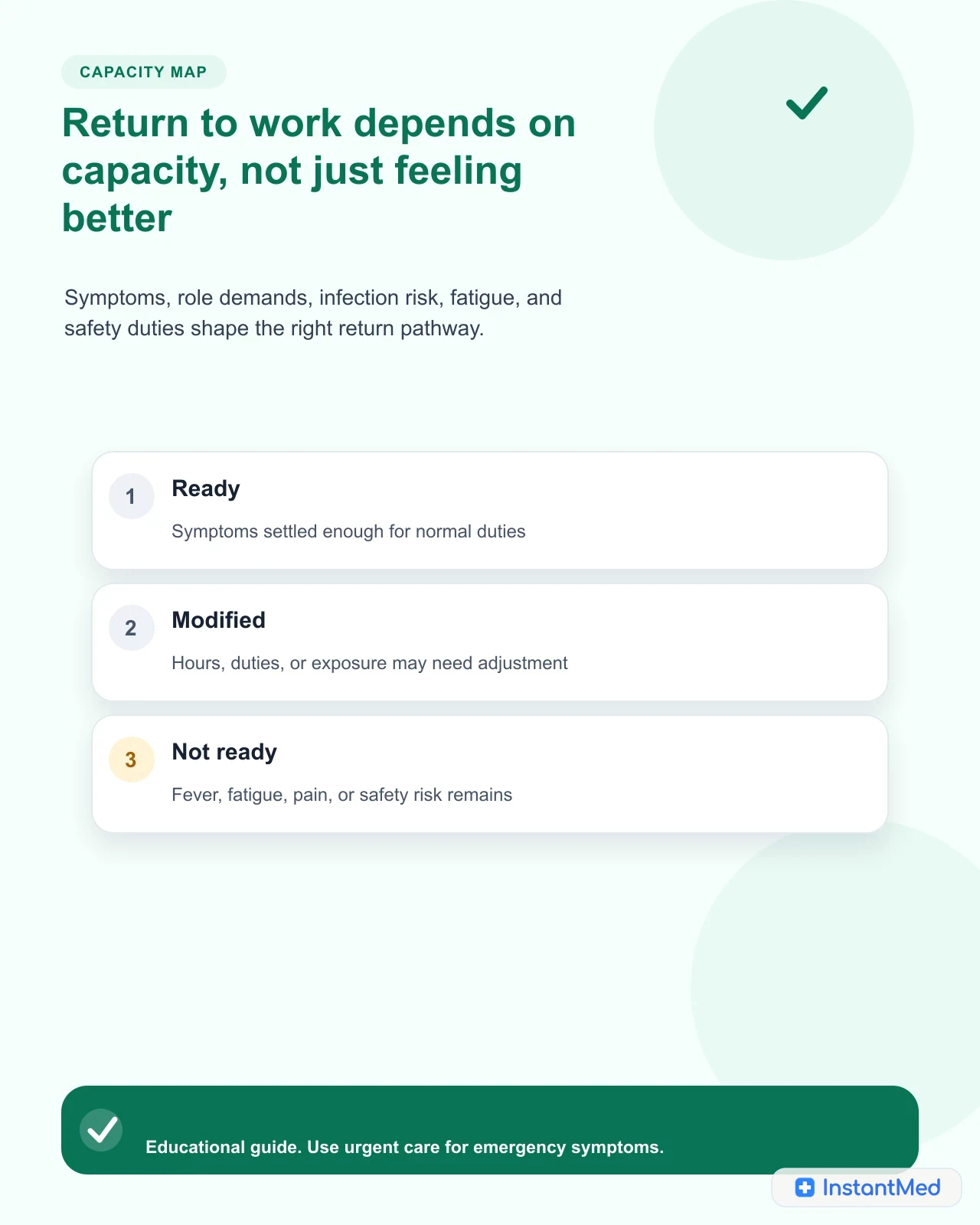
Returning to Work After Illness: When You Are Ready
Returning too soon causes relapse, prolongs total absence, and risks colleagues. Here are the clinical markers for readiness by illness type, clearance certificate requirements, and your rights if an employer pushes you.
InstantMed Medical Team
9 min read
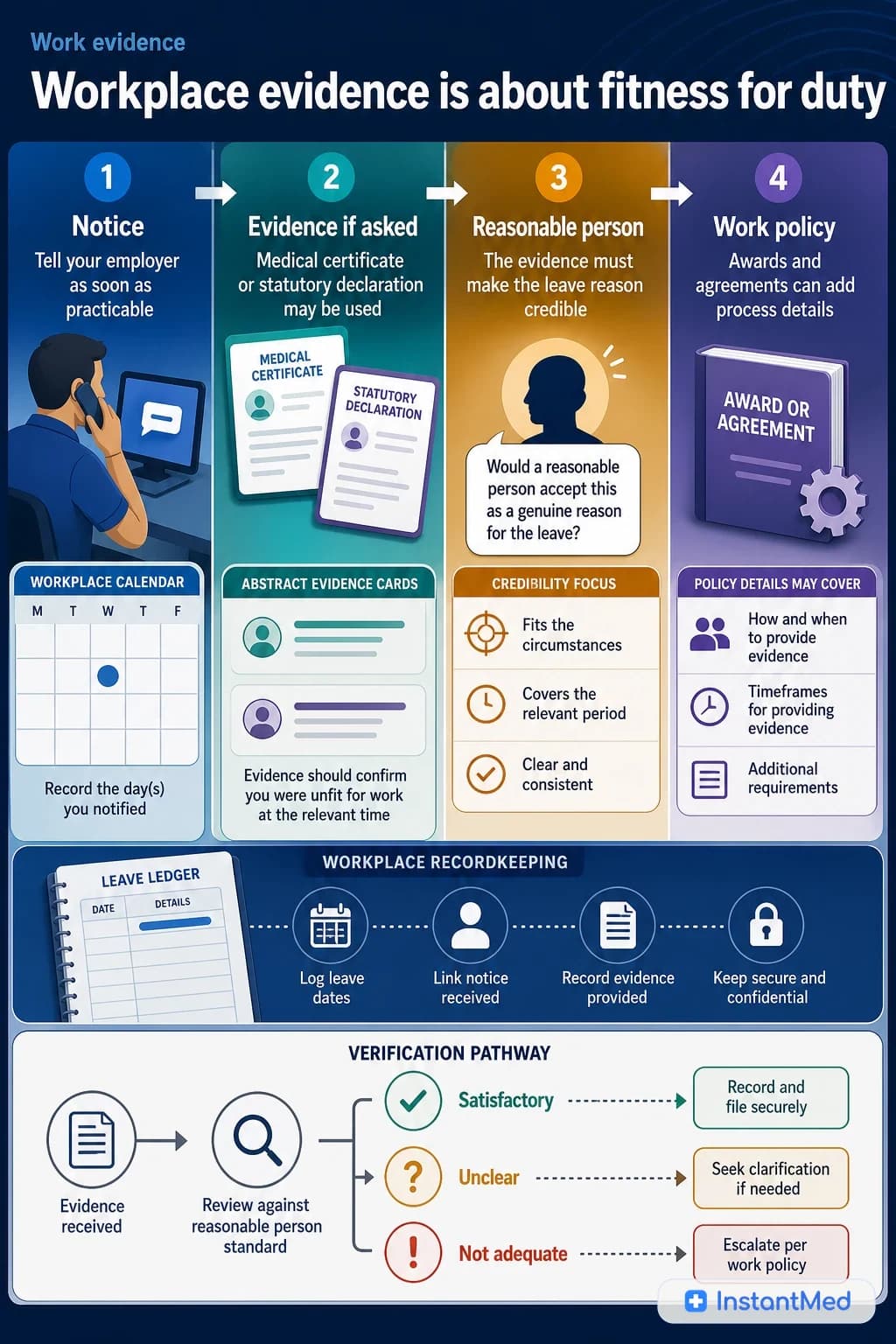
Medical Certificates for Work: Complete Australian Guide
A work medical certificate is evidence that you were unfit for work, not a public explanation of your diagnosis. This Australian guide explains employer evidence rules, privacy, telehealth, stat decs, and return-to-work issues.
InstantMed Medical Team
10 min read
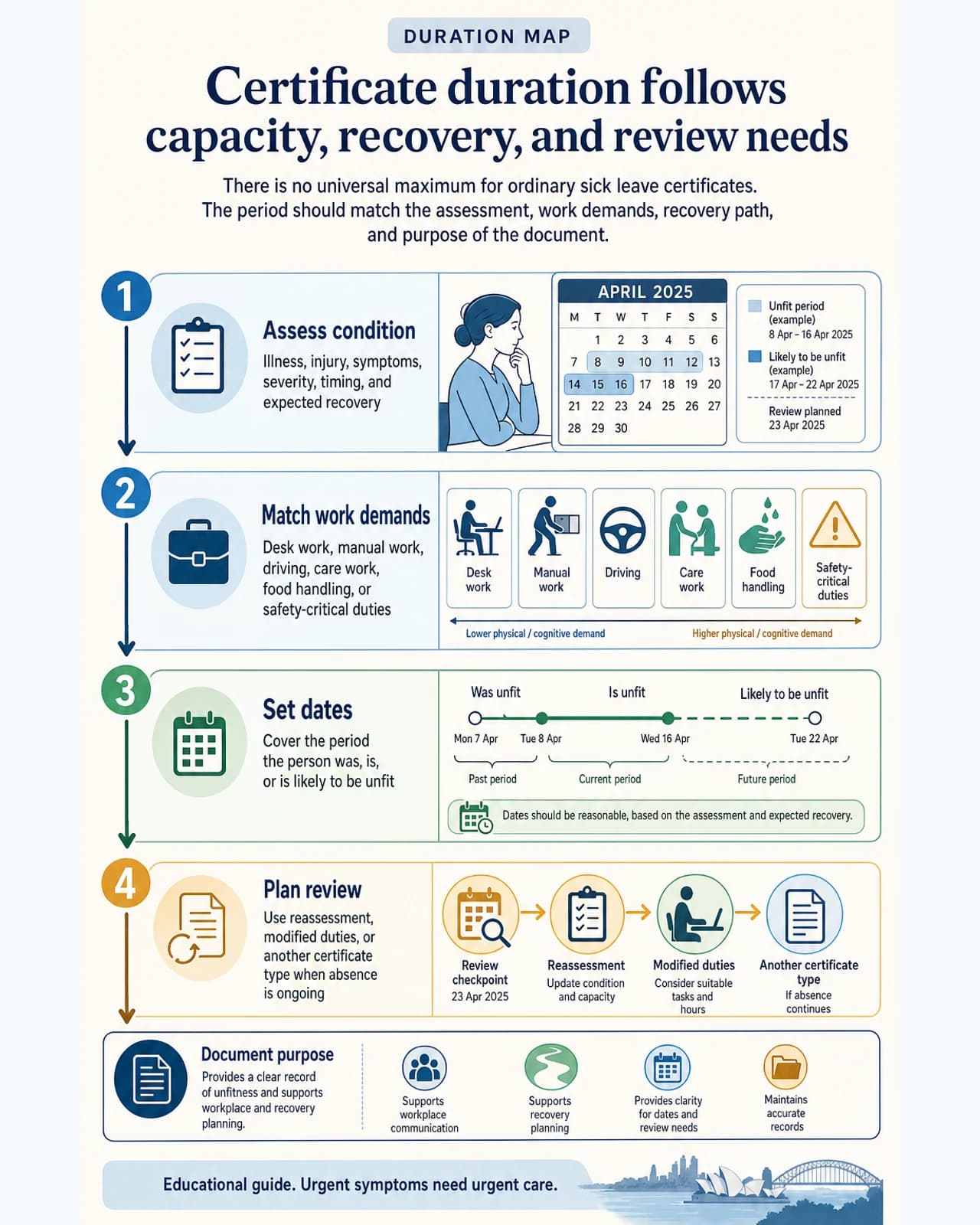
How Long Can a Medical Certificate Cover?
Medical certificate duration depends on clinical judgment, work capacity, workplace evidence rules, and the purpose of the certificate. Learn what can be covered, what cannot be assumed, and when a different certificate type is needed.
InstantMed Medical Team