Loading article
Back to Health Guides
How to Get a Repeat Prescription Online in Australia
What medications can be renewed via telehealth, how the review works, and how quickly you get your eScript.
7 min read
·Updated 10 May 2026
·Doctor Reviewed
AHPRA Verified
In this article
- 1What Qualifies as a Repeat Prescription Request
- 2Medications Suitable for Online Renewal
- 3Medications Not Suitable for Online-Only Renewal
- 4The Review Process
- 5What You Receive
Medical information only. This article is for general information and does not constitute medical advice. Treatment decisions are made by an AHPRA-registered doctor after reviewing your circumstances.
Review
InstantMed Clinical Team
Clinical governance review for guide content
Updated
10 May 2026
General information only, not personal medical advice.
Jump to section
1What Qualifies as a Repeat Prescription Request2Medications Suitable for Online Renewal3Medications Not Suitable for Online-Only Renewal4The Review Process5What You Receive6Timing7PBS Pricing Applies8Planning Repeat Scripts Without Subscriptions9Staying Connected to Your Regular GP10Sources Used In This Guide
Running out of a medication you rely on is stressful. Your regular GP is booked for the next two weeks. The walk-in clinic has a two-hour wait. You have been on the same blood pressure medication for three years, your readings have been stable, and you just need a new script with repeats.
This is exactly the scenario telehealth repeat prescriptions are built for. For established, stable medications, a doctor can review your case from the information you provide and issue an eScript within hours - no waiting room, no appointment scheduling, PBS pricing applied at the pharmacy.
Here is a clear-eyed guide to what this works for, what it does not work for, and what to expect.
What Qualifies as a Repeat Prescription Request
Online repeat prescriptions are appropriate when all of these apply:
- You have been taking the medication for at least 3-6 months
- Your condition is stable and well-controlled
- You have not had concerning new symptoms since your last prescription
- You are not due for monitoring that would affect whether the prescription is appropriate (some medications require blood tests before renewal)
- The medication is not a controlled substance (Schedule 8)
This is not a loophole or a shortcut around proper medical care. It is an appropriate application of telehealth to a well-defined clinical scenario: stable patient, known medication, established treatment plan, no new clinical concerns.
Medications Suitable for Online Renewal
Cardiovascular:
- Antihypertensives (ramipril, perindopril, amlodipine, irbesartan, metoprolol, and similar)
- Statins and cholesterol medications (atorvastatin, rosuvastatin, ezetimibe)
- Low-dose aspirin for secondary prevention
- Metformin
- SGLT2 inhibitors and GLP-1 agonists for stable, established patients
Thyroid:
- Levothyroxine (thyroxine) for thyroid issues - if recent thyroid function tests are available
Women's health:
- Combined oral contraceptives (pill)
- Progestogen-only pill
- Vaginal ring and patch contraceptives
Mental health (for established patients):
- SSRIs and SNRIs for depression and anxiety (sertraline, escitalopram, venlafaxine)
- Some other antidepressants for established, stable patients
Respiratory:
- Inhaled corticosteroids and combination inhalers (preventer medications for stable asthma)
- Intranasal corticosteroids for allergic rhinitis
Skin conditions:
- Topical corticosteroids for chronic skin conditions (eczema, psoriasis)
Other:
- Antihistamines for chronic allergies
- Some GI medications for chronic conditions
- Vitamin D and iron for diagnosed deficiency
Medications Not Suitable for Online-Only Renewal
Schedule 8 controlled substances: Opioids, stimulants for ADHD, benzodiazepines - these have strict prescribing requirements that generally require in-person assessment and, in some states, specific prescribing authorities.
New medications: A medication you have never taken before requires a full clinical assessment. Even if a drug is in the same class as something you have taken, a first prescription for any specific drug requires proper evaluation.
Medications requiring recent monitoring: Some medications should only be renewed if recent blood tests confirm safety. Levothyroxine without recent thyroid function tests, some diabetes medications requiring HbA1c review, medications affecting kidney or liver function requiring recent renal or hepatic panels. A responsible telehealth doctor will ask about recent results and may decline if monitoring is overdue.
Unstable or worsening conditions: If your condition has deteriorated, your current medication is not working as well as it was, or you have developed new relevant symptoms, this is not a repeat prescription scenario - it is a new clinical situation requiring proper assessment.
Key Information
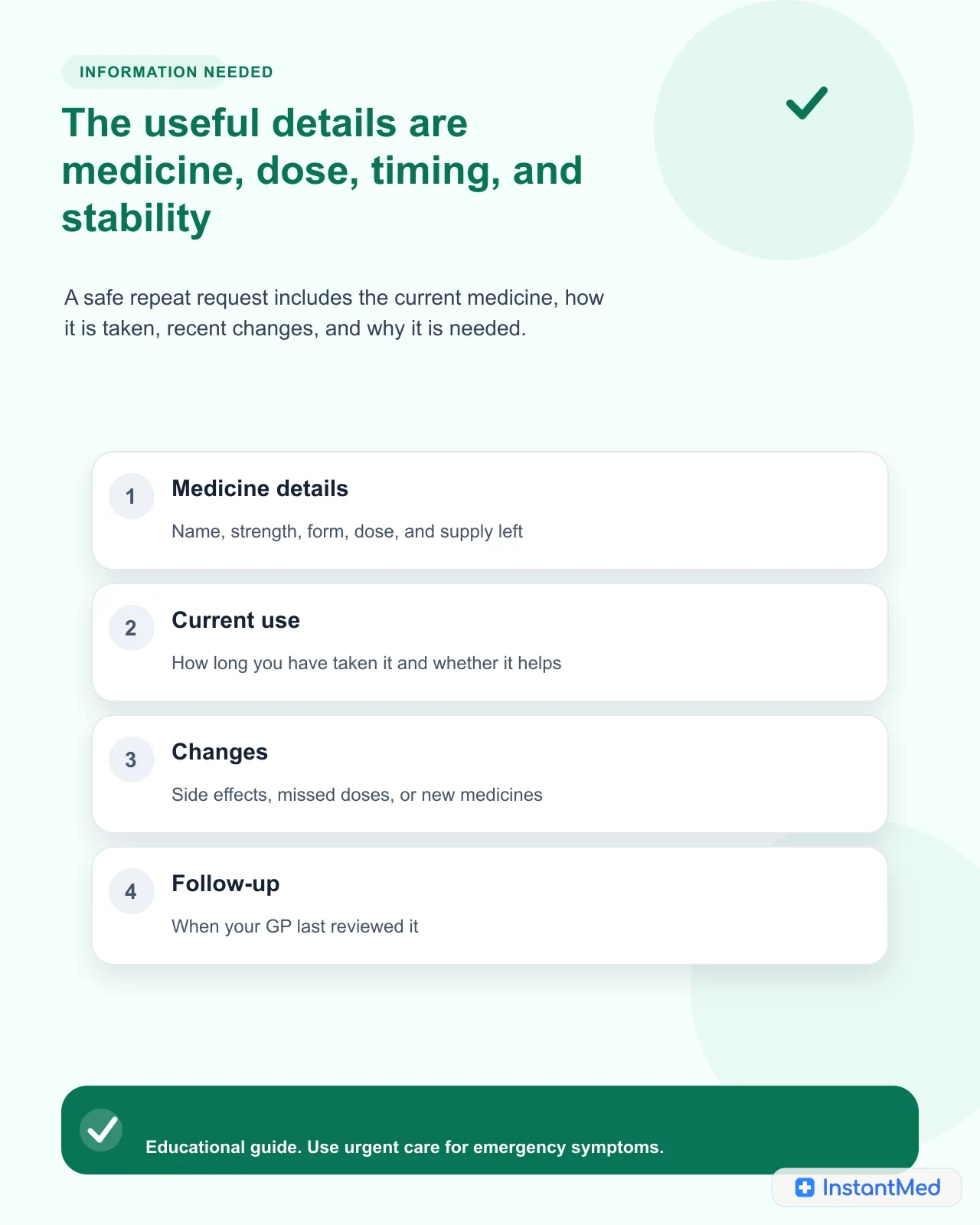
When in doubt, provide more information rather than less. Tell the reviewing doctor when you last had relevant blood tests and what the results were (even approximate values). Mention whether your condition has been stable or if there have been changes. The more clinical context you provide, the more confident the doctor can be in approving the renewal.
The Review Process
When you submit a repeat prescription request, a doctor reviews your submission. This is not automatic approval - it is a genuine clinical assessment, just done remotely from the information you provide.
The doctor considers:
- The medication requested and your reason for taking it
- How long you have been on this medication
- Whether your condition description is consistent with the medication being appropriate
- Your reported medical history and any contraindications you have disclosed
- Your current medications (for interaction checking)
- Any relevant recent results you have mentioned
If all of this is consistent and the request is clinically appropriate, the doctor issues the prescription. If there are concerns or gaps in information, they may ask for additional information or decline the request with a recommendation to see your GP.
What You Receive
A prescription from a telehealth service is an eScript - an electronic prescription delivered as a QR code token via SMS or email. You present this at any pharmacy in Australia to have it dispensed.
The token includes:
- The medication name, strength, and dose instructions
- The prescriber's name and AHPRA registration number
- The number of repeats authorised
- The prescription date and expiry (12 months from issue)
At the pharmacy, you present your Medicare card alongside the token. PBS pricing applies. You pay the standard co-payment ($25.00 for general patients, $7.70 for concession card holders in 2026). The pharmacist cannot tell and does not care whether your prescription came from a telehealth service or a clinic.
Timing
For asynchronous telehealth services:
- You submit your request online at any time
- A doctor reviews your request - the service operates 24/7
- Review and response typically takes 1-4 hours during busy periods, often faster
- The eScript arrives by SMS or email once the prescription is approved
Possible outcomes
Remote review should leave a clear next step, even when a script is not clinically appropriate.
Plan ahead. If you have one tablet left, submitting that morning should get you a prescription before the day is out. If you have a week's supply left, you have time to submit during a quieter period and ensure the review is not rushed.
PBS Pricing Applies
This is worth repeating because it is a common misconception: a prescription from a telehealth service is fully PBS-eligible. The subsidy is not linked to how the prescription was obtained - it is linked to your Medicare eligibility and the medication's PBS listing.
| Patient type | Co-payment, current from 1 January 2026 |
|---|---|
| General patient | Up to $25.00 |
| Concession card holder | Up to $7.70 |
| Safety Net (concession) | Free after $277.20/year |
| Safety Net (general) | $7.70 after $1,748.20/year |
The PBS Safety Net tracks across all scripts, including telehealth-sourced ones.
Planning Repeat Scripts Without Subscriptions
For the current InstantMed model, repeat prescriptions are handled as one-off doctor reviews rather than subscriptions. That is simpler and safer for patients who only need an occasional renewal, because there is no recurring card charge, no automatic monthly cycle, and no assumption that a medicine should keep being renewed without a fresh check.
If you take long-term medication, keep your usual GP involved for monitoring and planned reviews. A practical approach is to set a reminder two to three weeks before your supply runs out, keep recent blood pressure readings or pathology results handy where relevant, and use telehealth only when the request is stable and straightforward.
Staying Connected to Your Regular GP
Online repeat prescriptions are a convenience tool, not a substitute for a regular GP relationship. Best practice:
- Inform your regular GP of any prescriptions you have obtained via telehealth
- Share the consultation summary (a good telehealth service provides this) with your GP to keep your records complete
- Still attend regular GP check-ups for your chronic conditions - annual reviews, monitoring tests, and the broader clinical relationship that telehealth cannot replace
- Do not rely solely on telehealth for conditions that benefit from longitudinal care
Telehealth fills the gap when your GP is unavailable, booked out, or when the prescription is straightforward enough that it does not justify a full GP appointment. It is a complement to your regular care, not a replacement for it.
Sources Used In This Guide
- PBS: fees, patient contributions and Safety Net thresholds
- Services Australia: PBS Safety Net thresholds
- Healthdirect: medicines information
- Medical Board of Australia: telehealth consultations with patients
- AHPRA: Register of practitioners
- TGA: advertising a health service
Frequently Asked Questions
Which medications can I get online?
Most common chronic medications: blood pressure, cholesterol, diabetes, thyroid, contraceptives, antidepressants (for established patients), asthma inhalers, and many others. The criteria are that you are already established on the medication, your condition is stable, and the medication is not a controlled substance. See the full list in the article.
How quickly do I receive my eScript?
For asynchronous telehealth services, typically 1-4 hours during operating hours. Some services offer faster review options. The eScript arrives as an SMS token that you can use at any pharmacy.
Do I need to have an existing prescription to renew online?
Not necessarily, but you need to have been taking the medication for some time - typically 3+ months. The reviewing doctor needs to know your medication history, your current condition status, and any recent relevant results (blood tests, blood pressure readings). The more information you provide, the smoother the review.
Does PBS pricing still apply to telehealth prescriptions?
Yes. PBS subsidies are attached to the medication and your Medicare eligibility, not how the prescription was obtained. A telehealth eScript costs the same at the pharmacy as one from your regular GP - the applicable co-payment ($25.00 general, $7.70 concession in 2026).
What if the doctor needs to see me in person before prescribing?
Some requests will be declined for online renewal. If your last relevant blood test was more than a year ago, if you have new symptoms, or if the medication requires clinical monitoring before renewing, a telehealth doctor may ask you to see a GP in person first. This is appropriate clinical practice, not a failure of the service.
Can I get a new medication I have never taken before online?
For most medications, no. A first prescription for a new condition requires a full clinical assessment that typically cannot be done safely via an asynchronous online form. Telehealth repeat prescriptions are for established medications. There are some exceptions (e.g., some telehealth services can initiate treatment for certain conditions after a structured clinical intake), but the general rule is that new medications require a full consultation.
InstantMed Medical Team
Related Articles
8 min read
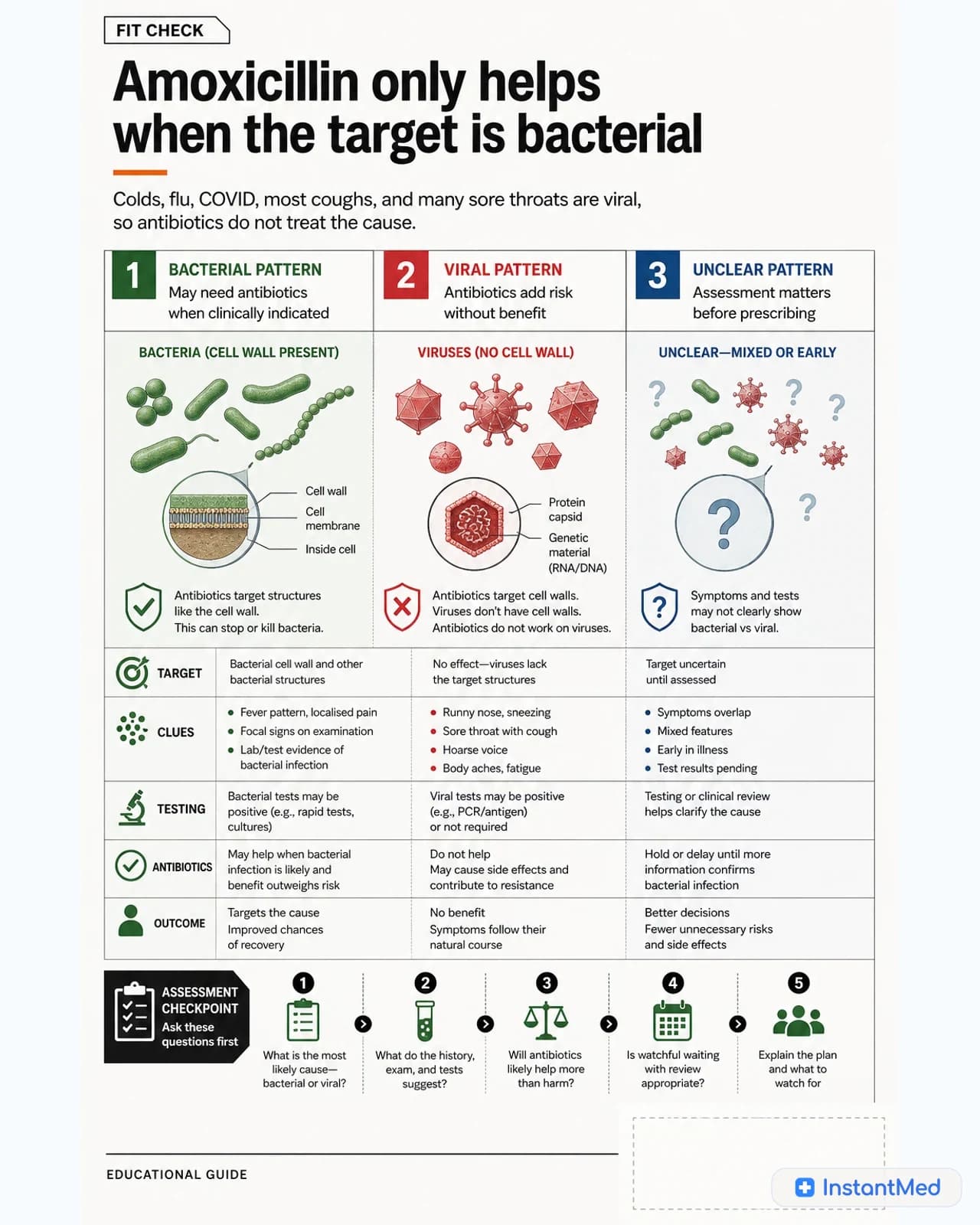
Amoxicillin in Australia: Uses, Dosing, and What to Know
Amoxicillin is a penicillin antibiotic used for selected bacterial infections. It does not treat viruses, and the right dose depends on the infection, person, and clinical context.
InstantMed Medical Team

8 min read
When Antibiotics Are Appropriate: Bacterial vs Viral Infections
Antibiotics treat bacterial infections, not viruses. This guide explains when antibiotics may be appropriate, when they are usually avoided, and what responsible use looks like.
InstantMed Medical Team
9 min read
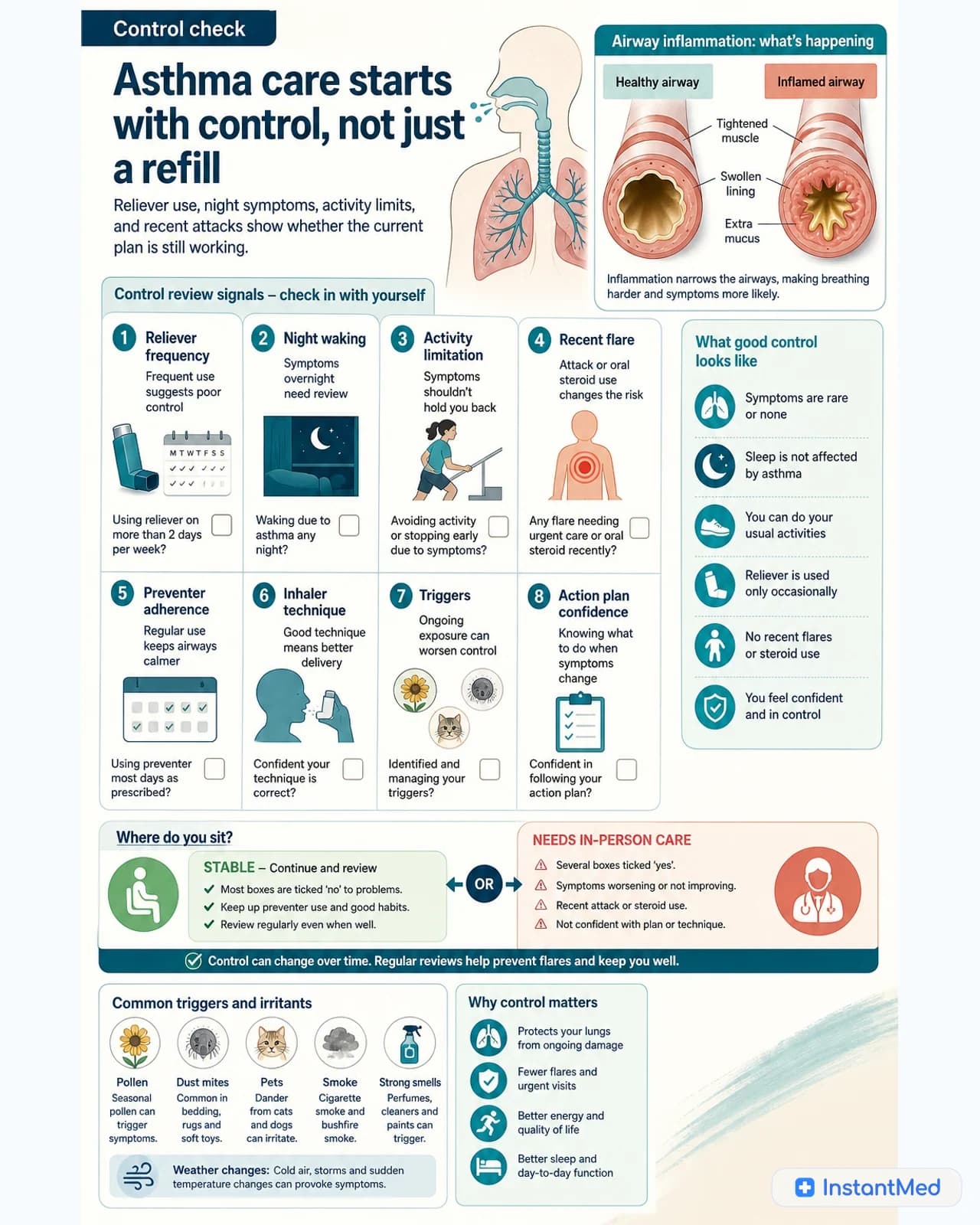
Asthma Management and Telehealth in Australia
Stable, established asthma may suit telehealth medication review, but diagnosis, worsening symptoms, children, and asthma attacks need in-person or emergency care. Learn the safety boundaries.
InstantMed Medical Team