Loading article
Back to Health Guides
Amoxicillin in Australia: Uses, Dosing, and What to Know
What amoxicillin treats, what it will not treat, how dosing decisions are made, and which side effects or allergy symptoms need action.
8 min read
·Updated 11 June 2026
·Doctor Reviewed
AHPRA Verified
In this article
- 1What Amoxicillin Is
- 2What It Can Treat
- 3What It Will Not Treat
- 4How Doctors Decide If It Fits
- 5Dosing: Why There Is No Universal Dose
Medical information only. This article is for general information and does not constitute medical advice. Treatment decisions are made by an AHPRA-registered doctor after reviewing your circumstances.
Review
InstantMed Clinical Team
Clinical governance review for guide content
Updated
11 June 2026
General information only, not personal medical advice.
Jump to section
1What Amoxicillin Is2What It Can Treat3What It Will Not Treat4How Doctors Decide If It Fits5Dosing: Why There Is No Universal Dose6How To Take It Safely7Common Side Effects8Allergy And Anaphylaxis9Penicillin Allergy Labels10Amoxicillin Versus Amoxicillin-Clavulanate11Interactions And Special Situations12Antibiotic Resistance13Prescription-Only Status In Australia14Practical Checklist15Sources
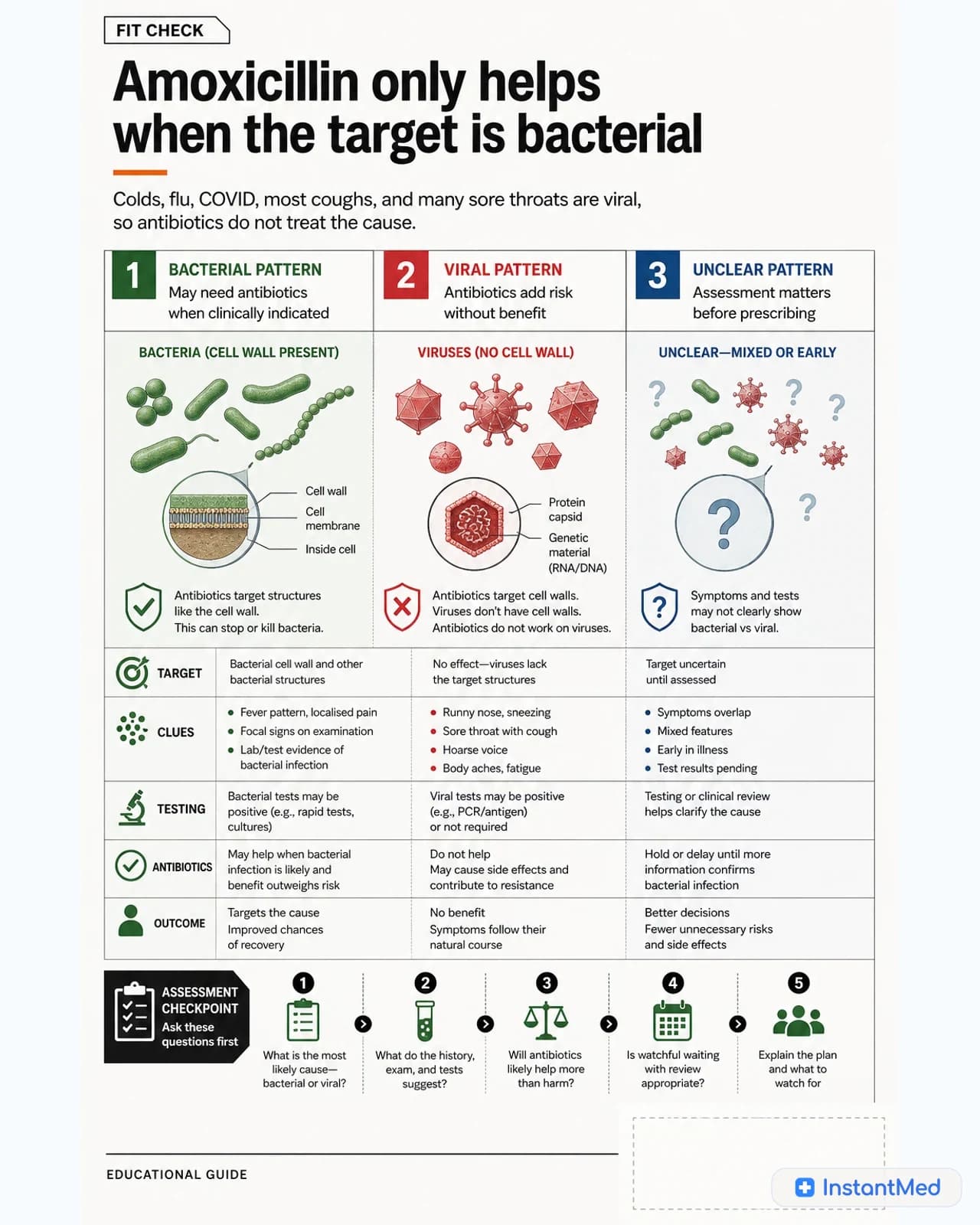
Amoxicillin is a penicillin antibiotic. In Australia it is used for selected bacterial infections, but it is not a general "infection medicine" and it does not treat viral illness.
That distinction matters. Taking amoxicillin when it is not needed can cause side effects, create allergy confusion, disrupt normal bacteria, and contribute to antimicrobial resistance. Not prescribing an antibiotic for a likely viral illness is often the safer medical decision, not a refusal to help.
What Amoxicillin Is
Amoxicillin works against bacteria that are susceptible to it. It belongs to the beta-lactam family of antibiotics, specifically the penicillin group.
It is available in Australia under different brand and generic names, including capsules, tablets, and oral liquid formulations. Healthdirect lists medicines containing the active ingredient amoxicillin and notes whether products require a prescription and whether they are subsidised through the PBS.
The spelling can vary. In Australia you may see both "amoxicillin" and "amoxycillin" in medicine names or older documents. They refer to the same active ingredient.
What It Can Treat
Amoxicillin may be used when the likely cause is a susceptible bacterial infection and the clinical situation fits.
Examples can include selected:
- Ear infections
- Sinus infections when bacterial features are present
- Throat infections when streptococcal infection is confirmed or strongly suspected
- Chest infections or pneumonia where the pattern fits
- Dental infections where antibiotics are indicated alongside dental care
- Part of some combination regimens for Helicobacter pylori
This list is not a self-diagnosis tool. Different infections can look similar, and local resistance patterns, severity, age, pregnancy status, immune status, and examination findings can change the decision.
What It Will Not Treat
Amoxicillin does not treat viruses.
That includes:
- Common colds
- Influenza
- COVID-19
- Most acute coughs and bronchitis
- Many sore throats
- Many sinus symptoms early in the illness
- Glandular fever
Healthdirect and Australian antimicrobial resistance guidance are clear on the main principle: antibiotics do not work against viral infections. If a clinician advises symptom care, watchful waiting, testing, or review instead of antibiotics, the reason may be that an antibiotic is unlikely to help and may cause harm.
Key Information
Green or yellow mucus does not automatically mean a bacterial infection. Colour alone is not enough to decide whether amoxicillin is appropriate.
How Doctors Decide If It Fits
The useful question is not "Do I have an infection?" The useful question is "Is this likely to be a bacterial infection where this antibiotic is appropriate?"
Assessment usually considers:
- Symptom pattern and duration
- Fever and systemic symptoms
- Site of infection
- Examination findings where relevant
- Test results if available
- Risk factors such as pregnancy, immune suppression, or chronic disease
- Previous antibiotic exposure
- Allergy history
- Local resistance patterns
- Whether a narrower or different antibiotic would be better
Sometimes the right answer is no antibiotic. Sometimes the answer is an antibiotic, but not amoxicillin. Sometimes the answer is urgent in-person care because remote history alone is not enough.
Dosing: Why There Is No Universal Dose
There is no single "normal amoxicillin dose" that applies to every person and infection.
The dose and duration depend on:
- The infection being treated
- Severity
- Adult vs child dosing
- Child weight
- Kidney function
- Pregnancy or breastfeeding
- Other medicines
- Allergy and adverse reaction history
- Whether amoxicillin is being used alone or as part of a combination regimen
Follow the prescription label and Consumer Medicine Information for your specific product. If the label is unclear, ask the pharmacist before taking the first dose.
Do not change the dose, stop early, extend the course, or reuse old capsules because symptoms "feel similar." The wrong dose or duration can fail to treat the infection, increase side effects, or create resistance pressure.
How To Take It Safely
Practical points:
- Take it exactly as prescribed.
- Space doses as evenly as the label directs.
- Use the supplied measuring device for liquid medicine, not a kitchen spoon.
- Store the medicine as directed on the label; some liquids have specific storage instructions.
- Do not share it with another person.
- Do not use leftovers from a previous illness.
- If you miss a dose, follow the product CMI or ask a pharmacist. Do not double dose unless a clinician specifically tells you to.
Allergy boundary
A childhood rash is different from hives, throat swelling, breathing trouble, or anaphylaxis.
Food instructions can vary by product and by how your stomach tolerates the medicine. The safest approach is to follow the label and ask the pharmacist if nausea, vomiting, or diarrhoea affects dosing.
Common Side Effects
Common or expected side effects can include:
- Nausea
- Diarrhoea or loose stools
- Stomach discomfort
- Rash
- Thrush
- Headache
Mild diarrhoea can happen because antibiotics affect normal gut bacteria. Severe diarrhoea, blood or mucus in stool, fever, or diarrhoea that continues after antibiotics needs medical advice because antibiotic-associated colitis is possible.
Rash is more complicated than people think. Some rashes are allergic. Some are non-allergic. Amoxicillin is also well known for causing a rash in people with glandular fever. Do not assume a rash is harmless, but do not automatically label yourself allergic forever without proper assessment either.
Allergy And Anaphylaxis
Amoxicillin is not suitable for people with confirmed serious penicillin allergy unless specialist advice says otherwise.
Use urgent care for:
- Breathing difficulty
- Wheeze
- Swelling of the face, lips, tongue, or throat
- Widespread hives
- Dizziness, collapse, or faintness
- Rapidly worsening rash with systemic symptoms
Emergency Information
Call Triple Zero (000) for breathing trouble, throat swelling, collapse, or symptoms suggesting anaphylaxis after taking amoxicillin.
Penicillin Allergy Labels
Many people carry a penicillin allergy label from childhood. Australian Prescriber notes that more than 90% of people labelled as having a penicillin allergy can tolerate penicillins after appropriate assessment and testing.
That does not mean it is safe to test yourself at home. It means the history matters:
- What happened?
- How soon after the dose?
- Was there hives, swelling, wheeze, or collapse?
- Was it just nausea or diarrhoea?
- Was there a viral illness at the same time?
- Have you taken penicillin or related antibiotics since?
An inaccurate allergy label can push clinicians toward broader antibiotics that may be less suitable. A true severe allergy must be respected. An uncertain label may be worth discussing with a doctor or allergy service.
Amoxicillin Versus Amoxicillin-Clavulanate
Amoxicillin-clavulanate combines amoxicillin with clavulanic acid. Clavulanic acid helps overcome some bacterial resistance mechanisms, which broadens the antibiotic's cover.
Broader is not automatically better.
Amoxicillin-clavulanate can be more appropriate for some infections, but it can also cause more gastrointestinal side effects and creates broader antibiotic pressure. Good antibiotic stewardship means using the narrowest effective antibiotic when an antibiotic is genuinely needed.
Interactions And Special Situations
Tell the prescriber and pharmacist about:
- Previous penicillin or cephalosporin reactions
- Warfarin or other anticoagulants
- Methotrexate
- Allopurinol
- Kidney disease
- Pregnancy or breastfeeding
- Recent antibiotic use
- Severe vomiting or diarrhoea
Stewardship
Antibiotic stewardship means using the right drug, for the right infection, at the right dose and duration.
People often ask about the oral contraceptive pill. Amoxicillin is not classed like enzyme-inducing antibiotics such as rifampicin. However, vomiting or severe diarrhoea can affect absorption of oral medicines, including contraceptive pills. If that happens, follow contraceptive missed-pill guidance or ask a pharmacist.
Antibiotic Resistance
Antimicrobial resistance means bacteria become harder to treat because medicines stop working as well. The Australian AURA surveillance program tracks antimicrobial use and resistance in human health.
For patients, the practical stewardship rules are:
- Use antibiotics only when they are suitable.
- Do not demand antibiotics for colds, flu, COVID, or likely viral illness.
- Take the prescribed antibiotic exactly as directed.
- Do not share antibiotics.
- Do not keep leftovers for next time.
- Return unused medicines to a pharmacy for safe disposal.
Resistance is not an abstract hospital problem. It affects everyday infections, future surgery, cancer care, pregnancy care, and the ability to treat severe illness.
Prescription-Only Status In Australia
Amoxicillin is not an over-the-counter medicine in Australia.
The TGA explains that Schedule 4 medicines are prescription-only medicines. They must be prescribed by an authorised health professional. A pharmacy cannot lawfully supply amoxicillin just because someone is confident they have used it before.
This protects people from three common failure modes:
- Treating viral illness with antibiotics
- Using the wrong antibiotic for the infection
- Missing a condition that needs examination, testing, drainage, imaging, or urgent care
Practical Checklist
Before taking amoxicillin, check:
- Do I know what infection is being treated?
- Is this a bacterial infection where an antibiotic is expected to help?
- Has my allergy history been reviewed?
- Is the dose and timing clear?
- Do I know how long to take it?
- Do I know what side effects need urgent help?
- Have I told the prescriber about warfarin, methotrexate, allopurinol, kidney disease, pregnancy, or breastfeeding?
- Am I using this prescription only for myself and only for this illness?
Amoxicillin is useful when it is the right antibiotic for the right bacterial infection. It is also easy to misuse when symptoms are vague, viral, recurrent, or self-diagnosed.
Sources
- Healthdirect: Amoxicillin active ingredient
- Healthdirect: Antibiotics
- Healthdirect: Bacterial vs viral infections
- TGA: Scheduling basics of medicines and chemicals in Australia
- Australian Government AMR: Use antibiotics only when suitable
- Australian Commission on Safety and Quality in Health Care: AURA
- Australian Prescriber: Penicillin allergy, a practical approach
Frequently Asked Questions
Can I take amoxicillin if I am allergic to penicillin?
Do not take amoxicillin if you have a confirmed penicillin allergy unless a doctor with access to your history has specifically assessed it as safe. Amoxicillin is a penicillin antibiotic.
Can I get amoxicillin over the counter in Australia?
No. Amoxicillin is a prescription medicine in Australia. It needs a prescription from an authorised prescriber and must be supplied by a pharmacy.
Does amoxicillin treat colds, flu, COVID, or most coughs?
No. Antibiotics do not work against viral infections, including colds, flu, COVID, and many sore throats or coughs.
What dose of amoxicillin should I take?
Follow the dose and duration on your prescription label. The right dose depends on the infection being treated, age, weight, kidney function, pregnancy or breastfeeding status, allergy history, and other medicines.
What are serious allergy symptoms?
Breathing trouble, wheeze, facial, lip, tongue, or throat swelling, collapse, or widespread hives after taking amoxicillin can indicate a serious allergic reaction. Use emergency care.
Should I keep leftover amoxicillin for next time?
No. Leftover antibiotics may be the wrong medicine, dose, or duration for the next illness. They also increase the risk of side effects and antibiotic resistance.
InstantMed Medical Team
Related Articles

11 min read
Can You Get Antibiotics Online in Australia?
Antibiotics are prescription-only in Australia. Learn how online prescribing works, when a pharmacist can help with a UTI, what PBS costs in 2026, and which symptoms need in-person care.
InstantMed Medical Team

8 min read
When Antibiotics Are Appropriate: Bacterial vs Viral Infections
Antibiotics treat bacterial infections, not viruses. This guide explains when antibiotics may be appropriate, when they are usually avoided, and what responsible use looks like.
InstantMed Medical Team
8 min read
Medications That Cannot Be Prescribed Online
Telehealth can prescribe most common medications for established patients. Schedule 8 controlled drugs, new medications requiring examination, and several other categories require in-person assessment. Here is the complete picture.
InstantMed Medical Team