Loading article
Back to Health Guides
Renewing a Prescription Online in Australia
How to renew an existing prescription without a GP appointment, what the doctor checks, and how your eScript reaches your phone.
7 min read
·Updated 10 May 2026
·Doctor Reviewed
AHPRA Verified
In this article
- 1When Online Prescription Renewal Is Appropriate
- 2What Information to Provide
- 3The Clinical Review Process
- 4Medications Available for Online Renewal
- 5How the eScript Reaches You and Works at the Pharmacy
Medical information only. This article is for general information and does not constitute medical advice. Treatment decisions are made by an AHPRA-registered doctor after reviewing your circumstances.
Review
InstantMed Clinical Team
Clinical governance review for guide content
Updated
10 May 2026
General information only, not personal medical advice.
Jump to section
Prescription renewal is one of the most established and appropriate uses of telehealth in Australia. If you are on a stable medication that is working well, you have been taking it for some time, and you simply need a new script - that situation does not require a full in-person GP consultation. A reviewing doctor can assess your case from the information you provide and issue an eScript the same day.
This is not a workaround or a shortcut. It is an appropriate application of remote healthcare to a well-defined clinical scenario where the risk-benefit calculation clearly supports the model.
When Online Prescription Renewal Is Appropriate
Online renewal is appropriate when all of the following apply:
You have been taking this medication for at least 3 months. A prescription renewal presupposes that the medication has been established, the dosing is known to be appropriate for you, and the condition is being treated. A very recent prescription is not a "renewal" - it is a continuation assessment that may need more context.
Your condition is stable and well-controlled. If your blood pressure is controlled on your current medication, if your thyroid function is in range, if your anxiety is being managed effectively - the renewal is appropriate. If your condition is actively changing, worsening, or not responding to current treatment, that is a new clinical situation requiring proper assessment.
No concerning new symptoms have developed. Side effects that have appeared since the last prescription, new symptoms in the condition being treated, or changes that suggest the medication may need adjustment are reasons to see a doctor rather than simply renew.
Required monitoring is not overdue. Some medications should only be continued if periodic monitoring confirms safety. If monitoring is due or overdue, the renewal may be declined until results are available.
The medication is not a Schedule 8 controlled drug. Opioid analgesics, ADHD stimulants, and some other controlled substances cannot be renewed via asynchronous telehealth. They require in-person assessment, and in most states, require specific prescribing authorities.
What Information to Provide
The quality of your submission directly affects how efficiently your renewal is processed:
Medication details: Name, dose, and frequency. A photograph of the current packaging is the most reliable approach - it shows the exact product, brand, dose, and manufacturer without any ambiguity. If you have recently switched brands or formulations, note this.
How long you have been taking it and who originally prescribed it: This provides clinical context. "Prescribed by my GP, Dr [name], approximately 3 years ago for hypothyroidism" is more useful than "thyroid medication."
Current condition status: Briefly describe how your condition is going. "Blood pressure has been consistently around 130/80 on home monitoring" or "anxiety is well-managed, no significant episodes in the past few months" gives the doctor the clinical information they need to confirm the renewal is appropriate.
Recent relevant test results: If your medication requires periodic monitoring, having recent results available is valuable. For thyroid medication: recent TSH and free T4 levels. For diabetes medication: recent HbA1c and eGFR. For blood pressure medications at higher doses: recent electrolytes and creatinine.
All other medications and supplements: Interaction checking is part of every prescribing decision.
Allergies: Particularly relevant if the doctor might prescribe a different brand or formulation.
Key Information
The most common reason prescription renewal requests are delayed or declined is insufficient information about monitoring requirements. If you know your medication requires regular blood tests, check when you last had them done before submitting. Having the results on hand (most Australian pathology providers have patient portals) allows the doctor to confirm monitoring is current and proceed with the renewal.
The Clinical Review Process
When your renewal request is submitted, an AHPRA-registered doctor reviews it. This is a genuine clinical assessment, not an automated approval.
The doctor is assessing:
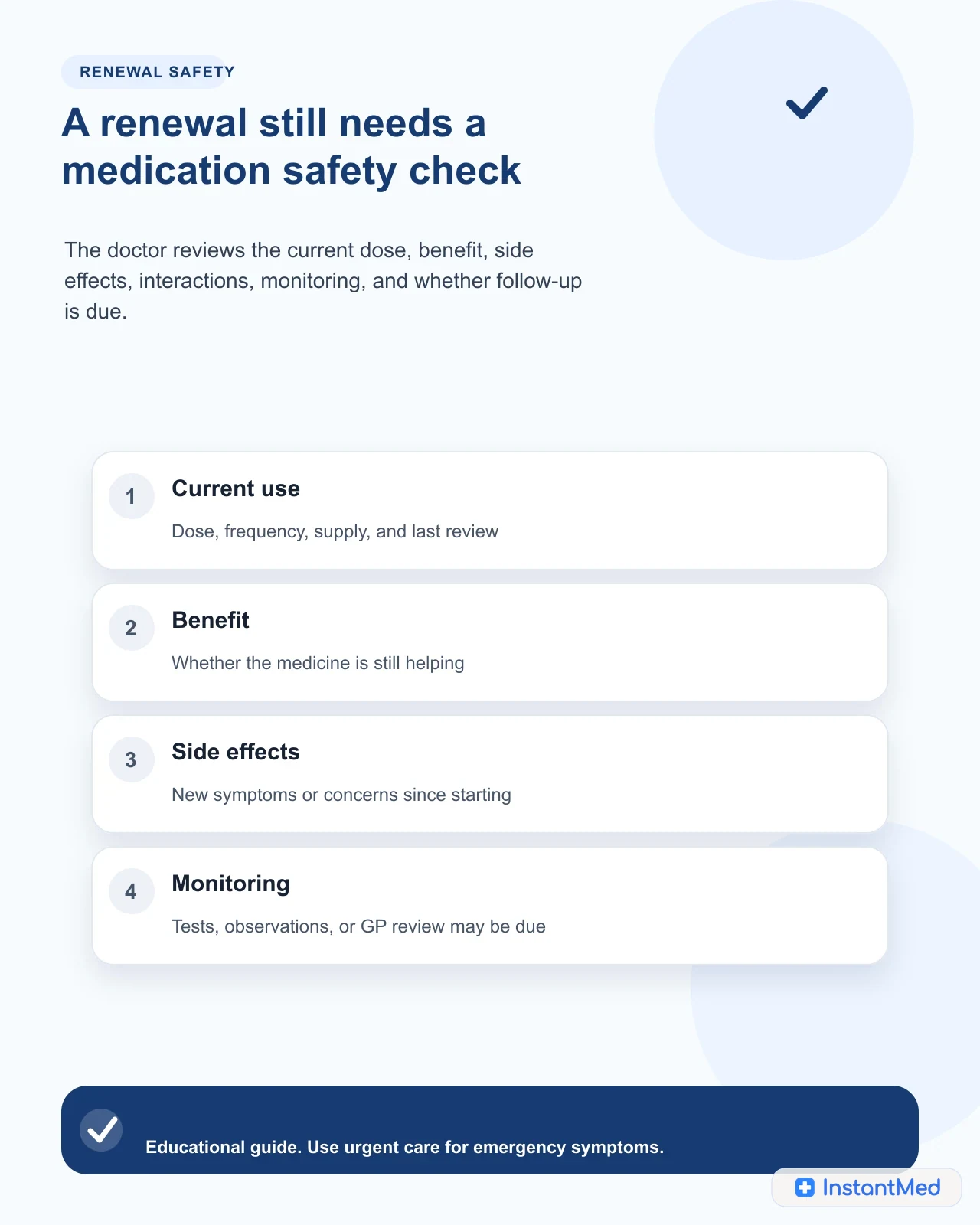
Is this medication appropriate to continue? For established medications in stable conditions, the answer is usually yes - provided the clinical context provided is consistent. For medications with monitoring requirements, the doctor checks whether monitoring is current.
Is the dose and formulation being requested correct? Occasionally patients continue requesting a dose that has since been changed, or a formulation that has been superseded. The doctor verifies this is consistent with appropriate prescribing.
Are there any interaction concerns with other medications? A complete medication list allows the doctor to check whether any new medications (prescribed elsewhere or over-the-counter) create interaction concerns with the renewal being requested.
Are there clinical features suggesting the condition needs reassessment? If your description of your current status raises any concerns - symptoms suggesting the treatment is not working, or adverse effects suggesting a problem - the doctor may ask follow-up questions or recommend seeing a GP before renewing.
Per the Medical Board of Australia's Good Medical Practice standards, a doctor issuing a prescription bears professional responsibility for the clinical appropriateness of that prescription. A legitimate telehealth service does not simply process renewal requests - it conducts a genuine clinical review.
Medications Available for Online Renewal
The following categories of medications are routinely renewed via telehealth for established, stable patients:
Cardiovascular: Antihypertensives (ramipril, perindopril, amlodipine, irbesartan, metoprolol, telmisartan, candesartan), statins (atorvastatin, rosuvastatin) for high cholesterol, antiplatelet medications (low-dose aspirin), rate control medications for atrial fibrillation (stable patients).
Endocrine: Metformin for type 2 diabetes, SGLT2 inhibitors (empagliflozin, dapagliflozin), GLP-1 receptor agonists for established patients, levothyroxine for thyroid issues (where recent TFTs are available), combined oral contraceptives, progestogen-only pill.
Mental health (for established patients): SSRIs (sertraline, escitalopram, fluoxetine), SNRIs (venlafaxine, duloxetine), some other antidepressants for stable patients with depression.
Respiratory: Inhaled corticosteroids (budesonide, fluticasone), combination preventer/reliever inhalers for stable asthma, intranasal corticosteroids for allergic rhinitis.
Other common categories: Antihistamines for chronic conditions, topical corticosteroids for chronic skin conditions, vitamin D for diagnosed deficiency, iron supplementation for diagnosed deficiency, gastric acid medications for established GORD.
How the eScript Reaches You and Works at the Pharmacy
When the doctor approves your prescription:
- 1
The prescription is submitted digitally to the Prescription Exchange Service (PES) - Australia's national electronic prescribing infrastructure
- 2
The PES registry generates a unique QR code token
- 3
The token arrives as an SMS to your phone
- 4
You take the SMS to any Australian pharmacy
- 5
The pharmacist scans the QR code to retrieve the full prescription details
- 6
The medication is dispensed and the prescription is marked as used
- 7
If there are repeats, the first dispensing generates a repeat token sent to your phone
When renewal pauses
New symptoms, pregnancy, side effects, missed monitoring, or high-risk medicines can require a different route.
The eScript is valid for 12 months from the date of issue. Unused repeat tokens cannot be generated after the expiry of the original prescription.
You can fill the prescription at any pharmacy in Australia - you do not need to return to the same pharmacy.
Planning Renewals Without Subscriptions
If you renew the same medication every few months, plan the renewal before you run out rather than relying on a recurring prescription subscription. The current InstantMed model is one-off doctor review with no subscription commitment, no automatic card charge, and no assumption that a medicine should keep being renewed without a fresh clinical check.
For regular medicines, a safer routine is simple:
- Set a reminder two to three weeks before your supply runs out
- Keep your current dose, strength, and medicine list available
- Keep recent monitoring results handy if your medicine normally needs them
- Book your usual GP review when long-term monitoring is due
Telehealth can fill access gaps, but it should not silently replace monitoring for blood pressure, diabetes, thyroid disease, mental health, kidney function, liver function, or medicines with interaction risk.
When to Renew In Person Instead
Online renewal is not always the right pathway. See your regular GP in person for renewals when:
- Your condition has changed significantly since the last prescription
- You have developed new symptoms that may be related to the medication
- Monitoring is significantly overdue and your GP needs to review the results with you in context
- You are requesting a medication with significant monitoring requirements for the first time in several years without any recent results
- The medication is approaching maximum duration for telehealth-appropriate renewal (some medications benefit from periodic in-person review)
- You want a comprehensive review that considers the full picture of your health, not just the renewal
Online renewal is a convenience tool. It is best used for straightforward situations where the clinical picture is clear and stable. For anything more complex, your regular GP is the appropriate first contact.
Sources Used In This Guide
- PBS: fees, patient contributions and Safety Net thresholds
- Services Australia: PBS Safety Net thresholds
- Healthdirect: medicines information
- Medical Board of Australia: telehealth consultations with patients
- AHPRA: Register of practitioners
- TGA: advertising a health service
Frequently Asked Questions
Can I renew any prescription online?
You can renew most prescriptions for established, stable medications via telehealth. The key criteria: you have been taking the medication for at least 3 months, your condition is stable, and the medication is not a Schedule 8 controlled drug. Medications requiring recent blood test results may need monitoring data before renewal. New medications (not previously prescribed) generally require an in-person assessment.
How quickly will I get the eScript?
For asynchronous telehealth services, the typical review time is 1-4 hours. The eScript arrives as an SMS token once the doctor approves the prescription. You can take it to any pharmacy immediately.
Do I need my original prescription to renew?
No. You need to provide the medication name, dose, and how long you have been taking it. A photo of the current packaging is the most efficient way to provide this information. The doctor reviews your request independently - they do not need to see the original prescription.
How many repeats will the new prescription include?
The number of repeats depends on the medication, the indication, and the reviewing doctor's clinical judgment. For most chronic medications, 1-5 repeats are standard. Schedule 4 medications have PBS-defined maximum repeat quantities for certain indications. The doctor prescribes what is clinically appropriate.
What if my medication needs monitoring before renewal?
If you take a medication that requires regular blood tests (such as levothyroxine requiring thyroid function tests, or metformin requiring HbA1c and renal function), the reviewing doctor will ask about your most recent results. If monitoring is overdue, they may ask you to get tests done first, or may recommend seeing your GP if the oversight of your condition requires more than a prescription renewal.
InstantMed Medical Team
Related Articles
8 min read
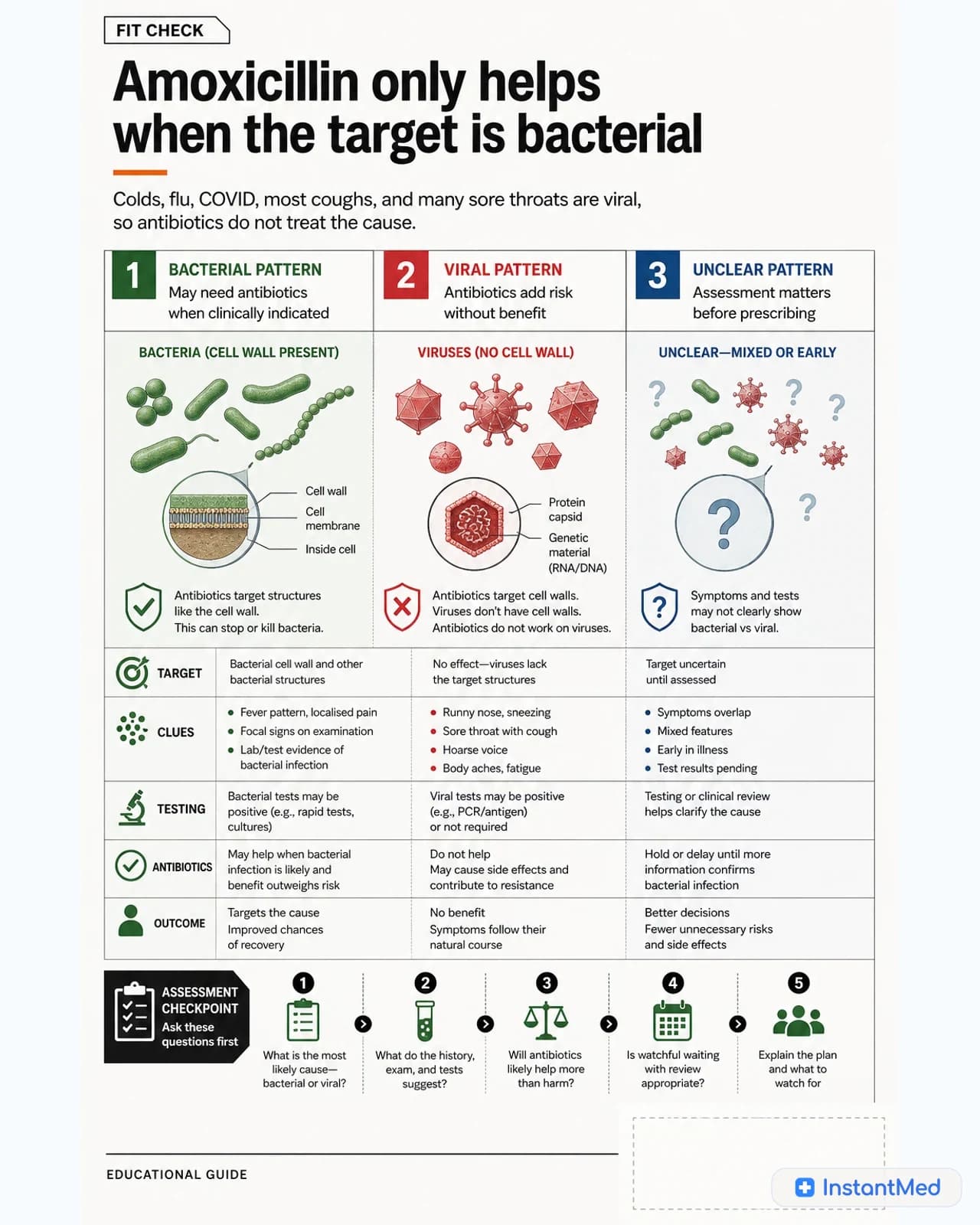
Amoxicillin in Australia: Uses, Dosing, and What to Know
Amoxicillin is a penicillin antibiotic used for selected bacterial infections. It does not treat viruses, and the right dose depends on the infection, person, and clinical context.
InstantMed Medical Team

8 min read
When Antibiotics Are Appropriate: Bacterial vs Viral Infections
Antibiotics treat bacterial infections, not viruses. This guide explains when antibiotics may be appropriate, when they are usually avoided, and what responsible use looks like.
InstantMed Medical Team
9 min read
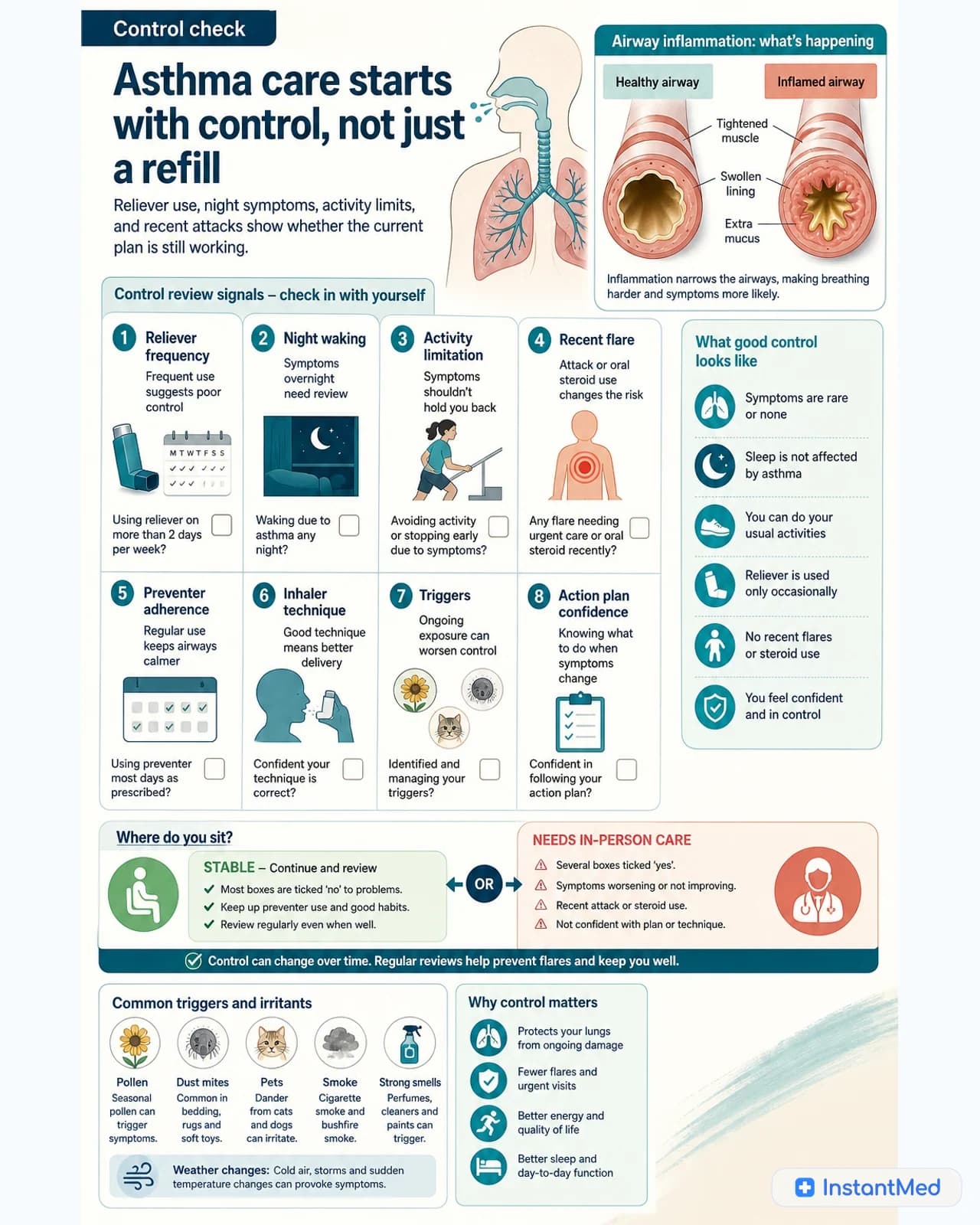
Asthma Management and Telehealth in Australia
Stable, established asthma may suit telehealth medication review, but diagnosis, worsening symptoms, children, and asthma attacks need in-person or emergency care. Learn the safety boundaries.
InstantMed Medical Team