Loading article
Back to Health Guides
How the PBS Works: Prescription Medication Costs in Australia
What you pay at the pharmacy, who qualifies, Safety Net thresholds, authority prescriptions, and why some medicines still cost more.
11 min read
·Updated 5 July 2026
·Doctor Reviewed
AHPRA Verified
In this article
- 1What the PBS Actually Does
- 2What You Pay in 2026
- 3Who Is Eligible for PBS Pricing
- 4Concession Cards That Count
- 5PBS Safety Net in 2026
Medical information only. This article is for general information and does not constitute medical advice. Treatment decisions are made by an AHPRA-registered doctor after reviewing your circumstances.
Review
InstantMed Clinical Team
Clinical governance review for guide content
Updated
5 July 2026
General information only, not personal medical advice.
Jump to section
1What the PBS Actually Does2What You Pay in 20263Who Is Eligible for PBS Pricing4Concession Cards That Count5PBS Safety Net in 20266Why a PBS Medicine May Cost More Than Expected7PBS-Listed vs Private Prescription8Restrictions and Authority Prescriptions9Why Some Medicines Are Not PBS-Listed10Repeats, Quantities, and 60-Day Prescriptions11How to Check a Medicine Before You Pay12Common Questions at the Pharmacy Counter13Sources
The Pharmaceutical Benefits Scheme (PBS) is the Australian Government system that subsidises many prescription medicines. It does not make every medicine free. It does not cover every medicine. It also does not cover every use of a medicine that is otherwise available in Australia.
The practical question at the pharmacy is usually this: is this exact medicine, for this patient, for this use, being supplied under the PBS today?
What the PBS Actually Does
The PBS Schedule lists medicines that can be supplied at a government-subsidised price. The Department of Health, Disability and Ageing is responsible for the policy settings, the PBS website publishes the Schedule, and Services Australia administers payments and Safety Net processes.
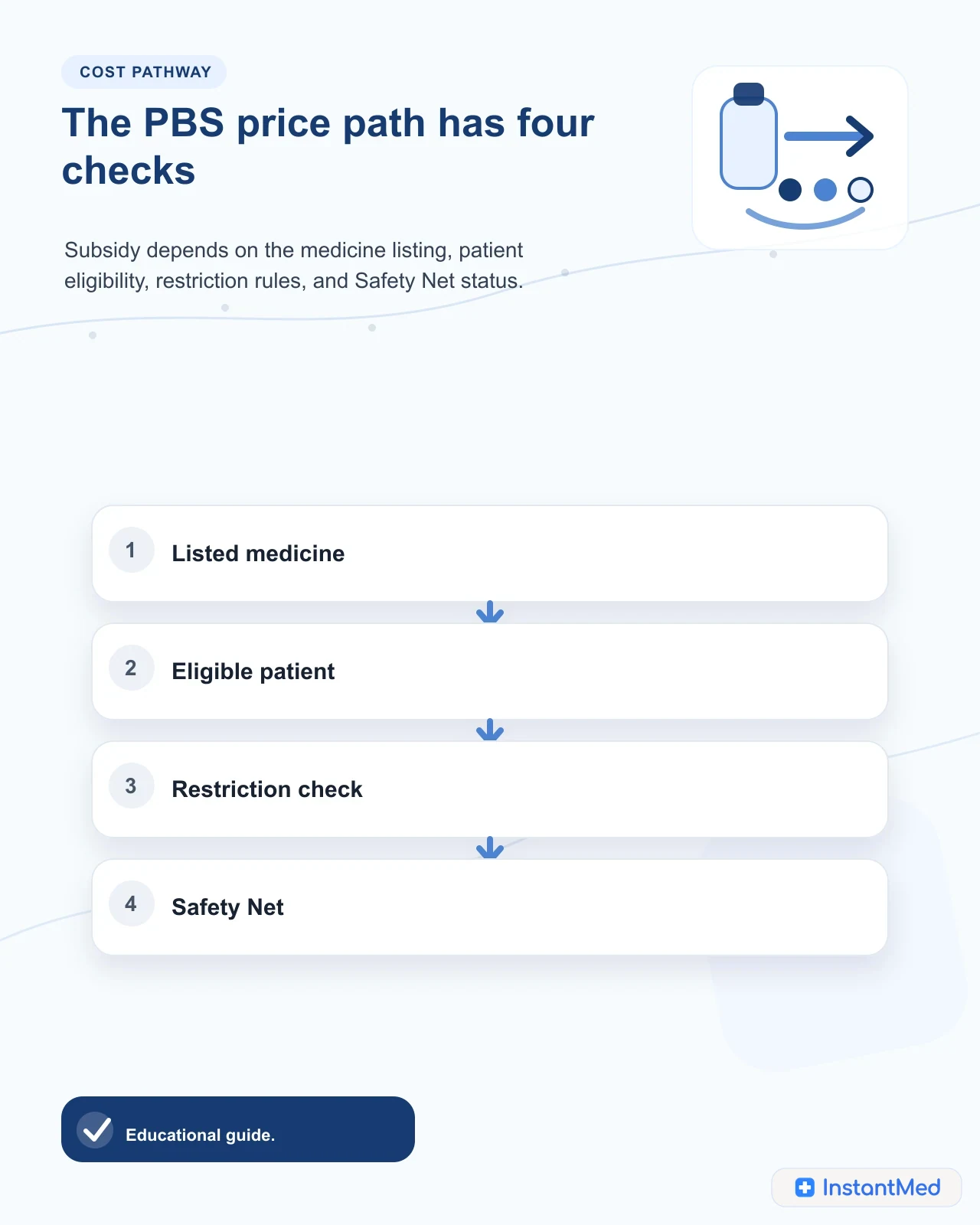
For an eligible PBS prescription, the patient pays a contribution at the pharmacy and the Australian Government pays the remaining eligible subsidised amount. The exact patient price depends on several checks:
| PBS check | What it means | Why it changes the counter price |
|---|---|---|
| Medicine listing | The medicine, form, strength, and pack are listed on the PBS Schedule | A medicine can be approved for use in Australia but not subsidised on the PBS |
| Patient eligibility | The patient has Medicare, DVA, or eligible reciprocal access | Without eligibility, the PBS subsidy may not apply |
| Clinical indication | The prescription matches the listed use or criteria | Some listings only apply for specific conditions or treatment steps |
| Restriction type | The item is unrestricted, restricted, authority required, or streamlined authority | Missing criteria or authority can move the script to private price |
| Pharmacy supply | The pharmacist supplies the correct listed item and brand | Brand premiums or private brands can add cost |
| Safety Net status | The patient or family has reached the annual threshold | Later eligible PBS medicines may cost less for the rest of the year |
What You Pay in 2026
From 1 January 2026, the maximum general co-payment for most PBS medicines is lower than in previous years. The concession rate and Safety Net settings still matter because many people take several regular medicines.
| Patient situation in 2026 | Maximum patient charge for most eligible PBS medicines |
|---|---|
| General patient before Safety Net | $25.00 |
| Concession card holder before Safety Net | $7.70 |
| General patient after reaching the Safety Net threshold | $7.70 |
| Concession card holder after reaching the Safety Net threshold | $0, except applicable premiums |
These are caps for most PBS medicines, not a guarantee that every medicine will cost exactly that amount. If the actual dispensed price is below the cap, the patient may pay the lower price. Some under-co-payment medicines can vary between pharmacies.
The final amount can also include premiums or fees that sit outside the simple co-payment number. This is why two people with similar medicines can still pay different amounts at different times.
Who Is Eligible for PBS Pricing
PBS eligibility generally applies to Australian residents with a current Medicare card. It can also apply to some overseas visitors from countries that have a Reciprocal Health Care Agreement with Australia.
Patients may be asked for:
- A Medicare card
- A DVA card, if the medicine is supplied under Repatriation Pharmaceutical Benefits Scheme arrangements
- An eligible concession card, if claiming concessional PBS pricing
- A Safety Net card or record, if the threshold has been reached
The reciprocal country list and exact evidence rules can change. Services Australia is the best place to check current eligibility if a patient is visiting Australia or has unusual residency circumstances.
Concession Cards That Count
Not every seniors, state, membership, or discount card is a PBS concession card. PBS concessional pricing usually depends on specific Commonwealth or DVA cards.
| Card type | PBS concession effect |
|---|---|
| Pensioner Concession Card | Can support concessional PBS pricing |
| Health Care Card | Can support concessional PBS pricing |
| Commonwealth Seniors Health Card | Can support concessional PBS pricing |
| DVA White, Gold, or Orange Card | Can support concessional or DVA-related supply depending on context |
| State or territory Seniors Card | Not a PBS concession card by itself |
If the pharmacy cannot confirm the correct card, the script may be charged at the general patient rate or handled differently until evidence is resolved.
PBS Safety Net in 2026
The PBS Safety Net protects people and families with high annual medicine costs. It runs by calendar year, not financial year.
| 2026 Safety Net item | Amount or result |
|---|---|
| General patient threshold | $1,748.20 |
| Concession threshold | $277.20 |
| General patient after reaching threshold | Pays the concessional rate for eligible PBS medicines |
| Concession card holder after reaching threshold | Pays $0 for eligible PBS medicines, except applicable premiums |
Authority rules
The same prescription medicine may be unrestricted, restricted, authority required, or private for that script.
Safety Net spending can apply to an individual or to a family unit where the PBS rules allow family members to combine eligible spending. Pharmacies can help patients keep a prescription record form or equivalent pharmacy record, then issue the appropriate Safety Net card when the threshold is reached.
Not every amount paid at the pharmacy counts towards the threshold. Brand premiums, therapeutic group premiums, and special patient contributions are generally excluded from Safety Net totals.
Why a PBS Medicine May Cost More Than Expected
The number on the receipt may be more complicated than the co-payment cap. Common reasons include:
| Extra cost or variation | What it means | What to ask the pharmacist |
|---|---|---|
| Brand premium | A chosen brand costs more than the lowest-priced subsidised brand | Is there an equivalent brand without the premium? |
| Therapeutic group premium | The subsidy is based on the lowest-priced medicine in a group | Is this premium avoidable or clinically necessary? |
| Special patient contribution | A medicine has an extra contribution because of subsidy arrangements | Is this amount separate from the normal co-payment? |
| Delivery or after-hours fee | The pharmacy charges a service fee outside the PBS subsidy | Is this a pharmacy service fee rather than a PBS amount? |
| Under-co-payment variation | The medicine costs less than the cap, and pharmacies may price differently | Is the price below the PBS cap and set by the pharmacy? |
| Private supply | The script is not being supplied under PBS rules | Which PBS criterion was not met? |
If the price looks wrong, ask for a breakdown. The useful distinction is: PBS patient contribution, premium, pharmacy service fee, or private medicine price.
PBS-Listed vs Private Prescription
Three terms are often mixed together:
| Term | Plain-English meaning |
|---|---|
| Prescription-only | The medicine legally requires a prescription |
| PBS-listed | The medicine can be subsidised under the PBS for listed circumstances |
| Private prescription | The script is supplied outside PBS subsidy rules, so the patient pays the private price |
A medicine can be prescription-only and not PBS-listed. It can also be PBS-listed for one condition but private for another. The active ingredient alone is not enough to decide subsidy.
Restrictions and Authority Prescriptions
PBS restrictions are one way the scheme matches public subsidy with clinical criteria and cost-effectiveness. The restriction type tells the prescriber and pharmacist what has to be true before the subsidy applies.
| PBS listing type | How it works | Example of the practical effect |
|---|---|---|
| Unrestricted benefit | No PBS restriction on therapeutic use for the listed item | PBS subsidy can apply when other supply rules are met |
| Restricted benefit | Subsidised only for specified therapeutic uses | The prescription needs to match the listed indication |
| Authority required | Approval or authority coding is needed | The prescriber may need Services Australia approval or an authority code |
| Streamlined authority | A streamlined code can be used where permitted | The prescriber records the correct code without a phone approval step |
For authority medicines, the prescriber may need to contact Services Australia or the Department of Veterans' Affairs, or use an electronic streamlined authority process where the Schedule allows it. At the pharmacy, the authority number or streamlined code tells the pharmacist that the PBS criteria have been addressed.
If an authority step is missing, the medicine may still be available, but it may price privately.
Why Some Medicines Are Not PBS-Listed
The PBS does not list every medicine available in Australia. The Pharmaceutical Benefits Advisory Committee considers clinical effectiveness, safety, comparative benefit, cost-effectiveness, and community need before a medicine is recommended for subsidy.
A medicine may be unavailable on the PBS because:
- It has not been assessed for subsidy.
- It was assessed but not recommended.
- It is listed only for another condition.
- It is listed only after specific prior treatments.
- It is listed only for certain age groups, severity levels, specialist settings, or clinical criteria.
- It is supplied as a private brand or product outside the subsidised listing.
This is why two people taking the same active ingredient can sometimes pay different prices. The PBS indication, authority status, dose, strength, pack size, brand, patient eligibility, and Safety Net status all matter.
Repeats, Quantities, and 60-Day Prescriptions
PBS listings can specify maximum quantities and repeat numbers. Some items have no repeats, some have several repeats, and some long-term stable medicines may be eligible for 60-day prescribing.
That does not mean every patient automatically receives the longest possible supply. The prescriber still needs to decide whether the quantity and repeat pattern are clinically appropriate. Reasons for a smaller quantity or fewer repeats can include:
Safety Net tracker
Eligible spending can be recorded for an individual or family until the annual threshold changes later costs.
- A new medicine that needs early review
- Recent dose changes
- Side effect monitoring
- Pregnancy, kidney, liver, or interaction considerations
- Medicine shortages or substitution issues
- A clinical need to check response before ongoing supply
If a repeat has expired, been fully used, or is no longer clinically appropriate, a new prescription is needed. If the medicine changes dose, form, or indication, the PBS listing may need to be checked again.
How to Check a Medicine Before You Pay
The quickest practical workflow is:
- 1
Search the active ingredient or brand name in PBS Medicine Search.
- 2
Confirm the form, strength, pack size, and item number.
- 3
Check whether the item is unrestricted, restricted, authority required, or streamlined authority.
- 4
Read the listed indication and criteria.
- 5
Check quantity, repeats, and whether 60-day prescribing applies.
- 6
Ask the pharmacist whether any premium, under-co-payment price, or private cost applies.
The pharmacist is often the best person to explain the final counter price because they can see the exact supplied item, brand, premium, patient eligibility, Safety Net status, and dispensing context.
Common Questions at the Pharmacy Counter
| Patient question | Useful answer |
|---|---|
| "Why is this not $25?" | It may be below the cap, above the cap because of a premium or fee, or private because PBS criteria are not met. |
| "Does my concession card apply?" | Only eligible Commonwealth or DVA concession cards support concessional PBS pricing. |
| "Does this count towards Safety Net?" | Eligible PBS and RPBS amounts can count, but premiums and some extra charges may not. |
| "Can I choose a cheaper brand?" | Often yes, but substitution depends on the medicine, brand availability, prescriber instructions, and patient suitability. |
| "Why is the same medicine private for me?" | The PBS listing may not cover the same indication, dose, quantity, patient group, or authority status. |
Sources
- PBS: About the PBS
- PBS: Fees and patient contributions
- PBS: Safety Net Scheme explanatory notes
- PBS: Medicine Search
- Services Australia: PBS Safety Net for pharmacists
- Services Australia: When you spend a lot on PBS medicines
- Department of Health, Disability and Ageing: PBS price reduction fact sheet
Frequently Asked Questions
What are the PBS co-payments in 2026?
From 1 January 2026, most PBS medicines cost up to $25 for general patients and up to $7.70 for concession card holders. The government pays the remaining eligible PBS cost, except for premiums and certain allowable charges.
What is the PBS Safety Net in 2026?
From 1 January 2026, the general patient Safety Net threshold is $1,748.20 and the concession threshold is $277.20. After reaching the threshold, general patients pay the concessional rate and concession card holders pay $0 for eligible PBS prescriptions for the rest of the calendar year, except applicable premiums.
Why did my PBS medicine cost more than the co-payment?
Some medicines can attract brand premiums, therapeutic group premiums, special patient contributions, delivery or after-hours fees, or other allowable charges. A pharmacist can explain which part of the price is the PBS co-payment and which part is an additional charge.
Does prescription-only mean PBS-listed?
No. Prescription-only describes legal access to a medicine. PBS-listed describes whether the government subsidises that medicine for a specific indication and patient group. A medicine can be prescription-only but still private or unsubsidised.
How can I check whether a medicine is PBS-listed?
Use the PBS Medicine Search at pbs.gov.au or ask a pharmacist. Search by active ingredient or brand name and check the listed indications, restrictions, quantity, repeats, authority requirements, and patient contribution.
InstantMed Medical Team
Related Articles
8 min read
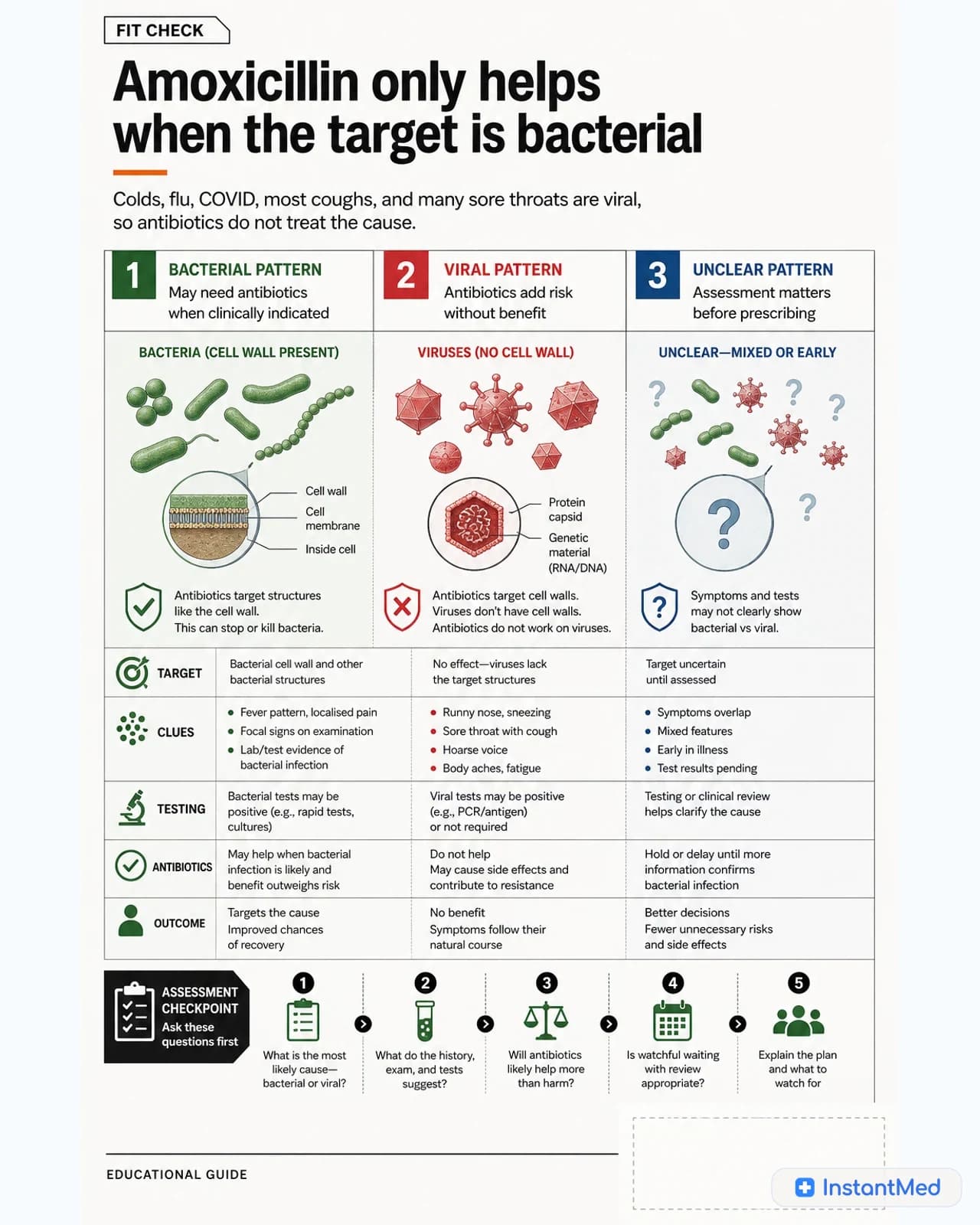
Amoxicillin in Australia: Uses, Dosing, and What to Know
Amoxicillin is a penicillin antibiotic used for selected bacterial infections. It does not treat viruses, and the right dose depends on the infection, person, and clinical context.
InstantMed Medical Team
8 min read
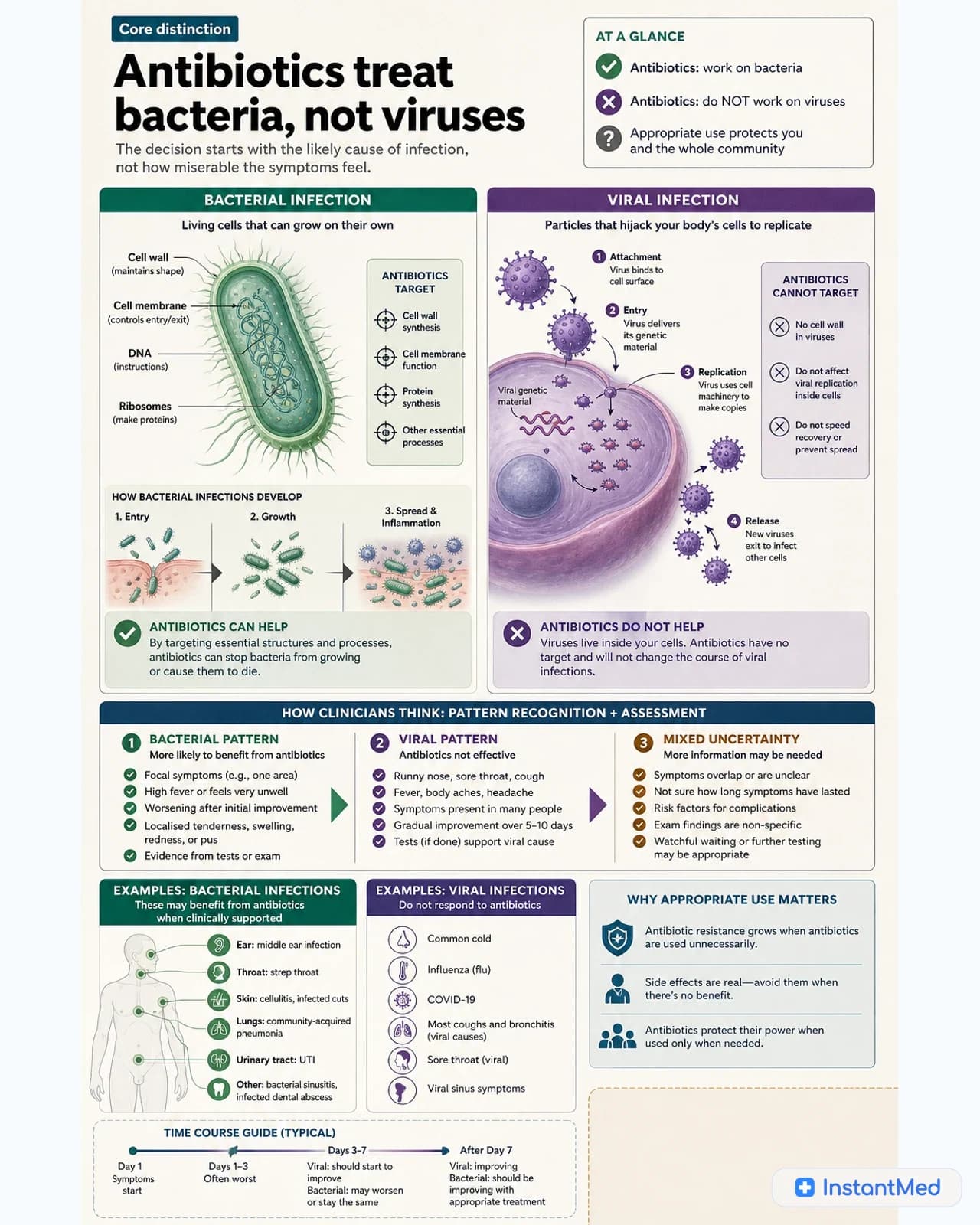
When Antibiotics Are Appropriate: Bacterial vs Viral Infections
Antibiotics treat bacterial infections, not viruses. This guide explains when antibiotics may be appropriate, when they are usually avoided, and what responsible use looks like.
InstantMed Medical Team
9 min read
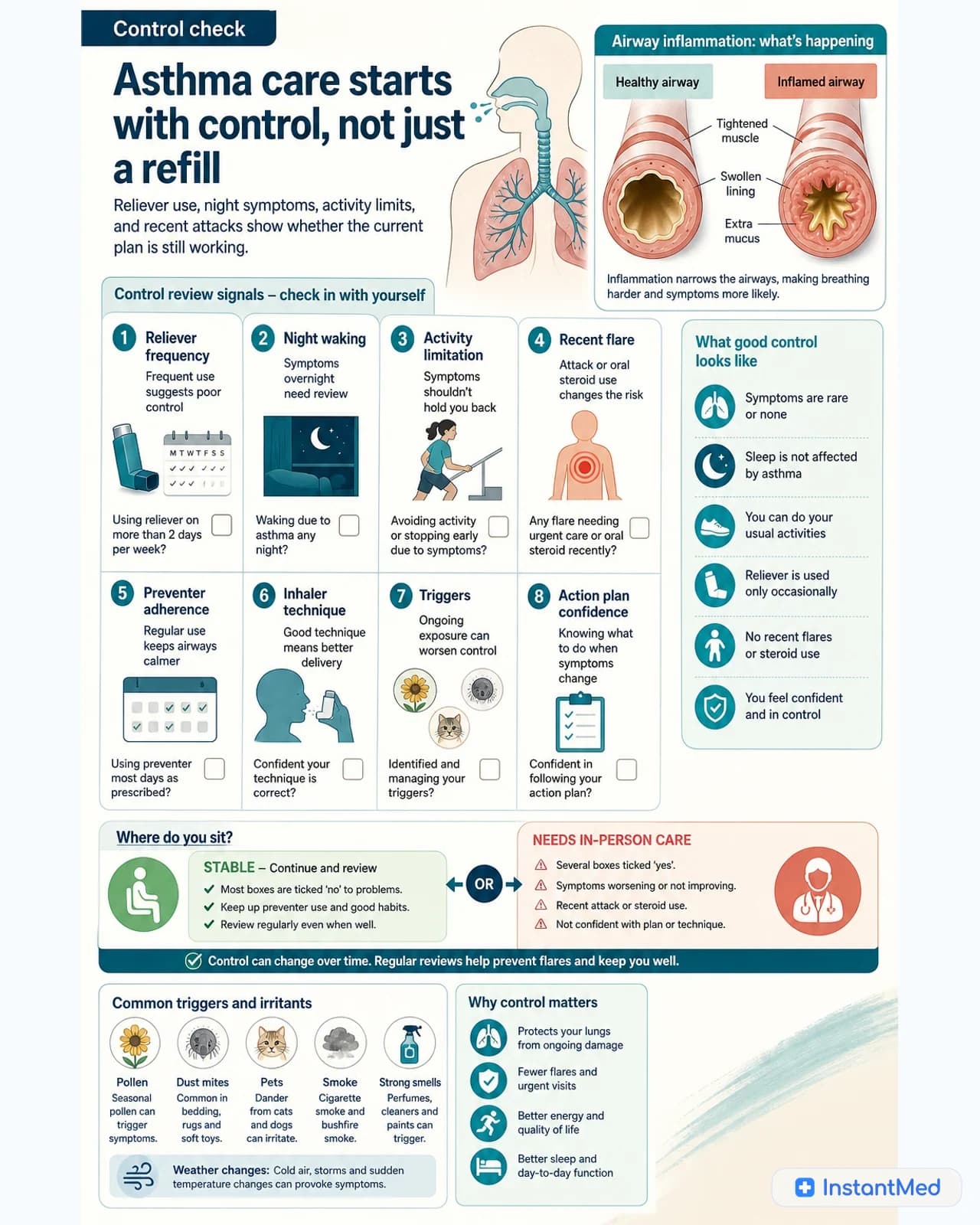
Asthma Management and Telehealth in Australia
Stable, established asthma may suit telehealth medication review, but diagnosis, worsening symptoms, children, and asthma attacks need in-person or emergency care. Learn the safety boundaries.
InstantMed Medical Team