Loading article
Back to Health Guides
Online Doctor Consultations in Australia: Complete Guide
How telehealth works, what it can treat, costs, Medicare rules, and how to choose a service.
8 min read
·Updated 11 June 2026
·Doctor Reviewed
AHPRA Verified
In this article
- 1The Regulatory Framework
- 2Types of Online Consultations
- 3What Online Doctors Can Assess and Treat
- 4What Online Doctors Cannot Do
- 5Medicare and Costs
Medical information only. This article is for general information and does not constitute medical advice. Treatment decisions are made by an AHPRA-registered doctor after reviewing your circumstances.
Review
InstantMed Clinical Team
Clinical governance review for guide content
Updated
11 June 2026
General information only, not personal medical advice.
Jump to section
Online doctor consultations are now a standard feature of Australian primary healthcare. The Australian Institute of Health and Welfare (AIHW) reported that approximately 37% of all GP services in 2021-22 were delivered via telehealth, reflecting how rapidly the model was normalised during and after the COVID-19 pandemic. For patients seeking medical certificates, repeat prescriptions, non-urgent consultations, and referrals, telehealth provides the same clinical outcomes with significantly less friction than in-person care for many presentations.
This guide explains how online consultations work in Australia, what the regulatory framework covers, what doctors can and cannot do remotely, and how to identify a legitimate service.
The Regulatory Framework
Australian telehealth is not a separate, lighter regulatory category -- it operates under the same framework as all medical practice.
AHPRA registration: All doctors providing telehealth in Australia must hold current registration with the Australian Health Practitioner Regulation Agency (AHPRA). The Medical Board of Australia, which operates under AHPRA, sets registration standards, continuing professional development requirements, and professional conduct standards that apply equally to in-person and telehealth practice. You can verify any doctor's registration at ahpra.gov.au.
Medical Board Standards: The Medical Board of Australia's Good Medical Practice: A Code of Conduct for Doctors in Australia applies to all clinical encounters, including telehealth. Specifically, the Medical Board's telehealth guidance requires doctors to make an adequate assessment before providing advice or treatment -- the fact that a consultation occurs online does not reduce the standard of care required.
Privacy Act 1988 (Cth): Your health information obtained during a telehealth consultation is protected under the Privacy Act 1988 and the 13 Australian Privacy Principles (APPs). APP 3 requires that health information only be collected with consent and for the stated purpose. APP 6 prevents secondary use of your health data without consent. APP 11 requires that your health information be protected from misuse or unauthorised access.
State and territory prescribing laws: Each state and territory has its own legislation governing prescribing. Telehealth doctors must comply with the relevant state law for the patient's location, including real-time prescription monitoring systems (SafeScript in Victoria, DORA in Queensland, WAPMS in Western Australia, SAPIS in South Australia, and equivalent systems in other jurisdictions) for Schedule 8 controlled medications.
Types of Online Consultations
There are two primary models of telehealth consultation in Australia:
Synchronous consultations (video or phone): Real-time conversations between you and a doctor, conducted via video call (most common) or phone. These are the model used by Medicare-eligible telehealth services and most GP clinics offering telehealth appointments. Review times are typically set in advance, similar to an in-person booking.
Asynchronous consultations (form-based): You submit a detailed health questionnaire describing your symptoms, history, and what you need. An AHPRA-registered doctor reviews your submission and responds with a clinical decision -- typically within hours during operating hours. No real-time call is required. This model is particularly efficient for medical certificates, repeat prescriptions for stable conditions, and non-urgent consultations where a real-time call does not add clinical value.
Both models involve real clinical assessment by a real doctor. The choice between them depends on the nature of your health need and your preference.
What Online Doctors Can Assess and Treat
AHPRA-registered telehealth doctors can provide the following without physical examination, subject to appropriate clinical assessment:
Medical certificates and documentation
- Work absence certificates under the Fair Work Act 2009 (Cth) section 107
- University academic consideration certificates
- Centrelink medical documentation (standard cases)
- Return-to-work clearances for appropriate presentations
Prescriptions (eScripts)
- Repeat prescriptions for established, stable medications (those you have been taking for 3+ months without recent change)
- Prescriptions for acute conditions that can be safely assessed remotely (urinary tract infections, respiratory infections, skin conditions assessed via photos)
- PBS-listed medications are available at standard PBS co-payment rates: general patients pay up to $25.00 per item; concession card holders pay up to $7.70 (PBS, 2026)
Consultations and advice
- Respiratory symptoms (cough, congestion, sore throat)
- Skin conditions with photo evidence (rashes, eczema, skin infections)
- Urinary tract infections based on symptom history
- Mental health support (anxiety, depression, stress, burnout) and referrals
- Gastrointestinal symptoms where examination is not required
- Medication management and dosage queries
- General health advice and second opinions
Referrals and requests
- Referral letters to specialists (all specialties)
- Pathology request forms (blood tests, urine cultures, etc.)
- Radiology requests where clinical history supports the request
What Online Doctors Cannot Do
Understanding the boundaries of telehealth is as important as understanding its capabilities:
- Conditions requiring physical examination: Ear infections requiring otoscopy, abdominal conditions requiring palpation, chest conditions requiring auscultation, and acute musculoskeletal injuries requiring examination cannot be safely assessed without physical contact
- Schedule 8 medications: Opioids, benzodiazepines, and other Schedule 8 controlled substances cannot be prescribed via asynchronous telehealth regardless of the patient's history
- New medications requiring workup: Starting a patient on a new medication class that requires baseline measurements (blood pressure, ECG, blood tests) requires in-person assessment first
- Emergencies: Telehealth has no role in emergency care. Call 000 for chest pain, difficulty breathing, signs of stroke (face drooping, arm weakness, speech difficulty, time to call), severe injury, or any life-threatening situation
Medicare and Costs
Medicare-eligible telehealth: Since March 2020, Medicare has funded a range of telehealth MBS items for video and phone consultations. These are available when a patient has a pre-existing clinical relationship with the GP practice (generally, a prior in-person consultation within the preceding 12 months). Bulk-billed Medicare telehealth remains the most cost-effective option when your own GP practice offers it.
Private telehealth: Asynchronous telehealth services (form-based, no real-time call) are typically private fee services and do not attract a Medicare rebate. They operate outside the MBS framework but within AHPRA and Privacy Act requirements. Fixed fees provide cost certainty -- the fee is the same regardless of outcome.
PBS at the pharmacy: PBS co-payments are uniform regardless of how the prescription was obtained. Whether your prescription came from an in-person GP consultation or a telehealth consultation, the pharmacy charges the same PBS co-payment.
How to Identify a Legitimate Service
Legitimate Australian telehealth services will:
- Clearly state that doctors are AHPRA-registered, with the ability to verify registration numbers
- Decline to prescribe when the clinical information is insufficient or the medication is not appropriate for telehealth prescribing
- Refer patients to in-person care when the presentation requires physical assessment
- Not guarantee specific outcomes, medications, or certificates before clinical assessment occurs
- Have transparent pricing with no hidden fees
- Operate under a clear privacy policy referencing the Privacy Act 1988 and Australian Privacy Principles
Clinical fit
Urgent symptoms, physical examination, complex diagnosis, or unsafe prescribing can require in-person care.
Warning signs: Services that guarantee specific medications upfront, promise approval of any certificate request, or do not require any clinical information before issuing documents are not conducting genuine clinical assessments. The Medical Board of Australia's Good Medical Practice standards require adequate assessment before treatment -- services that skip this are not compliant with AHPRA standards.
Complaints and Patient Rights
Australian patients have the same rights in telehealth as in in-person care:
- AHPRA complaints: If you have concerns about a doctor's clinical conduct or professional behaviour, you can lodge a notification with AHPRA at ahpra.gov.au. AHPRA investigates notifications about registered practitioners and can take action including conditions on registration, suspension, or cancellation.
- State health complaints commissioners: Each state and territory has a health complaints commission or health ombudsman (e.g., NSW Health Care Complaints Commission, Queensland Health Ombudsman, Victorian Health Complaints Commissioner) that handles complaints about health service providers, including telehealth services.
- Access to records: You have the right to access your health records from any telehealth provider. Records must be maintained to the same standard as in-person medical records.
- Privacy complaints: Complaints about privacy breaches can be made to the Office of the Australian Information Commissioner (OAIC).
The Process: How It Works
- 1
Submit your intake: Complete a structured health questionnaire describing your symptoms, relevant history, current medications, and what you need. Typically takes 5-10 minutes.
- 2
Doctor review: An AHPRA-registered doctor reviews your clinical information. This is a genuine clinical assessment -- the doctor may send follow-up questions if they need more information. They make an independent decision about what is clinically appropriate.
- 3
Digital delivery: If the request is clinically appropriate, the outcome is delivered digitally. Medical certificates are delivered as PDF by email; eScripts are sent by SMS as a QR code fillable at any Australian pharmacy.
- 4
In-person direction: If the doctor determines that in-person assessment is needed, they will tell you so and advise the appropriate care pathway. This is the system working correctly.
Review times are typically 30-90 minutes, sometimes longer during busy periods. The service operates 24 hours a day, 7 days a week.
When to Present In Person
Telehealth is appropriate for a wide range of non-urgent presentations. It is not appropriate for:
- Any emergency (call 000)
- Conditions requiring physical examination for safe clinical decision-making
- Situations where you feel too unwell to accurately describe your symptoms in writing
- Complex chronic disease management requiring monitoring, examination, and longitudinal relationship with a doctor
For these situations, present to your GP, an after-hours clinic, or -- for emergencies -- your nearest hospital emergency department.
Sources Used In This Guide
- AIHW: Primary health care in Australia
- Department of Health and Aged Care: Telehealth
- Services Australia: Medicare
- Medical Board of Australia: telehealth consultations with patients
- RACGP: General Practice Health of the Nation
- AHPRA: Register of practitioners
Frequently Asked Questions
Are online doctors real Australian doctors?
Yes. Legitimate telehealth services use AHPRA-registered medical practitioners - the same registration required for in-person practice. You can verify any doctor's registration at ahpra.gov.au using their name or registration number.
How much does an online doctor consultation cost in Australia?
Private telehealth fees vary by service and consultation type. InstantMed's services start from $24.95 for medical certificates. Medicare bulk-billed telehealth is available for video or phone consultations with an enrolled GP practice - contact your regular GP to check availability.
Can online doctors prescribe any medication?
Most commonly prescribed medications can be issued via telehealth as an eScript. Exceptions include Schedule 8 controlled substances (opioids, benzodiazepines), medications requiring physical examination before prescribing, and new treatments requiring in-person review. The prescribing doctor makes a clinical decision on each request.
Is telehealth private and secure?
Yes. Telehealth providers are bound by the Privacy Act 1988 (Cth) and the Australian Privacy Principles (APPs). Your health information is protected health information under the Privacy Act. Reputable services use encrypted platforms and do not share your information without your consent.
Can I see my regular GP online?
Many GP clinics now offer telehealth appointments - contact your practice to check availability. For urgent needs when your regular GP is unavailable, services like InstantMed provide access to AHPRA-registered doctors for medical certificates, repeat prescriptions, and general consultations.
InstantMed Medical Team
Related Articles
11 min read
Telehealth vs GP: What's Actually Different in Australia?
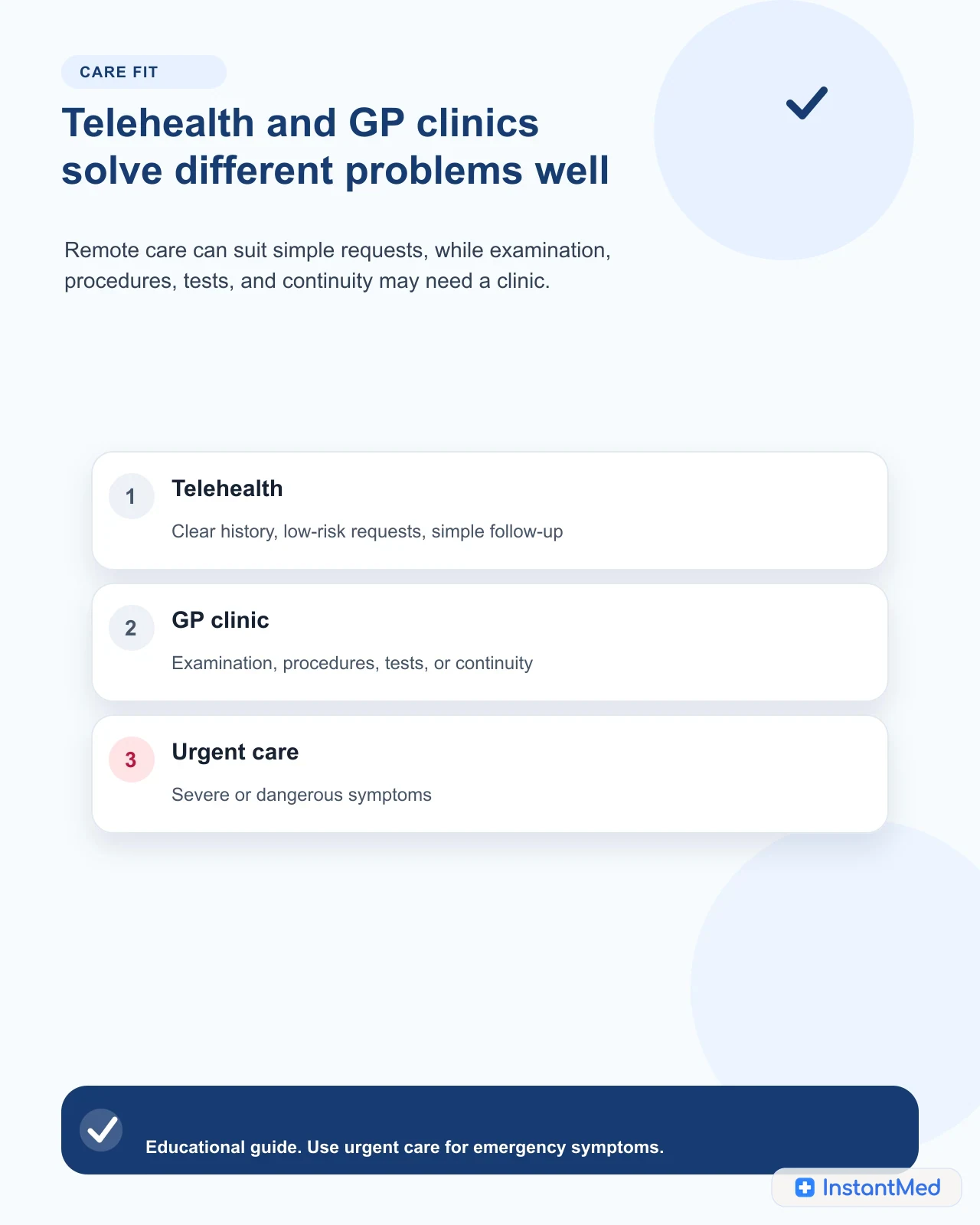
Telehealth and in-person GP care are not rivals. Telehealth can be useful for suitable remote assessment, while GP clinics remain essential for examination, continuity, procedures, tests, and complex care.
InstantMed Medical Team
10 min read
Is Telehealth Bulk Billed in Australia?
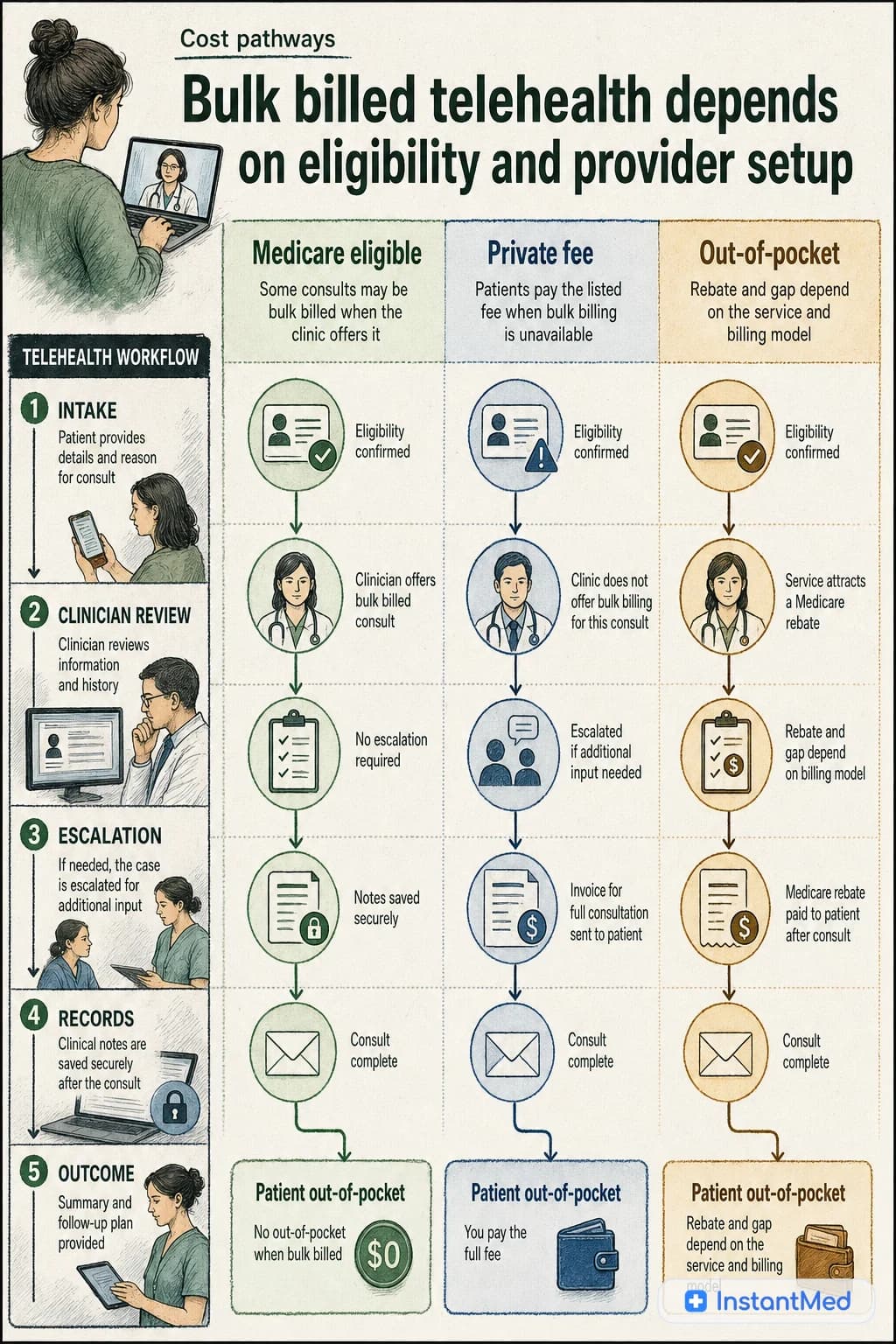
Telehealth can be bulk billed in Australia, but it is not automatic. Learn when Medicare telehealth rebates apply, what bulk billing means, and what to check before booking.
InstantMed Medical Team
11 min read
How Telehealth Consultations Work in Australia
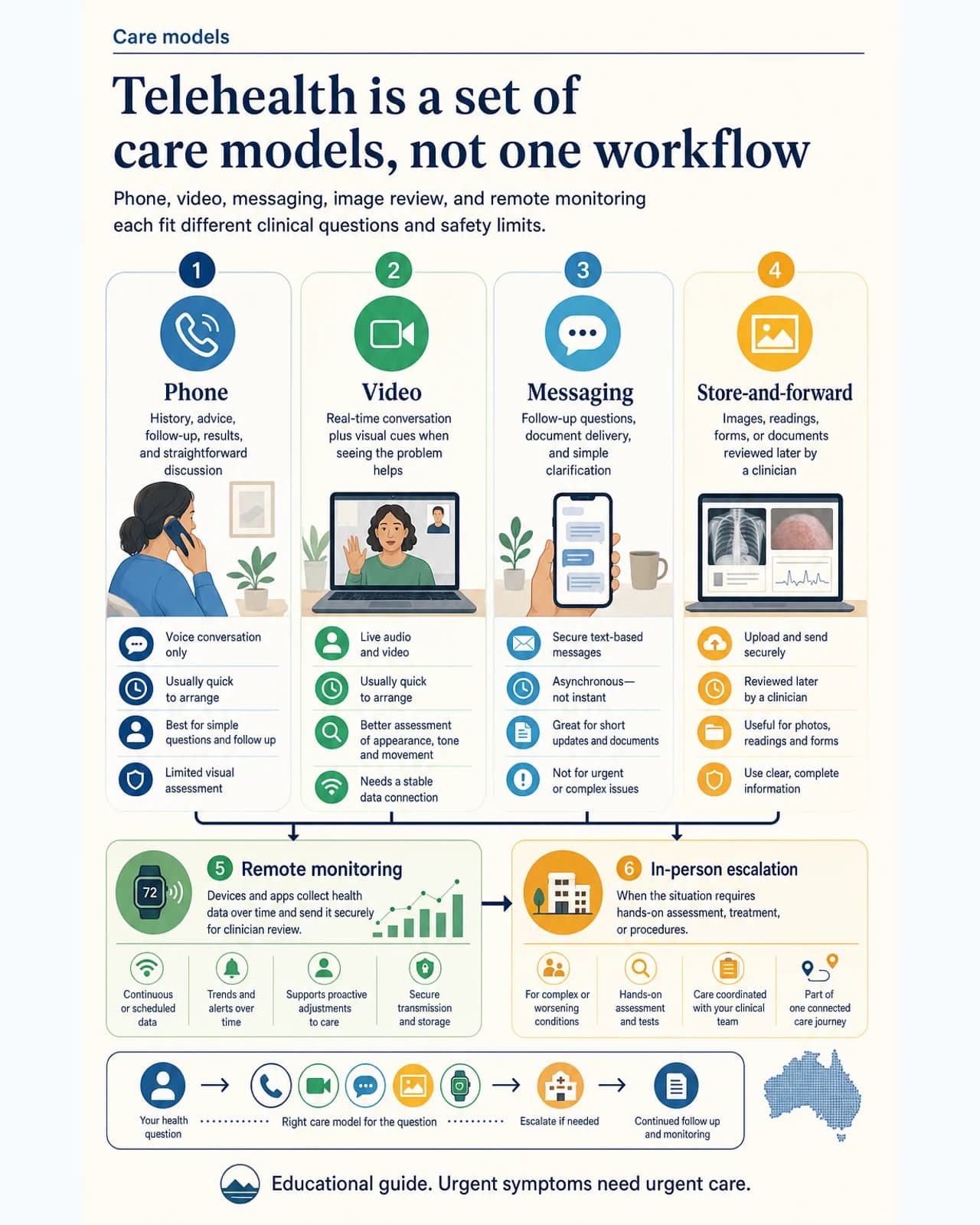
Telehealth can mean phone, video, online messaging, image sharing, remote monitoring, or a mix of digital tools. Learn how it works, what a clinician still needs to check, and where telehealth should stop.
InstantMed Medical Team