Loading article
Back to Health Guides
How Telehealth Consultations Work in Australia
A plain-English guide to phone, video, online messaging, store-and-forward review, privacy, Medicare, prescribing limits, and when in-person care is safer.
11 min read
·Updated 10 May 2026
·Doctor Reviewed
AHPRA Verified
In this article
- 1Telehealth Is A Category, Not One Workflow
- 2What Regulators Expect
- 3Before The Consultation
- 4During A Phone Or Video Consultation
- 5Online Forms And Store-And-Forward Review
Medical information only. This article is for general information and does not constitute medical advice. Treatment decisions are made by an AHPRA-registered doctor after reviewing your circumstances.
Review
InstantMed Clinical Team
Clinical governance review for guide content
Updated
10 May 2026
General information only, not personal medical advice.
Jump to section
1Telehealth Is A Category, Not One Workflow2What Regulators Expect3Before The Consultation4During A Phone Or Video Consultation5Online Forms And Store-And-Forward Review6What The Clinician Is Actually Deciding7Possible Outcomes8When Telehealth Should Escalate9Medicare, Private Fees, And Eligibility10Privacy And Records11Continuity Of Care12How To Use Telehealth Well13The Bottom Line14Sources Used In This Guide
Telehealth is healthcare delivered at a distance using technology. In Australia, it can include phone calls, video calls, online messaging, image sharing, electronic prescriptions, referrals, investigation requests, and remote monitoring.
The important point is that telehealth is a mode of care, not a lower standard of care. The clinician still has to decide whether the information available is enough to provide safe care.
Key Information
Telehealth is useful when the problem can be assessed safely at a distance. It is not a routine replacement for in-person care when examination, monitoring, urgent treatment, or physical procedures are needed.
Telehealth Is A Category, Not One Workflow
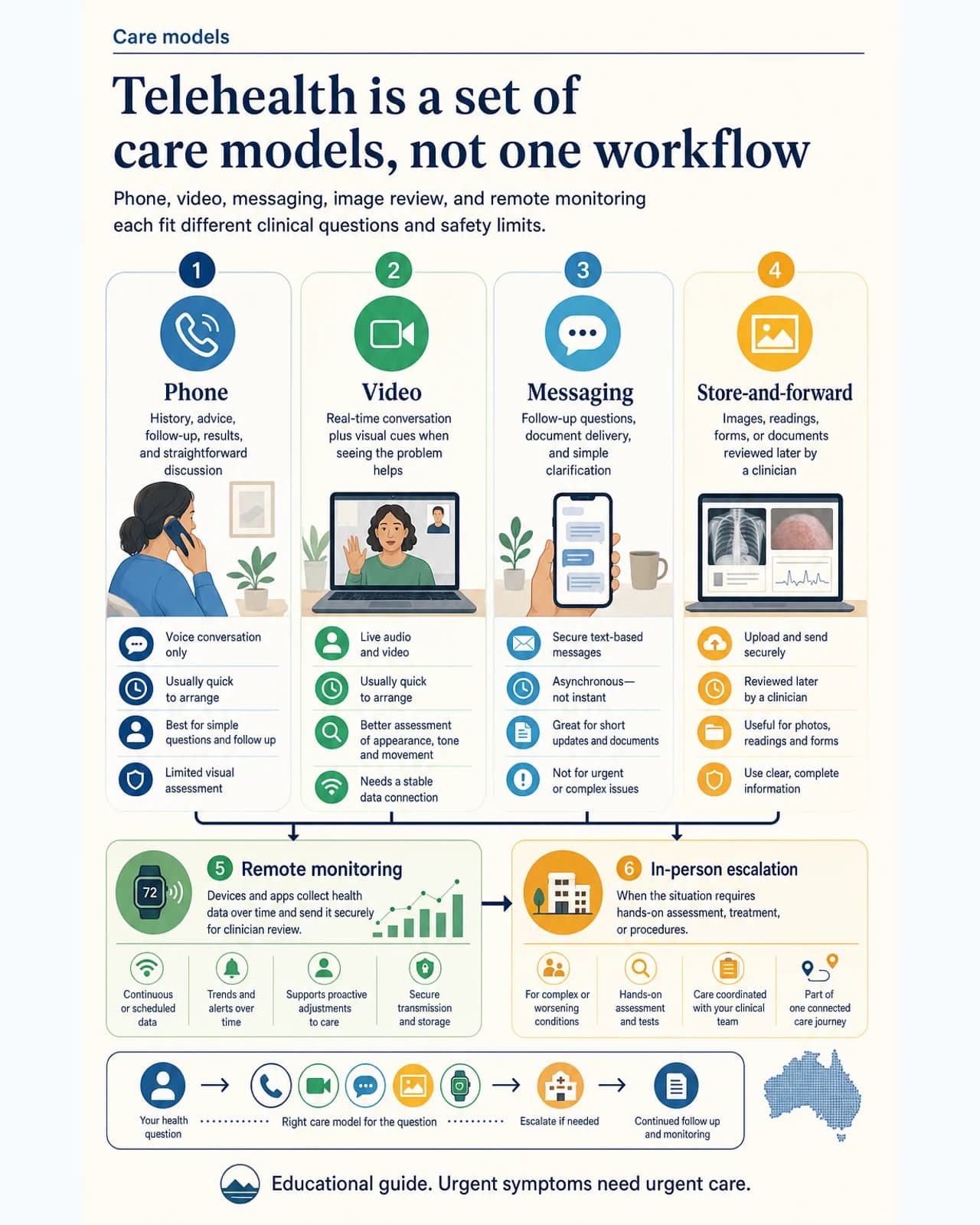
People use "telehealth" to describe several different models.
| Model | What happens | Best fit |
|---|---|---|
| Phone consultation | You speak with a clinician by phone. | Follow-up, history-based issues, medication review, advice, results discussion. |
| Video consultation | You speak face to face by video. | More complex discussion, visual assessment, mental health review, shared decision-making. |
| Online messaging | You exchange written information through a secure platform. | Clarification, follow-up questions, document delivery, simple updates. |
| Store-and-forward | You send information, images, readings, or documents for later clinical review. | Skin images, forms, home measurements, structured pre-consult information. |
| Remote monitoring | Readings from devices are reviewed over time. | Chronic disease monitoring, post-discharge follow-up, selected specialist care. |
Many real services combine these. For example, a patient may complete an online form, upload photos, then receive a phone call because the clinician needs more information.
What Regulators Expect
The Medical Board of Australia's telehealth guidelines say telehealth can support triage, diagnosis, treatment, and preventive health services, but it is not appropriate for all consultations.
Key safety principles include:
- Telehealth care should be safe and, as far as possible, meet the same standard as in-person care.
- Video is often preferable to telephone when practical.
- Telehealth is generally strongest when it supports an ongoing clinical relationship that also includes in-person care.
- One-off telehealth can still have a role, especially where access is difficult or the problem is episodic.
- Privacy, confidentiality, informed consent, culturally safe care, and professional boundaries still apply.
- The practitioner is responsible for deciding whether telehealth is clinically appropriate.
Updated AHPRA and National Boards guidance also warns about poor practice where prescribing relies on text, email, or online questionnaires instead of a face-to-face, video, or telephone consultation.
Before The Consultation
A safe telehealth consultation starts before the call, message, or review.
Patients should prepare:
- A private place to speak or type
- A charged phone or computer
- A stable internet connection if video is needed
- Current medicines and allergies
- Relevant medical history
- Recent test results or letters if available
- A list of symptoms, timing, severity, and concerns
- Photos or home readings only if requested or relevant
Clinicians should use systems that support secure access to records, clinical notes, prescriptions, referrals, investigation requests, images, and follow-up information.
During A Phone Or Video Consultation
A real-time consultation should feel like a clinical conversation, not a script.
The clinician may ask about:
- Main symptoms and when they started
- Severity and whether symptoms are improving or worsening
- Associated symptoms
- Medical history
- Medicines, allergies, pregnancy status, and risk factors
- Work, study, driving, caring, or safety implications
- Previous episodes and what helped
- Red flags that would change the pathway
On video, the clinician may ask to see something visible, such as a rash, swelling, wound, breathing effort, mobility, or a document. Video is not the same as a physical examination, but it can add information that phone alone cannot.
Online Forms And Store-And-Forward Review
Online forms can make telehealth safer when they collect structured information before a clinician reviews the case. They can also make telehealth unsafe if they are treated as a substitute for clinical judgment.
Good use of online forms:
- Collects symptoms, timing, history, medicines, allergies, and risk information
- Helps identify red flags early
- Gives the clinician a structured record
- Supports follow-up questions
- Tells the patient when telehealth may not be suitable
Weak use of online forms:
- Approves requests automatically
- Ignores missing information
- Treats every patient the same
- Uses a questionnaire alone for decisions that need real-time contact
- Fails to redirect urgent or examination-dependent problems
The safe version is not "form equals approval." The safe version is "form supports a clinician's decision."
What The Clinician Is Actually Deciding
A telehealth clinician is not just deciding whether to provide a document, advice, prescription, referral, or test request. They are deciding whether remote care is adequate.
The core questions are:
Safety checks
The clinician has to confirm identity, privacy, history, consent, suitability, red flags, records, and follow-up before deciding what care is appropriate.
- Is the patient who they say they are?
- Is the problem suitable for remote assessment?
- Is the information complete enough?
- Is real-time contact needed?
- Is video needed rather than phone?
- Is an in-person examination needed?
- Are there red flags or safety concerns?
- Is follow-up required?
- What should the patient do if symptoms worsen?
This is why decline, redirection, or escalation can be the correct outcome.
Possible Outcomes
Depending on the consultation and the service, telehealth may result in:
- Self-care advice
- Safety-netting instructions
- A medical certificate or other document
- An eScript
- A pathology request
- An imaging request
- A specialist referral
- A follow-up plan
- A request for more information
- Advice to attend in-person care
- Advice to seek urgent care
Not every telehealth consultation should end with a prescription, certificate, or referral. Sometimes the most clinically appropriate outcome is a boundary.
When Telehealth Should Escalate
Telehealth should not slow down emergency care.
Use urgent or in-person care for symptoms such as:
- Chest pain, severe shortness of breath, collapse, or stroke symptoms
- Severe allergic reaction
- Severe bleeding or major injury
- New neurological weakness, confusion, or seizure
- Severe abdominal pain
- Pregnancy-related red flags
- Serious eye pain or vision changes
- Severe mental health crisis or immediate risk of harm
- Symptoms that require physical examination, imaging, monitoring, or procedures
The exact pathway depends on the symptom and location. Emergency symptoms should bypass routine telehealth.
Medicare, Private Fees, And Eligibility
Some Australian telehealth services can be billed to Medicare. Others are private services.
MBS telehealth rules are specific. Video and phone items are available across many practitioner groups, but eligibility depends on item rules, practitioner type, clinical relationship requirements, exemptions, location, and the service provided.
For general practice telehealth, MBS rules can include an eligible telehealth practitioner or established clinical relationship requirement, with exemptions for some situations. These rules have changed over time, so patients should not assume every phone or video consultation is automatically Medicare-rebatable.
Private telehealth fees are separate from Medicare. A private fee does not make a service unsafe by itself, and a Medicare rebate does not make a consultation automatically appropriate. The clinical standard is the key issue.
Privacy And Records
Telehealth involves health information, so privacy matters.
Practical privacy expectations include:
Right channel
Telehealth should escalate when examination, monitoring, procedures, emergency treatment, or immediate mental health support is needed.
- A private space for the consultation
- Secure systems for clinical notes and records
- Appropriate handling of images, videos, messages, prescriptions, referrals, and test requests
- Clear consent when technology or data sharing is involved
- No unnecessary sharing of sensitive information with employers, family, or third parties
Patients should avoid sending health images or documents through workplace accounts, shared devices, or unsecured channels when a safer option is available.
Continuity Of Care
Telehealth is strongest when it fits into ongoing care.
Continuity matters for:
- Chronic conditions
- Mental health
- Medication changes
- Pregnancy
- Older patients or complex health needs
- Children
- Recurrent symptoms
- Abnormal test results
- Problems that may need examination or follow-up
If telehealth produces a prescription, referral, result, or important diagnosis, the information should be available for follow-up and, where appropriate, shared with the patient's regular GP or treating team.
How To Use Telehealth Well
Good telehealth use is not just about convenience.
Before choosing a telehealth pathway, ask:
- Is this urgent?
- Would a physical examination change the decision?
- Is video better than phone?
- Do I have enough information ready?
- Do I need continuity with my regular GP?
- What should I do if symptoms worsen?
- How will I receive records, prescriptions, referrals, or results?
If the answer points to in-person care, telehealth should not be forced.
The Bottom Line
Telehealth can be safe, useful, and efficient when the clinical problem fits the medium. It can include phone, video, messaging, image review, prescriptions, referrals, and follow-up, but the mode does not lower the standard of care.
The best telehealth consultations are clear about identity, privacy, history, consent, clinical limits, escalation, and continuity. The worst ones treat convenience as the goal. In healthcare, convenience only works when safety stays in charge.
Sources Used In This Guide
- Medical Board of Australia: Telehealth consultations with patients
- Medical Board of Australia: updated telehealth guidance
- Australian Commission on Safety and Quality in Health Care: Digital health
- healthdirect: Virtual care clinics
- MBS Online: MBS Telehealth Services
Frequently Asked Questions
What counts as telehealth in Australia?
The Medical Board of Australia describes telehealth consultations as consultations using technology as an alternative to in-person consultations. This can include video, internet or telephone consultations, transmitting digital images or data, and some prescribing activities.
Is telehealth the same standard as in-person care?
The Medical Board expects telehealth care to be safe and, as far as possible, meet the same standards as in-person care. Telehealth is not appropriate for every situation because the clinician may not be able to physically examine you.
Can a questionnaire alone replace a consultation?
Not for everything. Updated regulator guidance highlights concerns about healthcare that relies only on text, email, or online questionnaires to assess a patient's needs, especially for prescribing. Real-time phone, video, or face-to-face contact may be needed.
Can telehealth be Medicare-rebatable?
Some phone and video services can attract Medicare benefits when the MBS item rules are met. Eligibility depends on the practitioner, item number, relationship requirements, exemptions, and the type of service. Private telehealth services may not be Medicare-rebatable.
When should telehealth be avoided?
Use urgent or in-person care when symptoms are severe, rapidly worsening, require physical examination, need emergency treatment, involve major injury, chest pain, stroke symptoms, severe breathing trouble, collapse, severe allergic reaction, or immediate mental health crisis.
InstantMed Medical Team
Related Articles
10 min read
What AHPRA-Registered Means for Doctors in Australia
AHPRA registration is a live, checkable status on the national register. Learn what to verify before relying on a doctor's credentials.
InstantMed Medical Team

9 min read
Best Online Doctor Services in Australia: How to Compare Them
The best online doctor service depends on the problem, not the brand. This guide explains how to compare Australian telehealth services by clinical fit, practitioner registration, pricing transparency, privacy, and safety boundaries.
InstantMed Medical Team

9 min read
How Doctors Review Online Medical Requests
Online medical forms can help collect history, but they are not a substitute for clinical judgment. Learn how doctors review telehealth requests, what information matters, and when real-time or in-person assessment is required.
InstantMed Medical Team