Loading article
Back to Health Guides
Is Telehealth Bulk Billed in Australia?
How bulk billing, Medicare rebates, gap fees, and private telehealth fees differ.
10 min read
·Updated 6 July 2026
·Doctor Reviewed
AHPRA Verified
In this article
- 1What bulk billed telehealth means
- 2The three checks that decide what you pay
- 3Bulk billed, rebated, gap fee, and private fee
- 4The GP telehealth relationship rule
- 5What changed on 1 July 2026
Medical information only. This article is for general information and does not constitute medical advice. Treatment decisions are made by an AHPRA-registered doctor after reviewing your circumstances.
Review
InstantMed Clinical Team
Clinical governance review for guide content
Updated
6 July 2026
General information only, not personal medical advice.
Jump to section
1What bulk billed telehealth means2The three checks that decide what you pay3Bulk billed, rebated, gap fee, and private fee4The GP telehealth relationship rule5What changed on 1 July 20266Why private telehealth still exists7What to ask before booking8Prescriptions and PBS costs are separate9Where billing stops being the main issue10Bottom line11Sources
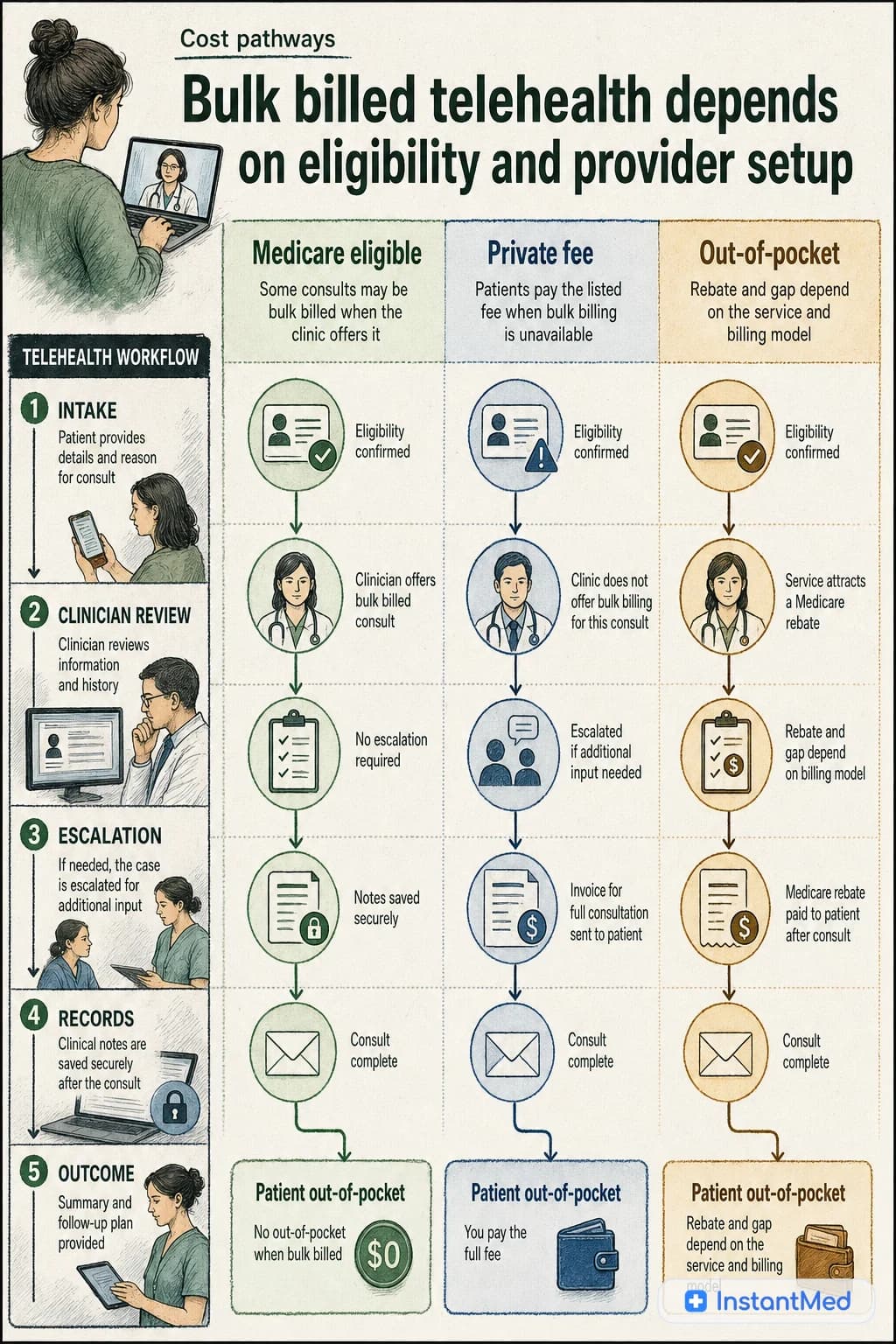
Some telehealth is bulk billed in Australia, but not every online consultation is free. Bulk billing depends on four things lining up: there must be an eligible Medicare Benefits Schedule (MBS) telehealth item, the patient must meet the relevant eligibility rules, the provider must choose to bulk bill, and the patient must assign the Medicare benefit to the provider.
If any of those steps does not apply, you may pay a gap fee, claim a Medicare rebate after paying the full fee, or pay a private fee with no Medicare claim. The safest way to think about telehealth billing is not "online equals bulk billed". It is "which billing pathway applies to this consultation?"
What bulk billed telehealth means
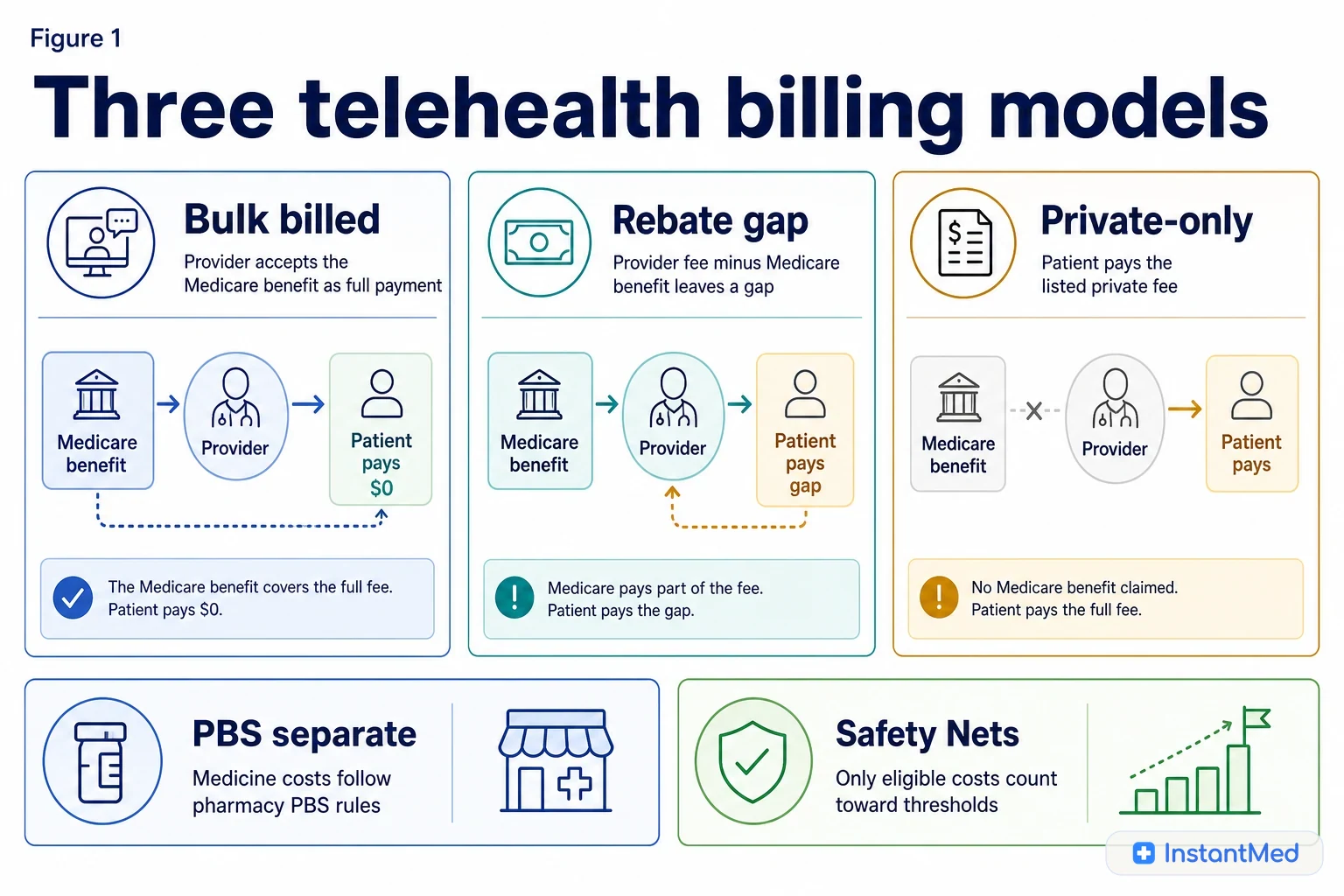
Bulk billing means the provider accepts the Medicare benefit as full payment for an eligible service. You do not pay a consultation gap. Instead, you assign your Medicare benefit to the provider, and the provider claims it from Medicare.
For telehealth, the word "bulk billed" only makes sense if the consultation is eligible for a Medicare telehealth item in the first place. The format can be phone or video where the MBS item allows it. The same general principle applies as in a clinic: the provider must be allowed to bill the item, the consultation must meet the item rules, and the provider must choose the billing model.
Bulk billing is not the same thing as a discount, a coupon, or a free private service. It is a Medicare billing arrangement for an eligible health service. Services Australia says Medicare benefits are available for eligible phone and video telehealth services, and MBS Online lists ongoing telehealth arrangements across general practice, specialists, nurse practitioners, participating midwives, allied health, and other eligible providers.
The three checks that decide what you pay
Most patient confusion comes from mixing three different questions together. Separate them before booking.
| Billing check | Plain-English question | Why it changes the cost |
|---|---|---|
| Medicare item fit | Is there an MBS telehealth item for this type of consultation? | Without an item, there is no Medicare benefit to bulk bill or rebate. |
| Patient and provider eligibility | Do the patient and provider meet that item rule? | Some GP telehealth items require an eligible-practitioner relationship, MyMedicare pathway, or exemption. |
| Provider billing choice | Will the provider bulk bill, charge a gap, or charge privately? | Even when Medicare applies, bulk billing is a provider billing decision. |
| Assignment of benefit | If it is bulk billed, has the patient assigned the Medicare benefit? | Bulk billing requires the patient benefit to be assigned to the provider. |
If all relevant Medicare and billing steps line up, the consultation may be bulk billed. If Medicare applies but the provider charges more than the rebate, you may pay a gap. If the service does not use an MBS item, you usually pay the private fee.
Bulk billed, rebated, gap fee, and private fee
These terms are often used as if they mean the same thing. They do not.
| Billing model | What happens | What you pay | Common patient misunderstanding |
|---|---|---|---|
| Bulk billed | The provider accepts the Medicare benefit as full payment. | Usually $0 for the consultation. | Assuming every Medicare-eligible telehealth service must be bulk billed. |
| Medicare rebate with gap | You pay the provider's fee, then Medicare pays a benefit or the provider processes the rebate. | The difference between the fee and the rebate. | Thinking "Medicare rebate" means no out-of-pocket cost. |
| Private telehealth fee | The provider charges a listed fee and does not claim a Medicare item for that service. | The listed private fee. | Thinking private fee means the care is unregulated or not doctor-reviewed. |
| Not clinically suitable | The doctor decides telehealth is not enough for the problem. | Billing may not be the main issue. | Treating price as the only decision when symptoms need in-person or urgent care. |
The practical question before booking is: "Will this be bulk billed, Medicare rebated with a gap, or privately charged?"
The GP telehealth relationship rule
For many GP telehealth items, Medicare rules are designed around continuity of care. The rule has been described as the "established clinical relationship" requirement and is now often referred to as the "eligible telehealth practitioner" requirement.
In practical terms, a patient may need a recent face-to-face relationship with the GP, another GP at the same practice, or an eligible MyMedicare pathway with their registered practice. The exact rule depends on the item, provider type, consultation type, and exemptions.
Examples of exemption pathways can include certain rural and remote patients, residential aged care residents, patients of Aboriginal Medical Services or Aboriginal Community Controlled Health Organisations, and other listed circumstances. Because item rules change over time, check the provider's billing information and current MBS guidance rather than relying on a generic online summary.
What changed on 1 July 2026
From 1 July 2026, the assignment-of-benefit process for Medicare bulk billing was updated. The change affects how patients assign their Medicare benefit for bulk billed services across healthcare settings, including telehealth.
The important patient takeaway is narrow: assignment-of-benefit paperwork and consent processes changed. The change does not mean every online consultation now attracts a Medicare rebate. It also does not force a provider to bulk bill where they otherwise charge a gap or private fee.
Before booking
Telehealth can be bulk billed, rebated with a gap, privately charged, or clinically unsuitable for remote care.
For bulk billed telehealth, approved digital and other assignment processes can be used when the service is eligible and the required information is captured. For some ongoing GP bulk billed services, the government also describes enduring assignment options for eligible patients such as MyMedicare-registered patients, aged care residents, and patients of Aboriginal Community Controlled Health Organisations or Aboriginal Medical Services.
Why private telehealth still exists
Private telehealth exists because some services are not billed through Medicare, some patients do not meet a relevant Medicare item rule, and some providers choose a private-fee model.
That does not automatically make the care lower quality. A private telehealth service may still involve an AHPRA-registered doctor, clinical screening, records, privacy obligations, and a decision to approve, decline, ask for more information, or refer the patient elsewhere. The billing model is separate from the clinical standard.
Private billing does mean the cost needs to be clear before you continue. Look for the service fee, refund policy, what happens if the request is declined, whether a phone or video review may be required, and whether any pharmacy or medicine costs are separate.
What to ask before booking
If cost matters, ask precise billing questions. Vague questions like "Is it covered by Medicare?" can still leave uncertainty.
- Is this consultation bulk billed?
- If not bulk billed, is it Medicare rebated?
- If there is a rebate, what is the expected out-of-pocket gap?
- Does this item require an existing practice relationship or MyMedicare registration?
- Is this a private-fee service with no Medicare claim?
- Are pharmacy costs, pathology, imaging, certificates, or follow-up reviews separate?
- What happens if the doctor decides telehealth is not clinically suitable?
If the service cannot explain the billing model clearly before you pay, treat that as a reason to slow down and compare options.
Prescriptions and PBS costs are separate
The consultation fee and the pharmacy price are separate questions. A privately charged telehealth consultation may still lead to a prescription for a PBS-listed medicine if the patient, medicine, and prescribing situation meet PBS requirements. The pharmacy then applies PBS rules when dispensing.
The reverse can also be true. A bulk billed consultation does not make every medicine free, and it does not change whether a medicine is PBS listed for your situation. You may still have a PBS co-payment, a private prescription price, or a pharmacy stock issue.
Safety boundary
A cheaper or bulk billed appointment is still the wrong pathway if symptoms need examination, monitoring, or urgent care.
This is why a prescription-related telehealth bill has two layers:
| Cost layer | Who sets it | What to check |
|---|---|---|
| Consultation fee | The doctor, clinic, or telehealth service billing model. | Bulk billed, rebated with gap, or private fee. |
| Medicine price | PBS rules, pharmacy pricing, and whether the script is PBS or private. | PBS eligibility, concession status, Safety Net, and pharmacy stock. |
Where billing stops being the main issue
Price matters, but clinical suitability comes first. Telehealth may be convenient for routine advice, repeat administrative needs, and some follow-up care, but it is not a substitute for every clinical situation.
Decision guide
Where telehealth billing fits
May fit telehealth
- A routine concern where phone or video assessment can meet the clinical standard and the billing model is clear before you proceed.
- A follow-up with your usual GP or registered practice where Medicare telehealth eligibility and provider billing choices are confirmed.
Needs in-person care
- Symptoms where examination, observation, vital signs, procedures, imaging, pathology, or continuity from a treating clinician is needed.
- Requests where the main problem is not billing, but whether remote assessment is enough to make a safe decision.
Urgent care
- Chest pain, severe breathing trouble, stroke signs, fainting, severe dehydration, confusion, severe allergic reaction, major injury, or any immediate danger.
Bottom line
Telehealth can be bulk billed in Australia, but only when the Medicare item, patient eligibility, provider eligibility, provider billing choice, and assignment process all line up. A Medicare rebate is not the same as no cost, and a private telehealth fee is not the same as unregulated care.
Before booking, ask what billing model applies and what you will pay if the service is not bulk billed. For ongoing care, your usual GP or registered practice is often the first place to check. For private telehealth, judge the service on transparent pricing, clinical screening, privacy, and clear escalation when telehealth is not suitable.
Sources
- Services Australia: who can claim telehealth services under the MBS or DVA
- MBS Online: MBS telehealth services
- Department of Health, Disability and Ageing: AskMBS advisory on eligible telehealth practitioner requirements
- Department of Health, Disability and Ageing: improving the assignment of benefit process
- Department of Health, Disability and Ageing: telehealth
Frequently Asked Questions
Is telehealth bulk billed in Australia?
Some telehealth is bulk billed, but it is not automatic. A consultation needs to fit a Medicare telehealth item, the patient needs to meet the relevant eligibility rules, and the provider must choose to accept the Medicare benefit as full payment.
Can a new patient get a Medicare rebate for GP telehealth?
Often no for standard GP telehealth, unless a specific pathway or exemption applies. Many GP telehealth items require an eligible telehealth practitioner relationship, such as a face-to-face attendance with the provider or practice in the relevant period, or a MyMedicare pathway with the registered practice.
What is the difference between bulk billed and Medicare rebated telehealth?
Bulk billed means the provider accepts the Medicare benefit as full payment and you pay no consultation gap. Medicare rebated means Medicare pays a benefit for an eligible service, but the provider may charge more than the benefit, leaving you with a gap.
Do private telehealth prescriptions still use the PBS?
A prescription's PBS price is separate from the consultation fee. If the medicine and patient are PBS eligible, the pharmacy price is based on PBS rules regardless of whether the consultation itself was bulk billed or privately charged.
Did the 1 July 2026 assignment-of-benefit update make telehealth free?
No. The July 2026 assignment-of-benefit changes update how patients assign their Medicare benefit for bulk billed services. They do not make every telehealth service bulk billed and do not remove Medicare telehealth eligibility rules.
InstantMed Medical Team
Related Articles
11 min read
Telehealth vs GP: What's Actually Different in Australia?
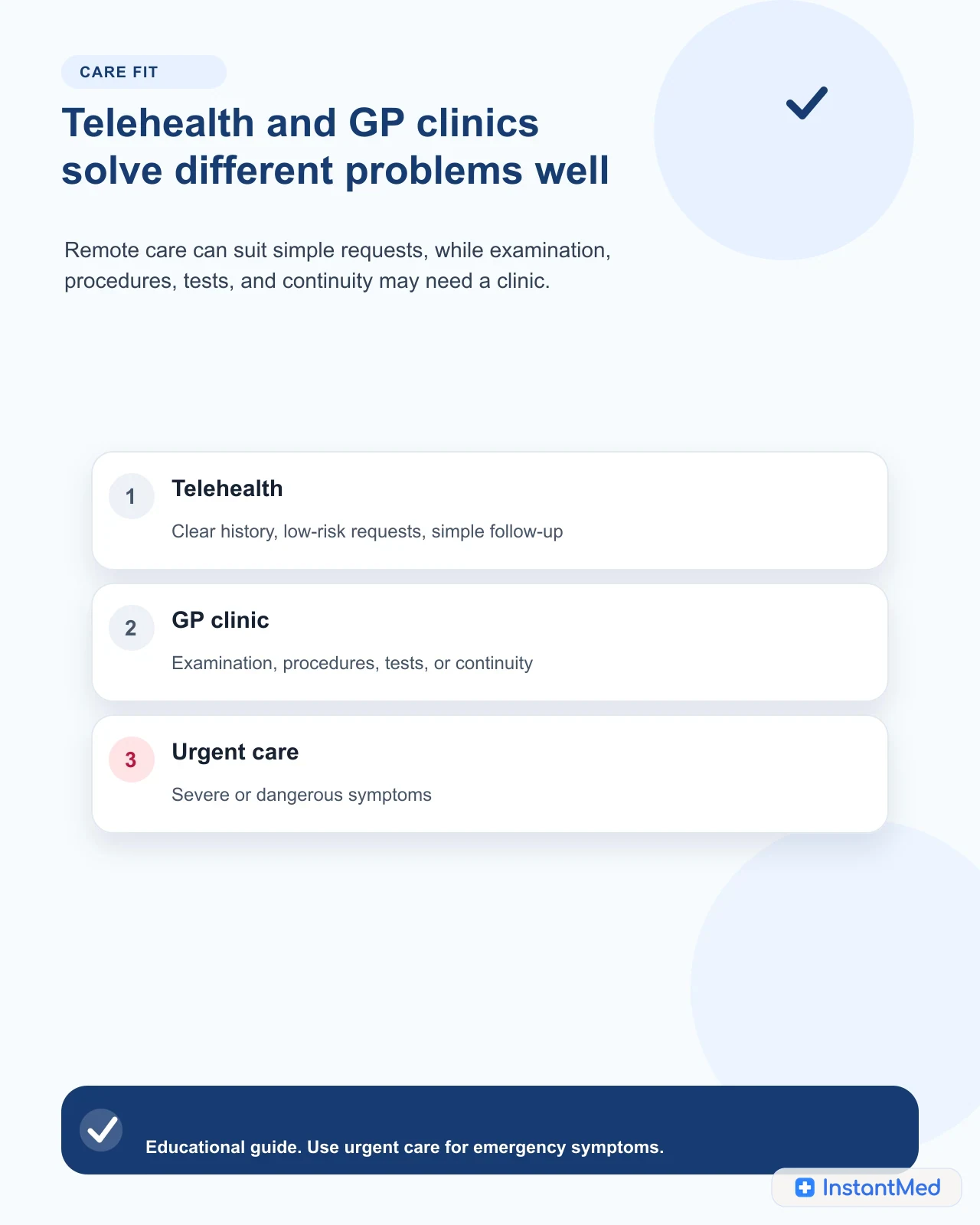
Telehealth and in-person GP care are not rivals. Telehealth can be useful for suitable remote assessment, while GP clinics remain essential for examination, continuity, procedures, tests, and complex care.
InstantMed Medical Team
12 min read
Telehealth Costs: Bulk Billing vs Private
Telehealth is not one price model. Some services can be bulk billed, some may attract a Medicare rebate, and some are private-only. This guide explains the difference.
InstantMed Medical Team
11 min read
What Is Telehealth? How Online Healthcare Works in Australia
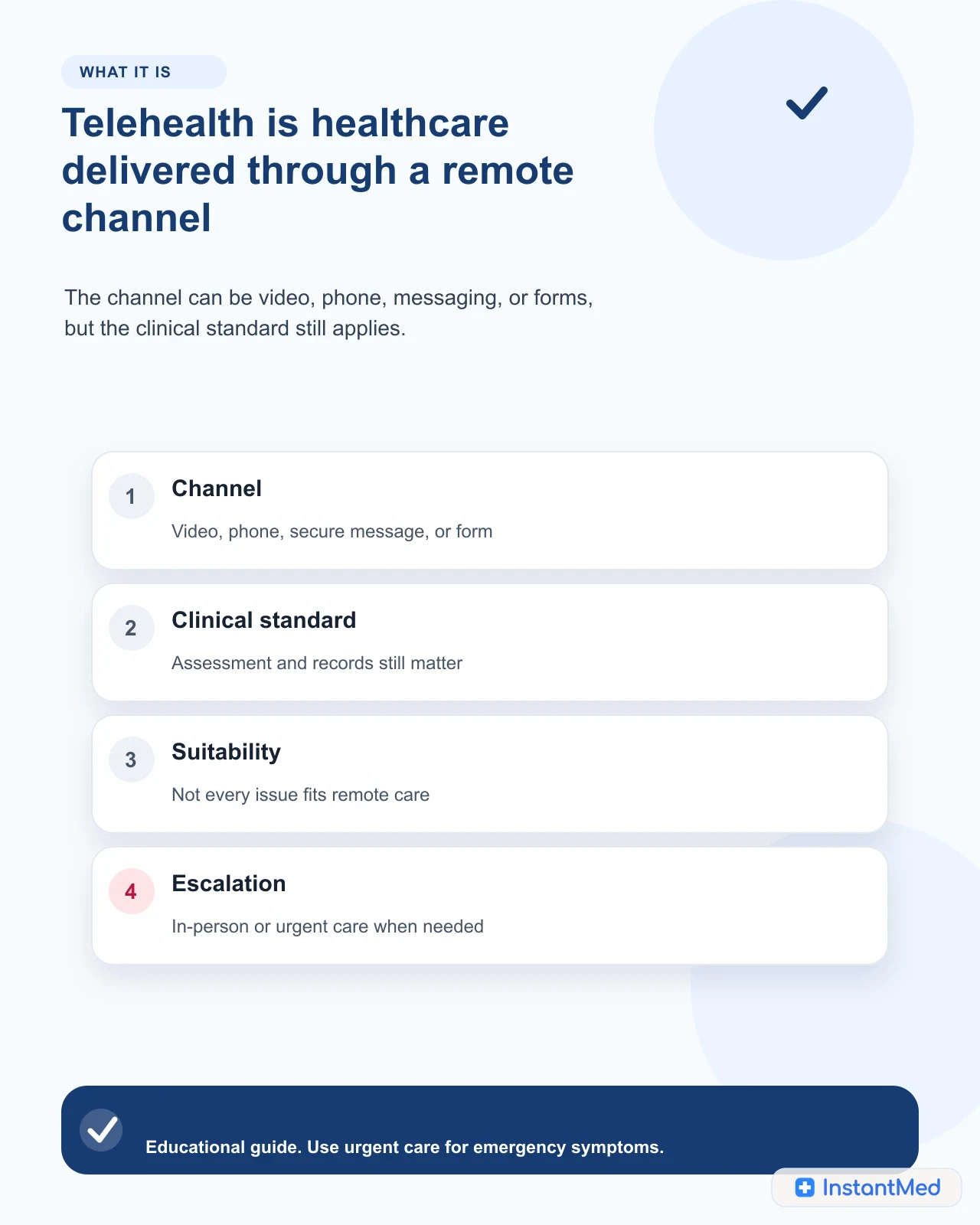
Telehealth is healthcare delivered remotely by phone, video, secure messaging, or structured online forms. The channel is different, but the practitioner still needs enough information to provide safe care.
InstantMed Medical Team