Loading article
Back to Health Guides
Online Doctor Certificate for Work: What Counts as Evidence
How online work certificates are assessed, what employers usually check, and when a different pathway is needed.
10 min read
·Updated 5 July 2026
·Doctor Reviewed
AHPRA Verified
In this article
- 1What an online doctor certificate for work is
- 2What Fair Work asks for
- 3What an employer usually checks
- 4How the online assessment works
- 5What the certificate should show
Medical information only. This article is for general information and does not constitute medical advice. Treatment decisions are made by an AHPRA-registered doctor after reviewing your circumstances.
Review
InstantMed Clinical Team
Clinical governance review for guide content
Updated
5 July 2026
General information only, not personal medical advice.
Jump to section
1What an online doctor certificate for work is2What Fair Work asks for3What an employer usually checks4How the online assessment works5What the certificate should show6When online may not be the right pathway7Privacy and diagnosis details8Dates, timing and backdating9If your employer questions the certificate10Sources
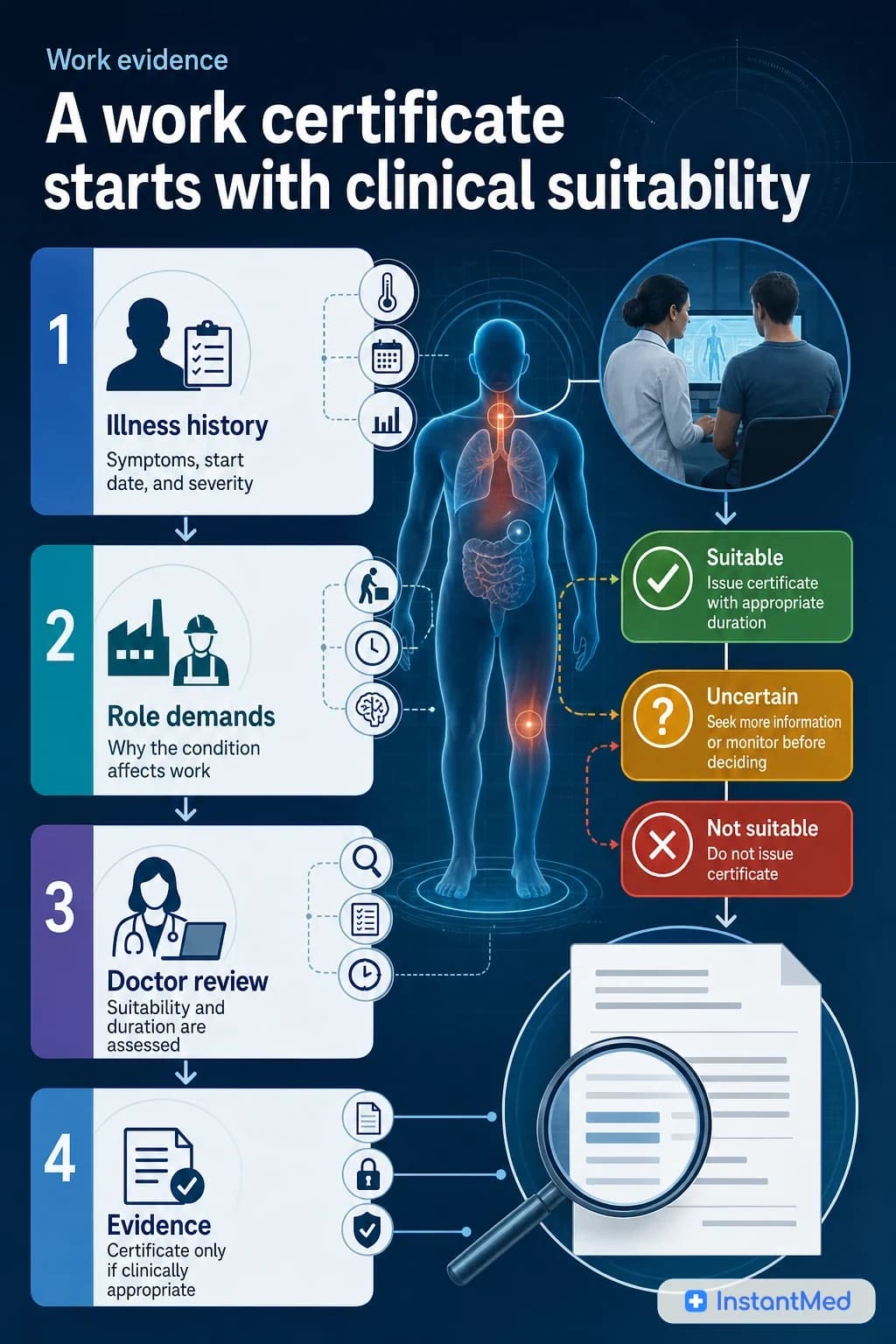
Yes. In Australia, an online doctor can provide a medical certificate for work when telehealth is clinically appropriate and the doctor can assess that you were unfit for work for the relevant period. The certificate is still medical evidence. It is not just a paid document, and it is not automatic.
The useful question is not whether the appointment happened online. The useful question is whether the evidence would satisfy a reasonable person: who was assessed, by whom, on what date, for what period of work incapacity, and whether the situation fits a routine certificate rather than a higher-stakes assessment.
What an online doctor certificate for work is
An online doctor certificate is a medical certificate issued after a telehealth assessment. The doctor may use an online form, secure messaging, phone, video, uploaded photos, or a mix of these depending on the service and the clinical situation.
For routine work absence, the certificate usually confirms that the doctor assessed you and considered you unfit for work for a defined period because of a medical condition. It serves the same administrative purpose as a certificate from a GP clinic: it helps your employer decide whether the absence should be treated as sick or carer's leave, or another type of leave.
It should not be treated as a guarantee. A doctor still has to decide whether there is enough information to support the dates requested. If the symptoms are unclear, severe, safety-sensitive, or outside the scope of remote assessment, online care may stop at advice or referral rather than a certificate.
What Fair Work asks for
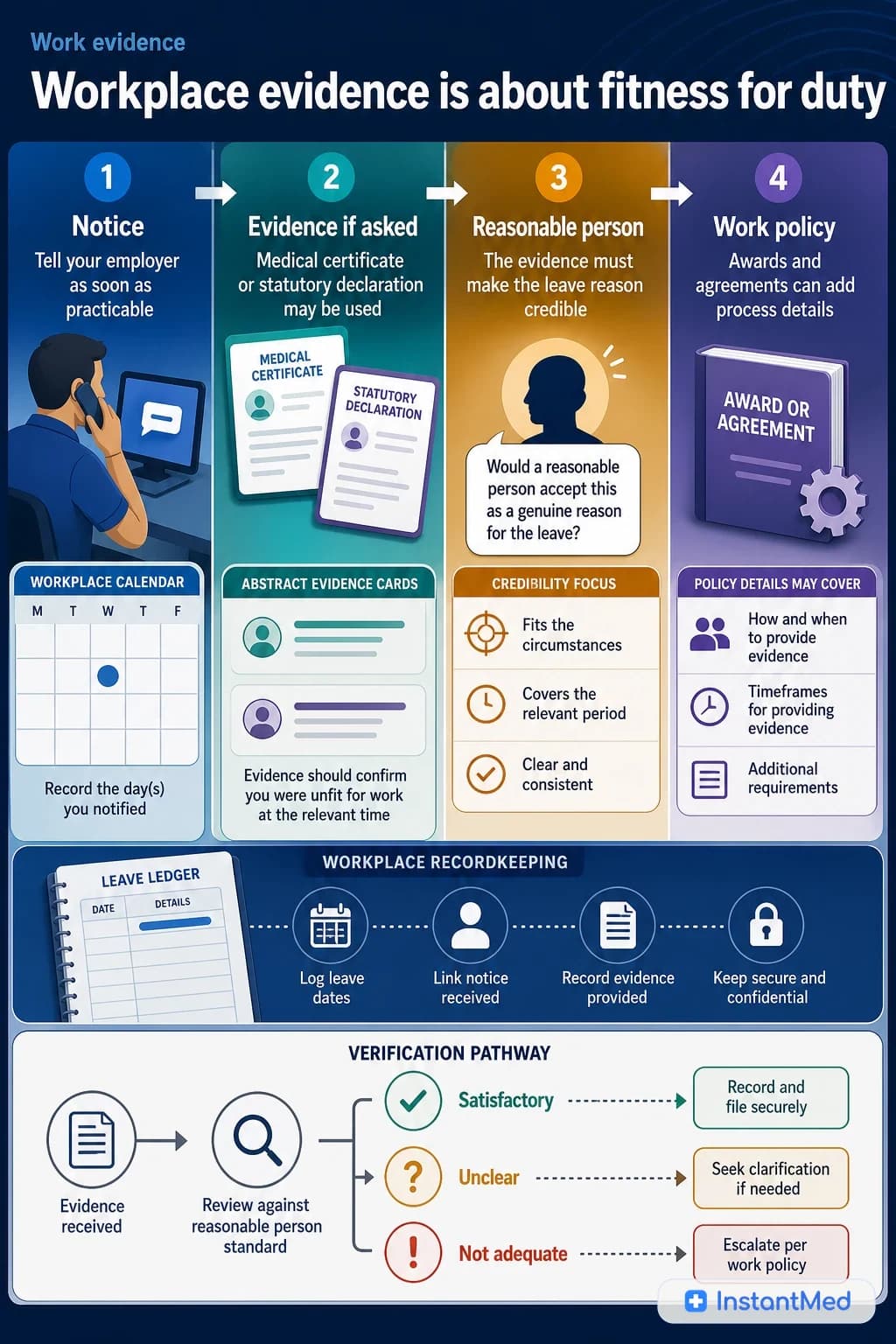
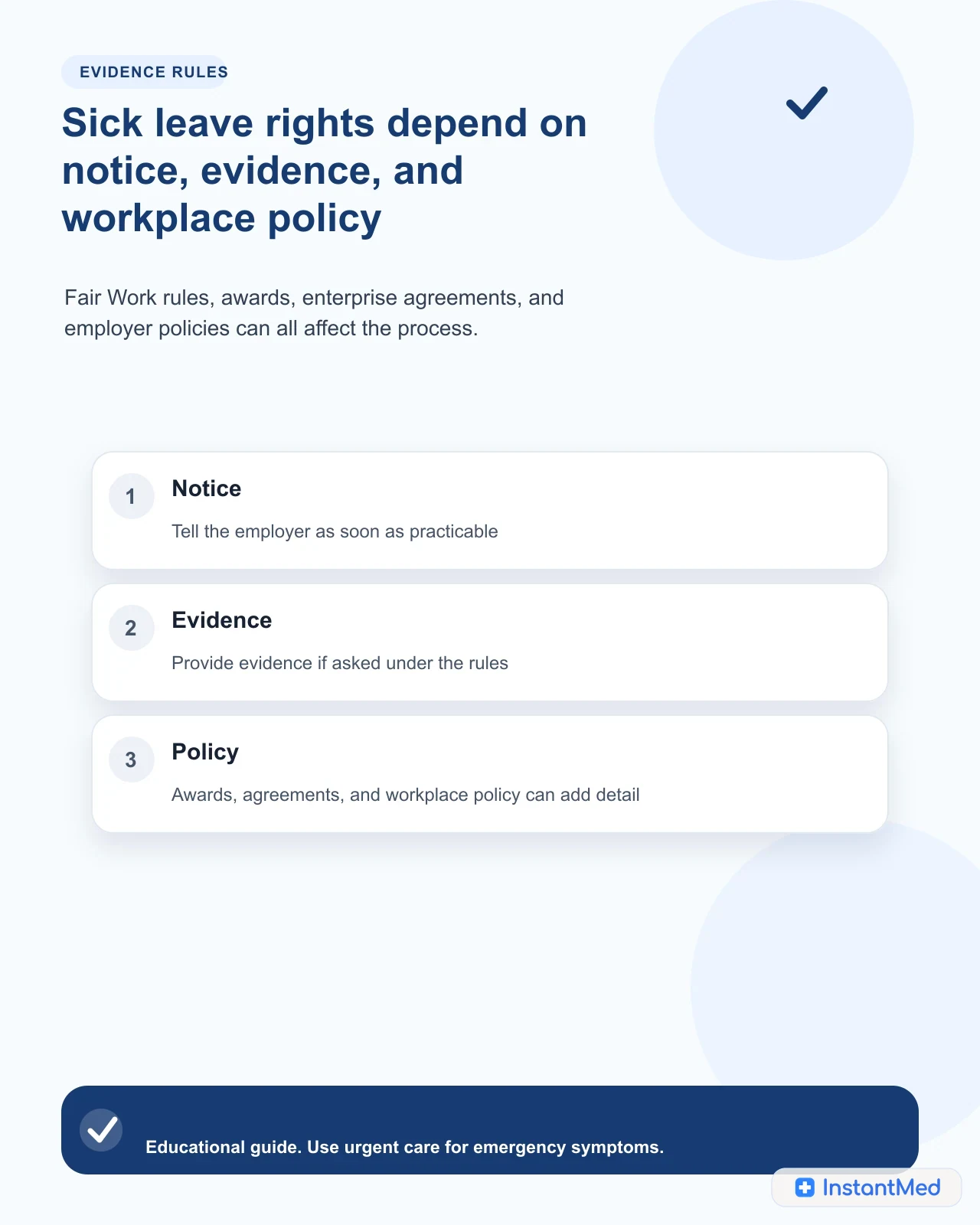
Fair Work says an employee has to let their employer know they are taking sick or carer's leave as soon as possible, and say how long they expect to be away if they can. Employers can ask for evidence that shows the employee was not able to work because of illness or injury, or needed to care for an eligible family or household member.
The evidence rule is practical, not format-specific. Medical certificates and statutory declarations are examples of acceptable evidence. The evidence has to convince a reasonable person that the leave was genuine.
| Workplace evidence question | Practical answer | Why it matters |
|---|---|---|
| Can evidence be requested for one day? | Yes. Fair Work says evidence can be requested for as little as one day or less. | Do not assume a short absence is always evidence-free. |
| Does the evidence have to be a GP clinic certificate? | Not necessarily. A medical certificate or statutory declaration can be acceptable. | The focus is whether the evidence is reasonable and credible. |
| Can a workplace policy add steps? | Yes. Awards, agreements, contracts, and workplace policies can set notice or evidence expectations. | You may need to meet both Fair Work rules and local policy steps. |
| Does the certificate need a diagnosis? | Usually no for routine sick leave. | Work leave evidence is about capacity and dates, not your private medical history. |
| Can an employer contact the doctor? | Fair Work says it does not consider that reasonable unless the employee asks for it. | Extra medical detail should not become routine workplace access. |
What an employer usually checks
Most employers are not checking whether the consultation happened by video, phone, form, or in a clinic. They are checking whether the document is credible and whether it answers the leave question.
Useful work certificates generally include:
- your full legal name, matching payroll or HR records
- the date the doctor assessed you or issued the certificate
- the date or period you were unfit for work
- a plain statement that you were unfit for work because of a medical condition
- the doctor's name and registration details
- the practice or service details
- the doctor's signature or approved digital signature
An employer may also check whether the certificate was submitted on time, whether the date range matches the absence, and whether it fits the workplace policy. If the certificate has the wrong name, unclear dates, missing practitioner details, or a date range that does not match the absence, the argument is usually about document quality rather than telehealth itself.
How the online assessment works
For a routine work certificate, the online assessment usually starts with current symptoms, when they started, how they affect work, the date range requested, and whether any red flags suggest the problem needs urgent or in-person care.
The doctor is assessing work capacity, not just collecting a reason. A sore throat, migraine, gastro, period pain, anxiety flare, or back pain may affect different jobs differently. A person working from home on a laptop may have a different capacity question from someone driving, operating machinery, handling food, working at heights, or caring for vulnerable people.
Detail check
Name, dates, work capacity, practitioner details, and privacy limits are the details employers usually check.
The Medical Board of Australia says telehealth must be safe and, as far as possible, meet the same standard of care as in-person care. It also says doctors should keep assessing whether telehealth is appropriate and arrange in-person care if needed. That is why a good online certificate workflow has screening questions rather than a blank upload-and-pay form.
What the certificate should show
The certificate should be boring in the right way. It should answer the work evidence question without oversharing private health details.
| Certificate detail | What it does | Common issue |
|---|---|---|
| Patient name | Connects the document to the employee. | Nicknames or spelling mismatches can slow HR processing. |
| Assessment or issue date | Shows when the doctor considered the request. | A long delay can raise backdating questions. |
| Incapacity dates | States the period the employee was unfit for work. | Vague ranges can be hard for payroll to apply. |
| Work-capacity wording | Explains the leave reason at the right level. | Diagnosis details are usually unnecessary. |
| Practitioner details | Lets the recipient identify the issuing doctor. | Missing AHPRA details can make the certificate harder to verify. |
| Practice details | Shows the service or clinic context. | No contact or business details can look unreliable. |
When online may not be the right pathway
Some work evidence requests are routine. Others are not. A short online certificate may be the wrong tool where the document will be used for a legal, safety, compensation, disciplinary, or formal capacity decision.
Decision guide
Where an online work certificate fits
May fit telehealth
- Short, routine sick leave evidence where symptoms, dates, role demands, and red flags can be assessed remotely.
- Current-day or recent illness where the requested period matches the clinical history.
Needs in-person care
- Workers compensation, formal return-to-work clearance, fitness-for-duty, safety-critical work, court, exam, insurance, or disputed performance matters.
- Illness or injury where physical examination, observation, imaging, workplace assessment, or treating-doctor history is needed.
Urgent care
- Chest pain, severe breathing trouble, fainting, stroke signs, severe dehydration, confusion, major injury, severe allergic reaction, or any immediate danger.
If your employer needs a specific form, a capacity assessment, a return-to-duty opinion, or a detailed report, ask for the exact requirement before booking. A routine certificate may not answer the real question.
Privacy and diagnosis details
For ordinary sick leave, a certificate usually does not need to name your diagnosis. It can say that you were unfit for work due to a medical condition. That protects privacy while still giving the employer the evidence needed for leave administration.
You can choose to tell a manager more if that helps with support, rostering, or reasonable adjustments. But a workplace request for diagnosis details is a different thing from a request for evidence that you were not fit for work.
The boundary matters most for mental health, reproductive health, bowel symptoms, sexual health, medication side effects, and other private issues. The employer's usual task is to manage leave, not to take a medical history.
Dates, timing and backdating
Date ranges are one of the most common causes of certificate disputes. A doctor can usually certify what they can responsibly assess. That is easiest when the assessment is close to the illness period and the history is clear.
If you were unwell yesterday and seek a certificate today, the doctor may be able to record what you report and what they can assess now. But they should not pretend they examined you before they did. The more distant the requested date range, the more careful the doctor has to be.
Not suitable
Workers comp, fitness-for-duty, court, exams, safety-critical work, and disputed capacity need more formal assessment.
For future dates, the doctor also has to decide whether the expected period away from work is clinically reasonable. A simple gastro episode, migraine, viral illness, injury, or flare of an existing condition may have a predictable short course. Longer or uncertain absences often need review rather than one long certificate.
If your employer questions the certificate
Start by asking what is being questioned. The answer changes the next step.
- If the name or dates are wrong, ask the issuing service whether the document can be corrected.
- If the employer doubts telehealth, point to the practitioner's AHPRA registration and the fact that Fair Work focuses on reasonable evidence, not whether the consultation was in person.
- If the workplace has a specific policy, check whether it asks for a particular form, timing, or notification step.
- If the issue is high-stakes or disputed, ask whether a fuller assessment, treating-doctor report, occupational health review, or workplace process is actually being requested.
- If the disagreement continues, HR, a union, a workplace adviser, or the Fair Work Ombudsman can help you work out the right channel.
Keep the certificate private except where you need to provide it for leave evidence. If you send it by email or upload it to a HR portal, keep a copy of what you sent and when.
Sources
- Fair Work Ombudsman: Sick and carer's leave
- Fair Work Ombudsman: Notice and medical certificates
- Medical Board of Australia: Telehealth consultations with patients
- Ahpra: Register of practitioners
- OAIC: Health information
Frequently Asked Questions
Can I get a doctor certificate for work online on the same day?
Yes, when online assessment is clinically appropriate and the doctor is satisfied you were unfit for work for the relevant period. Timing varies by service and by whether the doctor needs more information.
Does an employer have to accept an online doctor certificate?
An employer can ask for reasonable evidence that would satisfy a reasonable person. A certificate from an AHPRA-registered doctor is commonly used for this purpose, but workplace policies and disputed situations can add practical steps.
Does a work certificate need to name my diagnosis?
Usually no. Routine work evidence normally confirms that you were unfit for work for a stated period. A diagnosis is not usually needed for ordinary sick leave administration.
Can I get a doctor certificate for work without a phone or video call?
Sometimes. Form-first telehealth can be appropriate for routine certificates, but the doctor may ask follow-up questions or direct you to in-person care if the information is not enough.
Can a casual worker use an online doctor certificate?
A casual worker may still need evidence for an absence if a workplace policy asks for it, even though paid sick leave rules differ from full-time and part-time employment. Check your award, agreement, contract, or workplace policy.
What if my employer questions my online certificate?
Ask what part of the evidence is being questioned and check the workplace policy. If the certificate identifies the practitioner, dates, and work capacity clearly, HR or the Fair Work Ombudsman can help clarify the next step.
InstantMed Medical Team
Related Articles
9 min read
Medical Certificates for Work: Complete Australian Guide
A work medical certificate is evidence that you were unfit for work, not a public explanation of your diagnosis. This Australian guide explains employer evidence rules, privacy, telehealth, stat decs, and return-to-work issues.
InstantMed Medical Team
9 min read
Sick Leave Rights in Australia: What You Are Entitled To
Full-time employees accrue 10 days of paid personal leave per year under the NES. It rolls over, covers mental health, and your employer cannot demand your diagnosis. Here is exactly what the law says.
InstantMed Medical Team

9 min read
Can an Employer Reject a Medical Certificate in Australia?
An employer should not reject a credible medical certificate simply because it came from telehealth, but they can ask reasonable questions if evidence is incomplete or inconsistent. Learn the practical boundaries.
InstantMed Medical Team