Loading article
Back to Health Guides
Same-Day Medical Certificates: How to Get One Fast
Your options when work needs evidence today, how to prepare a complete history, and when urgent or in-person care comes before paperwork.
9 min read
·Updated 11 June 2026
·Doctor Reviewed
AHPRA Verified
In this article
- 1First decide if this is a paperwork problem
- 2Same-day options compared
- 3What makes telehealth fast or slow?
- 4Can a certificate cover earlier today?
- 5What same-day certificates should contain
Medical information only. This article is for general information and does not constitute medical advice. Treatment decisions are made by an AHPRA-registered doctor after reviewing your circumstances.
Review
InstantMed Clinical Team
Clinical governance review for guide content
Updated
11 June 2026
General information only, not personal medical advice.
Jump to section
1First decide if this is a paperwork problem2Same-day options compared3What makes telehealth fast or slow?4Can a certificate cover earlier today?5What same-day certificates should contain6Employer evidence rules7Same-day certificates for different work types8If you are declined or redirected9Late-day and weekend requests10Practical checklist before sending to work11Sources
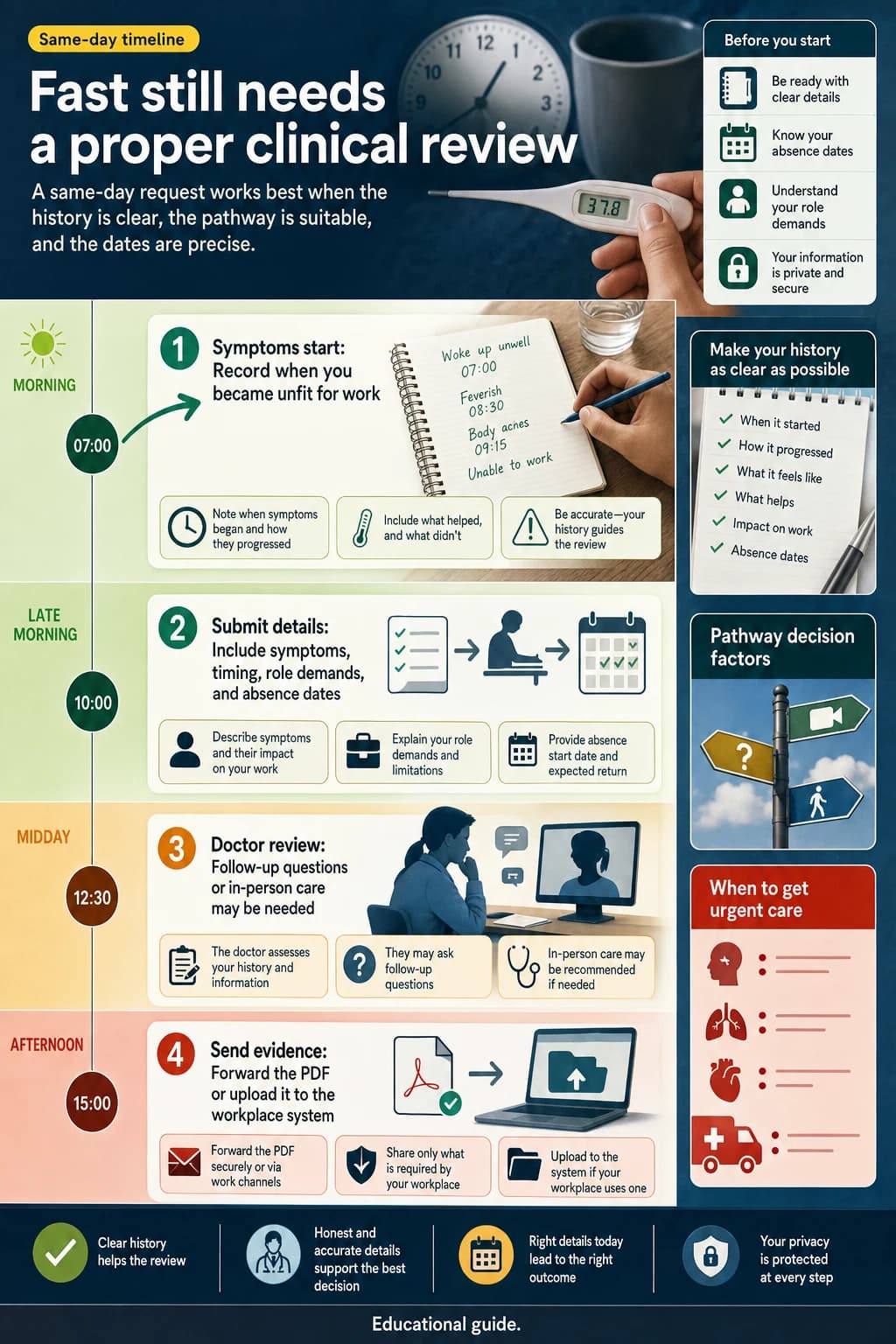
If you need a same-day medical certificate, speed matters, but the goal is not just getting a document quickly. The goal is getting the right evidence after the right level of clinical review. A rushed certificate that ignores red flags, omits dates, or comes from an unclear source can create more trouble than it solves.
For simple acute illness, telehealth can be the fastest practical pathway because you can provide a history from home and avoid travel. For severe symptoms, injuries, chest symptoms, abdominal pain, neurological signs, dehydration, or anything requiring examination, the fastest safe pathway may be a clinic, after-hours service, urgent-care centre, or emergency department.
First decide if this is a paperwork problem
Some situations are not certificate problems first. They are safety problems.
Call 000 or seek emergency care if you have chest pain, severe difficulty breathing, stroke-like symptoms, collapse, severe bleeding, severe allergic reaction, major injury, or sudden severe symptoms. A certificate can be addressed later.
Seek same-day clinical care rather than a paperwork-only pathway if you have worsening shortness of breath, severe abdominal pain, dehydration, high fever with confusion, a significant injury, severe headache with neurological symptoms, pregnancy red flags, or symptoms that feel unusually severe for you.
If the issue is a typical short illness and you mainly need workplace evidence, then it is reasonable to compare same-day documentation options.
Same-day options compared
The best option depends on clinical fit, access, and timing.
| Pathway | Useful when | Main limitation |
|---|---|---|
| Telehealth review | Clear acute illness where history is enough | Not suitable when examination or urgent care is needed |
| Regular GP | Your doctor knows your history or symptoms are more complex | Same-day appointments may be unavailable |
| Walk-in clinic | You need examination and can travel | Waiting time can be unpredictable |
| After-hours clinic | Evening, weekend, or more complex assessment | Availability varies by suburb and region |
| Emergency or urgent care | Severe or dangerous symptoms | Not for routine workplace paperwork |
Do not choose based only on speed. Choose the pathway that can safely answer the clinical question.
What makes telehealth fast or slow?
Telehealth is quickest when the submitted history is complete. It slows down when the doctor has to ask basic follow-up questions that could have been answered upfront.
Prepare:
- when symptoms started
- what symptoms you have
- whether symptoms are improving, stable, or worsening
- measured temperature if available
- vomiting, diarrhoea, breathing symptoms, pain severity, or mobility limits where relevant
- your work duties and why you cannot perform them safely
- the exact date or dates requested
- any relevant medical history
- medicines taken for the current illness
- whether you have red-flag symptoms
The doctor is deciding whether your symptoms reasonably explain being unfit for work, whether the requested period is proportionate, and whether remote assessment is safe. If they need more information, answer promptly.
Can a certificate cover earlier today?
Often, the relevant question is when you became unfit for work, not the minute the form was submitted. If you woke unwell at 6am and submit later in the day, explain the timeline clearly.
Useful wording is specific: "Symptoms started at 5:30am before my shift. I had vomiting twice before 8am and could not safely travel or work." Vague wording like "I am sick today" gives the doctor less to assess.
Retrospective certificates for previous days are more complex. A doctor can only certify what is clinically supportable based on the history and circumstances. The longer the delay, the more carefully the doctor needs to assess whether the evidence is still reliable.
What same-day certificates should contain
A same-day certificate should still be complete.
Look for:
Option map
Telehealth can be fast for simple cases, but examination needs, severe symptoms, and workplace injury change the route.
- your correct name
- assessment date
- absence dates covered
- a clear statement that you were unfit for work or usual duties
- practitioner name and registration details
- practice or service contact details
- signature, digital signature, or equivalent attestation
It usually does not need your diagnosis. If you are sending the document to work, check that the dates align with your leave request before forwarding it.
Employer evidence rules
The Fair Work Ombudsman says employers can ask for evidence for sick or carer's leave, including absences as short as one day or less. Medical certificates and statutory declarations are examples of evidence, and the evidence needs to satisfy a reasonable person that the leave was taken for the stated reason.
This is why same-day documentation needs to be clear. A fast certificate is still expected to make sense. If the document is missing dates, has an unclear practitioner, or does not match the absence, your employer may ask questions.
If the certificate is complete and issued by a registered practitioner after an appropriate review, the fact that the review happened by telehealth is not automatically a defect.
Same-day certificates for different work types
For office, study, or remote work, the key issue is usually whether illness prevented normal duties.
For food handling, gastro symptoms may create infection-control questions beyond a simple absence note. Return timing can matter.
For healthcare, aged care, and childcare, respiratory and gastro symptoms may need workplace-specific infection-control rules.
For driving, machinery, construction, mining, or high-risk physical work, symptoms, sedating medicines, dizziness, pain, or reduced mobility can affect safety. A certificate may need to address duties rather than just attendance.
For workplace injuries, a standard same-day sick certificate may not be enough. Workers compensation systems often require specific capacity certificates and a treating-practitioner process.
If you are declined or redirected
A declined same-day certificate can be frustrating, but it may be the clinically correct outcome. Reasons include insufficient information, symptoms requiring examination, urgent warning signs, an absence period that does not fit the history, or a request that does not involve genuine illness or injury.
If redirected, follow the recommended pathway. A doctor who refuses to certify remotely when examination is needed is protecting the quality of your care and the credibility of the evidence.
Urgent boundary
Chest pain, severe breathing trouble, stroke symptoms, collapse, severe bleeding, or severe injury need urgent care first.
Late-day and weekend requests
Late-day requests need especially clear timing. Explain when you became unfit, whether you attempted to work, whether symptoms worsened during the day, and why you could not safely continue. A doctor can assess a same-day history, but they still need enough detail to connect the illness or injury with the work absence.
Weekend and public-holiday requests can be more sensitive because some workplace policies specifically ask for evidence around non-working days, Mondays, Fridays, or rostered shifts. The safest approach is to keep the evidence factual: symptom onset, capacity, dates, and expected return. Avoid overexplaining private health details in emails to managers.
If your illness continues into the next rostered day, do not rely on assumptions. Check whether the certificate actually covers that day, and seek further assessment if you remain unfit after the documented period ends.
Practical checklist before sending to work
Before you upload or forward the certificate:
- confirm your name is correct
- confirm the dates match the absence
- keep a copy for your records
- send it through the normal workplace channel
- include your expected return date if known
- avoid adding unnecessary diagnosis details in your email
- respond promptly if HR asks for clarification about the document
If your employer disputes the evidence, ask what specific part is missing or unclear. A precise defect can often be fixed. A broad objection to the consultation method may need a calmer conversation about the workplace evidence standard.
Sources
- Fair Work Ombudsman: Notice and medical certificates
- Fair Work Ombudsman: Sick and carer's leave and compassionate leave fact sheet
- Medical Board of Australia: Telehealth consultations with patients
- Ahpra: Register of practitioners
- healthdirect: Calling triple zero
Frequently Asked Questions
Can I get a medical certificate the same day?
Often yes, if the presentation can be assessed safely and the reviewing practitioner has enough information. Same-day does not mean automatic; the doctor may ask questions, decline, or recommend in-person care.
What is the fastest pathway?
For simple acute illness, telehealth can be efficient because it avoids travel and waiting rooms. If examination, tests, injury assessment, or urgent care is needed, a clinic, GP, after-hours service, or emergency department may be faster and safer overall.
Can a certificate cover today if I submit later in the day?
The practitioner assesses the history and timing. If you became unfit earlier that day and the history supports it, the certificate may cover the relevant day. Submit as early as reasonably possible and explain when symptoms started.
What details should I prepare?
Prepare symptom timing, severity, measured temperature if relevant, medicines taken, work duties affected, the exact dates needed, and any red flags such as chest pain, breathing trouble, fainting, neurological symptoms, severe pain, or dehydration.
When should I not wait for a certificate?
Do not wait for paperwork if symptoms suggest urgent risk. Chest pain, severe breathing difficulty, stroke-like symptoms, collapse, severe bleeding, severe allergic reaction, or major injury need urgent care first.
InstantMed Medical Team
Related Articles
9 min read
How to Get a Medical Certificate Online in Australia
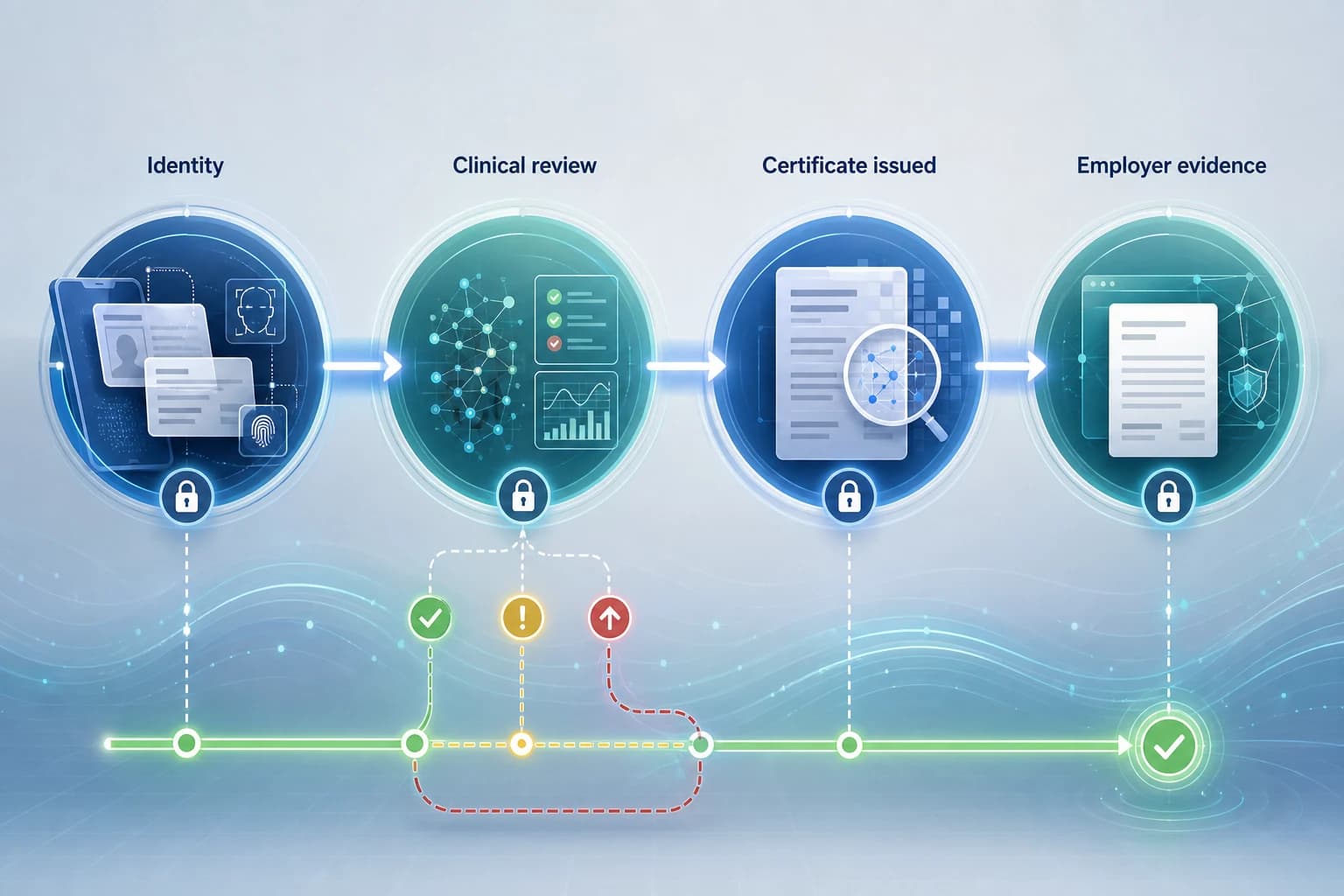
Online medical certificates can be valid workplace evidence in Australia when issued after an appropriate clinical review by a registered practitioner. Learn what matters, what to prepare, and where the limits are.
InstantMed Medical Team
9 min read
Medical Certificates for Work: Complete Australian Guide
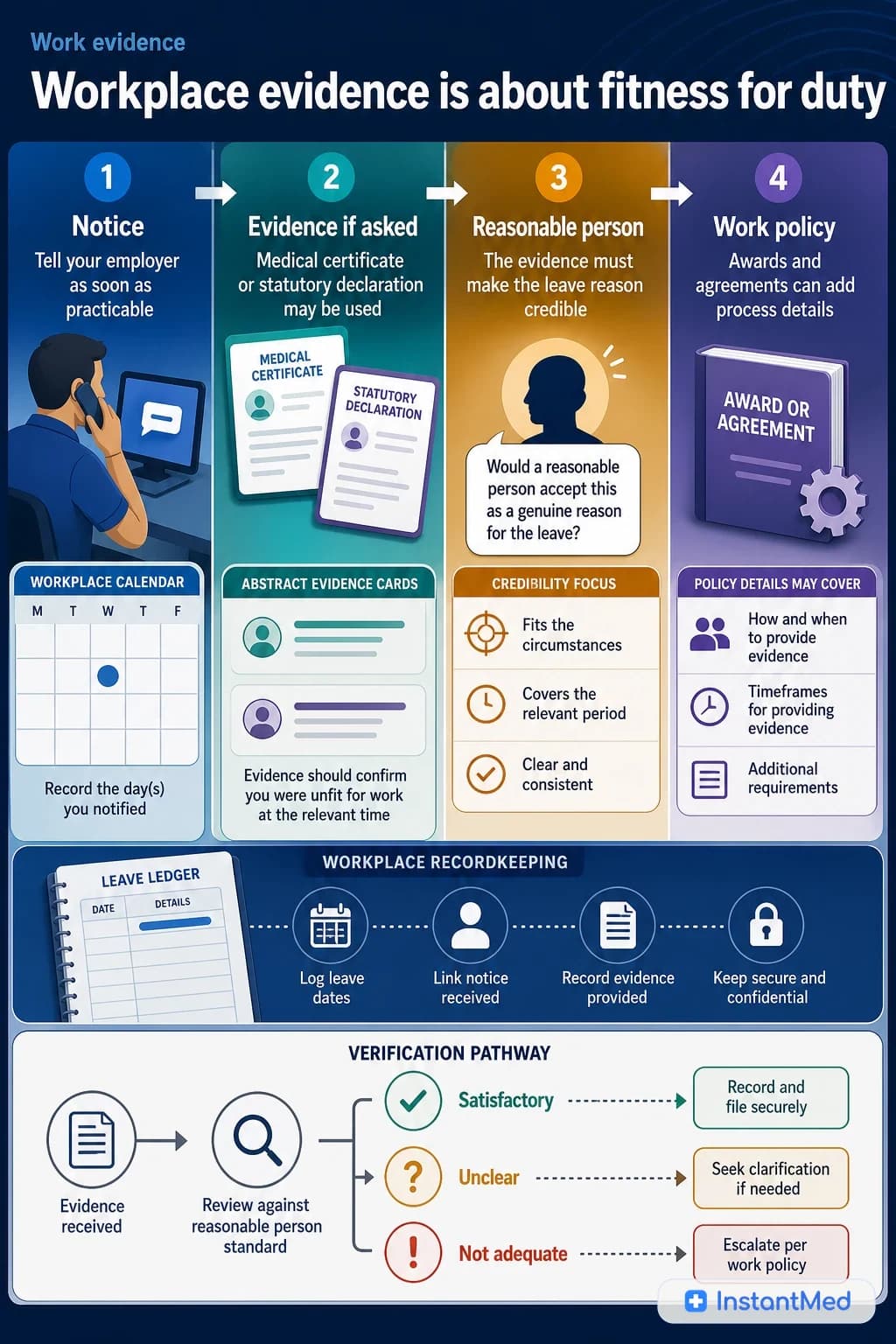
A work medical certificate is evidence that you were unfit for work, not a public explanation of your diagnosis. This Australian guide explains employer evidence rules, privacy, telehealth, stat decs, and return-to-work issues.
InstantMed Medical Team
13 min read
Doctor's Note for Work Australia: What Counts?
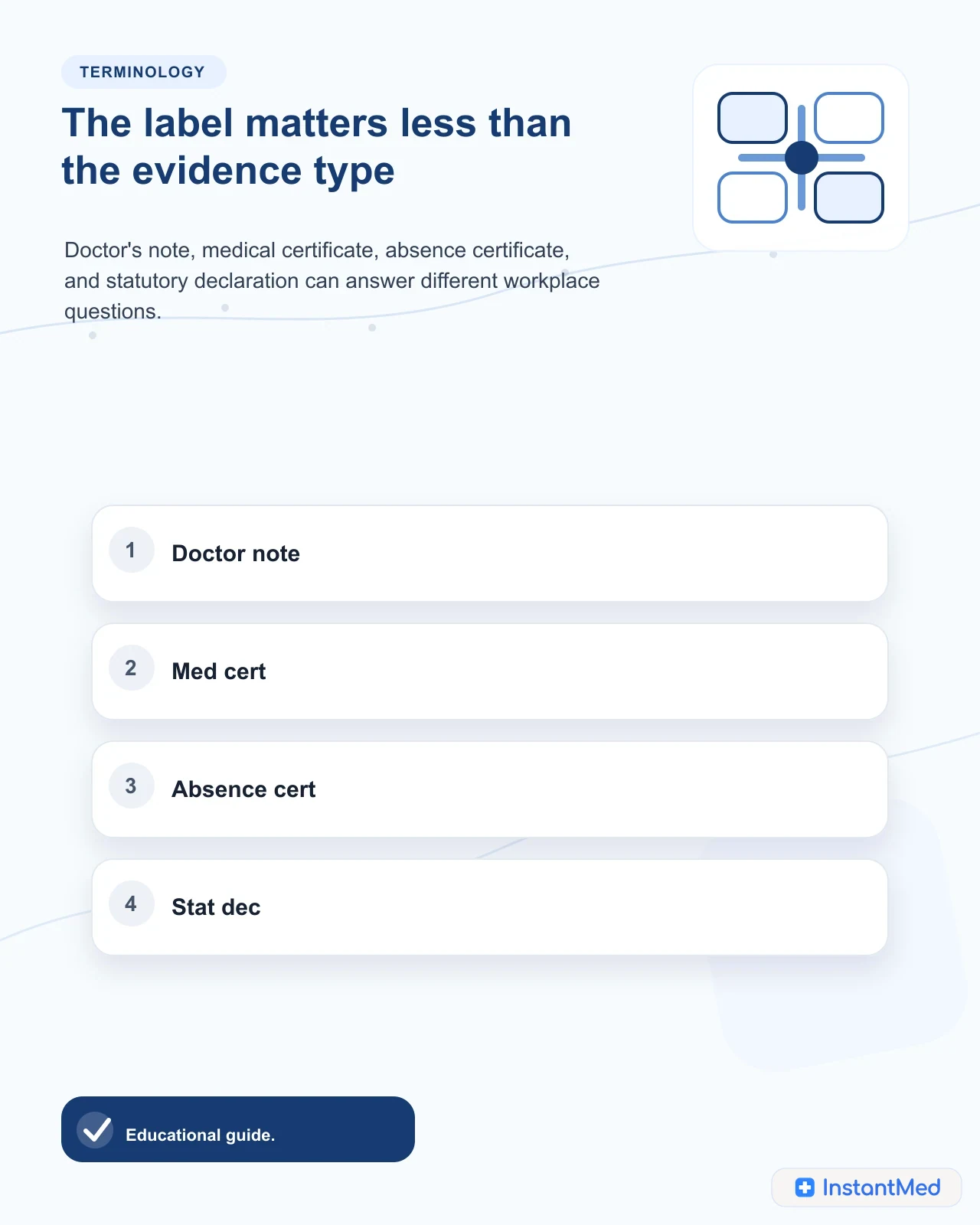
A doctor's note for work in Australia usually means a medical certificate, but sick notes, absence-from-work certificates, and statutory declarations can also matter. Learn what counts as evidence, what a strong certificate includes, and when a workplace may ask questions.
InstantMed Medical Team