Loading article
Back to Health Guides
How to Get a Medical Certificate Online in Australia
A practical guide to online medical certificates: legal standing, clinical review, employer evidence, privacy, and when telehealth is not the right pathway.
9 min read
·Updated 3 June 2026
·Doctor Reviewed
AHPRA Verified
In this article
- 1What makes an online certificate legitimate?
- 2The Fair Work evidence standard
- 3What to prepare before an online request
- 4What the doctor is assessing
- 5What the certificate should contain
Medical information only. This article is for general information and does not constitute medical advice. Treatment decisions are made by an AHPRA-registered doctor after reviewing your circumstances.
Review
InstantMed Clinical Team
Clinical governance review for guide content
Updated
3 June 2026
General information only, not personal medical advice.
Jump to section
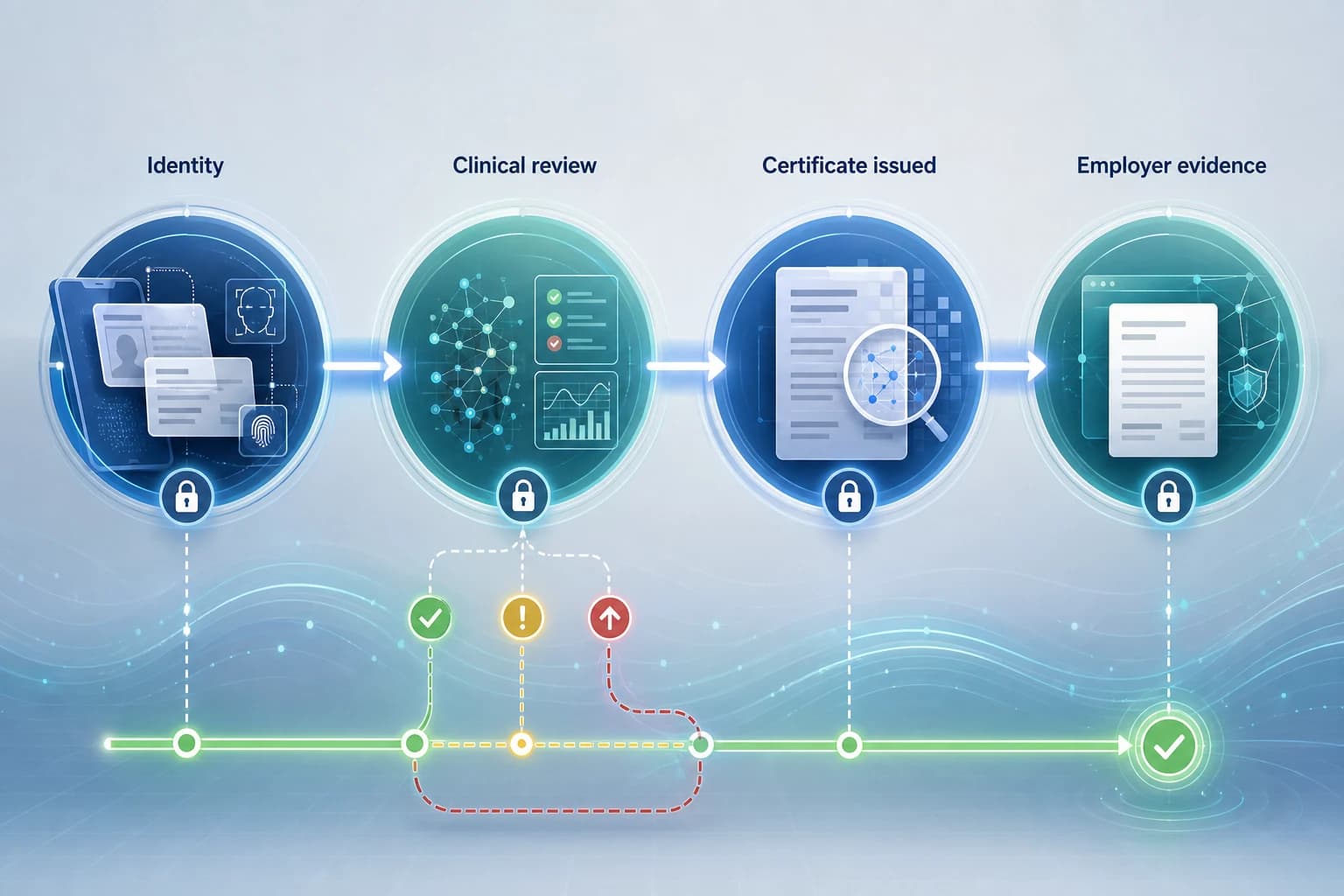
If you need a medical certificate online in Australia, the practical answer is this: online can be a legitimate pathway, but only when the certificate follows a real clinical assessment and the presentation is suitable for telehealth. The fact that the consultation happened online is not the core legal question. The core question is whether the evidence would satisfy a reasonable person that you were not fit for work because of illness or injury.
That distinction matters. A proper online certificate is not a downloadable excuse note, a form letter, or an automated document. It should come after a registered practitioner has enough information to make a clinical judgement. If the history is incomplete, the symptoms suggest risk, or a physical examination is needed, the right outcome may be follow-up questions, referral to in-person care, or no certificate.
What makes an online certificate legitimate?
A useful workplace medical certificate has four foundations.
First, the practitioner must be appropriately registered. In Australia, doctors are regulated through Ahpra and the Medical Board of Australia. For a work absence certificate, the document should identify the practitioner clearly enough for the employer to verify that the certificate came from a real registered health professional.
Second, there needs to be a clinical assessment. Telehealth can be clinically appropriate for many short, self-limited illnesses where the history is enough to assess temporary work incapacity. It is weaker when the doctor needs to listen to your chest, examine your abdomen, assess an injury, check neurological signs, inspect a rash closely, or arrange urgent investigation.
Third, the certificate should state the relevant work-capacity conclusion. It usually does not need a diagnosis. It should state that you were unfit for work, or unfit for your usual duties, for a defined period.
Fourth, the dates need to make sense. A certificate that clearly covers the relevant day or days is much easier for payroll, HR, and your manager to process than one with vague wording.
The Fair Work evidence standard
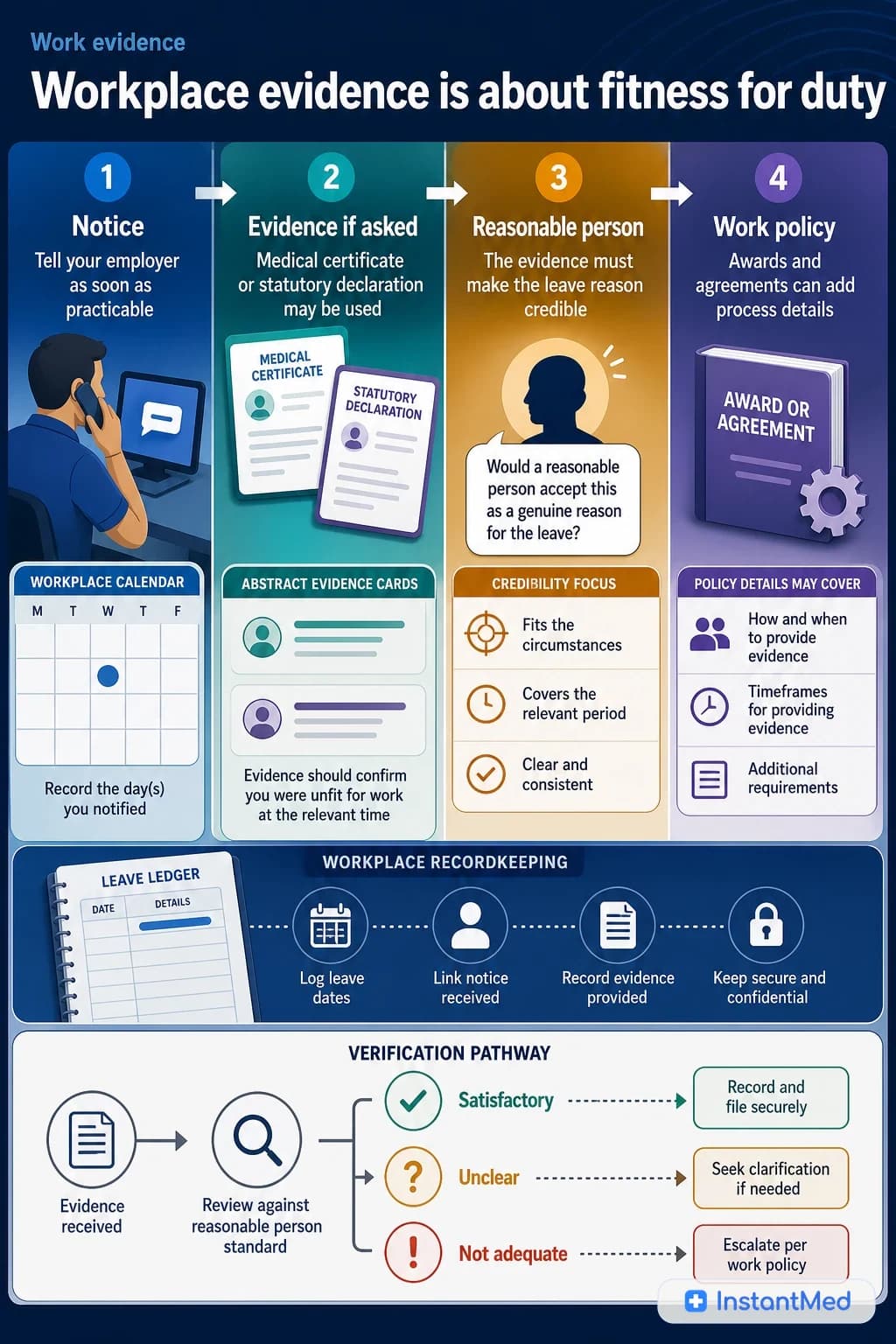
The Fair Work Ombudsman explains that employers can ask for evidence when an employee takes sick or carer's leave, even for as little as one day or less. The evidence must show that the employee was unable to work because of illness or injury, or needed to provide care or support to an immediate family or household member. Medical certificates and statutory declarations are examples of acceptable evidence.
The standard is not "paper from a clinic building." It is whether the evidence would satisfy a reasonable person. That is why a certificate issued online can be useful evidence, and why a poor online certificate can still fail. Mode of consultation is only one part of the context.
An employer may reasonably question a document if it is incomplete, inconsistent, impossible to verify, covers dates that do not align with the absence, or appears to have been issued without meaningful assessment. But a blanket rule that all telehealth certificates are invalid is a different claim, and it does not reflect the way the evidence standard is framed.
What to prepare before an online request
The strongest online submissions read like a clear medical history, not a one-line excuse.
Include when symptoms started, what symptoms you have, whether they are improving or worsening, any measured temperature, any relevant medical history, what work duties you could not safely perform, and the exact dates you are requesting. If your job involves driving, food handling, machinery, clinical care, childcare, or heavy physical work, mention that context because capacity depends on the role.
For example, "vomiting and diarrhoea since 2am, unable to keep fluids down, work as a food handler, requesting today off" is much more useful than "sick today." The first version helps the doctor assess the absence, infection-control implications, and likely duration. The second forces guesswork and increases the chance of follow-up questions.
Keep your phone and email available. If the doctor needs clarification and you do not respond, the review may stall or be declined.
What the doctor is assessing
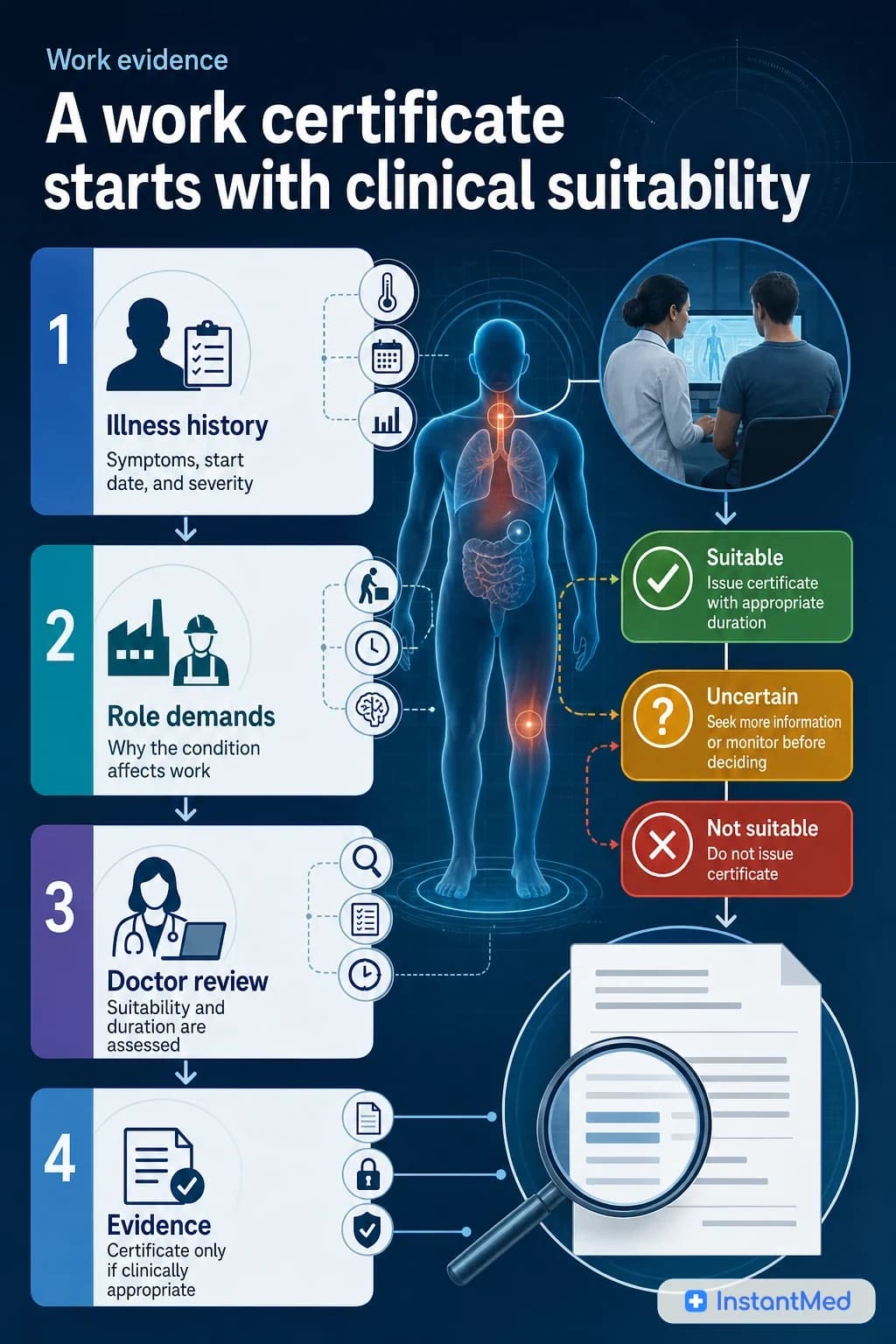
The doctor is not just checking whether you typed symptoms into a form. They are deciding whether the described illness or injury reasonably explains temporary unfitness for work, whether the requested period is proportionate, and whether telehealth is safe for the presentation.
They may consider:
Scope boundary
Simple acute illness may be assessed remotely, while red flags, uncertainty, or examination needs change the pathway.
- the nature and severity of symptoms
- timing and progression
- measured observations you can provide, such as temperature
- relevant medical history
- current medicines or allergies where relevant
- your work duties and safety-sensitive tasks
- whether red flags suggest urgent or in-person assessment
- whether the requested certificate duration is clinically plausible
The doctor may ask follow-up questions. That is a sign of review quality, not friction. A legitimate service should be willing to decline or redirect requests that cannot be assessed safely.
Important Warning
If you have chest pain, severe shortness of breath, stroke-like symptoms, collapse, severe bleeding, severe allergic reaction, or a major injury, seek urgent care first. A work certificate is secondary to immediate safety.
What the certificate should contain
For ordinary workplace sick leave, a certificate will usually be most useful when it includes:
- your name, and often your date of birth
- the consultation or assessment date
- the period you were certified unfit for work
- a clear statement of unfitness for work or usual duties
- the practitioner's name and registration details
- practice or service contact details
- a signature, digital signature, or equivalent attestation
It usually should not include unnecessary diagnosis detail. Many workplaces only need evidence that you were unfit for work for the relevant period. Your diagnosis is health information, and keeping it out of routine workplace files protects privacy.
How to submit it to work
Send the certificate through your employer's normal process: manager email, HR inbox, payroll portal, leave management system, or roster platform. Include a short note with the absence dates and expected return date if that is not already clear.
If your employer asks for more information, separate three issues.
First, is the certificate complete? Check name, dates, practitioner details, and legibility.
Second, is the request about privacy? An employer can ask for evidence, but they usually do not need your diagnosis for ordinary sick leave.
Third, is the issue about fitness for a specific role? Safety-critical work, infectious illness in food handling, healthcare exposure, or extended absence may create a different documentation question.
When online certification is not suitable
Telehealth is not a universal shortcut. It may be unsuitable when the doctor cannot form a safe opinion without examination or tests.
Common examples include severe abdominal pain, chest symptoms needing examination, significant injury, neurological symptoms, worsening shortness of breath, severe dehydration, uncontrolled pain, concerning pregnancy symptoms, suspected workplace injury requiring a compensation certificate, or any situation where the story does not fit a short temporary illness.
Detail check
A workplace certificate usually needs clear dates and practitioner details, not private diagnosis detail.
In these cases, a good online review should redirect you to the right care pathway. That can feel inconvenient, but it protects you and preserves the credibility of the certificate system.
Other purposes need different evidence
A standard work medical certificate is not always the right document.
Centrelink may require specific medical information or official forms. Universities may have special consideration forms with their own wording and timing rules. Travel insurers may ask for evidence from a treating practitioner. Workers compensation generally uses separate capacity certificates and may require assessment by a doctor involved in managing the injury.
Before using a standard certificate outside ordinary workplace sick leave, check the receiving organisation's requirements.
Sources
- Fair Work Ombudsman: Notice and medical certificates
- Fair Work Ombudsman: Sick and carer's leave and compassionate leave fact sheet
- Medical Board of Australia: Telehealth consultations with patients
- Ahpra: Register of practitioners
- healthdirect: Calling triple zero
Frequently Asked Questions
Is an online medical certificate valid in Australia?
It can be valid workplace evidence when it is issued by an appropriately registered practitioner after a clinically appropriate telehealth assessment. The key issues are practitioner registration, assessment quality, certificate content, and whether the evidence would satisfy a reasonable person.
Can an employer reject a certificate only because it was issued online?
A blanket rejection of telehealth evidence is difficult to justify if the certificate is from a registered practitioner and otherwise satisfies the evidence standard. Employers can still question incomplete, inconsistent, or unreasonable evidence.
Does a certificate need to include my diagnosis?
Usually no. For ordinary workplace sick leave, the useful information is that you were unfit for work and the period covered. Diagnosis details are private unless there is a genuine role-specific reason or you choose to disclose them.
What if the doctor says I need in-person care?
Follow that advice. Some symptoms need examination, tests, urgent care, or a longer treating relationship before a certificate can be issued safely.
Can I use an online certificate for Centrelink, insurance, or workers compensation?
Do not assume a standard workplace certificate will be enough. Centrelink forms, insurance claims, and workers compensation often have different forms, wording, examination expectations, or treating-practitioner requirements.
InstantMed Medical Team
Related Articles
9 min read
Medical Certificates for Work: Complete Australian Guide
A work medical certificate is evidence that you were unfit for work, not a public explanation of your diagnosis. This Australian guide explains employer evidence rules, privacy, telehealth, stat decs, and return-to-work issues.
InstantMed Medical Team
7 min read
Same-Day Medical Certificate: How It Works
You woke up sick and your GP cannot see you until next week. Telehealth lets an AHPRA-registered doctor assess your case and issue a certificate the same day - often within 1-2 hours. Here is exactly how it works.
InstantMed Medical Team
10 min read
Online Doctor Certificate for Work: What Counts as Evidence
Need a doctor certificate for work but cannot visit a clinic? Learn when online certificates can be used, what details matter, and where the limits sit.
InstantMed Medical Team