Loading article
Back to Health Guides
Gout: Causes, Acute Treatment, and Long-Term Prevention
How flares happen, which red flags need urgent assessment, and why long-term urate control prevents joint damage.
9 min read
·Updated 10 May 2026
·Doctor Reviewed
AHPRA Verified
In this article
- 1What Happens Inside the Joint
- 2Symptoms of an Acute Gout Flare
- 3Diagnosis: Why Blood Urate Is Not the Whole Story
- 4Red Flags: When a Hot Joint May Not Be Gout
- 5Treating an Acute Flare
Medical information only. This article is for general information and does not constitute medical advice. Treatment decisions are made by an AHPRA-registered doctor after reviewing your circumstances.
Review
InstantMed Clinical Team
Clinical governance review for guide content
Updated
10 May 2026
General information only, not personal medical advice.
Jump to section
1What Happens Inside the Joint2Symptoms of an Acute Gout Flare3Diagnosis: Why Blood Urate Is Not the Whole Story4Red Flags: When a Hot Joint May Not Be Gout5Treating an Acute Flare6Long-Term Prevention: Treat to Target7Allopurinol and Other Urate-Lowering Medicines8Diet, Alcohol, and Lifestyle9Medicines and Health Conditions That Change the Plan10When to Seek Medical Review11Sources
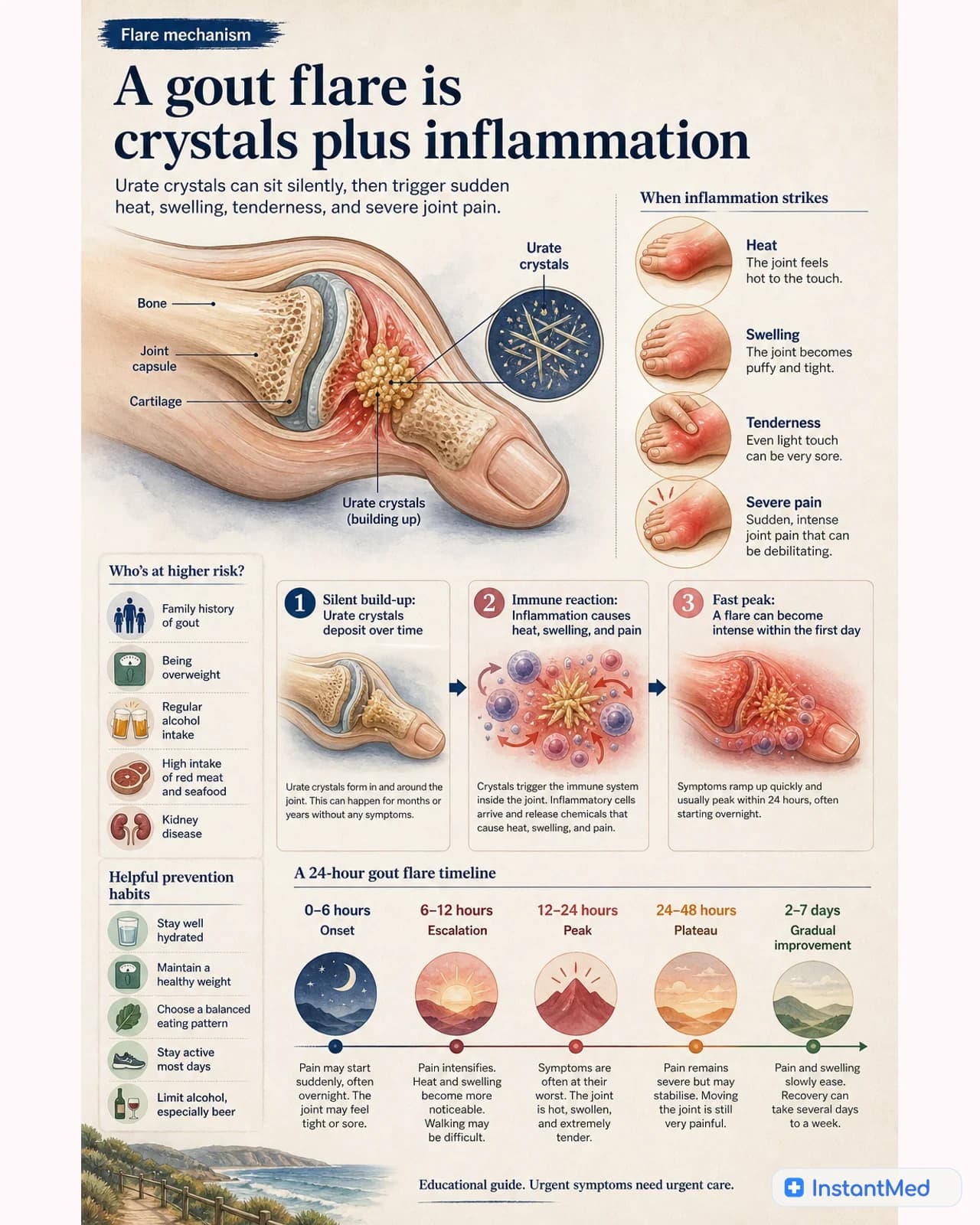
Gout is a crystal-driven inflammatory arthritis. It happens when excess urate, also called uric acid, forms sharp monosodium urate crystals in or around a joint. Those crystals can sit silently for months or years, then trigger sudden inflammation and severe pain.
AIHW estimates that around 224,000 Australians were living with gout in 2022, and about three quarters were male. The condition becomes more common with age, kidney disease, metabolic risk factors, and some medicines. It can be controlled, but the control strategy is often misunderstood: treating the flare is only the first step; preventing future flares means keeping urate below target over time.
What Happens Inside the Joint
Urate is a normal waste product from purine breakdown. Most urate is produced by the body, and the kidneys remove much of it through urine. When production is high or excretion is reduced, urate can build up in the blood. Once blood urate remains above the crystal-forming threshold, crystals can deposit in joints, tendons, bursae, and soft tissue.
The painful flare is not the crystal forming in that moment. It is the immune system reacting to crystals already present in the joint. That immune reaction causes heat, swelling, redness, stiffness, and pain.
This explains why gout can be episodic. A person may feel normal between flares while crystals remain present. Without long-term urate control, attacks can become more frequent, involve more joints, and eventually lead to tophi, chronic joint damage, and kidney stones.
Symptoms of an Acute Gout Flare
A typical flare develops quickly and often peaks within the first day.
- Sudden severe pain, often overnight
- Swelling, warmth, redness, and marked tenderness over the joint
- Pain with light touch, footwear, bedsheets, standing, or walking
- Reduced joint movement
- One joint affected at first, although recurrent gout can become polyarticular
- Common sites including the big toe, midfoot, ankle, knee, wrist, fingers, and elbow
The big toe joint is the classic site, but gout is not limited to the toe. A knee, ankle, wrist, or finger flare can still be gout, especially in someone with previous flares or high urate.
Diagnosis: Why Blood Urate Is Not the Whole Story
Diagnosis starts with the pattern: sudden inflammatory joint pain, site, timing, previous attacks, medicines, kidney function, alcohol intake, diet pattern, family history, and other causes of joint swelling.
Blood urate is useful, but it is imperfect. Australian Prescriber notes that a normal or low serum urate does not exclude acute gout because urate may not be elevated during the flare itself. Healthdirect notes that a joint-fluid sample can be checked for urate crystals; this is the most definitive test when the diagnosis is uncertain.
Other tests may be used depending on the situation:
- Blood tests for urate, kidney function, inflammatory markers, glucose, lipids, and other risk factors
- Joint aspiration if infection, crystal arthritis, or another diagnosis is possible
- Ultrasound or dual-energy CT in selected uncertain or recurrent cases
- X-ray when recurrent attacks raise concern for joint damage
Red Flags: When a Hot Joint May Not Be Gout
The dangerous mimic is septic arthritis, a joint infection. It can destroy a joint quickly and can be life-threatening. A hot, swollen joint with fever or systemic unwellness should not be assumed to be gout.
Seek urgent assessment for:
- Fever, chills, confusion, faintness, or feeling very unwell
- A first-ever hot, swollen joint where the diagnosis is uncertain
- Severe spreading redness beyond the joint
- Recent joint surgery, injection, wound, or infection elsewhere
- Immunosuppression, chemotherapy, diabetes with infection concern, or prosthetic joint
- Severe pain after injury, fall, or inability to bear weight
- Symptoms that are worsening despite appropriate treatment
Important Warning
A previous gout diagnosis does not rule out infection. If the pattern is different, systemic symptoms are present, or the joint is unusually red and hot, urgent in-person assessment may be needed.
Treating an Acute Flare
Acute treatment focuses on reducing inflammation and pain. Healthdirect notes that starting treatment early, within 24 hours, helps decrease symptoms. Australian Prescriber lists NSAIDs, colchicine, and corticosteroids as first-line options, with the safest choice depending on the person.
NSAIDs
Treat to target
Preventing attacks means measuring urate, lowering it to target, and maintaining the plan long enough for crystals to dissolve.
NSAIDs such as naproxen or ibuprofen can reduce pain and swelling during a flare. They are not suitable for everyone. Kidney disease, stomach ulcer history, blood thinners, heart failure, uncontrolled blood pressure, and some other medicines can change the risk.
Colchicine
Colchicine can help when taken early, but dosing matters. Australian Prescriber describes low-dose colchicine as effective with fewer adverse effects than high-dose regimens. It can interact with several medicines and needs extra caution in kidney impairment.
Corticosteroids
Corticosteroids may be used as tablets or as an injection into the affected joint. They can be useful when NSAIDs or colchicine are unsuitable, or when a single accessible joint is involved.
Home Measures
Home care does not replace flare medicine when medicine is needed, but it can reduce discomfort.
- 1
Rest the affected joint and avoid loading a painful foot, ankle, or knee.
- 2
Use an icepack wrapped in cloth for 10-15 minutes at a time.
- 3
Elevate the limb if swelling is prominent.
- 4
Drink enough water, especially during illness or hot weather.
- 5
Avoid alcohol during the flare.
- 6
Do not massage an intensely inflamed joint.
Long-Term Prevention: Treat to Target
Flare relief and prevention are different jobs. Anti-inflammatory medicines calm the flare, but they do not remove the crystal burden. Urate-lowering therapy aims to keep serum urate low enough that crystals stop forming and existing deposits slowly dissolve.
RACGP and Australian Prescriber describe a treat-to-target approach. For most people, the serum urate target is below 0.36 mmol/L. For people with tophi, a lower target below 0.30 mmol/L may be considered. Urate levels are checked and therapy is adjusted until the target is reached and maintained.
Urate-lowering therapy is usually considered when there are:
- Two or more flares per year
- Tophi
- Chronic kidney disease
- Uric acid kidney stones
- Recurrent attacks, severe attacks, or high-risk comorbidities
Allopurinol and Other Urate-Lowering Medicines
Allopurinol is the first-line urate-lowering medicine used in Australia. It reduces uric acid production by inhibiting xanthine oxidase. The usual principle is to start low and increase gradually while monitoring serum urate and tolerability.
Important points:
- Allopurinol is prevention medicine, not a painkiller for the current flare.
- Do not stop established allopurinol during a flare unless a clinician tells you to.
- Starting or changing urate-lowering therapy can trigger flares at first, so anti-inflammatory prophylaxis may be used during the early months.
- Kidney function, rash history, interactions, and ancestry-related HLA-B*5801 risk may affect starting dose and monitoring.
- A rash, mouth ulcers, fever, or severe skin reaction after starting allopurinol needs prompt medical advice.
Febuxostat and uricosuric medicines may be used in selected cases, usually when allopurinol is not tolerated or the urate target cannot be reached. Specialist input is often helpful for difficult gout, tophi, kidney impairment, multiple medicine interactions, or uncertain diagnosis.
Diet, Alcohol, and Lifestyle
Diet matters, but it is not the whole disease. Arthritis Australia emphasises that alcohol is not the sole cause of gout and that vitamin C or cherry juice should not be relied on to lower uric acid. Healthdirect notes that medicine plus a healthy balanced diet is enough for many people to manage gout.
Practical prevention focuses on the highest-yield changes:
Safety boundary
Fever, first-ever swelling, spreading redness, injury, or systemic illness need urgent assessment for infection or other causes.
- Reduce beer and spirits, especially binge drinking.
- Reduce sugar-sweetened drinks and fruit juice high in fructose.
- Limit organ meats, large red-meat portions, and high-purine seafood if they trigger flares.
- Avoid crash dieting and fasting, which can precipitate flares.
- Lose weight gradually if overweight.
- Stay hydrated, especially during illness, heat, travel, or heavy exercise.
- Keep low-fat dairy, vegetables, and balanced meals in the diet rather than over-restricting.
Vegetable purines are not treated the same as animal purines. Broadly avoiding vegetables such as spinach or asparagus is usually unnecessary and can make the diet worse overall.
Medicines and Health Conditions That Change the Plan
Gout often travels with other health risks. AIHW links hyperuricaemia with obesity, diabetes, hypertension, heart disease, poor kidney function, kidney disease, and diets high in meat, seafood, and alcohol. RACGP also highlights comorbidities such as hypertension, chronic kidney disease, obesity, diabetes, and cardiovascular disease.
Medication review matters because some medicines can raise urate, including thiazide and loop diuretics and low-dose aspirin. Do not stop these medicines yourself; they may be essential. The point is to review the whole risk picture with a clinician so gout prevention, blood pressure, kidney function, and heart risk are managed together.
When to Seek Medical Review
Seek review if:
- This is your first suspected gout attack.
- Flares are becoming more frequent, lasting longer, or affecting more joints.
- You have two or more flares per year.
- You have kidney disease, kidney stones, diabetes, heart disease, or complex medicines.
- You have visible or palpable lumps that may be tophi.
- Your urate has not been checked recently.
- You are taking allopurinol but still flaring.
- You are unsure whether symptoms are gout, infection, injury, or another arthritis.
The best gout plan is not just "take something when it hurts." It is a loop: confirm the diagnosis, treat flares early, identify red flags, measure urate, lower urate to target when indicated, and keep monitoring until flares stop.
Sources
- AIHW: Gout
- healthdirect: Gout
- healthdirect: Medicines for gout
- RACGP: The management of gout: Much has changed
- Australian Prescriber: The management of gout
- Arthritis Australia: Gout
Frequently Asked Questions
What does a gout attack feel like?
A typical gout flare causes sudden severe pain, swelling, heat, redness, and tenderness in one joint, often the big toe, ankle, knee, wrist, or foot. Symptoms can develop quickly, often overnight, and may last days to weeks.
Can a blood uric acid test diagnose gout?
A urate blood test helps with assessment, but it does not prove or exclude gout during a flare. Healthdirect and Australian Prescriber note that joint fluid testing for urate crystals is the definitive diagnostic test when the diagnosis is uncertain.
What treats an acute gout flare?
First-line flare treatments include NSAIDs, colchicine, or corticosteroids, chosen according to kidney function, stomach ulcer risk, medication interactions, and other medical history. Starting treatment early, ideally within 24 hours, reduces symptoms.
Should allopurinol be stopped during a gout flare?
No. RACGP and Australian Prescriber advise that allopurinol should not be stopped during an acute flare. In some cases it can be started during a flare when combined with acute flare treatment, but this should be planned with a clinician.
Can diet cure gout?
Diet can reduce triggers, but diet alone usually does not control established gout. Long-term prevention often needs urate-lowering medicine, weight and alcohol review, hydration, kidney and heart risk review, and regular serum urate monitoring.
InstantMed Medical Team
Related Articles
8 min read
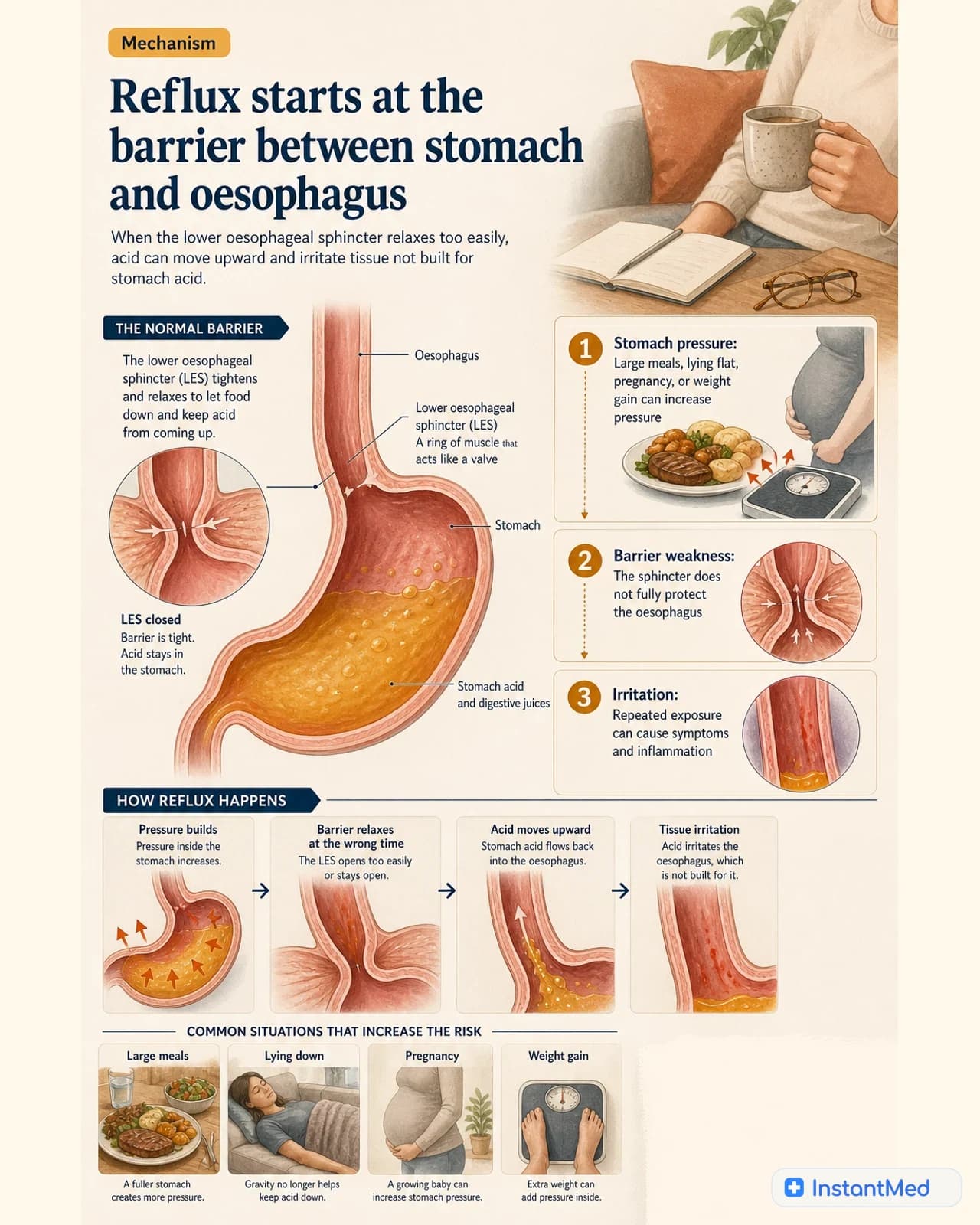
Acid Reflux and GORD: Symptoms, Red Flags, and Treatment
Occasional reflux is common, but frequent heartburn, regurgitation, swallowing symptoms, chest pain, bleeding signs, or persistent vomiting need a more careful plan.
InstantMed Medical Team

8 min read
Burnout vs Stress: How to Tell the Difference
Stress and burnout overlap, but they are not the same. Learn the practical differences, common warning signs, workplace drivers, recovery steps, and when to seek professional support.
InstantMed Medical Team
8 min read
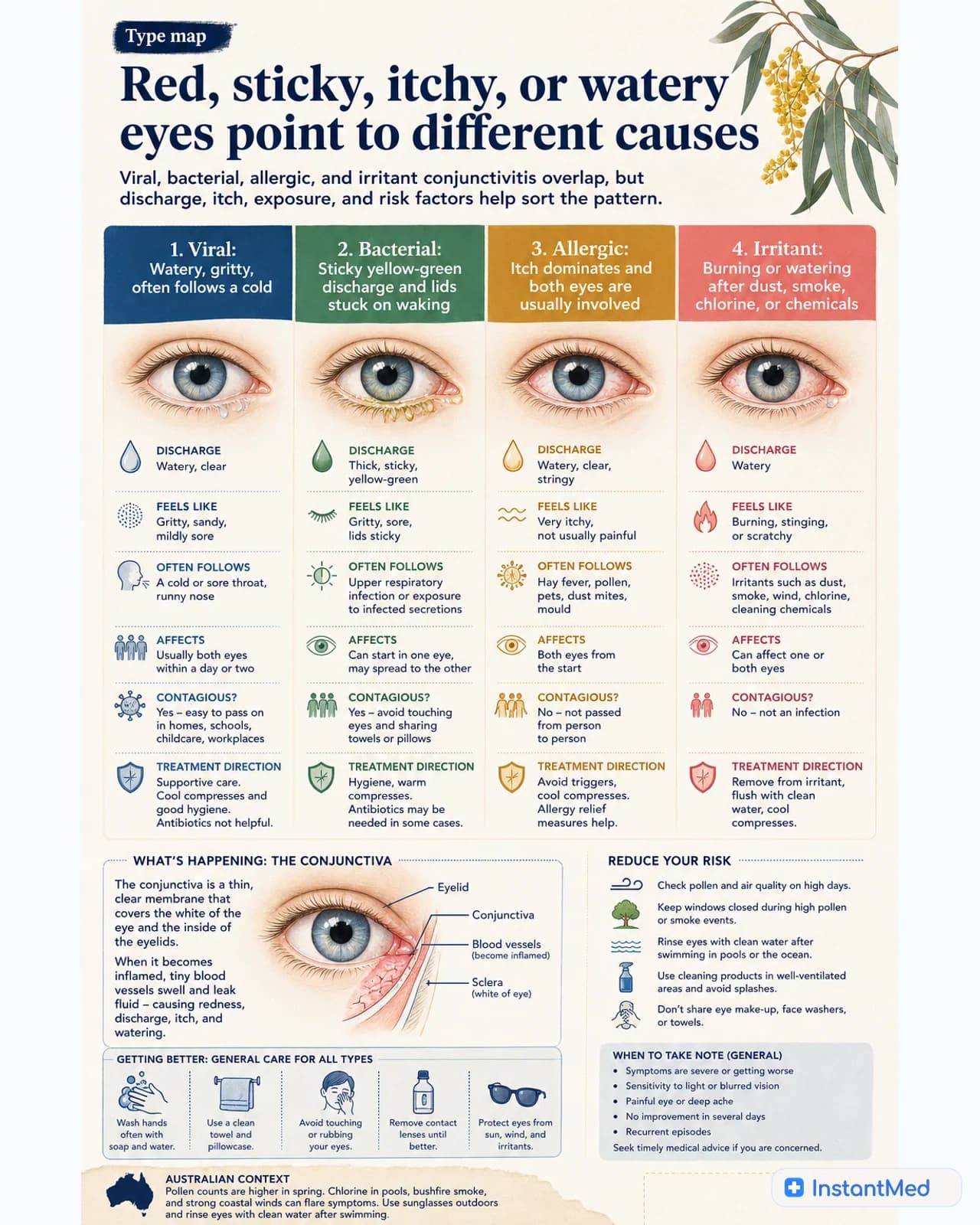
Conjunctivitis (Pink Eye): Types, Treatment, and When to Seek Care
Conjunctivitis is common, but not every red eye is routine pink eye. Discharge, itch, contact lens use, pain, light sensitivity, and vision change determine the safest next step.
InstantMed Medical Team