Loading article
Back to Health Guides
What AHPRA-Registered Means for Doctors in Australia
How to check a doctor's registration, what the register proves, and where the limits sit.
10 min read
·Updated 5 July 2026
·Doctor Reviewed
AHPRA Verified
In this article
- 1The basic rule
- 2How to check a doctor on the public register
- 3What the registration types mean
- 4What AHPRA registration does not prove
- 5Telehealth still has the same professional standard
Medical information only. This article is for general information and does not constitute medical advice. Treatment decisions are made by an AHPRA-registered doctor after reviewing your circumstances.
Review
InstantMed Clinical Team
Clinical governance review for guide content
Updated
5 July 2026
General information only, not personal medical advice.
AHPRA-registered means the practitioner appears on Australia's public health practitioner register and can practise only within the scope, status, and limits shown there.
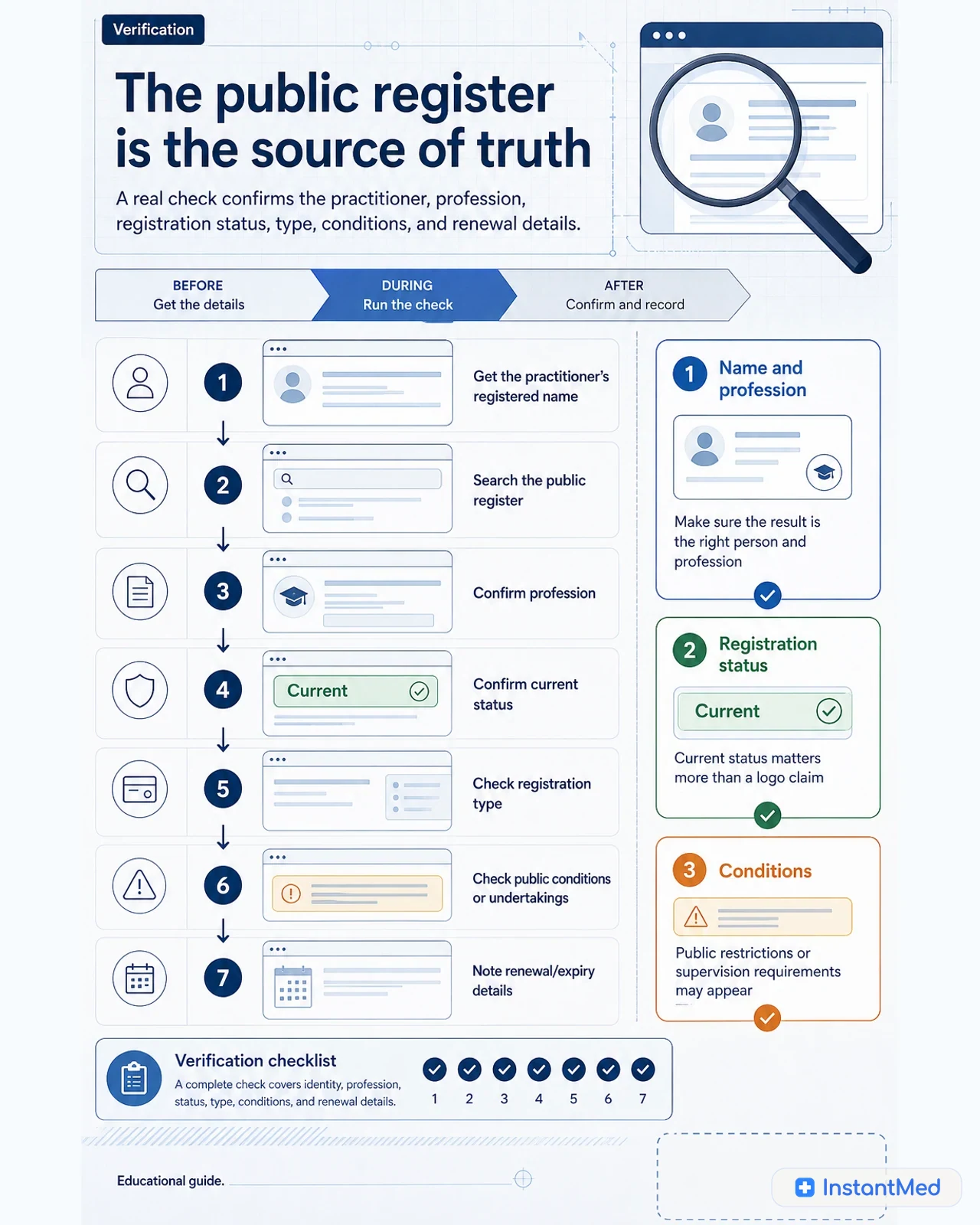
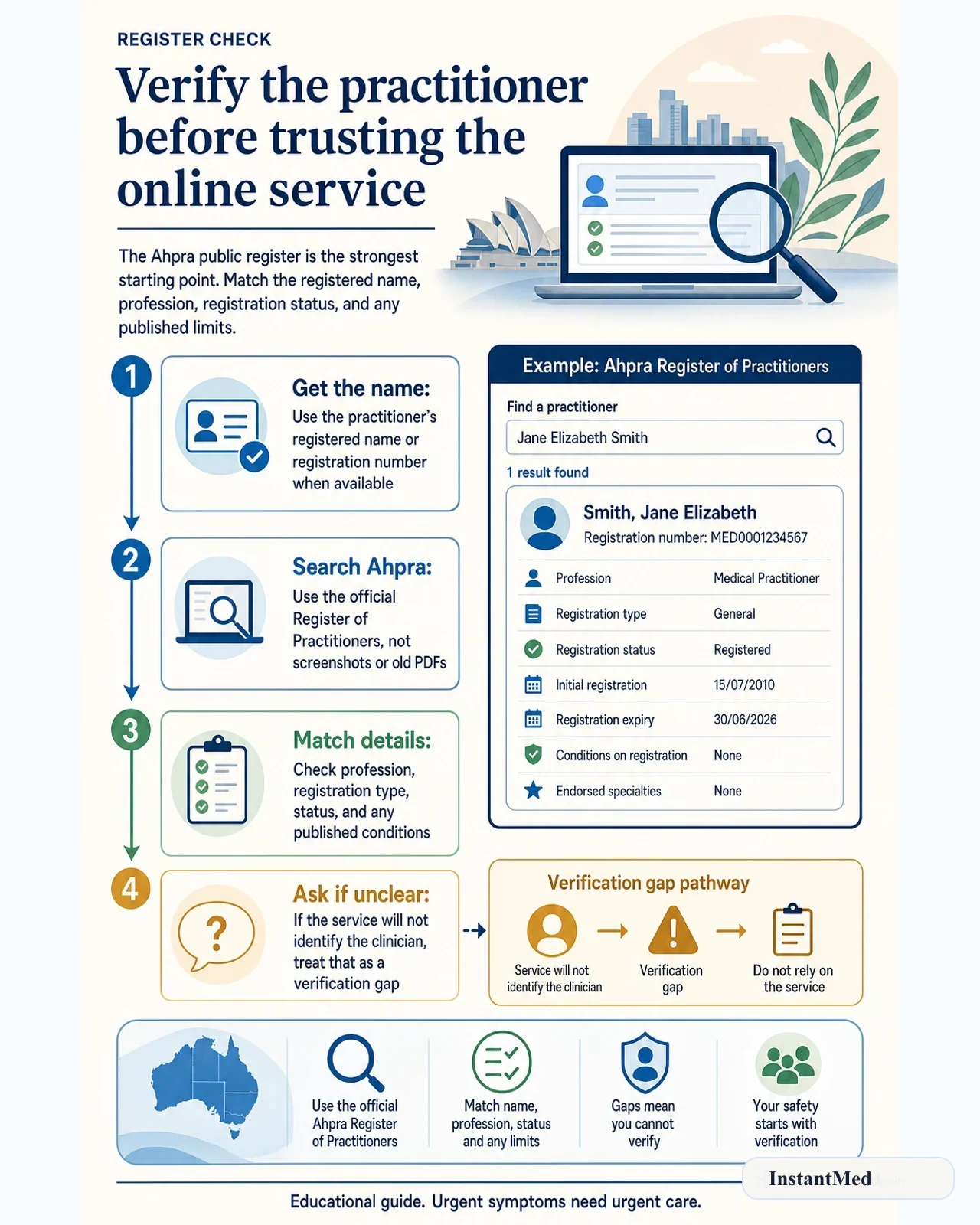
For a doctor, the important check is not a badge on a website. It is the live Ahpra Register of practitioners result: profession, current status, registration type, conditions or undertakings, and any specialist registration.
The basic rule
Ahpra works with 15 National Boards to run Australia's National Registration and Accreditation Scheme. The scheme regulates 16 health professions, including medical practitioners. For doctors, the relevant National Board is the Medical Board of Australia.
The public register is the practical source of truth. It shows whether a practitioner is registered and what public limits apply. Ahpra describes the register as a list of every health practitioner who is registered to practise in Australia in the regulated professions.
For a doctor, AHPRA registration usually tells you:
- the person is listed as a Medical Practitioner
- the registration status is current or otherwise limited
- the registration type is shown
- public conditions or undertakings may be visible
- specialist registration may appear if held
- the principal place of practice may be listed
- registration must be renewed
The phrase "AHPRA-registered" should therefore be treated as a checkable claim, not a trust decoration.
How to check a doctor on the public register
Use the official Ahpra Register of practitioners. You do not need an account to search.
- 1
Search by the doctor's registered name or registration number.
- 2
Choose the right profession: Medical Practitioner.
- 3
Open the matching result rather than relying on the search summary.
- 4
Confirm the name matches the person or document you are checking.
- 5
Check current status, registration type, and any public conditions or undertakings.
- 6
Look for specialist registration if the person claims a specialist role.
- 7
If something does not match, ask the service for clarification before relying on the claim.
The register result is not just a yes/no screen. A name match without the right profession, current status, or scope is not enough.
| Register field | What to check | Why it matters |
|---|---|---|
| Name | The name matches the doctor or document | Similar names can create false confidence |
| Profession | It says Medical Practitioner | Other health professions are regulated, but they are not medical doctors |
| Current status | Registration is current and active for practice | Lapsed, suspended, cancelled, or non-practising status changes the answer |
| Registration type | General, specialist, provisional, limited, or non-practising | Each type has a different practice meaning |
| Conditions or undertakings | Any public restrictions are understood | Some restrictions can limit what the practitioner may do |
| Specialist registration | Specialist status appears if claimed | "Doctor" and "specialist" are not the same claim |
What the registration types mean
The Medical Board lists several types of medical registration. The exact details can be technical, but the patient-facing difference is simple: some types allow broad practice within scope, while others are linked to supervision, defined purposes, or no clinical practice.
| Registration type | Plain-English meaning | What it does not automatically prove |
|---|---|---|
| General registration | The doctor is registered to practise medicine in the general category | That the doctor is a specialist GP or specialist in your condition |
| Specialist registration | The doctor is recognised in a specialty shown on the register | That every service outside that specialty is suitable |
| Provisional registration | Often used in supervised training pathways | Unrestricted independent practice |
| Limited registration | Granted for defined purposes such as area of need, postgraduate training, public interest, or teaching and research | A broad licence to practise in any context |
| Non-practising registration | The person remains registered but is not practising | Permission to provide clinical care |
Use the Medical Board's current registration-type pages for exact legal and professional detail. This guide explains the practical patient check, not every pathway a doctor may use to obtain registration.
This is why "on the register" is not always enough. The registration type and visible restrictions are part of the answer.
What AHPRA registration does not prove
AHPRA registration is the floor for lawful, accountable practice. It is not a stamp that makes every clinical decision correct.
Registration does not automatically prove:
Registration types
General, specialist, provisional, limited, and non-practising registration mean different things.
- the doctor is a GP
- the doctor is a specialist in the area you need
- the doctor has no public restrictions
- a particular telehealth model is suitable for your problem
- a prescription, certificate, or report will be accepted elsewhere
- every document signed by the doctor was clinically appropriate
- every advertising claim made by a service is accurate
Registration sits alongside clinical judgement, informed consent, privacy, safe prescribing, good records, and escalation to in-person care when needed.
Telehealth still has the same professional standard
Telehealth does not create a lower standard of medicine. The Medical Board's guidance says telehealth can include video, internet, telephone, digital image transmission, and prescribing, but it also says telehealth is not suitable for every consultation.
For Australian patients, the practical telehealth checks are:
- Is the doctor registered with the Medical Board?
- Does the doctor gather enough information to make a safe decision?
- Are the limits of remote assessment recognised?
- Are privacy and records handled properly?
- Is there a plan for follow-up or in-person care if remote review is not enough?
This matters for overseas-based or anonymous online services. If the patient is in Australia, registration with the Australian Medical Board is part of the accountability check.
Red flags when checking a service
Be cautious when a clinic, platform, or practitioner asks you to rely on trust wording instead of verifiable details.
Red flags include:
- no practitioner name on the clinical document
- a badge, seal, or website claim instead of a live register result
- a practitioner listed in another country but not on the Australian register
- non-practising, suspended, lapsed, or cancelled status
- conditions or undertakings that are not explained
- claimed specialist status without specialist registration shown
- automatic approval claims for certificates, prescriptions, or reports
- no clear privacy or complaints pathway
Decision guide
Where a registration check fits
May fit telehealth
- You can identify the doctor and verify current Medical Practitioner registration.
- The register details match the document or service claim.
- The problem can be assessed remotely with enough history and escalation options.
Needs in-person care
- The register check is fine, but your symptoms need examination, observations, tests, or urgent treatment.
- The service cannot explain the responsible practitioner, scope, or follow-up pathway.
Urgent care
- Severe symptoms, immediate safety concerns, chest pain, breathing trouble, collapse, severe bleeding, or mental health crisis.
- Call 000 or use urgent local care for emergency symptoms.
The register is a credential check. It is not a triage system.
If you have a concern
Ahpra and the National Boards manage concerns about registered practitioners through the notifications process. Concerns can relate to conduct, performance, health, boundaries, unsafe practice, dishonesty, or other risks to public safety.
The pathway varies by state. Ahpra says people in the Australian Capital Territory, Northern Territory, South Australia, Tasmania, Victoria, or Western Australia can report concerns about registered practitioners or students to Ahpra. New South Wales and Queensland have different arrangements through state bodies, with mandatory notification rules still applying in some circumstances.
Accountability
The Medical Board's expectations still apply: adequate assessment, clinical judgement, records, privacy, and follow-up where needed.
If the problem is immediate danger, do not wait for a regulatory process. Use emergency or urgent medical care first.
Related guides
- How to verify an online doctor
- Is telehealth safe?
- How doctors review online requests
- Telehealth privacy and security
- When telehealth cannot help
Sources
- Ahpra: Register of practitioners
- Ahpra: What we do
- Ahpra: National Registration and Accreditation Scheme
- Ahpra: About registration
- Ahpra: How to raise a concern about a health practitioner
- Medical Board of Australia: Types of medical registration
- Medical Board of Australia: Registration standards
- Medical Board of Australia: Registration renewal
- Medical Board of Australia: Good medical practice
- Medical Board of Australia: Telehealth consultations with patients
Frequently Asked Questions
What does AHPRA-registered mean?
It means the practitioner appears on the public Ahpra Register of practitioners and can practise within the scope and limits shown on that live register.
Does AHPRA registration mean someone is a GP?
Not by itself. A doctor may have general, specialist, provisional, limited, or non-practising registration. GP status depends on the registration details and any specialist or vocational recognition shown on the register.
How do I check if a doctor is registered in Australia?
Use Ahpra's public Register of practitioners. Search by name or registration number, select Medical Practitioner, then check the name, profession, current status, registration type, public conditions or undertakings, and any specialist registration.
Can a doctor outside Australia treat Australian patients by telehealth?
The Medical Board says a doctor consulting with patients in Australia is expected to be registered with the Board, regardless of where the doctor is located, and must meet relevant registration standards.
What does non-practising registration mean?
Non-practising registration means the person remains on the register but is not allowed to practise medicine. It is not the same as current practising registration.
Does Ahpra check every consultation?
No. Ahpra and the National Boards register practitioners, set standards, audit compliance, and manage concerns. Registration does not mean every consultation, certificate, prescription, or service model has been individually pre-approved.
What should I do if the register details do not match a service's claim?
Ask the service for clarification before relying on the claim. If there is a safety concern about a registered practitioner, Ahpra and state health complaints bodies explain how to raise concerns.
InstantMed Medical Team
Related Articles
11 min read
How to Verify an Online Doctor in Australia
Before using an online doctor or relying on a telehealth document, check the practitioner, the service, the clinical process, and the document. This guide explains how to verify legitimacy without relying on badges or polished PDFs.
InstantMed Medical Team

11 min read
Is Telehealth Safe in Australia?
Telehealth can be safe when the service is regulated, the doctor has enough information, and there is a clear path to in-person or urgent care when remote review is not enough.
InstantMed Medical Team
12 min read
Telehealth Privacy and Security in Australia
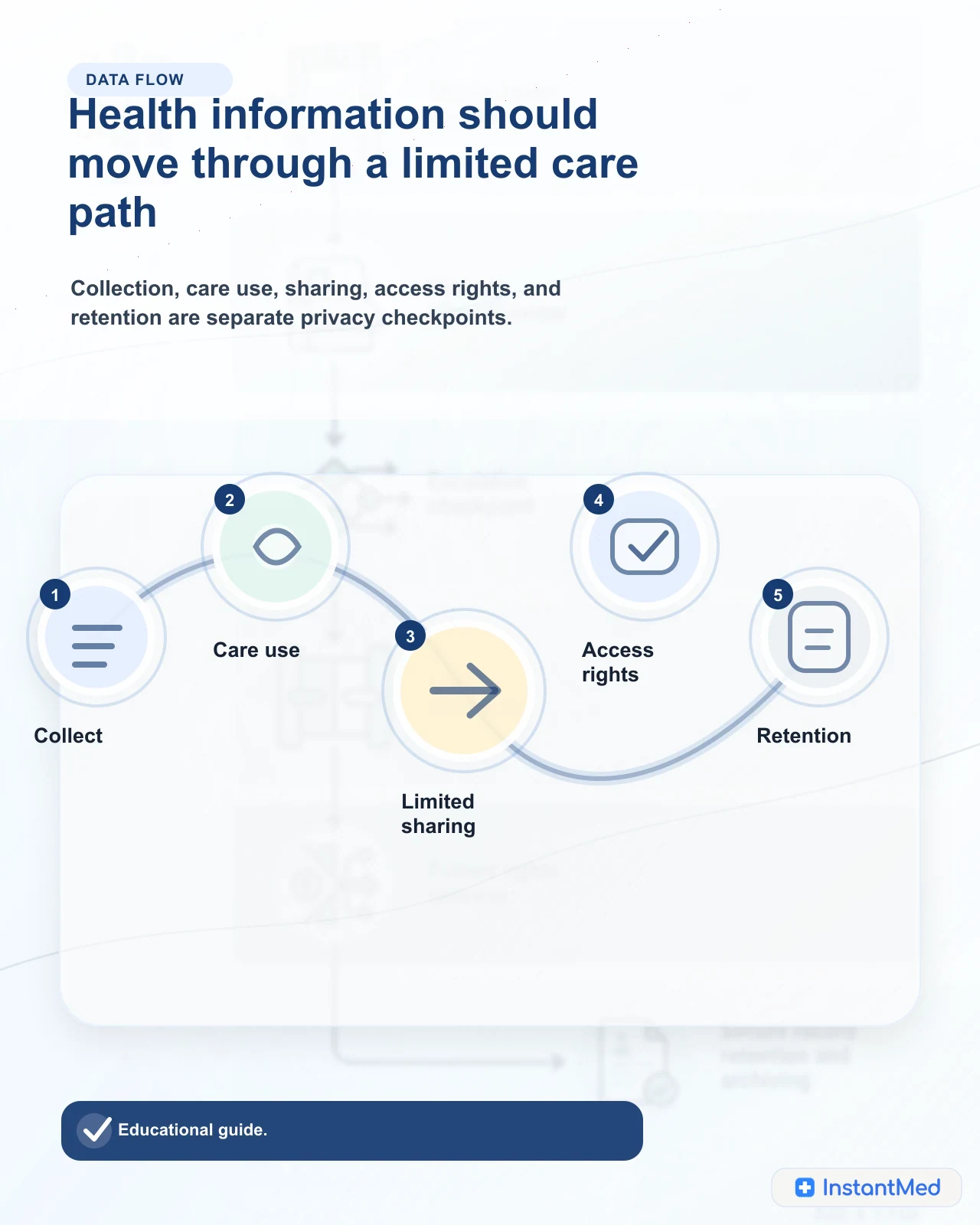
Telehealth privacy depends on law, clinical governance, security controls, and patient-side habits. Learn what to check before sharing health information with an online doctor service in Australia.
InstantMed Medical Team