Loading article
Back to Health Guides
Telehealth Costs: Bulk Billing vs Private
A practical Australian guide to $0 bulk billing, Medicare rebates, gap payments, private fees, PBS medicine costs, and what to check before booking.
12 min read
·Updated 8 July 2026
·Doctor Reviewed
AHPRA Verified
In this article
- 1The three billing models
- 2What bulk billing means
- 3What private telehealth means
- 4When Medicare rebates apply to telehealth
- 5Form-first and private-only services
Medical information only. This article is for general information and does not constitute medical advice. Treatment decisions are made by an AHPRA-registered doctor after reviewing your circumstances.
Review
InstantMed Clinical Team
Clinical governance review for guide content
Updated
8 July 2026
General information only, not personal medical advice.
Jump to section
1The three billing models2What bulk billing means3What private telehealth means4When Medicare rebates apply to telehealth5Form-first and private-only services6PBS medicine costs are separate7Medicare Safety Net is different from PBS Safety Net8The real cost comparison9What to check before booking10Choosing the right model11Related guides12Sources Used In This Guide
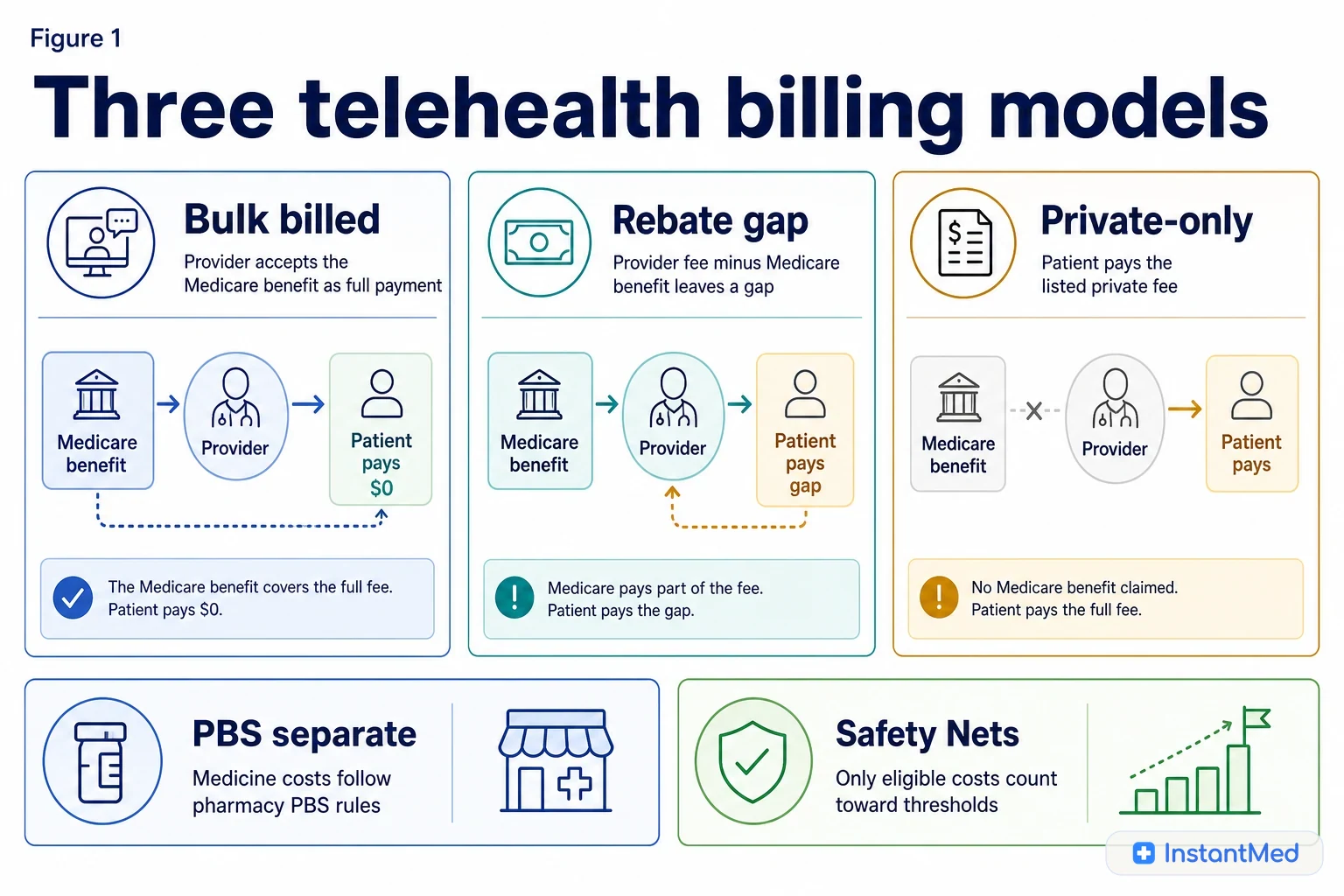
Telehealth costs in Australia depend on the billing model, not just the fact that the consultation happens online. A telehealth appointment may be bulk billed, privately billed with a Medicare rebate, or privately billed with no Medicare rebate.
The safest way to think about it is this: bulk billing answers "what does Medicare cover?", while private telehealth answers "what does this provider charge for this service?"
The three billing models
Most patient confusion comes from mixing three different payment models together.
| Billing model | What happens | What you pay |
|---|---|---|
| Bulk billed telehealth | The provider bills Medicare directly and accepts the Medicare benefit as full payment | $0 out of pocket for that eligible service |
| Private telehealth with a rebate | You pay the provider fee, then claim or receive a Medicare benefit if the service qualifies | The gap between the fee and the rebate |
| Private-only telehealth | The provider charges a private fee and no Medicare rebate applies | The listed private fee |
What bulk billing means
Bulk billing is not the same as "cheap" or "discounted". It means the health professional accepts the Medicare benefit as the full fee for an eligible service. You do not pay a separate gap for that service.
For telehealth to be bulk billed, the key pieces usually need to line up:
| Requirement | Why it matters |
|---|---|
| You are enrolled in Medicare | Medicare pays benefits only for eligible patients and services |
| The consultation fits an MBS item | The service must be one Medicare can pay a benefit for |
| The provider can bill Medicare for that item | Not every provider or service type uses MBS billing |
| The provider chooses to bulk bill | Services Australia says not all health professionals bulk bill |
| You assign the Medicare benefit | The provider needs patient agreement so Medicare can pay them directly |
Bulk billing can also be partial in a practical sense. A visit may include more than one service, and Services Australia notes you may not be bulk billed for everything in a visit. Always ask whether the whole appointment, any tests, certificates, procedures, reports, or follow-up items are included.
What private telehealth means
Private telehealth means the provider sets and charges its own fee. That fee can be fixed by service type, time, clinical complexity, urgency, after-hours availability, or whether documents, prescriptions, referrals, or follow-up are included.
Private does not automatically mean "no Medicare". It means Medicare is not necessarily paying the provider as full payment. There are two common private patterns:
| Private pattern | How it usually feels to the patient |
|---|---|
| Private with rebate | You pay the provider fee and receive a Medicare benefit if the item is valid |
| Private-only | You pay the listed fee and no Medicare benefit is attached |
The practical formula is:
| Fee type | Formula |
|---|---|
| Bulk billed | Medicare benefit accepted as full payment = $0 patient gap |
| Rebateable private | Provider fee minus Medicare benefit = out-of-pocket gap |
| Private-only | Provider fee = out-of-pocket cost |
If a service advertises a private fee, do not assume there is a rebate unless the provider says the service is Medicare-rebateable and gives a valid claim pathway or receipt.
When Medicare rebates apply to telehealth
Services Australia says Medicare benefits are available for video and phone telehealth services, and that MBS telehealth items have the same clinical requirements as the corresponding face-to-face items. MBS Online says ongoing telehealth arrangements remain in place for a wide range of phone and video services.
That does not mean every online service attracts a rebate. Eligibility can depend on the service type, provider type, MBS item, relationship rules, MyMedicare settings, clinical requirements, and how the consultation is delivered.
| Question to ask | Why it matters |
|---|---|
| Is this service bulk billed? | If yes, the provider accepts the Medicare benefit as full payment |
| If not bulk billed, is there a Medicare rebate? | This determines whether there may be a gap rather than a full private cost |
| Which item or claim pathway applies? | Rebateable services should be able to explain how the Medicare claim works |
| Is phone or video required? | Some MBS rules depend on the consultation format |
| Do I need an existing relationship or MyMedicare registration? | Some GP telehealth rules depend on the patient-provider relationship |
| Are documents, scripts, tests, or referrals included? | The consultation fee and downstream costs may be separate |
Form-first and private-only services
Some online services are built around a structured form, secure messaging, stored photos, document requests, or doctor review that may not use a Medicare video or phone attendance item. These services often charge a private fee because their billing model is separate from Medicare telehealth claiming.
That does not automatically tell you whether the service is clinically appropriate. It tells you how the service is paid for. The clinical question is separate: can a doctor safely assess the request from the information provided, and can they redirect to phone, video, GP, urgent care, or emergency care if needed?
Figure 2
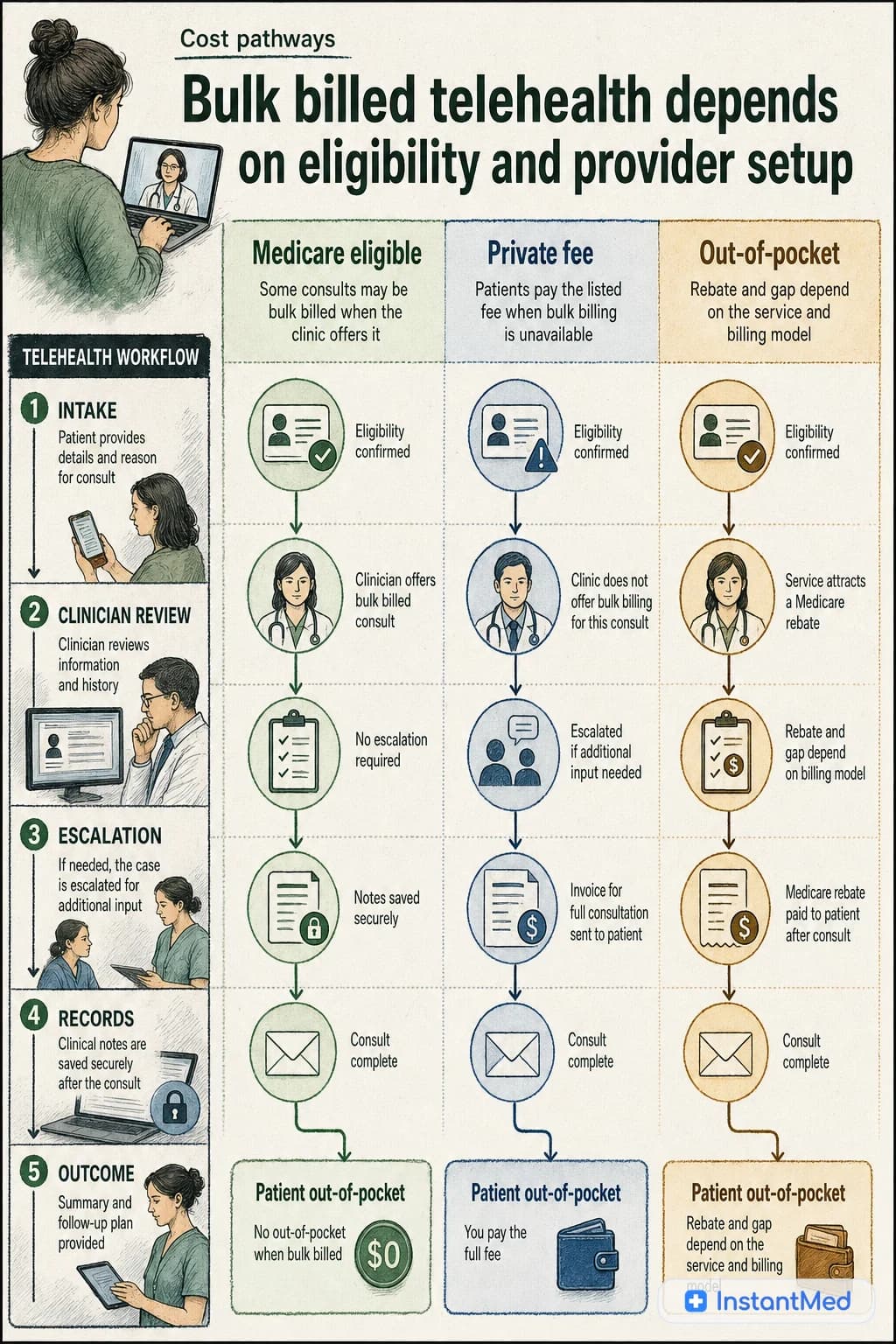
Medicare eligibility, an MBS item, provider billing, service format, and receipt details all matter.
PBS medicine costs are separate
If the telehealth outcome includes a prescription, the pharmacy cost is a different cost bucket from the consultation fee.
PBS pricing depends on whether the medicine is PBS-listed for your situation, whether you are Medicare/PBS eligible, whether you have a concession card, and whether your PBS Safety Net status has changed.
As at 1 July 2026, PBS states the current patient co-payment amounts and Safety Net thresholds as:
| PBS category | Current amount |
|---|---|
| General patient co-payment | Up to $25.00 |
| Concession co-payment | Up to $7.70 |
| General PBS Safety Net threshold | $1,748.20 |
| Concessional PBS Safety Net threshold | $277.20 |
| After general PBS Safety Net | Up to $7.70 |
| After concessional PBS Safety Net | Free |
The consultation billing model does not turn a non-PBS medicine into a PBS medicine. It also does not remove any brand premiums, private medicine costs, delivery fees, after-hours fees, or pharmacy-specific charges that may apply.
Medicare Safety Net is different from PBS Safety Net
There are two separate Safety Net systems patients often mix up:
| Safety Net | What it tracks | 2026 threshold examples |
|---|---|---|
| Medicare Safety Net | Eligible gap or out-of-pocket amounts for out-of-hospital Medicare services | Original Medicare Safety Net $594.40; Extended Medicare Safety Net general $2,699.10; concessional/Family Tax Benefit Part A $861.20 |
| PBS Safety Net | PBS medicine spending in the calendar year | General $1,748.20; concession $277.20 |
Only eligible Medicare services count toward Medicare Safety Net thresholds. A purely private telehealth fee with no Medicare rebate usually does not help you reach a Medicare Safety Net threshold.
The real cost comparison
The cheapest option on paper is not always the easiest to access, and the fastest option is not always the cheapest.
| Situation | Cost lens |
|---|---|
| Existing GP offers bulk billed telehealth | Lowest out-of-pocket cost if timing and clinical fit work |
| Private service with rebate | You need to compare the gap, not just the sticker price |
| Private-only service | You need to decide whether the fixed fee is worth the access, speed, or service type |
| In-person appointment | Include travel, parking, waiting time, time off work, and childcare if relevant |
| Urgent symptoms | Cost comparison should stop; urgent or emergency care comes first |
If you have urgent symptoms, severe pain, breathing difficulty, chest pain, stroke signs, collapse, severe bleeding, a mental health crisis with immediate danger, or a child who appears very unwell, do not choose based on price. Use urgent or emergency care.
What to check before booking
Use this checklist before assuming what a telehealth service will cost.
| Check | Good question |
|---|---|
| Upfront fee | What will I pay before or after the consultation? |
| Bulk billing | Is the service bulk billed for my situation? |
| Rebate | If it is private, can I claim a Medicare rebate? |
| Gap | What is my likely out-of-pocket cost after any rebate? |
| Scope | Does the fee include review, prescription, certificate, referral, or follow-up? |
| Suitability | What symptoms or requests will be redirected to in-person or urgent care? |
| Pharmacy cost | If a prescription is issued, is the medicine PBS-listed for me? |
| Records | Will I get a receipt, clinical record, document, or follow-up instructions? |
Figure 3
Consult fee, rebate, medicine cost, travel or time, Safety Nets, and urgent-care suitability sit in separate buckets.
Choosing the right model
Decision guide
Bulk billed, rebateable, or private telehealth
May fit telehealth
- Your problem is low risk, remote-suitable, and the provider explains the fee, rebate, gap, and limits before you proceed.
- You understand whether the service is bulk billed, rebateable private, or private-only.
Needs in-person care
- Examination, observations, procedures, imaging, wound care, pregnancy assessment, child assessment, or urgent tests may change the plan.
- The provider says telehealth is not enough or asks you to see a GP, urgent care, or emergency department.
Urgent care
- Chest pain, stroke signs, severe breathing difficulty, collapse, seizure, severe bleeding, poisoning, overdose, major injury, immediate self-harm risk, or rapid deterioration should bypass routine telehealth.
- Call 000 for serious and urgent symptoms.
Related guides
- Is telehealth bulk billed in Australia?
- What happens in a telehealth consultation?
- How telehealth consultations work
- PBS medicine costs in Australia
Sources Used In This Guide
- Healthdirect: Bulk billing for medical services
- Services Australia: Bulk billing
- Services Australia: Who can claim telehealth services under MBS or DVA
- MBS Online: MBS Telehealth Services
- Medical Board of Australia: Telehealth consultations with patients
- Services Australia: Medicare Safety Net thresholds
- PBS: Fees, patient contributions and Safety Net thresholds
- Services Australia: PBS Safety Net thresholds
Frequently Asked Questions
Is telehealth bulk billed in Australia?
It can be, but it is not automatic. Bulk billing requires Medicare eligibility, a service that fits an MBS item, and a provider who chooses to accept the Medicare benefit as full payment.
What is the difference between bulk billed and private telehealth?
Bulk billed telehealth means the provider bills Medicare directly and accepts the Medicare benefit as full payment, so the patient has no out-of-pocket cost for that service. Private telehealth means the provider sets a fee. A Medicare rebate may or may not apply, depending on the service and billing model.
Can private telehealth still have a Medicare rebate?
Sometimes. A private service can be Medicare-rebateable if it meets MBS requirements and the provider gives a valid itemised receipt or claim pathway. If no Medicare item applies, the patient pays the listed private fee.
Do PBS medicine prices change if the consultation was private?
No. PBS medicine co-payments are separate from the consultation fee. If the medicine is PBS-listed for you and you are eligible, the pharmacy PBS price is based on the PBS rules, not whether the consultation was bulk billed or privately billed.
What should I ask before booking telehealth?
Ask the upfront fee, whether the service is bulk billed, whether any Medicare rebate applies, whether there may be a gap, whether urgent symptoms are excluded, and whether prescriptions, certificates, tests, or referrals have separate costs.
Does a private telehealth fee count toward the Medicare Safety Net?
Only eligible out-of-pocket costs for Medicare services count. A purely private fee with no Medicare rebate generally does not count toward Medicare Safety Net thresholds.
InstantMed Medical Team
Related Articles
10 min read
Is Telehealth Bulk Billed in Australia?
Telehealth can be bulk billed in Australia, but it is not automatic. Learn when Medicare telehealth rebates apply, what bulk billing means, and what to check before booking.
InstantMed Medical Team
11 min read
Telehealth Consultation in Australia: What to Expect
A telehealth consultation is a real clinical review delivered by phone, video, secure message, or structured online form. Learn what happens, what to prepare, and when remote care is not enough.
InstantMed Medical Team
11 min read
How Telehealth Consultations Work in Australia
Telehealth can mean phone, video, online messaging, image sharing, remote monitoring, or a mix of digital tools. Learn how it works, what a clinician still needs to check, and where telehealth should stop.
InstantMed Medical Team