Loading article
Back to Health Guides
How to Get a Prescription Online in Australia
The complete guide to online prescriptions: what is legal, how eScripts work, which medications qualify, PBS pricing, and how to verify a service is genuine.
8 min read
·Updated 3 June 2026
·Doctor Reviewed
AHPRA Verified
In this article
- 1The Legal Framework
- 2How the eScript System Works
- 3What Information You Need to Provide
- 4Which Medications Can Be Prescribed Online
- 5PBS Pricing: Same at the Pharmacy
Medical information only. This article is for general information and does not constitute medical advice. Treatment decisions are made by an AHPRA-registered doctor after reviewing your circumstances.
Review
InstantMed Clinical Team
Clinical governance review for guide content
Updated
3 June 2026
General information only, not personal medical advice.
Jump to section
1The Legal Framework2How the eScript System Works3What Information You Need to Provide4Which Medications Can Be Prescribed Online5PBS Pricing: Same at the Pharmacy6Private (Non-PBS) Prescriptions7Planning Regular Prescriptions Without Subscriptions8How to Verify a Prescription Service Is Legitimate9Sources Used In This Guide
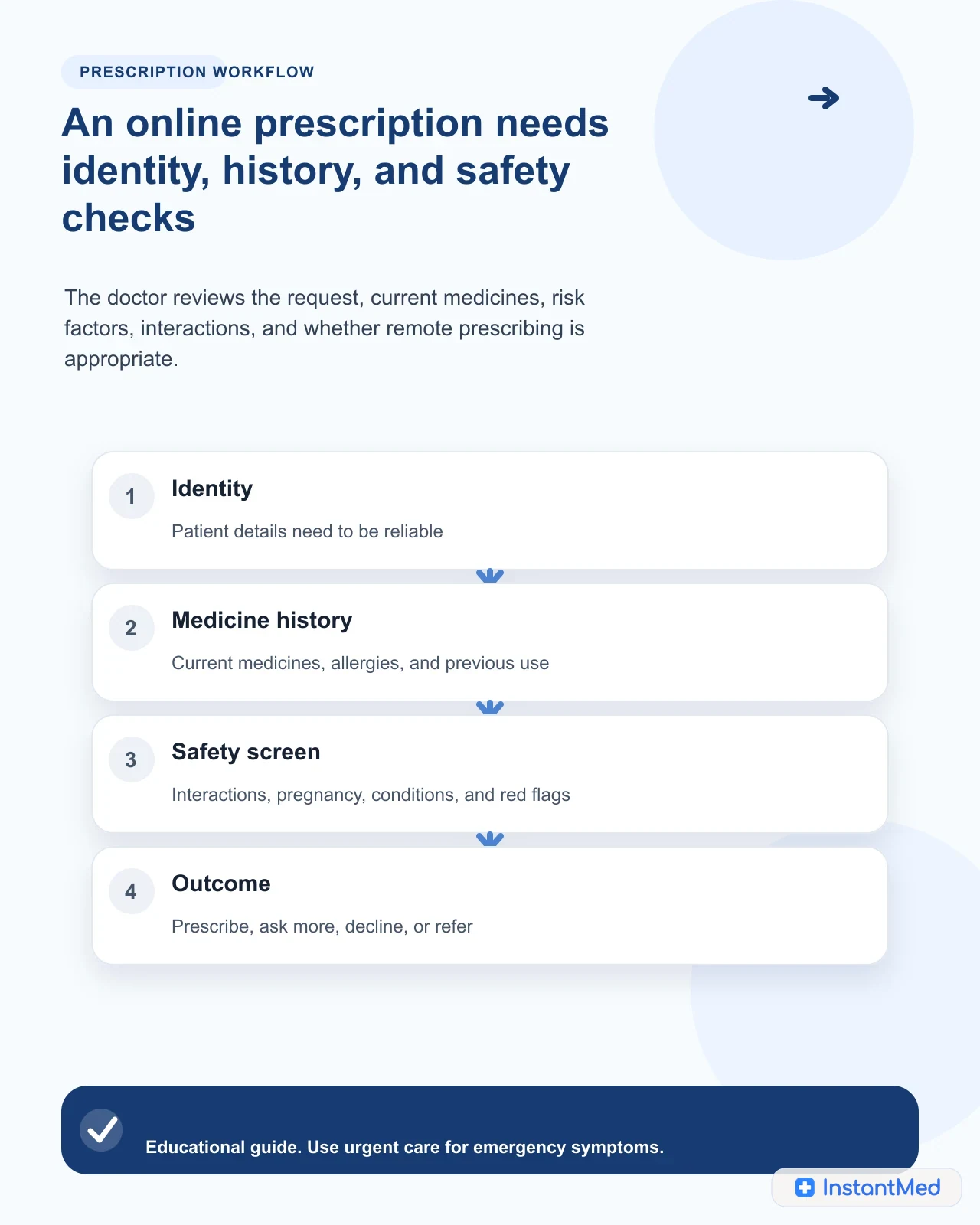
Getting a prescription online in Australia is safe, legal, and widely used. An AHPRA-registered doctor can issue an electronic prescription (eScript) through a telehealth consultation - you receive it by SMS and fill it at any pharmacy in Australia, with PBS pricing applying as normal.
The process is the same clinically as any other prescription: a doctor assesses your situation, applies prescribing guidelines, checks for contraindications, and makes a clinical decision. The delivery mechanism is different - a digital token rather than a paper or printed script.
The Legal Framework
Under the Health Practitioner Regulation National Law (enacted in all states and territories), prescribing authority is vested in AHPRA-registered medical practitioners, nurse practitioners, and other authorised prescribers. There is no requirement in that legislation that prescriptions be issued from an in-person consultation.
Electronic prescriptions are governed by the Electronic Prescriptions Standard, published by the Australian Digital Health Agency. This standard defines the technical and clinical requirements for eScripts and forms the regulatory basis for the nationwide eScript system.
The Pharmaceutical Benefits Scheme (PBS) does not differentiate between prescriptions based on how they were generated. A prescription issued via telehealth by an AHPRA-registered doctor attracts the same PBS subsidy as one from a face-to-face consultation.
The only prescribing restriction relevant to telehealth is for Schedule 8 controlled drugs (opioids, ADHD stimulants, some benzodiazepines), which generally require in-person assessment under state and territory Poisons legislation.
How the eScript System Works
The eScript system in Australia uses a token-based model operating through the Prescription Exchange Service (PES) - the national electronic prescribing infrastructure that connects prescribers, the PES registry, and pharmacies.
The process:
- 1
The doctor submits the prescription digitally to the PES registry
- 2
The PES registry generates a unique QR code token
- 3
The token is sent to you by SMS (and optionally email)
- 4
You present the SMS to any pharmacy
- 5
The pharmacist scans the QR code to retrieve the full prescription from the PES registry
- 6
The medication is dispensed and the prescription is marked as used
If the prescription has repeats, the first dispensing generates a linked repeat token, which is sent to your phone when the first supply is dispensed. Each subsequent repeat generates the next token. This continues until all repeats are used.
If you have multiple scripts from the same consultation, each arrives as a separate SMS token. You can fill them at different times or different pharmacies.
What Information You Need to Provide
For a repeat prescription request, the doctor needs to form a clinical opinion about whether continuing your current medication is safe and appropriate. To enable this:
The medication: Exact name, strength, and dose. A photo of the current packaging is the most reliable way to provide this - it shows the brand name, active ingredient, dose, and manufacturer, eliminating any ambiguity.
Why you take it: The condition being treated and a brief description of how long you have been on the medication. "Ramipril 10mg - prescribed for high blood pressure, taking for 4 years" is sufficient.
Recent monitoring: Some medications require monitoring results before renewal is appropriate. If you take a medication that requires regular blood tests (thyroid medications, diabetes medications, ACE inhibitors at higher doses), having recent test results available makes the renewal process faster and avoids requests for clarification.
All other medications: Interaction checking is part of every prescribing decision. Provide a complete list including over-the-counter products and supplements.
Allergies: Any known drug allergies, the specific drug, and the reaction type.
Which Medications Can Be Prescribed Online
Suitable for online repeat prescription:
- Antihypertensives (ramipril, perindopril, amlodipine, irbesartan, metoprolol, and others)
- Statins (atorvastatin, rosuvastatin)
- Type 2 diabetes medications for established patients (metformin, SGLT2 inhibitors, GLP-1 agonists)
- Thyroid medications (levothyroxine for thyroid issues, where recent thyroid function tests are available)
- Oral contraceptives (combined pill, progestogen-only pill)
- SSRIs and SNRIs for established patients with depression (sertraline, escitalopram, venlafaxine)
- Inhaled medications for stable asthma (preventer and combination inhalers)
- Antihistamines for chronic allergic conditions
- Topical treatments for chronic skin conditions
Not available via asynchronous telehealth:
- Schedule 8 controlled drugs (opioids, ADHD stimulants, most benzodiazepines)
- First prescriptions for new conditions requiring examination
- Medications where required monitoring has lapsed (the doctor may ask you to see your GP first)
- Specialist-only medications (some immunosuppressants, biologics, certain psychiatric medications)
The general principle: telehealth is appropriate for renewing established, stable medications for conditions that are not changing. New medications, changing clinical situations, and controlled substances require in-person assessment.
PBS Pricing: Same at the Pharmacy
A common misconception is that prescriptions obtained via telehealth cost more at the pharmacy. They do not.
PBS pricing is determined by your Medicare eligibility and the medication's PBS listing, not by the source of the prescription. The pharmacy co-payment is the same whether your script came from a bulk-billed GP, a private telehealth service, or a hospital outpatient clinic.
Under the Pharmaceutical Benefits Scheme (PBS, 2026):
| Patient type | PBS co-payment |
|---|---|
| General patient | Up to $25.00 per item |
| Concession card holder | Up to $7.70 per item |
| Safety Net (concessional) | Free after $277.20/year |
| Safety Net (general) | $7.70 after $1,748.20/year |
The telehealth consultation fee is separate from the pharmacy cost. You pay the consultation fee to the service and the PBS co-payment at the pharmacy - these are entirely independent transactions.
Private (Non-PBS) Prescriptions
Some medications are not listed on the PBS or may be prescribed in a non-PBS format. Private prescriptions are dispensed at the full unsubsidised price. This can be substantially higher than the PBS co-payment for the same medication.
Common situations involving private prescriptions:
Not automatic
Unsafe medicines, missing information, urgent symptoms, or monitoring needs can change the outcome.
- Medications not listed on the PBS
- Doses or formulations not on the PBS
- PBS medications prescribed in quantities above PBS limits
- Compounded medications (not listed on the PBS)
When a doctor prescribes privately rather than via PBS, the prescription should indicate this, and the pharmacist will confirm the full cost before dispensing.
Planning Regular Prescriptions Without Subscriptions
If you need the same medication repeatedly, plan renewals before you run out and keep your usual GP involved for monitoring. Some services use recurring programs, but InstantMed's current model is one-off doctor review with no subscription commitment.
This keeps the clinical decision attached to the current facts rather than a recurring billing cycle. A practical routine is to set a reminder two to three weeks before your supply runs out, keep recent readings or pathology results handy where relevant, and use telehealth only when the medicine and condition are stable. For chronic conditions, periodic usual-GP review remains important even when individual renewals can be handled online.
How to Verify a Prescription Service Is Legitimate
The core verification is AHPRA registration of the prescribing practitioner. Any prescription issued in Australia must include the prescriber's name and AHPRA registration number. With this information, you can verify the registration at ahpra.gov.au.
Additional indicators of legitimacy:
- Requires clinical information before issuing (not instant approval on submission)
- Has a clear decline process for requests that are not clinically appropriate
- Privacy policy addressing health information specifically
- LegitScript certification (independent verification of regulatory compliance)
- Australian business registration and identifiable contact details
- Transparent pricing displayed before you start
Services that promise instant prescriptions with no clinical intake, that will prescribe controlled substances remotely, or that will prescribe any medication on request without a genuine assessment are not operating within Australian prescribing standards.
Sources Used In This Guide
- Australian Digital Health Agency: Electronic prescriptions
- Department of Health, Disability and Ageing: PBS co-payments
- Medical Board of Australia: Telehealth consultations with patients
- AHPRA: Register of practitioners
- TGA: Scheduling basics of medicines and chemicals
Frequently Asked Questions
Are online prescriptions legal in Australia?
Yes. Online prescriptions are legal when issued by an AHPRA-registered medical practitioner following a genuine clinical assessment. The Pharmaceutical Benefits Scheme and the National Law governing medical practice do not require prescriptions to be generated from an in-person consultation - only that they be issued by an authorised prescriber after appropriate clinical assessment.
Does PBS pricing apply to online prescriptions?
Yes. PBS subsidies are attached to your Medicare eligibility and the medication's listing on the Pharmaceutical Benefits Scheme - not to how the prescription was obtained. An eScript from a telehealth service costs the same at the pharmacy as one from your GP. General patients pay up to $25.00 per PBS item; concession card holders pay up to $7.70 (PBS, 2026).
Can I get a new medication prescribed online?
For repeat prescriptions of established medications, yes. For medications you have never taken before, a full clinical assessment is generally required, which usually means in-person care. Exceptions exist for some structured telehealth services that initiate treatment for specific conditions (erectile dysfunction, hair loss, contraception) after a detailed clinical intake, but the general rule is that new medications require a full GP assessment.
How long does an eScript last?
An eScript token is valid for 12 months from the date of issue. Repeat tokens generated when you fill each script also expire 12 months from the original prescription date. After expiry, you will need a new prescription. Repeat tokens cannot be generated after the original prescription expires.
Can I fill an eScript at any pharmacy?
Yes. eScripts issued in Australia are part of the national Prescription Exchange Service (PES) infrastructure and can be filled at any registered pharmacy in Australia. You present the SMS token (QR code) to the pharmacist, who scans it to access the full prescription details.
InstantMed Medical Team
Related Articles
8 min read
How to Get a Repeat Prescription Online in Australia
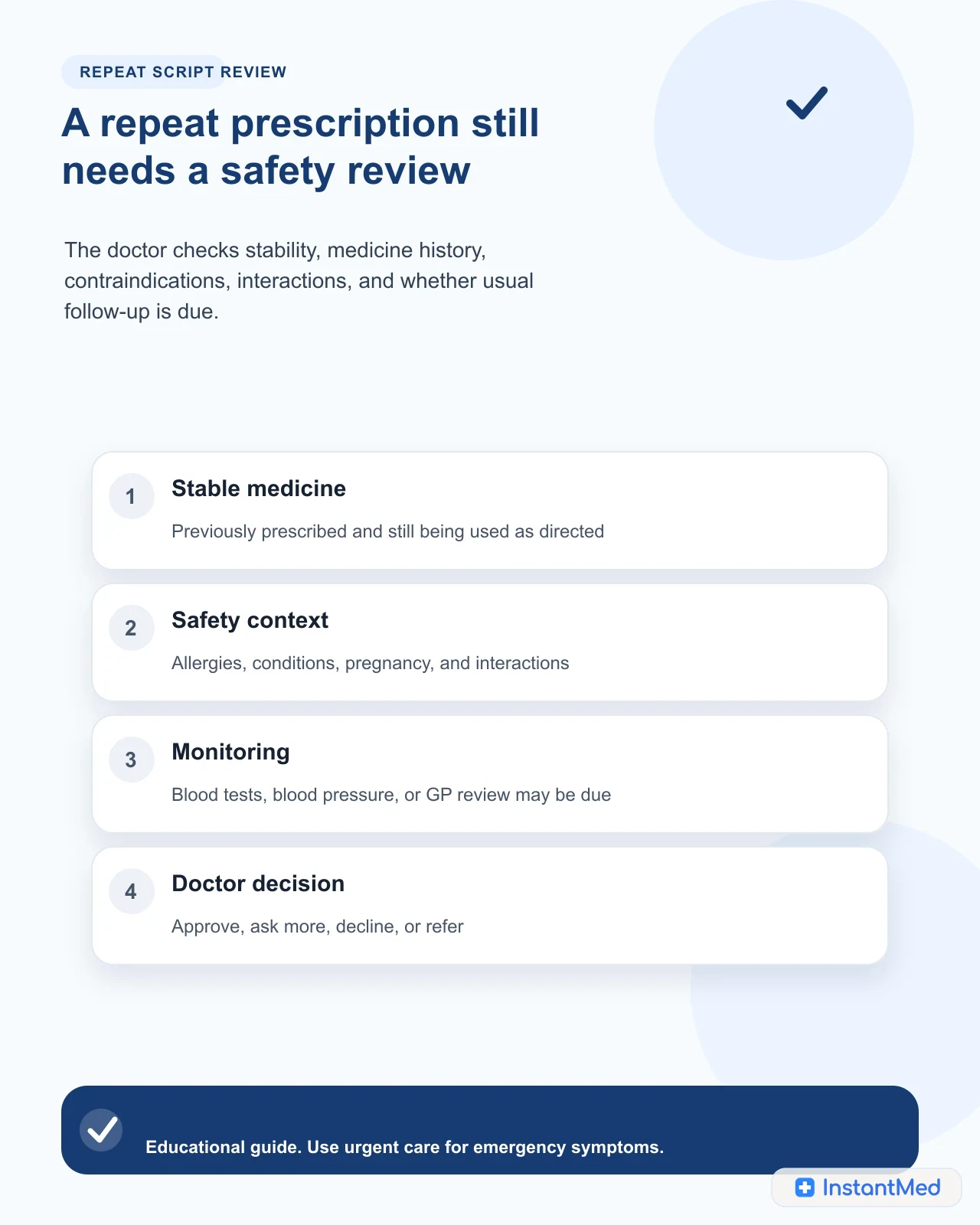
Running low on your regular medication? Learn how to get a repeat prescription online through an Australian telehealth doctor, including what medications qualify and how eScripts work.
InstantMed Medical Team
10 min read
How eScripts Work in Australia: Electronic Prescriptions Explained
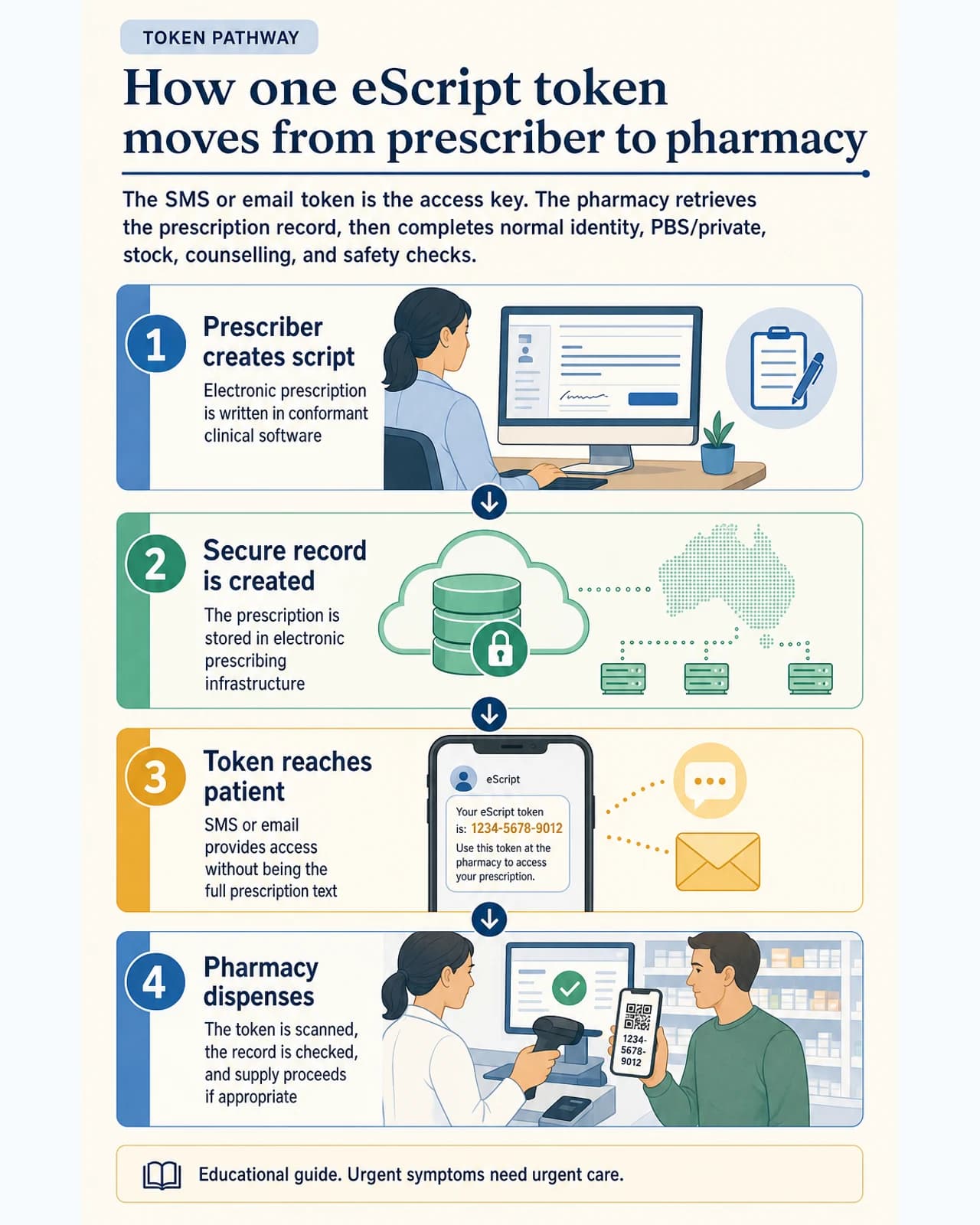
Australian eScripts can be delivered as SMS or email tokens or managed through an Active Script List. Learn what the pharmacy sees, how repeats work, when paper still matters, and what to do if a token is lost.
InstantMed Medical Team
7 min read
Renewing a Prescription Online in Australia
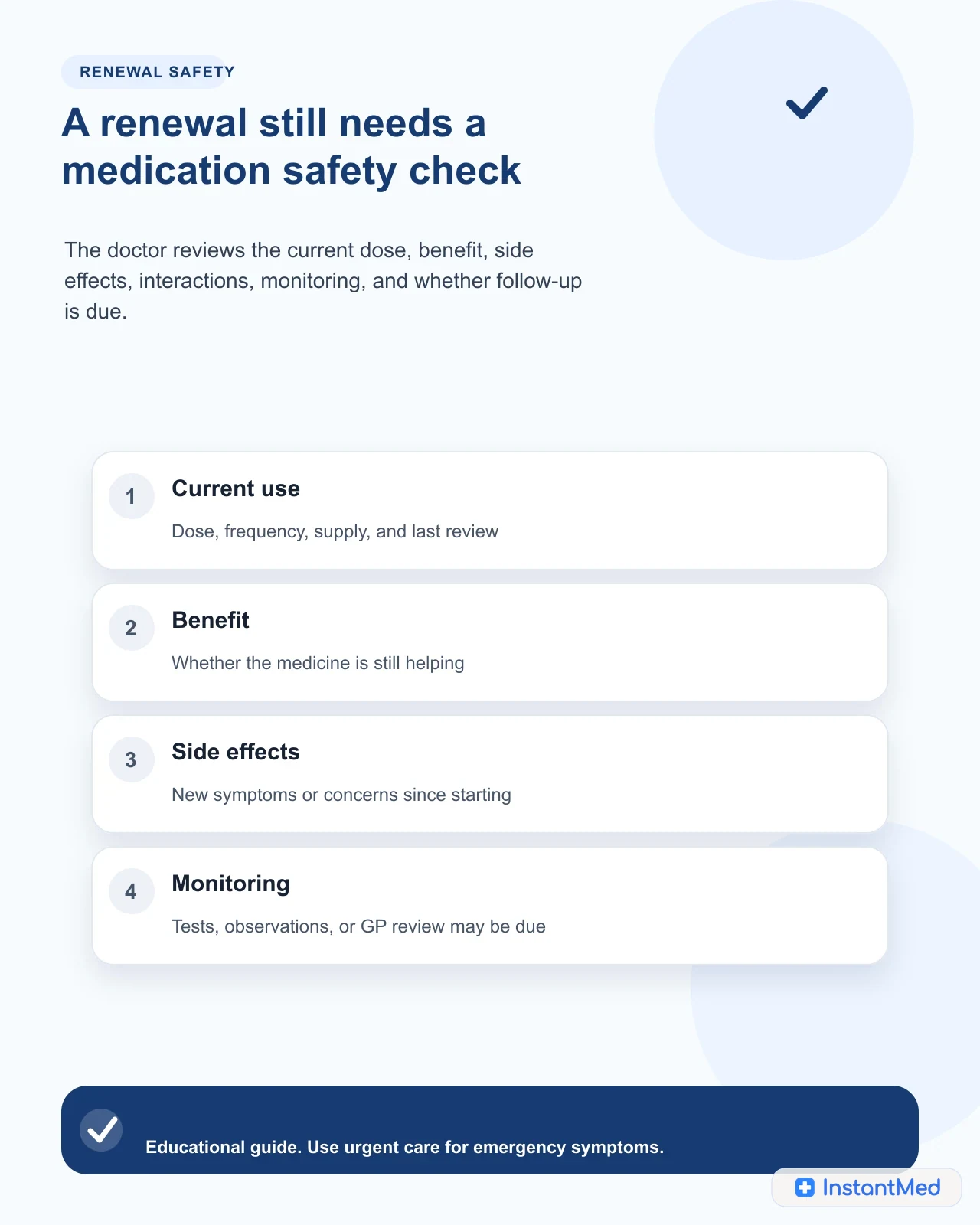
Prescription renewals are one of the most appropriate uses of telehealth. If you are on a stable medication and need a new script, an AHPRA-registered doctor can review your case and issue an eScript the same day. Here is how it works.
InstantMed Medical Team