Loading article
Back to Health Guides
Medications That Cannot Be Prescribed Online
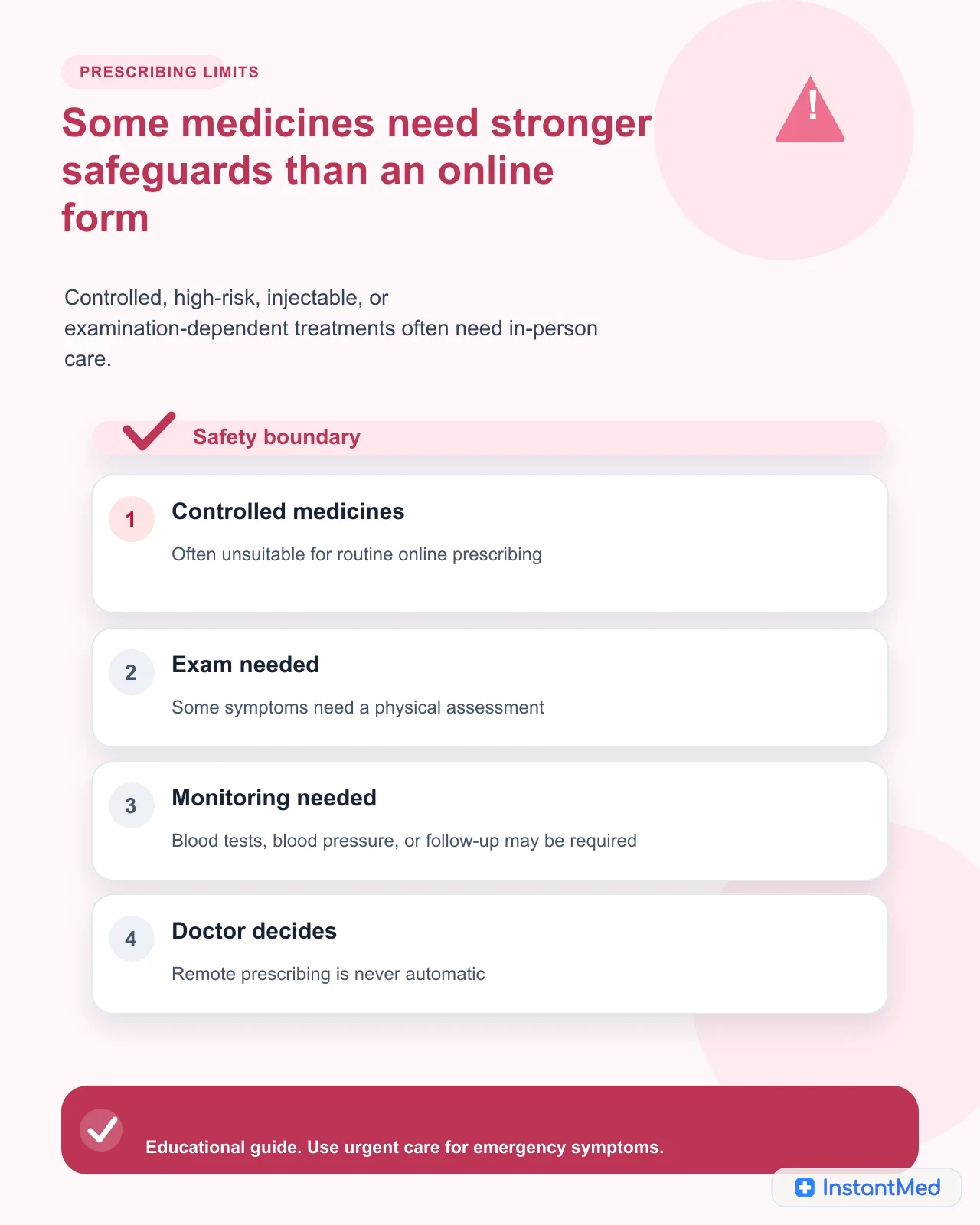
Why some medications require in-person assessment, how the TGA scheduling system works, and what to do when telehealth is not the right pathway.
8 min read
·Updated 4 June 2026
·Doctor Reviewed
AHPRA Verified
In this article
- 1The TGA Scheduling System
- 2Schedule 8 Medications: Cannot Be Prescribed via Telehealth
- 3New Medications Requiring In-Person Assessment
- 4Medications Requiring Recent Monitoring Results
- 5What Telehealth Can Prescribe
Medical information only. This article is for general information and does not constitute medical advice. Treatment decisions are made by an AHPRA-registered doctor after reviewing your circumstances.
Review
InstantMed Clinical Team
Clinical governance review for guide content
Updated
4 June 2026
General information only, not personal medical advice.
Jump to section
1The TGA Scheduling System2Schedule 8 Medications: Cannot Be Prescribed via Telehealth3New Medications Requiring In-Person Assessment4Medications Requiring Recent Monitoring Results5What Telehealth Can Prescribe6When Telehealth Declines Your Request7Where to look a medicine up8Sources Used In This Guide
Telehealth prescribing works well for a large proportion of common medications. For established patients with stable conditions, a repeat prescription for a blood pressure medication, contraceptive pill, or antidepressant can be issued after a remote clinical review without any loss in safety or quality.
But some medications cannot be prescribed via telehealth, and understanding why - not just which ones - is important for anyone relying on online healthcare services. The restrictions are grounded in patient safety, regulatory requirements, and clinical logic.
The TGA Scheduling System
The Therapeutic Goods Administration (TGA) maintains the Standard for the Uniform Scheduling of Medicines and Poisons (the Poisons Standard), which classifies all medicines and poisons into schedules based on risk of harm, potential for misuse, and necessity for professional supervision.
The schedules most relevant to prescribing are:
Schedule 4 (Prescription Only Medicine): Requires a prescription from an authorised prescriber. Most common medications - antibiotics, antihypertensives, antidepressants, and thousands of others - are Schedule 4. These can be prescribed via telehealth, subject to clinical appropriateness.
Schedule 8 (Controlled Drug): Drugs with high potential for misuse or dependence. Opioid analgesics, stimulants, and some other substances. These have significant additional regulatory requirements beyond a standard prescription.
Under the TGA's Poisons Standard, the regulations for Schedule 8 medicines require in-person assessment in most circumstances, and state and territory legislation adds further requirements including real-time prescription monitoring and, for some substances, specialist prescribing authorities.
Schedule 8 Medications: Cannot Be Prescribed via Telehealth
The following categories of Schedule 8 medications generally cannot be prescribed via asynchronous telehealth:
Opioid analgesics: Morphine, oxycodone, hydromorphone, fentanyl, codeine products above Schedule 3 thresholds, buprenorphine (for pain - separate rules apply for opioid dependence treatment). These require in-person assessment, ongoing monitoring, and compliance with state real-time prescription monitoring systems (RTPM) including SafeScript (Victoria), DORA (Queensland), and similar systems in other states.
ADHD stimulants: Dextroamphetamine (Dexedrine), methylphenidate (Ritalin, Concerta), lisdexamfetamine (Vyvanse). In most Australian states, ADHD stimulant prescribing requires specialist (psychiatrist or paediatrician) initiation and ongoing review. GP continuation prescribing requires a valid specialist recommendation and, in some states, a specific prescribing authority.
Benzodiazepines (in most circumstances): Diazepam, alprazolam, temazepam, and other benzodiazepines are Schedule 4 in standard form but are treated as S8-equivalent in many states for prescribing purposes given their high dependence potential. Most Australian states require careful documentation, limited quantities, and in-person review for benzodiazepine prescribing to new patients.
Gamma-hydroxybutyrate (GHB) and similar: Rarely encountered in clinical practice but strictly controlled.
Important Warning
Real-time prescription monitoring (RTPM) systems are now active in all Australian states and territories. Every S8 prescription is recorded in the state database, and pharmacists and prescribers can see a patient's S8 prescription history. These systems were implemented specifically to identify dangerous prescribing patterns. Any telehealth service that claims to prescribe S8 medications remotely without proper clinical oversight is operating outside legal and ethical boundaries.
New Medications Requiring In-Person Assessment
Beyond controlled substances, several other prescribing situations require in-person assessment:
First prescriptions for new conditions: A medication being prescribed for the first time for a condition the patient has not been diagnosed with requires a full clinical assessment. Telehealth is not the appropriate pathway for initiating treatment for an undiagnosed condition, because the diagnosis itself requires clinical examination or investigation that cannot be performed remotely.
Medications requiring physical examination to initiate:
- Isotretinoin (Accutane, Roaccutane): Requires dermatologist initiation, ongoing monitoring, and strict iPLEDGE-equivalent pregnancy prevention program in Australia. Cannot be initiated via telehealth.
- Clozapine (antipsychotic): Requires specialist initiation with regular mandatory blood monitoring. Cannot be initiated via telehealth.
- Biologics for autoimmune conditions (adalimumab, etanercept, etc.): Specialist initiation required, cannot be prescribed via telehealth.
- Warfarin initiation: While repeat prescriptions for stable patients are appropriate via telehealth, initiating warfarin requires INR monitoring infrastructure.
Medications Requiring Recent Monitoring Results
Some medications are appropriate for telehealth renewal but only where relevant monitoring results are available and within acceptable timeframes:
| Medication category | Monitoring required | Typical interval |
|---|---|---|
| Levothyroxine (thyroid) | Thyroid function tests (TFTs) | Every 6-12 months |
| Metformin / SGLT2 inhibitors | HbA1c, renal function | Every 3-6 months |
| ACE inhibitors / ARBs | Electrolytes, renal function | Annually or more frequently |
| Statins (high-dose) | Liver function, CK if symptoms | Annually |
| Lithium | Serum lithium level, renal, thyroid | Every 3-6 months |
| Methotrexate | FBC, liver function | Every 1-3 months depending on dose |
A responsible telehealth doctor will ask about recent test results before renewing these medications, and may decline to renew if results are overdue. This is appropriate clinical practice, not an obstacle.
Medication reviews are a standard component of chronic disease management, and monitoring intervals for many medications are specified in evidence-based clinical guidelines such as the RACGP's guidance and Therapeutic Guidelines.
What Telehealth Can Prescribe
To balance the above, the extensive range of medications appropriate for telehealth prescribing includes:
Antibiotics: For urinary tract infections, respiratory tract infections (where bacterial cause is likely), skin infections, sexually transmitted infections (some), and other conditions where remote assessment is clinically adequate. Note that antibiotic stewardship principles apply - doctors are not obligated to prescribe antibiotics when the clinical evidence does not support it.
Decision tree
A clinician weighs the request, risk factors, available history, and whether follow-up is adequate.
Cardiovascular medications (renewals): Antihypertensives, statins, antiplatelet medications for established patients.
Endocrine (renewals): Metformin and other type 2 diabetes medications, levothyroxine for thyroid issues (where recent TFTs are available), contraceptives.
Mental health medications (renewals): SSRIs, SNRIs, and other antidepressants for established patients with depression; mood stabilisers for stable patients with monitoring current.
Respiratory: Inhaled corticosteroids, bronchodilators, intranasal corticosteroids.
Skin conditions: Topical corticosteroids, antifungals, some antibiotics.
Contraception: Combined oral contraceptives, progestogen-only pill, emergency contraception.
The key limiting factors are: the medication must be for an established condition, the patient must be a known user of the medication (not a first prescription), and no monitoring requirements have been missed.
When Telehealth Declines Your Request
If a telehealth service declines a prescription request, the declination message will typically explain why and recommend the appropriate next step. Common guidance includes:
- "See your GP for an in-person consultation to obtain this prescription"
- "This medication requires monitoring results before renewal - please provide recent test results or see your GP for updated tests"
- "This is a controlled substance requiring in-person assessment"
Follow this guidance. Attempting to obtain controlled substances through multiple telehealth services is identifiable through RTPM systems and is not a clinically safe or legally appropriate approach. The in-person requirement exists for patient safety reasons that are not arbitrary.
Your regular GP is the appropriate starting point for medications that require in-person assessment.
Where to look a medicine up
Free, government-backed consumer medicine information is available if you want to check a medication before contacting a telehealth service. Healthdirect publishes plain-English medicines information and explains how to read the Consumer Medicine Information (CMI) - the patient-facing summary of what a medicine is, how to use it, and what to watch for. The TGA's scheduling information explains which schedule a medicine sits in and why that matters.
The former NPS MedicineWise service closed at the end of 2022; its Medicine Finder and quality-use-of-medicines resources have since moved to the Australian Commission on Safety and Quality in Health Care and Healthdirect.
If you are uncertain whether a medication can be prescribed via telehealth, checking its schedule and CMI is a reliable starting point.
Sources Used In This Guide
- TGA: Scheduling basics - the Poisons Standard and medicine schedules
- Medical Board of Australia: Telehealth consultations with patients
- RACGP: Telehealth
- Healthdirect: Medicines
- Australian Commission on Safety and Quality in Health Care: Medication safety
- Ahpra: Register of practitioners
Frequently Asked Questions
Why can't some medications be prescribed online?
Restrictions exist for patient safety and regulatory compliance. Some medications have a high potential for misuse or dependence (controlled drugs), require examination findings that can only be obtained in person, or have safety monitoring requirements that cannot be met via telehealth. The Therapeutic Goods Administration's Poisons Standard governs scheduling, and state legislation adds further requirements for some substances.
What are Schedule 8 medications?
Schedule 8 medications are Controlled Drugs under the Therapeutic Goods Administration (TGA) Standard for the Uniform Scheduling of Medicines and Poisons. They include opioid analgesics (morphine, oxycodone, fentanyl), ADHD stimulants (dextroamphetamine, methylphenidate), benzodiazepines in some contexts, and other substances with significant dependence potential. Prescribing these requires in-person assessment, state registration as an S8 prescriber in many cases, and adherence to state-specific real-time prescription monitoring.
Can I get a new medication prescribed online?
Generally no. A first prescription for a medication you have never taken before requires a full clinical assessment. Telehealth is appropriate for renewing established medications, not initiating new pharmacological treatment for undiagnosed conditions. There are exceptions for some telehealth-specific services (e.g., initiated treatment for erectile dysfunction after a structured clinical intake) but the general rule holds.
What if I need a controlled substance and have a valid reason?
You will need to see a GP in person. For some controlled substances (opioids for chronic pain, ADHD stimulants), specialist assessment is also required in most states. These are regulatory requirements, not arbitrary restrictions. Your GP can assess your needs, initiate the prescription if appropriate, and arrange the necessary approvals.
Are antibiotics available via telehealth?
Yes, for most common antibiotic-treated conditions. A telehealth doctor can prescribe antibiotics for urinary tract infections, some skin infections, respiratory tract infections, and other conditions where the clinical picture supports antibiotic therapy and no examination is needed to make that determination. Antibiotic stewardship principles still apply - telehealth doctors are not obligated to prescribe antibiotics on demand.
InstantMed Medical Team
Related Articles
8 min read
How to Get a Repeat Prescription Online in Australia
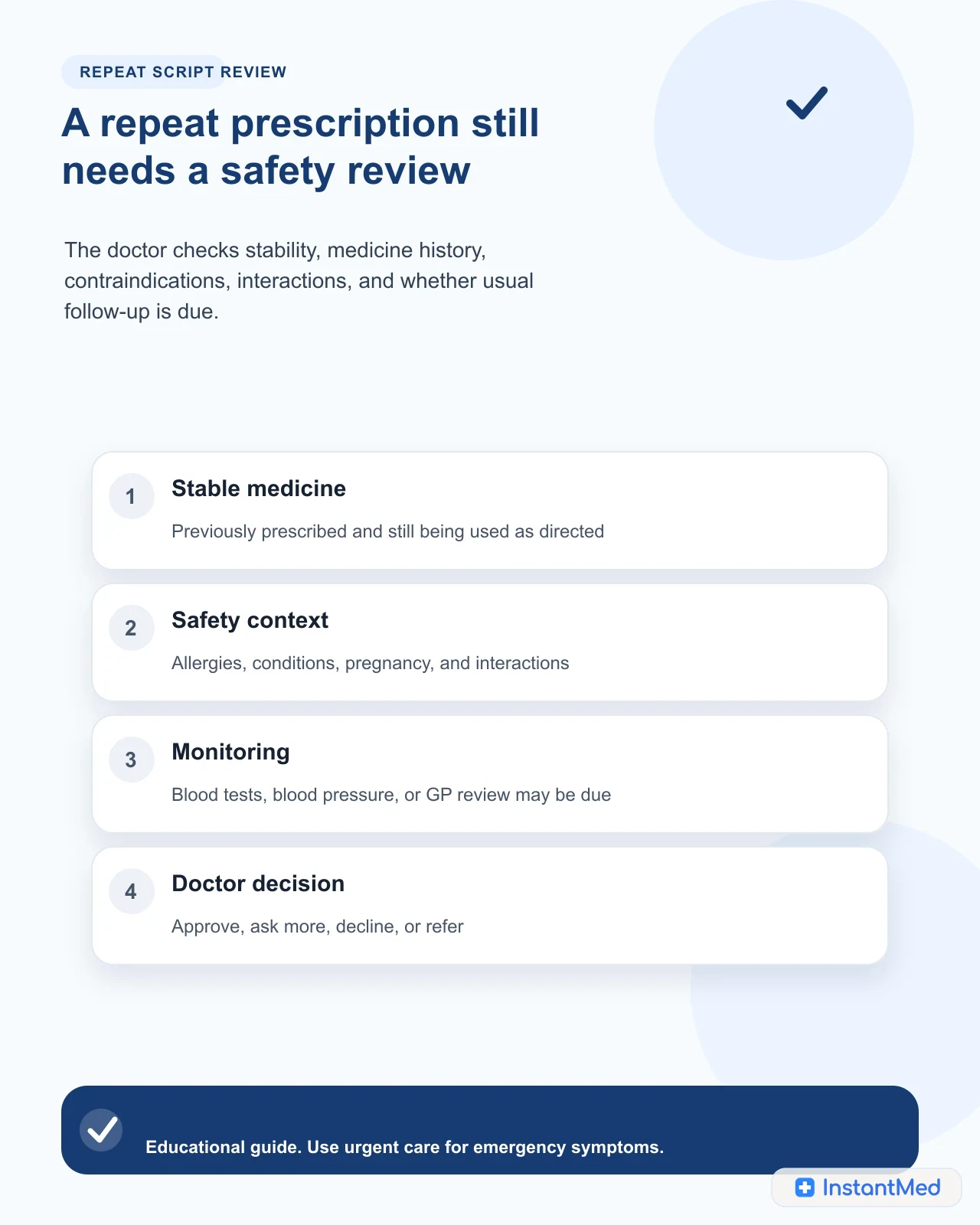
Running low on your regular medication? Learn how to get a repeat prescription online through an Australian telehealth doctor, including what medications qualify and how eScripts work.
InstantMed Medical Team
8 min read
How to Get a Prescription Online in Australia
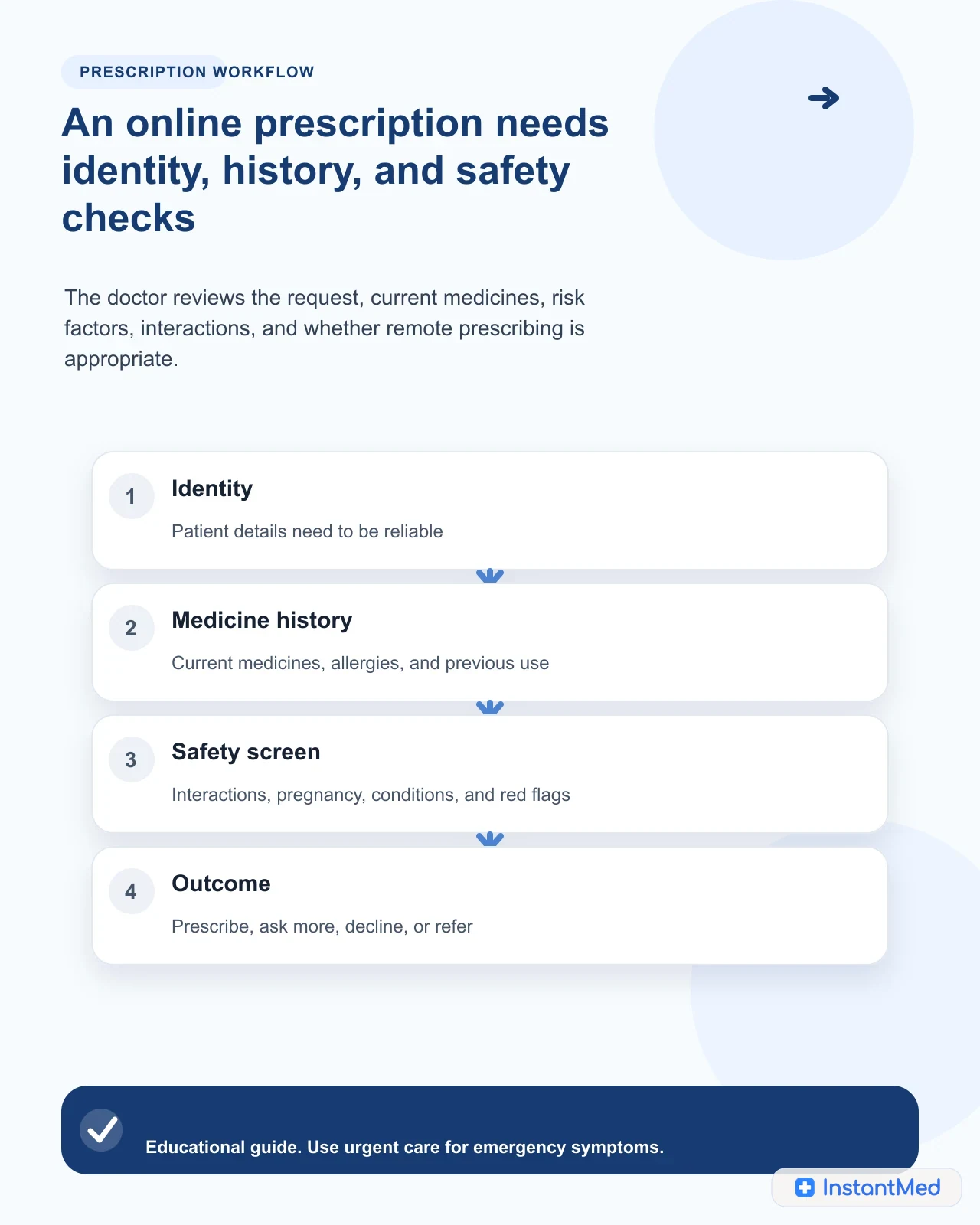
Online prescriptions are legal and safe when issued by AHPRA-registered doctors following Australian prescribing standards. This guide covers the full process, from submitting your request to filling your eScript at any pharmacy.
InstantMed Medical Team

11 min read
Can You Get Antibiotics Online in Australia?
Antibiotics are prescription-only in Australia. Learn how online prescribing works, when a pharmacist can help with a UTI, what PBS costs in 2026, and which symptoms need in-person care.
InstantMed Medical Team