Loading article
Back to Health Guides
Best Online Doctor Services in Australia: How to Compare Them
A practical guide to choosing between video telehealth, phone consults, asynchronous reviews, GP booking platforms, and specialist online clinics.
9 min read
·Updated 10 May 2026
·Doctor Reviewed
AHPRA Verified

In this article
- 1The Five Main Online Doctor Models
- 2Start With Clinical Fit
- 3Check Who Is Actually Reviewing You
- 4Understand the Telehealth Standard
- 5Compare Pricing Without Getting Tricked
Medical information only. This article is for general information and does not constitute medical advice. Treatment decisions are made by an AHPRA-registered doctor after reviewing your circumstances.
Review
InstantMed Clinical Team
Clinical governance review for guide content
Updated
10 May 2026
General information only, not personal medical advice.
Key Information
The best online doctor service is the one that matches the clinical problem. A cheap, fast service is poor value if the symptoms need a physical examination, urgent care, or continuity with your usual GP.
Australian telehealth is no longer a pandemic workaround. It is now part of mainstream healthcare, with Medicare-supported telehealth continuing for eligible services and private telehealth providers covering many one-off and specialised needs. That maturity helps patients, but it also makes the market harder to read.
Some services are live video clinics. Some are phone-first. Some use structured questionnaires reviewed by a clinician. Some are booking platforms for your existing GP. Some focus on one narrow treatment area. A good comparison starts with the model, not the marketing.
This guide does not rank providers or pretend one brand is best for every situation. It gives you the framework to choose safely.
The Five Main Online Doctor Models
Most Australian online doctor services fall into one of five models.
Video telehealth is a live appointment by video. It is useful when new symptoms need back-and-forth discussion or when visual context helps the doctor. It is not enough for emergencies or symptoms that need a hands-on examination.
Phone telehealth is a live appointment by phone. It can work for follow-up care, medication review, and simple history-based issues. It is weaker for rashes, eye symptoms, severe pain, breathing issues, and anything where the doctor needs to see or examine you.
Asynchronous review means you submit a structured form and a clinician reviews it later. It can suit low-risk requests with clear criteria. It is a poor fit for unclear, severe, rapidly changing, or complex symptoms.
GP booking platforms connect you with your usual clinic or a broader GP network. They are strongest when continuity matters: chronic disease, results follow-up, medication monitoring, and care where the doctor benefits from your existing record.
Specialist digital clinics focus on one condition area or treatment pathway. They can be useful for ongoing monitoring in a narrow scope. They should not be treated like a general GP for acute uncertainty or unrelated symptoms.
None of these models is automatically superior. Each has a different safety boundary.
Video and phone services give the doctor real-time interaction. That matters when the story is unclear, when the doctor needs to challenge an assumption, or when a patient may not know which details are clinically important.
Asynchronous review can be efficient for simple, low-risk requests, but it depends heavily on the quality of the intake questions and the clinician's willingness to decline unsuitable cases.
Your usual GP remains the strongest option for continuity: chronic conditions, complicated medication decisions, mental health plans, abnormal test results, pregnancy-related issues, and symptoms that keep recurring.
Specialist digital clinics can be useful when a condition needs ongoing monitoring and the pathway is narrow enough to be managed safely online. The trade-off is scope. A narrow clinic should not be treated like a general GP.
Start With Clinical Fit
Before comparing price or speed, ask: can this problem be assessed safely without being in the same room as the doctor?
Telehealth may be reasonable for:
- Administrative health documentation after a genuine assessment
- Stable repeat medication questions where history is clear
- Follow-up discussions where the clinician already has context
- Some low-risk infections or symptom patterns where remote assessment is accepted
- Mental health discussions when the patient is safe and the service has escalation pathways
- Specialist pathways that include screening, monitoring, and follow-up
Telehealth is the wrong first step for:
- Chest pain, severe shortness of breath, stroke symptoms, collapse, or severe allergic reaction
- Severe pain, rapidly worsening symptoms, confusion, fainting, or signs of sepsis
- Eye pain, vision change, significant injury, deep wounds, or burns
- New neurological symptoms such as weakness, slurred speech, or new seizure
- Pregnancy symptoms such as bleeding, severe abdominal pain, severe headache, or reduced fetal movement
- Children with significant acute illness, dehydration, breathing difficulty, or high fever
Important Warning
If symptoms could be urgent, do not compare telehealth providers. Call 000 or seek urgent in-person care. A good online service should redirect unsafe presentations, not try to keep the request online.
Check Who Is Actually Reviewing You
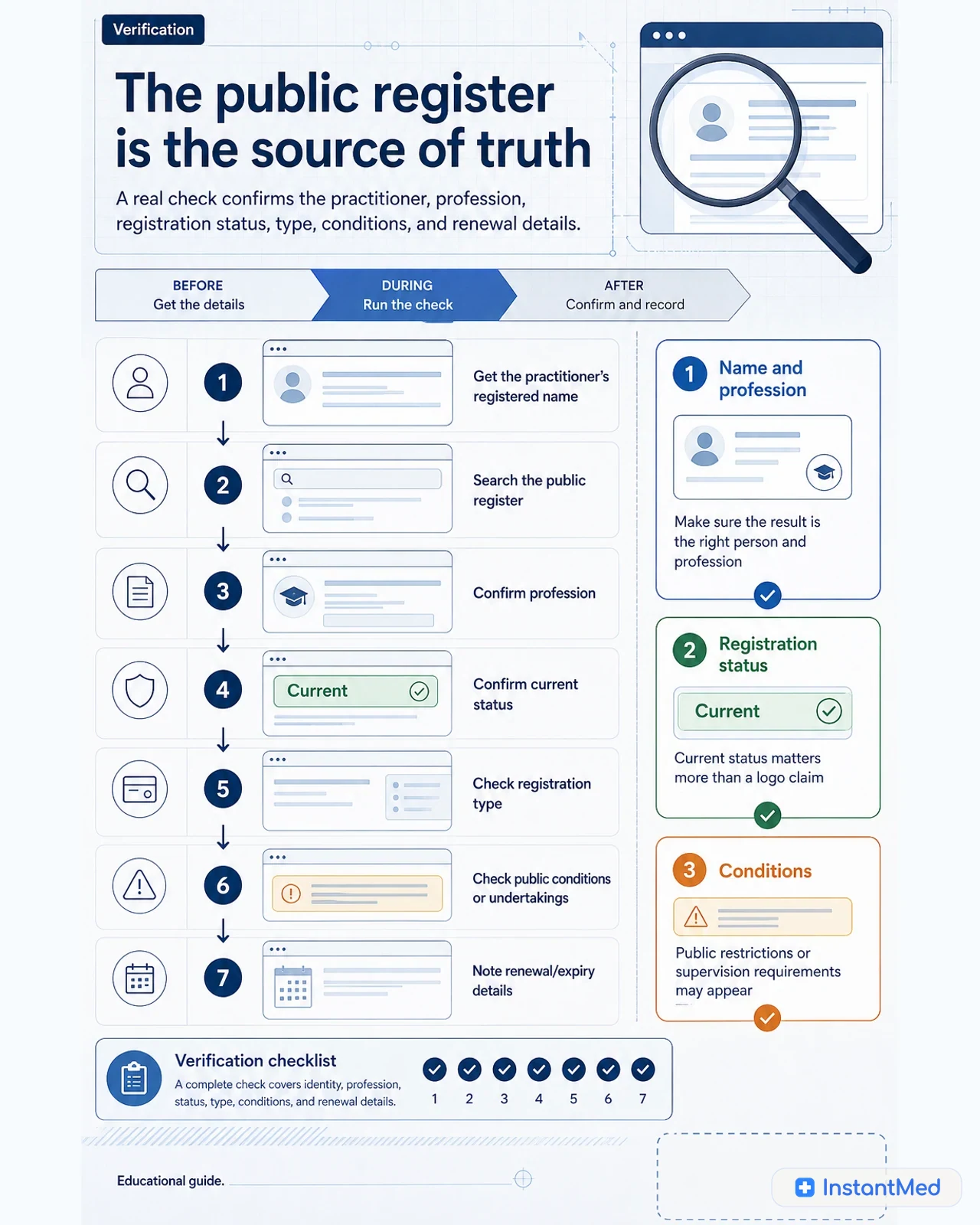
In Australia, the important trust signal is not a badge on the homepage. It is whether the practitioner is appropriately registered and accountable under AHPRA and the Medical Board of Australia.
Use the AHPRA public register to check a clinician's registration when a service gives you their name. The register can show profession, registration type, registration status, conditions, and other public details. For doctors, registration is regulated through AHPRA and the Medical Board of Australia.
A credible service should make it clear:
- Whether a doctor, nurse practitioner, pharmacist, or other practitioner is reviewing you
- Whether practitioners are registered in Australia
- Whether the practitioner can be identified on clinical documents
- What happens if the request is not clinically appropriate
- How follow-up or escalation works
Avoid services that hide who provides the care, imply approval by a regulator that does not approve clinics, or guarantee a prescription or certificate before assessment. Ahpra registers individual practitioners. It does not make a telehealth brand automatically safe.
Understand the Telehealth Standard
The Medical Board of Australia's telehealth guidance is built around a simple principle: telehealth is still medical practice. The standard of care does not drop because the consultation happens by phone, video, internet, or other technology.
That means the clinician still needs enough information to:
Safety checks
Registration, clinician identity, pricing, refund rules, privacy, and escalation pathways should be clear.
- Confirm they are dealing with the right patient
- Take an adequate history
- Consider relevant risk factors, medicines, allergies, and red flags
- Decide whether remote assessment is suitable
- Prescribe, certify, refer, or advise only when clinically justified
- Keep proper records
- Arrange follow-up or escalation when needed
For patients, this means a service asking more clinical questions is usually safer than one asking fewer. Fast is helpful only after the clinical basics are covered.
Compare Pricing Without Getting Tricked
Telehealth pricing can look simple until you check the details. Compare the total cost, not just the headline price.
Look for:
- Consultation fee
- Whether the fee is private, bulk billed, or Medicare-rebatable
- Whether payment is charged before or after clinical review
- Refund policy if the request is declined
- Prescription, pharmacy, delivery, or medicine costs
- Subscription terms and cancellation rules
- Fees for follow-up, repeats, documents, or priority handling
Subscription clinics can be good value for ongoing monitored care. They are usually poor value for a one-off problem. A private one-off fee can be reasonable when you need a single assessment and do not want an ongoing plan. Bulk billing can be best value if you are eligible and the appointment is available when you need it.
The failure mode is paying for the wrong model: a subscription for a one-off need, an asynchronous review for a complex presentation, or a cheap service that declines without a clear refund policy.
Privacy And Records Matter
Health information is sensitive. A serious online doctor service should treat privacy as core infrastructure, not a footer link.
Check whether the service explains:
- What information is collected
- Who can access it
- Whether information is stored in Australia
- How clinical notes are handled
- Whether information is shared with pharmacies, pathology, insurers, employers, or marketing tools
- How you can request access to your records
- How identity is verified
Be wary of healthcare flows that feel like ordinary ecommerce. A medical request is not the same as buying a product. Advertising pixels, vague consent language, and unclear practitioner accountability are all warning signs.
How To Choose By Situation
Use the problem type to narrow the model.
If you need your usual doctor involved: use your regular GP via clinic telehealth where available. They know your history, current plan, results, and past treatment decisions.
If you have a new symptom and feel unsure: use video or phone telehealth, or see a GP in person. Real-time questions reduce missed context.
If you have a simple administrative request: structured telehealth review may be enough if the history is clear and there are no red flags.
If you need ongoing treatment monitoring: use a specialist clinic or your usual GP. Follow-up, records, and continuity matter more than speed.
If you need a repeat medication reviewed: use your usual GP or a telehealth service that asks for medication history, indication, allergies, side effects, monitoring, and recent changes.
If you have red-flag symptoms: use urgent in-person care. Remote assessment is not the limiting step.
Questions To Ask Before You Pay
The useful comparison questions are practical:
- Is this model appropriate for my symptoms?
- Is the clinician registered and identifiable?
- Does the service explain when it will decline or refer?
- Is the total price clear before I submit?
- Is there a refund if the clinician cannot safely provide what I requested?
- Does the service avoid guarantees before assessment?
- Does it give me a record of the consultation or outcome?
- Can I contact someone if there is a problem with the document, prescription, or advice?
- Does the privacy policy explain how health information is handled?
- Is my usual GP a better option for this issue?
Fit check
Telehealth works best when the clinical problem can be assessed safely without a physical examination.
If a service fails several of those checks, the problem is not just user experience. It is clinical governance.
The Bottom Line
The safest way to compare online doctor services is to stop asking which brand is best and start asking which model fits the clinical job.
Use your regular GP when continuity matters. Use video or phone when the story needs real-time discussion. Use asynchronous review only when the request is simple, low-risk, and the service has a clear safety boundary. Use specialist digital clinics when you want structured ongoing care for the condition they actually cover.
Good telehealth is not the fastest path to a script or certificate. It is the right clinical channel for the right problem, with an accountable registered practitioner and a service that is willing to say no when remote care is unsafe.
Sources
- Medical Board of Australia: Guidelines for telehealth consultations with patients
- Ahpra: Register of practitioners
- Australian Government Department of Health: AskMBS advisory on eligible telehealth practitioner requirements
- MBS Online: Continuing MBS telehealth services fact sheet
- Services Australia: Bulk billing
Frequently Asked Questions
What is the best online doctor service in Australia?
There is no single best service for every patient. A video or phone consult is better when the doctor needs real-time conversation. An asynchronous review may suit simple, low-risk requests. Your regular GP is usually best for ongoing or complex care. Urgent symptoms should be assessed in person or through emergency care.
Are online doctors legitimate in Australia?
Telehealth can be legitimate when care is provided by appropriately registered health practitioners who follow Australian professional standards. Check the practitioner's registration on the Ahpra public register and use services that clearly explain who reviews your request.
Should I choose video, phone, or form-based telehealth?
Choose based on clinical need. Video or phone works better for uncertainty, follow-up questions, mental health concerns, and complex medication decisions. Form-based review may suit straightforward requests where a structured history gives enough information. Physical symptoms that need examination are not good candidates for remote-only care.
Can online doctors prescribe medicine?
Doctors can prescribe through telehealth when it is clinically appropriate and legally permitted. The prescribing decision still requires adequate assessment, medication history, allergy history, and a judgement about whether in-person review is needed. Some medicines and situations are not suitable for online prescribing.
Do online doctor services bulk bill?
Some telehealth appointments connected to your regular GP or eligible Medicare services may be bulk billed. Many private online services charge an upfront private fee. Always check the fee, refund policy, Medicare requirements, and whether pharmacy or medicine costs are separate.
InstantMed Medical Team
Related Articles
10 min read
What AHPRA-Registered Means for Doctors in Australia
AHPRA registration is a live, checkable status on the national register. Learn what to verify before relying on a doctor's credentials.
InstantMed Medical Team

9 min read
How Doctors Review Online Medical Requests
Online medical forms can help collect history, but they are not a substitute for clinical judgment. Learn how doctors review telehealth requests, what information matters, and when real-time or in-person assessment is required.
InstantMed Medical Team
10 min read
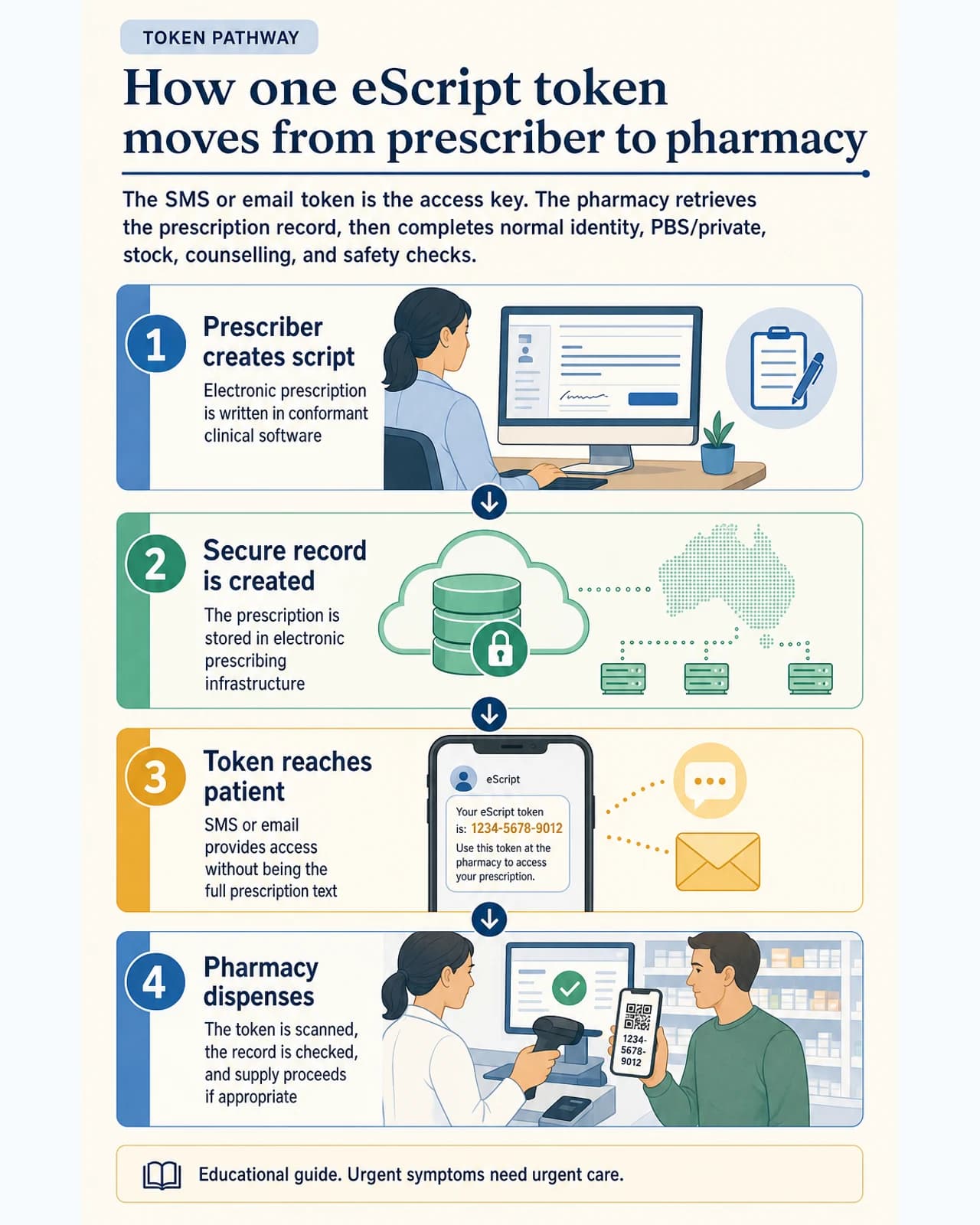
How eScripts Work in Australia: Electronic Prescriptions Explained
Australian eScripts can be delivered as SMS or email tokens or managed through an Active Script List. Learn what the pharmacy sees, how repeats work, when paper still matters, and what to do if a token is lost.
InstantMed Medical Team