Loading article
Back to Health Guides
Is Telehealth Legal in Australia?
How online consultations, medical certificates, eScripts, registration, privacy, and prescribing rules fit within Australian healthcare law.
11 min read
·Updated 7 July 2026
·Doctor Reviewed
AHPRA Verified
In this article
- 1The practical answer
- 2What laws and rules sit behind telehealth
- 3Practitioner registration is the starting point
- 4The clinical standard still applies
- 5Are online medical certificates legal?
Medical information only. This article is for general information and does not constitute medical advice. Treatment decisions are made by an AHPRA-registered doctor after reviewing your circumstances.
Review
InstantMed Clinical Team
Clinical governance review for guide content
Updated
7 July 2026
General information only, not personal medical advice.
Jump to section
1The practical answer2What laws and rules sit behind telehealth3Practitioner registration is the starting point4The clinical standard still applies5Are online medical certificates legal?6Are eScripts legal?7Medicines law still matters8Medicare and private telehealth are separate issues9Patient rights and privacy still apply10How to check whether a telehealth service is legitimate11When to be cautious12Related guides13Sources
Telehealth is legal in Australia, but "legal" does not mean every online request can be approved. The consultation still has to be real healthcare: an appropriately registered practitioner, enough clinical information, privacy and records, a suitable problem, and a lawful outcome.
The safest way to think about telehealth law is simple: the channel can be online, but the professional obligations do not disappear.
The practical answer
There is no separate "online doctor licence" in Australia. Telehealth sits inside the existing healthcare framework: practitioner registration, professional conduct, privacy law, medicines law, employment evidence rules, clinical records, and complaints pathways.
For patients, that means telehealth can be legitimate when:
- the practitioner is appropriately registered for the care being provided
- the patient is in a place where the practitioner can lawfully provide care
- the clinical problem can be assessed remotely
- the service verifies identity and contact details
- the patient understands the process, privacy limits, cost, and next steps
- prescriptions, certificates, referrals, and records are handled under the relevant rules
- the practitioner redirects care when telehealth is not enough
What laws and rules sit behind telehealth
The legal position is not one single law. Several overlapping rules matter.
| Area | What it controls | Why it matters for telehealth |
|---|---|---|
| Practitioner registration | Who can practise as a medical practitioner | Patients should be able to check whether the doctor is registered and accountable |
| Medical Board guidance | Professional obligations for doctors | Telehealth still needs consent, identity, privacy, records, clinical suitability, and follow-up |
| Privacy law | Handling of health information | Online forms, messages, images, prescriptions, and records need careful safeguards |
| Medicines and poisons law | What medicines can be prescribed and supplied | The electronic format does not remove medicine-specific restrictions |
| Electronic prescribing rules | How eScripts are created and dispensed | Tokens, compliant software, and pharmacy support are part of the prescription pathway |
| Workplace evidence rules | Evidence for sick or carer's leave | A certificate may support leave, but the evidence must satisfy the relevant test |
| Complaints pathways | How concerns are reviewed | Patients can raise practitioner, privacy, service, or workplace issues through different channels |
This is why broad statements like "telehealth is always valid" or "online certificates must always be accepted" are too loose. The better question is whether the online consultation and outcome meet the right standard for the situation.
Practitioner registration is the starting point
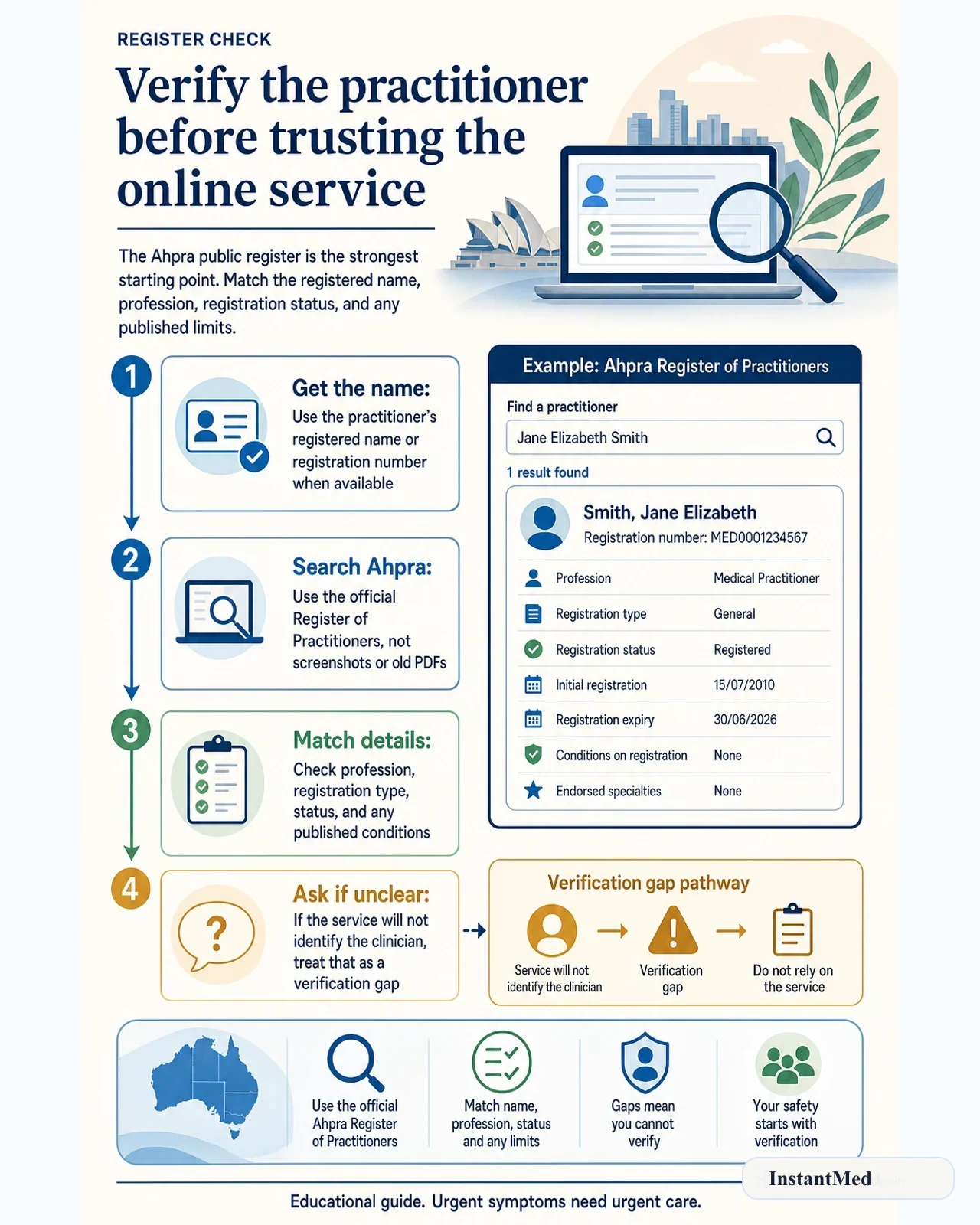
For medical care, the starting point is registration. Ahpra maintains the public Register of practitioners, including medical practitioners. The register is stronger evidence than a marketing badge because it shows current public registration information.
A legitimate Australian telehealth service should make practitioner accountability clear. It does not need to turn a public website into a doctor directory, but the patient should not be left unable to identify who is responsible for the clinical decision where that matters for care, documents, prescriptions, or complaints.
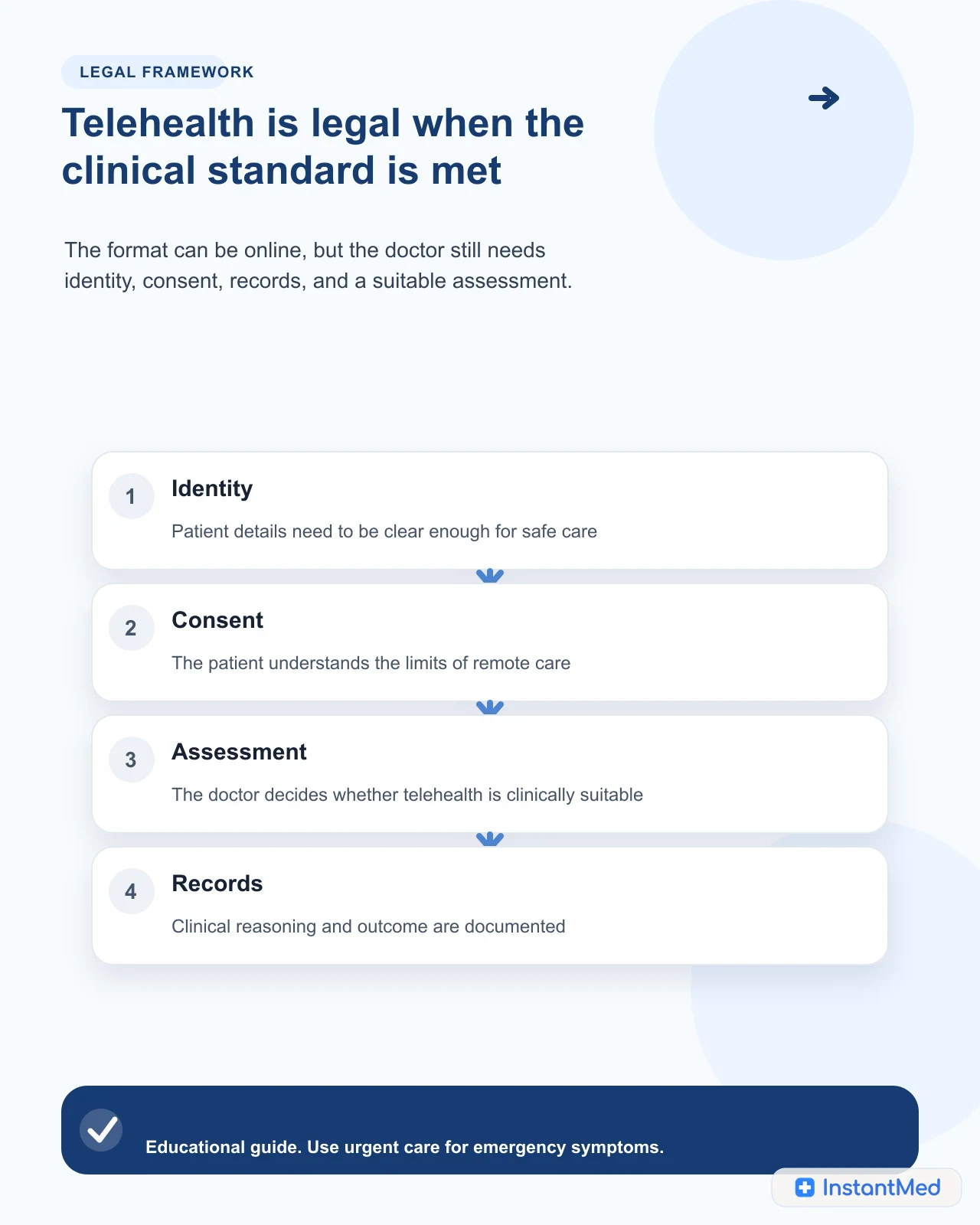
Registration alone is not enough. A registered doctor still needs a suitable process. The doctor must assess whether telehealth is appropriate, confirm identity as far as possible, document the consultation, and arrange follow-up or in-person care when needed.
The clinical standard still applies
The Medical Board's telehealth guidance says a doctor should tell the patient who they are, confirm the patient's identity to the best of their ability, obtain informed consent, protect privacy and confidentiality, and continuously assess whether telehealth remains appropriate.
That matters because legality is not just "a doctor clicked approve." The doctor remains responsible for evaluating the information used in assessment and treatment, even when some information comes from a questionnaire, uploaded image, third party, or previous record.
Safe telehealth can include phone, video, secure forms, messaging, images, or a mix. But the format has to give enough reliable information for the decision being made.
Are online medical certificates legal?
Online medical certificates can be valid evidence when they come from a registered medical practitioner after an appropriate assessment. The key issue is not whether the consultation happened online. The key issue is whether the evidence is credible and fit for the situation.
Fair Work says medical certificates and statutory declarations are examples of acceptable evidence for sick or carer's leave. It also says there are no strict rules about the type of evidence, but the evidence has to convince a reasonable person that the employee was genuinely entitled to the leave.
Clinical boundary
Severe symptoms, examination needs, identity uncertainty, or unsafe prescribing can move care offline.
That means a routine certificate from a telehealth doctor may support a simple sick leave request. It does not mean every online certificate must automatically settle every workplace dispute.
Factors that may matter include:
- whether the issuer is a registered practitioner
- whether the certificate identifies the patient and relevant dates
- whether the assessment was contemporaneous or delayed
- whether the requested use is routine sick leave, carer's leave, study evidence, insurance, court, or a safety-critical setting
- whether workplace policy, award, agreement, or law asks for a particular form of evidence
- whether the certificate appears altered, inconsistent, or incomplete
Are eScripts legal?
Yes. Electronic prescribing is a recognised digital health pathway in Australia. The Department of Health and Aged Care says electronic prescribing allows doctors, pharmacists, and patients to manage prescriptions without paper. A provider creates an electronic prescription using secure clinical software, and the patient receives a unique token, usually by SMS or email.
The Australian Digital Health Agency explains that the token is scanned by the pharmacist to access the electronic prescription from a secure prescription delivery service. A patient may also use an Active Script List in some cases.
The important distinction is that eScript legality is about the prescription format. It does not mean every medicine request should be approved online. The doctor still has to decide whether the medicine is clinically appropriate, whether the patient needs examination or monitoring, and whether state, territory, Commonwealth, PBS, or professional rules apply.
Medicines law still matters
Medicines and poisons are scheduled in Australia. The TGA explains that scheduling is a national classification system controlling how medicines and chemicals are made available to protect public health. The schedules are published in the Poisons Standard and given legal effect through state and territory legislation.
For telehealth, this creates several practical boundaries:
- some medicines are lower risk and may be suitable for remote prescribing when the history is clear
- some medicines need monitoring, pathology, blood pressure checks, pregnancy checks, specialist input, or continuity from a usual doctor
- some controlled or monitored medicines have extra restrictions
- state and territory rules can matter
- a doctor may decline even when a medicine is technically prescribable if remote assessment is not clinically safe
Avoid services that advertise prescription-only medicines as if they are ordinary retail products. The lawful pathway is assessment first, outcome second.
Medicare and private telehealth are separate issues
Telehealth can be lawful even when it is not bulk billed. Medicare eligibility is a funding question, not the only test of whether healthcare is legitimate.
Some telehealth consultations are Medicare-rebateable. Others are private services with transparent fees. A private fee does not make the service unlawful. The service should still be clear about cost, refunds or declines, privacy, practitioner accountability, and what happens if telehealth is unsuitable.
The reverse is also true: a service being cheap, fast, or bulk billed does not by itself prove clinical quality. The safety test still comes back to registration, assessment, records, privacy, and escalation.
Patient rights and privacy still apply
Telehealth does not remove patient rights. Health information is sensitive information, and a service should explain what it collects, why it collects it, who can access it, how it is protected, and how a patient can raise a concern.
Practical rights and protections may include:
- informed consent
- privacy and confidentiality
- access to records where applicable
- a complaints pathway
- the ability to seek urgent or in-person care when needed
- pharmacist checks before dispensing medicine
- workplace or Fair Work pathways for leave-evidence disputes
- Ahpra or state health complaints pathways for practitioner or service concerns
Be careful with services that ask for sensitive health details through ordinary public comments, social media messages, unsecured uploads, or unclear offshore forms.
How to check whether a telehealth service is legitimate
Use a simple pre-check before entering sensitive information.
Decision guide
Where telehealth legality fits
May fit telehealth
- The service is Australian-facing, the practitioner is accountable, the clinical issue is suitable for remote assessment, and the service has enough information to make a safe decision.
- Routine evidence, advice, follow-up, or lower-risk prescribing may be suitable when screening is complete and red flags are absent.
Needs in-person care
- The problem needs examination, vital signs, pathology, imaging, procedures, continuity from a treating clinician, or a document standard beyond what remote assessment can support.
- Identity, history, medicine details, or clinical context are too uncertain for a remote decision.
Urgent care
- Emergency symptoms, severe deterioration, severe pain, collapse, breathing trouble, stroke signs, severe allergic reaction, or other danger signs should bypass routine telehealth.
- Call 000 or use local urgent care for emergency symptoms.
Digital outcomes
Certificates need credible assessment evidence; eScripts need compliant software, a token, and pharmacy support.
Before using a service, check:
- 1
Is there a real Australian business name, ABN, contact pathway, privacy policy, terms, and complaints process?
- 2
Is practitioner accountability clear enough for care, documents, prescriptions, and complaints?
- 3
Does the service ask meaningful clinical questions before any outcome?
- 4
Does it explain that the doctor may ask for more information, decline, or redirect care?
- 5
Does it avoid guarantees about certificates, prescriptions, diagnosis, or approval?
- 6
Does it avoid advertising prescription-only medicines as products?
- 7
Does it explain costs before payment?
- 8
Does it handle health information in a secure and privacy-conscious way?
When to be cautious
Telehealth itself is not the problem. Poorly designed online healthcare is the problem.
Be cautious if a service:
- promises a prescription, certificate, or outcome before review
- hides who is clinically responsible
- skips identity, symptoms, medicines, allergies, and red-flag questions
- advertises controlled drugs or prescription-only medicines as easy online purchases
- has no clear privacy, complaints, refund, or contact pathway
- uses pressure tactics around payment or speed
- claims telehealth can replace every in-person assessment
- refuses to explain why a request was declined or redirected
The strongest legal signal is not a loud claim that something is "100% valid." It is a service that can show the normal healthcare obligations are being met.
Related guides
- Is telehealth safe in Australia?
- How telehealth safety screening works
- How to verify an online doctor
- Are online medical certificates valid in Australia?
Sources
- Medical Board of Australia: Telehealth consultations with patients
- Ahpra: Register of practitioners
- Fair Work Ombudsman: Notice and medical certificates
- Department of Health and Aged Care: Electronic prescribing
- Australian Digital Health Agency: Electronic prescriptions
- TGA: Scheduling basics of medicines and chemicals in Australia
- TGA: The Poisons Standard
- OAIC: Health information
Frequently Asked Questions
Is telehealth legal in Australia?
Yes. Telehealth is a lawful way to provide healthcare in Australia when the practitioner is appropriately registered, the consultation is clinically suitable, privacy and records are handled properly, and the practitioner follows relevant prescribing, Medicare, and state or territory requirements.
Are online medical certificates legal in Australia?
A medical certificate can be acceptable evidence when it is issued by a registered medical practitioner after an appropriate assessment. Fair Work says medical certificates and statutory declarations are examples of acceptable evidence, and that evidence must convince a reasonable person that the employee was genuinely entitled to sick or carer's leave.
Are eScripts legal in Australia?
Yes. Electronic prescribing is an Australian Government digital health initiative. A healthcare provider can create an electronic prescription using compliant clinical software, and the patient receives a token, usually by SMS or email, to present to a pharmacy that supports electronic prescriptions.
Can every medicine be prescribed by telehealth?
No. The prescription format may be electronic, but the doctor still has to decide whether remote prescribing is clinically appropriate and legally permitted. Medicine scheduling, state and territory laws, monitoring needs, and the need for examination can limit what can be prescribed online.
Is private telehealth legal if it is not bulk billed?
Yes. Medicare eligibility and legal healthcare delivery are separate questions. A private telehealth service can operate lawfully outside bulk billing, but it should explain pricing clearly and still meet practitioner, privacy, clinical, and complaints obligations.
How do I check if a telehealth service is legitimate?
Look for a real Australian business, clear privacy and complaints information, clear pricing, practitioner accountability, AHPRA-registered doctors, meaningful clinical screening, and no outcome guarantees before assessment.
InstantMed Medical Team
Related Articles

11 min read
Is Telehealth Safe in Australia?
Telehealth can be safe when the service is regulated, the doctor has enough information, and there is a clear path to in-person or urgent care when remote review is not enough.
InstantMed Medical Team
11 min read
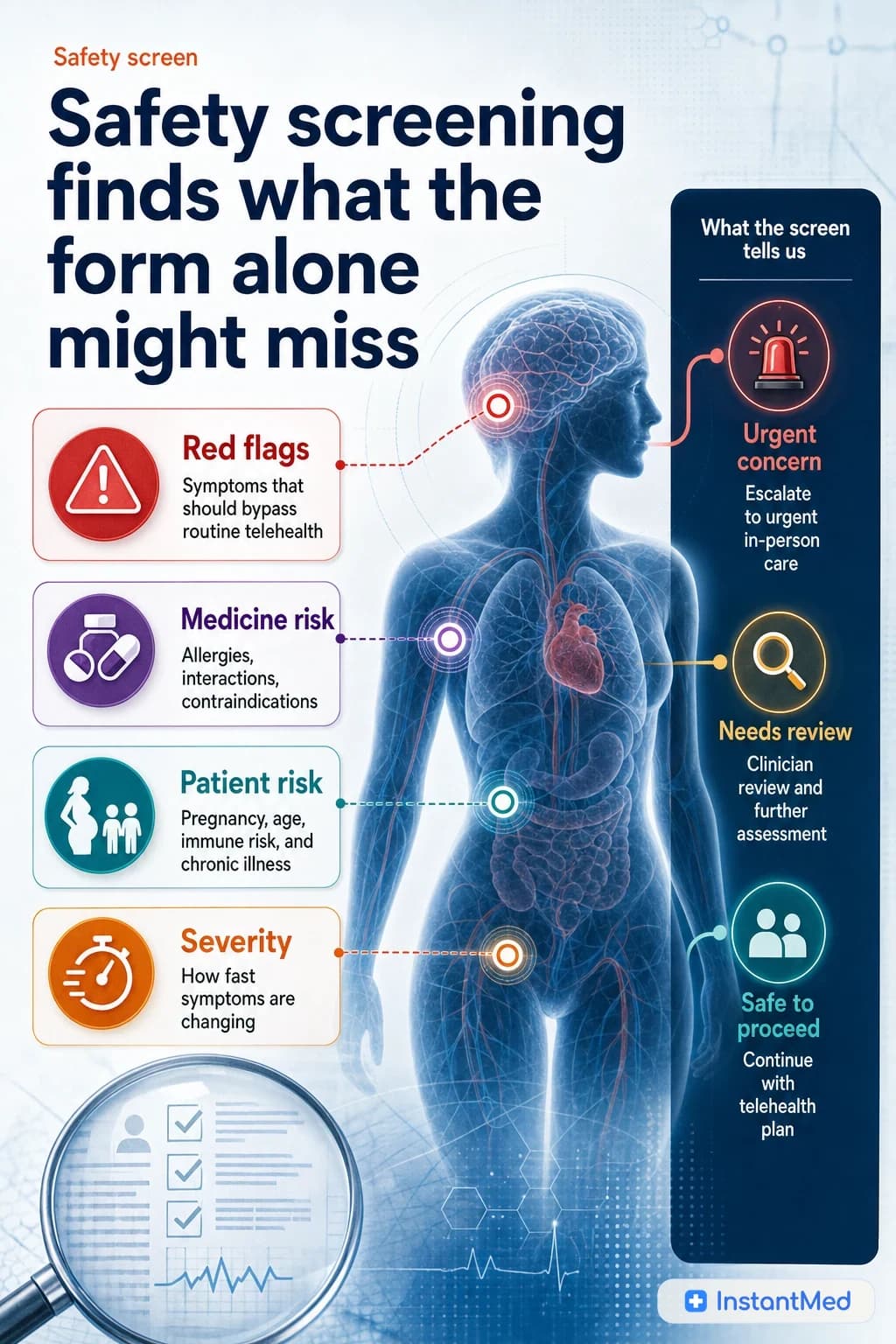
How Telehealth Safety Screening Works
Telehealth safety screening is the clinical filter that decides whether remote care is suitable. It checks symptoms, red flags, medical history, medicines, identity, privacy, and escalation needs before an online outcome is given.
InstantMed Medical Team
11 min read
How to Verify an Online Doctor in Australia
Before using an online doctor or relying on a telehealth document, check the practitioner, the service, the clinical process, and the document. This guide explains how to verify legitimacy without relying on badges or polished PDFs.
InstantMed Medical Team