Loading article
Back to Health Guides
When to Use Telehealth vs In-Person Care
A practical Australian decision guide for choosing remote care, a GP clinic, urgent care, or emergency help.
11 min read
·Updated 7 July 2026
·Doctor Reviewed
AHPRA Verified
In this article
- 1The core decision rule
- 2When telehealth may be a good fit
- 3When in-person, urgent, or emergency care is safer
- 4Grey-area problems depend on the details
- 5Children, pregnancy, and complex conditions need a lower threshold
Medical information only. This article is for general information and does not constitute medical advice. Treatment decisions are made by an AHPRA-registered doctor after reviewing your circumstances.
Review
InstantMed Clinical Team
Clinical governance review for guide content
Updated
7 July 2026
General information only, not personal medical advice.
Jump to section
1The core decision rule2When telehealth may be a good fit3When in-person, urgent, or emergency care is safer4Grey-area problems depend on the details5Children, pregnancy, and complex conditions need a lower threshold6Cost and Medicare should come after safety7What to check before using a telehealth service8How telehealth can support the next step9Related guides10Sources
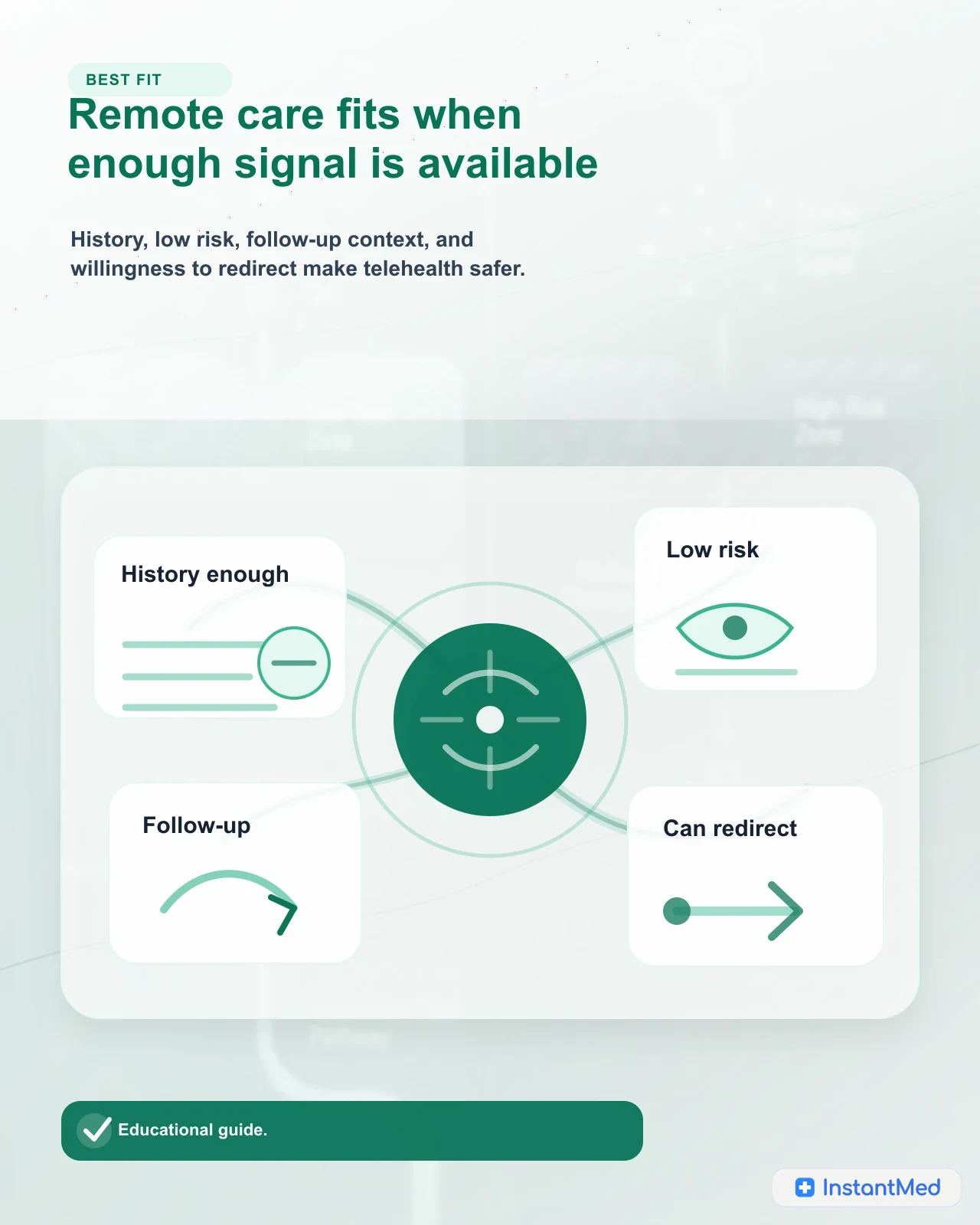
Use telehealth when the clinical question can be answered safely from remote information. Use in-person care when the decision depends on examination, observations, tests, procedures, urgent treatment, or continuity from a clinician who already knows you.
The safest answer is not "telehealth is convenient" or "in-person is always better." The practical question is whether the practitioner has enough reliable information to make the specific decision.
The core decision rule
A practitioner deciding between telehealth and in-person care is usually asking one question:
Can I make a safe, documented clinical decision with the information available remotely?
Remote information can include:
- what happened and when it started
- whether symptoms are improving, stable, or worsening
- current medicines, allergies, pregnancy status, and medical history
- relevant photos or readings, when securely requested
- previous results or discharge summaries
- real-time answers by phone or video
- the ability to arrange follow-up or redirect care
If the answer is yes, telehealth may be suitable. If the answer is no, the next step may be a GP clinic, urgent care clinic, emergency department, pathology collection, imaging, pharmacy advice, or another service.
When telehealth may be a good fit
Telehealth is strongest when the question is focused and the safety boundary is clear.
| Situation | Why telehealth may fit | What still matters |
|---|---|---|
| Follow-up after a previous review | The main diagnosis or plan may already be known | New symptoms or worsening signs may change the route |
| Simple administrative evidence | The doctor may assess work or study capacity from a clear history | The certificate or document is not automatic |
| Repeat medicine review | Prior use, dose history, side effects, and safety checks can be reviewed remotely | Some medicines need examination, tests, monitoring, or usual GP involvement |
| Mild, self-limiting symptoms | Advice may depend mainly on history and symptom pattern | Red flags, duration, and deterioration matter |
| Skin or visible concerns | Secure photos may add useful information | Changing, deep, spreading, painful, or atypical findings may need direct examination |
| Results or plan discussion | The question may be explanation, next steps, or monitoring | Serious results may need in-person review or urgent escalation |
| Triage when you are unsure | A clinician may help decide the next route | The service must be willing to redirect rather than force a remote outcome |
The common thread is not the body part or condition name. It is whether remote information is enough for the decision being made.
When in-person, urgent, or emergency care is safer
Some problems need hands-on assessment or immediate support.
Decision guide
Choose the safest care route
May fit telehealth
- The problem is non-urgent, focused, and can be explained clearly.
- Photos, readings, records, or follow-up questions are enough for the likely decision.
- You understand that the clinician may redirect if remote information is not enough.
Needs in-person care
- Examination, observations, tests, procedures, wound care, injections, imaging, or complex medicine changes may alter care.
- The problem involves a child, pregnancy, frailty, significant comorbidity, or ongoing complex care where continuity matters.
- Symptoms are unclear, unusual, persistent, or worsening despite initial advice.
Urgent care
- Chest pain, severe breathing difficulty, stroke symptoms, collapse, severe bleeding, severe allergic reaction, suicidal crisis, or rapid deterioration need urgent or emergency help.
- Call triple zero (000) for emergencies.
Telehealth should not be used to delay urgent care. It also should not be used to avoid an examination that is central to the question.
Grey-area problems depend on the details
Many real situations sit between "obviously remote" and "obviously in person." The same symptom can take different routes depending on severity, timing, risk factors, and what the doctor needs to check.
Examples:
Do not use
Urgent symptoms, examination needs, tests or procedures, and complex care can make remote review unsafe.
- A sore throat may be simple advice if symptoms are mild, but fever, dehydration, severe pain, breathing difficulty, or concern for complications can change the route.
- A cough may fit remote advice when mild and improving, but shortness of breath, chest pain, low oxygen readings, or clinical concern may need in-person assessment.
- Back pain may fit advice and activity planning when there are no neurological symptoms, but weakness, numbness, bladder or bowel changes, fever, trauma, or cancer history changes the risk.
- Skin rashes may be easier with clear photos, but rapidly spreading infection, severe pain, eye involvement, fever, or atypical lesions may need direct review.
- Mental health support can work well remotely for some planned reviews, but immediate risk of self-harm, psychosis, severe agitation, or inability to stay safe needs urgent help.
The value of telehealth in grey areas is not that it guarantees an online solution. It can help sort the next step when the service is set up to redirect safely.
Children, pregnancy, and complex conditions need a lower threshold
The threshold for in-person care is often lower when the person is:
- an infant or young child
- pregnant or recently postpartum
- older, frail, or immunocompromised
- living with significant heart, lung, kidney, liver, neurological, or endocrine disease
- on high-risk medicines
- recovering from surgery or hospital admission
- experiencing a new problem on top of complex chronic illness
Telehealth may still have a role for advice, triage, follow-up, or continuity, but the clinician may need observations, examination, local records, usual GP context, or urgent escalation sooner.
Cost and Medicare should come after safety
Cost matters, but it should not decide the care route on its own.
Some telehealth consultations can be Medicare-funded when MBS item rules, provider requirements, patient eligibility, and billing conditions apply. Other telehealth services charge privately. Some in-person GP visits are bulk billed, while others involve a gap fee.
| Cost factor | Telehealth | In-person care |
|---|---|---|
| Consultation fee | May be private, rebated, or bulk billed depending on service and eligibility | May be bulk billed, rebated with a gap, or private |
| Travel and parking | Usually none | Can add time and cost |
| Time away from work or caring duties | Often lower | Can be higher if travel and waiting are needed |
| Tests and procedures | Usually need separate pathology, imaging, pharmacy, or clinic attendance | May be arranged or performed on site depending on clinic |
| Safety cost | Can be high if urgent care is delayed | Can be high if unnecessary ED use replaces suitable primary care |
What to check before using a telehealth service
A suitable service should make the boundary clear before you rely on it.
Check for:
- AHPRA-registered practitioners or a clear clinical governance model
- plain-language privacy information
- clear fees and whether Medicare applies
- a process for asking follow-up questions
- a process for declining or redirecting unsafe requests
- a way to receive records, prescriptions, certificates, referrals, or summaries when appropriate
- advice about what to do if symptoms worsen
- no promise that a certificate, prescription, diagnosis, or approval is guaranteed
Be cautious if a site treats every problem as remote-friendly, promises approval before assessment, hides clinician identity or registration pathways, or discourages urgent care when symptoms are concerning.
How telehealth can support the next step
Telehealth can be useful even when it does not solve the whole problem online.
It may help you:
Route choice
The right next step depends on urgency, examination needs, tests, and continuity.
- understand whether the problem sounds urgent
- prepare for a GP visit with a clearer history
- obtain a referral or investigation request when clinically appropriate
- clarify whether a medicine or symptom needs review
- receive self-care advice while monitoring symptoms
- get a summary to share with your usual GP
After any telehealth consultation, keep the record, follow the escalation advice, and tell your usual GP about changes to medicines, diagnoses, referrals, or ongoing symptoms.
Related guides
- Telehealth vs GP care in Australia
- When telehealth cannot help
- Your first telehealth consultation
- How telehealth safety screening works
Sources
- Australian Government Department of Health and Aged Care: Telehealth
- Medical Board of Australia: Telehealth consultations with patients
- MBS Online: MBS Telehealth Services
- Healthdirect: Virtual care clinics
- Healthdirect: Symptom Checker
- Healthdirect: Calling triple zero (000)
- Healthdirect: How healthdirect can help you
Frequently Asked Questions
How do I know if telehealth is appropriate?
Ask whether the practitioner can make a safe decision from history, symptoms, photos, readings, records, and follow-up questions. If examination, urgent treatment, procedures, or complex continuity matter, in-person care may be safer.
Can I start with telehealth if I am unsure?
For non-urgent problems, telehealth may be a reasonable first contact if the service can redirect you. Do not use it for emergency symptoms, severe symptoms, or problems that clearly need hands-on examination or immediate treatment.
What symptoms should not wait for telehealth?
Chest pain, severe breathing difficulty, stroke symptoms, collapse, severe bleeding, severe allergic reaction, suicidal crisis, or rapidly worsening symptoms should be treated as urgent or emergency problems. Call triple zero (000) for emergencies.
Is telehealth cheaper than seeing a GP?
Sometimes, but cost should not be the safety test. Some telehealth consultations are Medicare-funded when MBS rules apply; others are private. In-person visits can also involve travel, parking, and time costs.
Can telehealth replace my usual GP?
Usually no. Telehealth can handle some focused questions, follow-up, certificates, repeat reviews, or triage, but ongoing complex care is often safer with a regular GP who knows your history.
InstantMed Medical Team
Related Articles
11 min read
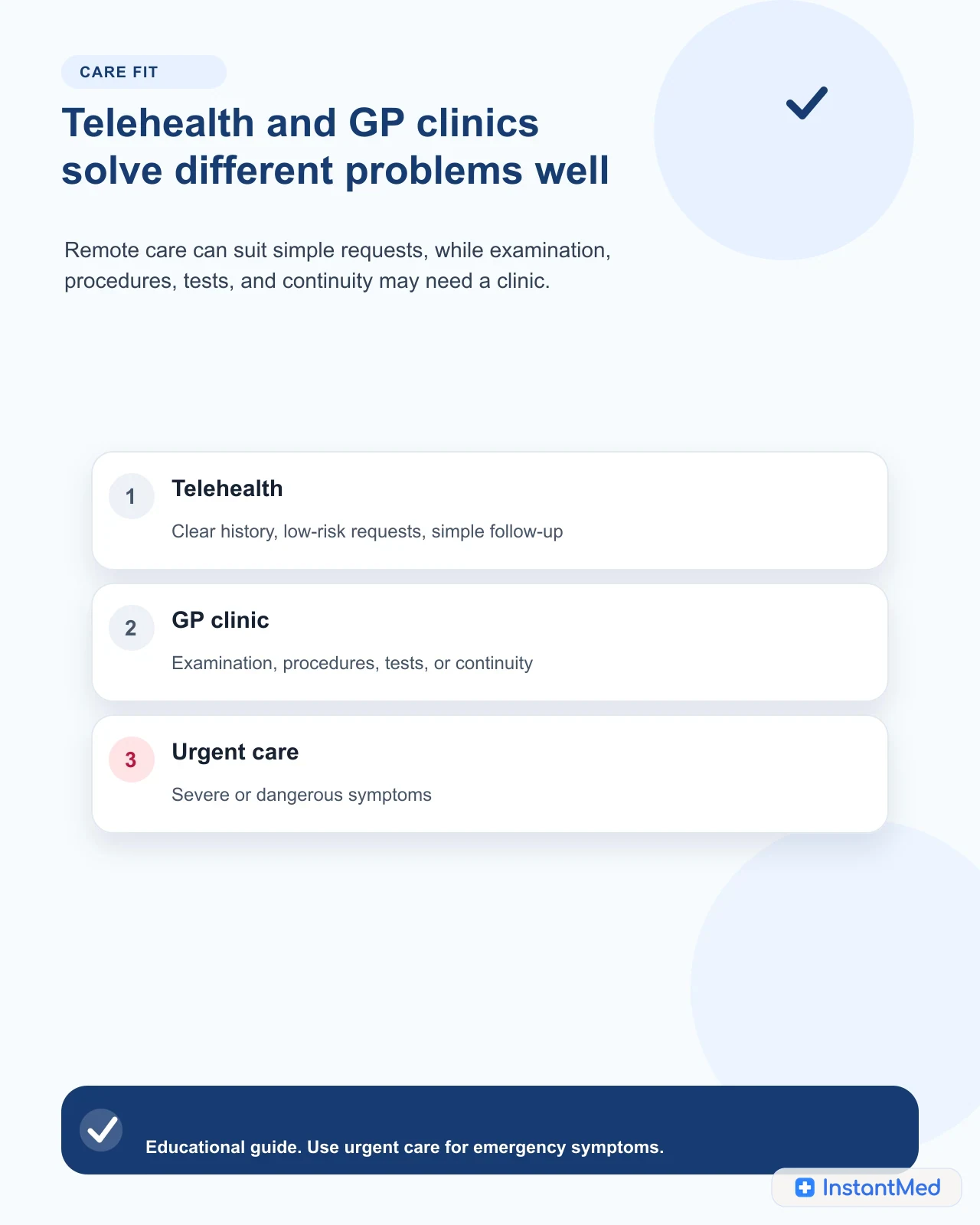
Telehealth vs GP: What's Actually Different in Australia?
Telehealth and in-person GP care are not rivals. Telehealth can be useful for suitable remote assessment, while GP clinics remain essential for examination, continuity, procedures, tests, and complex care.
InstantMed Medical Team
11 min read
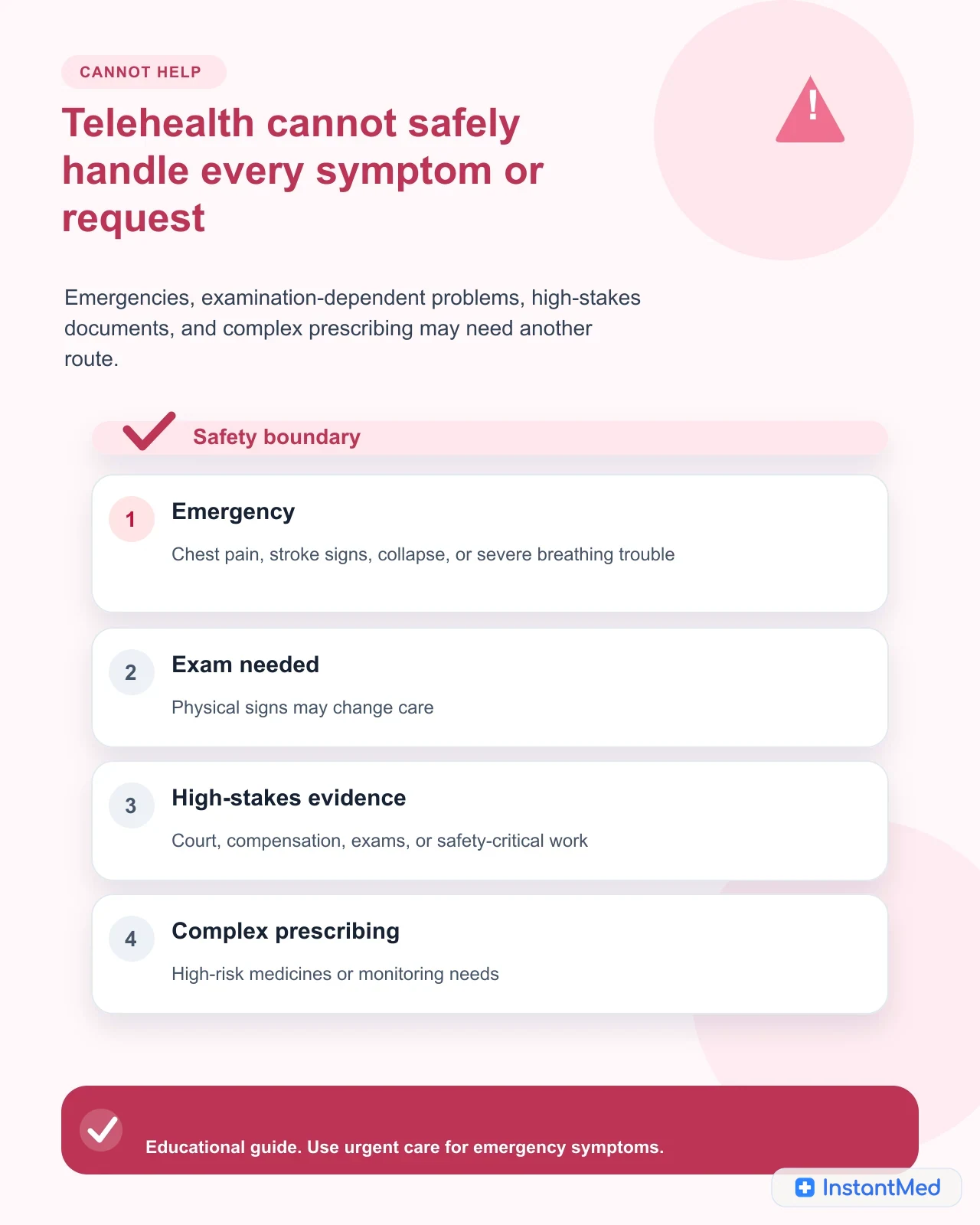
When Telehealth Cannot Help: Knowing the Limits
Telehealth can be safe and useful when the problem fits remote assessment. It cannot replace emergency care, a physical examination, monitoring, or continuity when those are needed. This guide explains the limits and safer next steps.
InstantMed Medical Team
11 min read
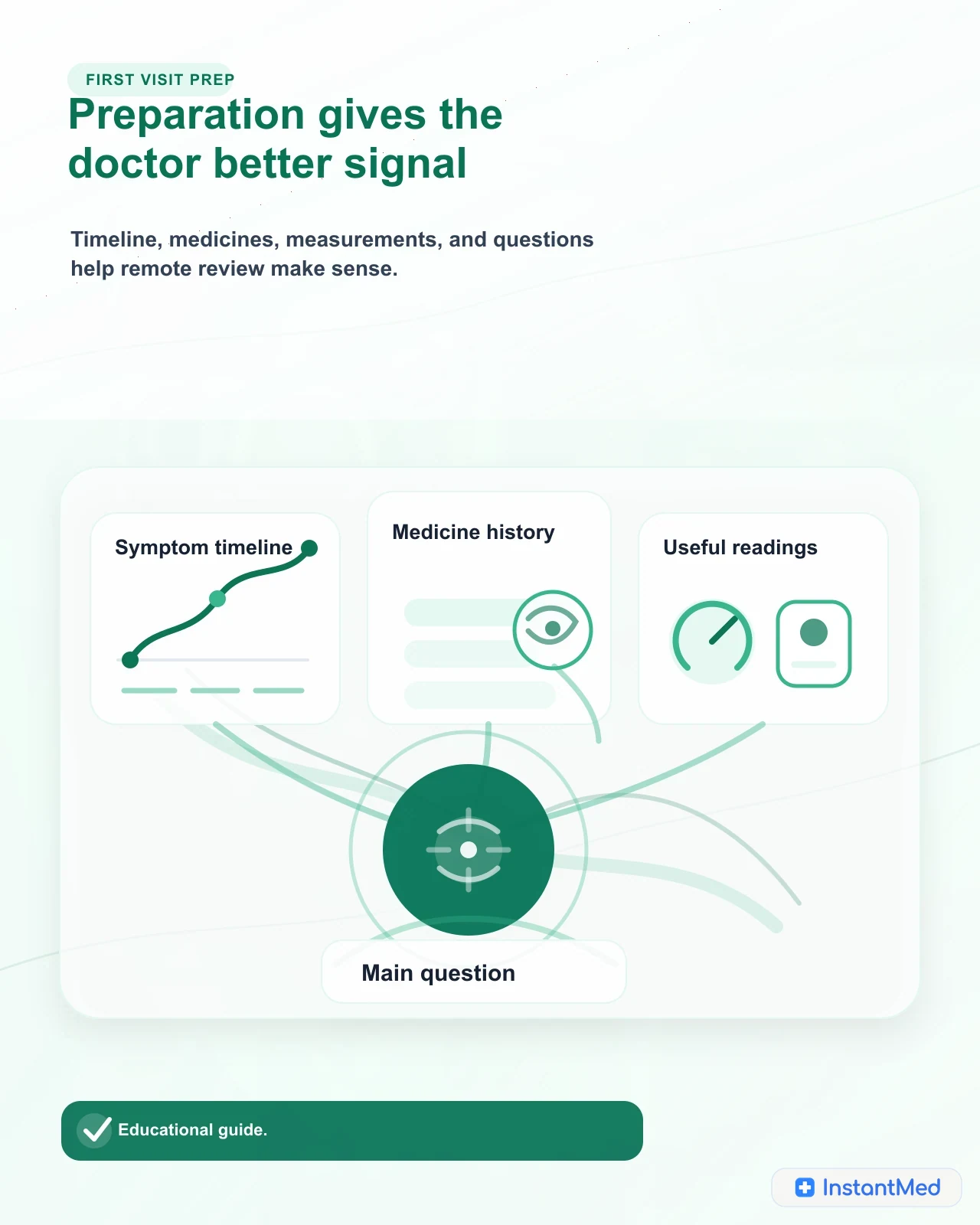
Your First Telehealth Consultation: What to Expect
New to telehealth? Learn what happens before, during, and after a remote consultation, what to prepare, how Medicare may apply, and when in-person or urgent care is safer.
InstantMed Medical Team