Loading article
Back to Health Guides
UTI Treatment Online: How to Get an Antibiotic Script for a UTI
Same-day assessment for uncomplicated urinary tract infections. No GP appointment needed.
7 min read
·Updated 10 May 2026
·Doctor Reviewed
AHPRA Verified
In this article
- 1What Is an Uncomplicated UTI?
- 2Symptoms That Suggest a UTI
- 3How to Get an Antibiotic Prescription for a UTI Online
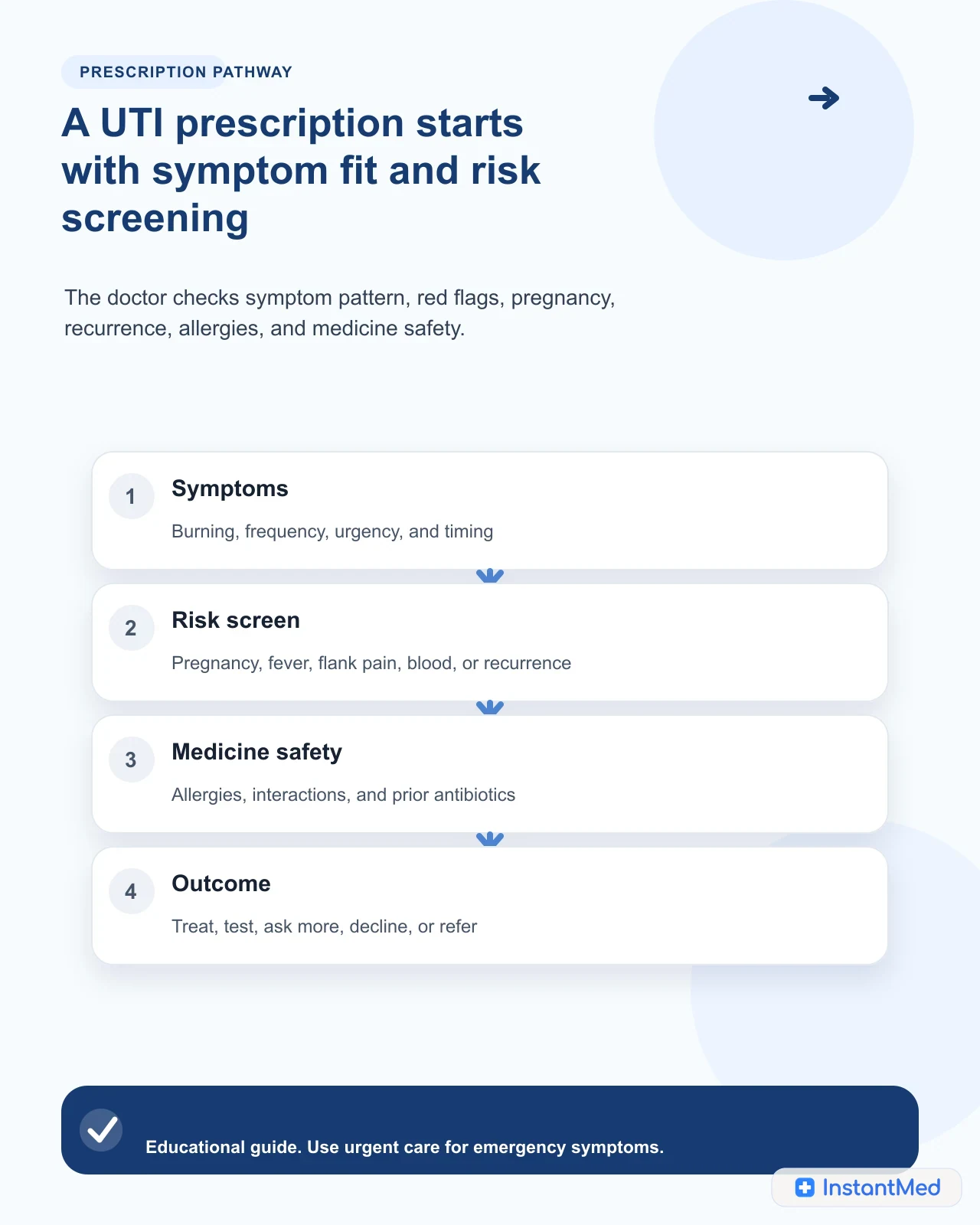
- 4What the Doctor Needs to Know
- 5When Telehealth Is Not Appropriate for a UTI
Medical information only. This article is for general information and does not constitute medical advice. Treatment decisions are made by an AHPRA-registered doctor after reviewing your circumstances.
Review
InstantMed Clinical Team
Clinical governance review for guide content
Updated
10 May 2026
General information only, not personal medical advice.
Jump to section
1What Is an Uncomplicated UTI?2Symptoms That Suggest a UTI3How to Get an Antibiotic Prescription for a UTI Online4What the Doctor Needs to Know5When Telehealth Is Not Appropriate for a UTI6PBS-Subsidised UTI Antibiotics7Completing Your Course of UTI Antibiotics8Preventing Recurrent UTIs9Connection to the Broader Antibiotics Framework10Sources Used In This Guide
Key Information
Uncomplicated UTIs in adult women can be assessed and treated online. The symptoms are clinically distinctive, and for straightforward cases, an AHPRA-registered doctor can assess your history and issue an antibiotic prescription without an in-person visit. eScript sent to your phone, fill at any pharmacy.
What Is an Uncomplicated UTI?
A urinary tract infection (UTI) is an infection of the urinary system - most commonly the bladder (cystitis) or urethra. UTIs are among the most common bacterial infections in Australia, affecting roughly half of all women at least once in their lifetime.
An "uncomplicated" UTI means:
- The infection is limited to the lower urinary tract (bladder and urethra, not the kidneys)
- The patient is an otherwise healthy adult woman, not pregnant
- There are no signs of systemic illness (no significant fever, no confusion, no back pain suggesting kidney involvement)
- There is no known structural abnormality of the urinary tract
- The patient is not immunocompromised
This specific combination is why uncomplicated UTIs are the most common condition treated via telehealth antibiotic assessment. The symptom profile is well-characterised, the evidence base for first-line treatment is strong, and physical examination rarely adds diagnostic value for straightforward cases.
Symptoms That Suggest a UTI
Classic symptoms of a lower urinary tract infection:
- Burning or stinging sensation during urination (dysuria)
- Needing to urinate more frequently than normal
- Urgency - a sudden, strong urge to urinate that is difficult to delay
- Lower abdominal or pelvic discomfort or pressure
- Urine that looks cloudy, dark, or has an unusually strong odour
- Passing only small amounts of urine despite strong urge
- General feeling of being unwell
These symptoms, occurring together in an adult woman without other significant health concerns, form a clinical picture that doctors recognise immediately.
Important Warning
Symptoms that suggest the infection has spread to the kidneys (pyelonephritis) include fever above 38 degrees, pain or tenderness in the back or flank (the area between your ribs and hip), nausea, or vomiting. These require in-person assessment, potentially including urine culture and more intensive treatment. Do not try to treat these symptoms online.
How to Get an Antibiotic Prescription for a UTI Online
The process is straightforward for eligible patients:
- Complete the online consultation form. Describe your symptoms, when they started, any previous UTIs and how they were treated, current medications, and known allergies.
- An AHPRA-registered doctor reviews your case. For a clear presentation of uncomplicated UTI symptoms with no complicating factors, this is typically reviewed within 1 to 2 hours during operating hours.
- If treatment is appropriate, the doctor issues an antibiotic prescription as an eScript. The digital token is sent to your phone via SMS.
- Take the SMS to any Australian pharmacy to collect your medication. Your Medicare card applies for PBS pricing.
If the doctor identifies complicating factors from your history, you will receive advice on why in-person assessment is more appropriate and what that should involve.
What the Doctor Needs to Know
To assess your UTI safely, the doctor needs:
- Symptom description: which symptoms you have, how long they have been present, and whether they are getting better or worse
- Severity: is this mild, moderate, or severe? Severe symptoms may indicate complications.
- Previous UTIs: how recently, how many, and what you were treated with previously. Frequent recurrence changes the clinical picture.
- Pregnancy status: non-negotiable safety check. UTIs in pregnancy require different management.
- Allergies: particularly to antibiotics. Penicillin allergy, for example, does not affect standard UTI treatment, but sulphonamide allergy does.
- Current medications: some medications interact with UTI antibiotics
- Fever or back pain: absence of these confirms lower tract involvement; presence indicates referral
Accurate answers lead to appropriate treatment. If you are unsure about any of these, note that uncertainty rather than guessing.
When Telehealth Is Not Appropriate for a UTI
Telehealth is appropriate for uncomplicated UTIs in healthy adult women. It is not appropriate when:
- You have a fever above 38 degrees - this suggests kidney involvement or sepsis
- You have back or loin pain - possible pyelonephritis requires in-person assessment and often urine culture
- You are pregnant - UTIs in pregnancy require different antibiotic selection and closer monitoring
- You are male - UTIs in men are considered complicated by definition and need in-person assessment
- The patient is a child - paediatric UTIs require in-person assessment
- You are immunocompromised - diabetes, HIV, chemotherapy, or immunosuppressive medications change the risk profile
- This is a recurrent UTI (more than 3 in 12 months) - recurrent UTIs need investigation to rule out an underlying cause
- Your symptoms are not improving on current antibiotics - treatment failure needs urine culture
- You have a known urinary tract abnormality - structural issues require specialist assessment
PBS-Subsidised UTI Antibiotics
Most antibiotics used for UTI treatment are listed on the Pharmaceutical Benefits Scheme (PBS). With a valid Medicare card and a prescription, you pay the standard co-payment:
- General patients: up to $25.00 per script
- Concession card holders: up to $7.70 per script
Testing boundary
Recurrent, atypical, severe, pregnancy-related, or treatment-resistant symptoms may need urine testing or GP care.
The PBS subsidy applies whether your prescription came from a telehealth service or an in-person GP. The eScript is accepted at all Australian pharmacies.
Without Medicare, you pay the full price. Common UTI antibiotics typically cost $15 to $35 without subsidy, varying by pharmacy and specific medication.
Completing Your Course of UTI Antibiotics
Complete the full prescribed course, even if symptoms improve after the first day. UTI symptoms often begin to improve within 24 to 48 hours of starting antibiotics, but stopping early allows surviving bacteria to persist and potentially develop resistance.
If your symptoms have not begun to improve within 48 hours of starting antibiotics, contact your prescribing doctor. Failure to respond to treatment may indicate:
- The bacteria causing your infection is resistant to the prescribed antibiotic
- The diagnosis may be incorrect (other conditions can mimic UTI symptoms)
- The infection may have spread beyond the bladder
Urine culture - which requires an in-person visit and laboratory testing - is the definitive way to identify the causative bacteria and its antibiotic sensitivity. This is recommended for recurrent or treatment-resistant UTIs.
Preventing Recurrent UTIs
If you are experiencing UTIs repeatedly, consider:
- Drinking adequate fluid throughout the day to promote regular urination
- Urinating after sexual intercourse, which reduces bacterial colonisation of the urethra
- Wiping front to back to reduce cross-contamination
- Avoiding prolonged use of spermicidal products, which can disrupt normal vaginal flora
- Discussing preventive antibiotic options with your GP if you have three or more UTIs per year
Cranberry products have mixed evidence. They may reduce recurrence slightly in some people but are not a substitute for antibiotic treatment of an active infection.
Connection to the Broader Antibiotics Framework
UTI treatment is part of Australia's broader approach to responsible antibiotic prescribing. First-line antibiotics are chosen based on local resistance patterns, which the Therapeutic Guidelines (eTG) update regularly. This matters because overuse of certain antibiotics creates resistance that makes future UTI treatment harder for everyone.
A doctor prescribing for your UTI is following these guidelines - not arbitrarily choosing a drug. If the antibiotic prescribed is not what you expected or have had before, there may be a good clinical reason. Ask the doctor if you are uncertain.
For more on how antibiotic prescriptions work in Australia and what conditions qualify for telehealth treatment, see our detailed guide.
Sources Used In This Guide
- PBS: fees, patient contributions and Safety Net thresholds
- Services Australia: PBS Safety Net thresholds
- Healthdirect: medicines information
- Medical Board of Australia: telehealth consultations with patients
- AHPRA: Register of practitioners
- TGA: advertising a health service
Frequently Asked Questions
Can a telehealth doctor treat a UTI?
Yes. Uncomplicated UTIs in adult women are one of the most commonly treated conditions in telehealth. The symptoms are distinctive and well-recognised, allowing doctors to make a confident clinical assessment based on history alone. An AHPRA-registered doctor can assess your symptoms and issue an antibiotic prescription if treatment is appropriate.
What UTI symptoms qualify for telehealth treatment?
Uncomplicated UTI symptoms that typically qualify: burning or stinging on urination, increased urinary frequency or urgency, lower abdominal or pelvic discomfort, cloudy or strong-smelling urine, and feeling unwell without a high fever. These symptoms, in an otherwise healthy adult woman with no significant medical history, are appropriate for telehealth assessment.
When should I see a doctor in person for a UTI?
Go in person if you have: fever above 38 degrees, back or loin pain (possible kidney involvement), nausea or vomiting, symptoms that have not improved after 48 hours of antibiotics, recurrent UTIs more than 3 times in 12 months, pregnancy, male UTI symptoms, or any UTI in a child. These presentations require a higher level of assessment than telehealth can safely provide.
What antibiotic will I be prescribed for a UTI?
The specific antibiotic is chosen by the doctor based on your symptom profile, any known allergies, previous antibiotic use, and local resistance patterns. First-line choices for uncomplicated UTI in Australian prescribing guidelines are well-established. The doctor selects the appropriate medication - you do not choose the antibiotic.
How much does online UTI treatment cost?
The consultation fee applies for the doctor review. If an antibiotic is prescribed, you collect it from any pharmacy. Most UTI antibiotics are PBS-listed, so with a Medicare card you pay the standard PBS co-payment - $25.00 for general patients or $7.70 for concession card holders. The consultation and medication costs are separate.
Can I get a UTI prescription online if I'm pregnant?
No. UTIs during pregnancy require in-person assessment and careful antibiotic selection due to safety considerations for both mother and baby. Some antibiotics commonly used for UTIs are not safe in pregnancy. Please see your GP or obstetrician for UTI treatment during pregnancy.
InstantMed Medical Team
Related Articles

8 min read
Amoxicillin in Australia: Uses, Dosing, and What to Know
Amoxicillin is a penicillin antibiotic used for selected bacterial infections. It does not treat viruses, and the right dose depends on the infection, person, and clinical context.
InstantMed Medical Team

8 min read
When Antibiotics Are Appropriate: Bacterial vs Viral Infections
Antibiotics treat bacterial infections, not viruses. This guide explains when antibiotics may be appropriate, when they are usually avoided, and what responsible use looks like.
InstantMed Medical Team
9 min read
Asthma Management and Telehealth in Australia
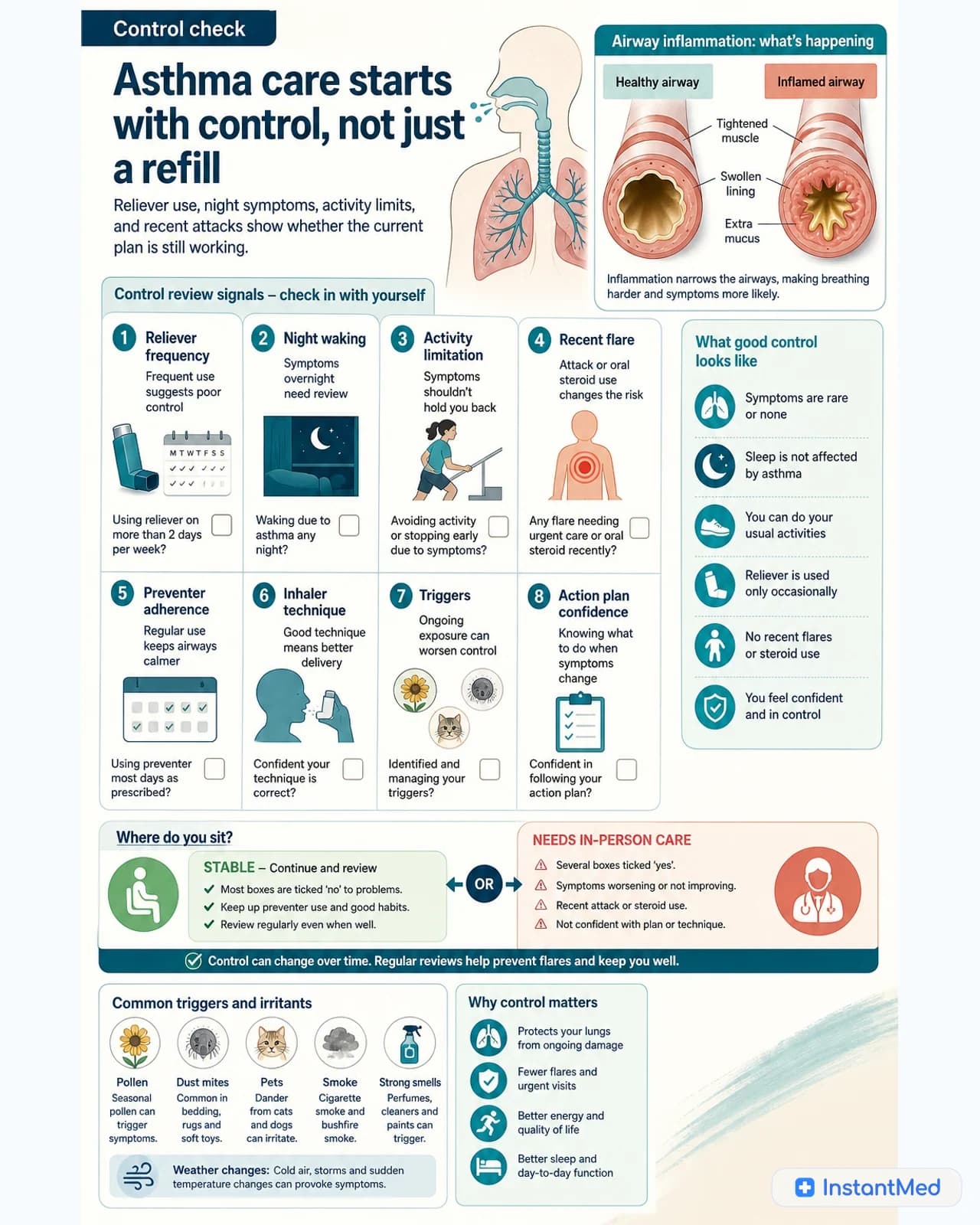
Stable, established asthma may suit telehealth medication review, but diagnosis, worsening symptoms, children, and asthma attacks need in-person or emergency care. Learn the safety boundaries.
InstantMed Medical Team