Loading article
Back to Health Guides
Your First Telehealth Consultation: What to Expect
A practical first-use guide for Australians: choosing the right format, preparing your history, understanding safety checks, and knowing when remote care is not enough.
11 min read
·Updated 7 July 2026
·Doctor Reviewed
AHPRA Verified
In this article
- 1First, know which kind of telehealth you are using
- 2What to prepare before you start
- 3How to describe symptoms clearly
- 4What happens during review
- 5Outcomes are not guaranteed
Medical information only. This article is for general information and does not constitute medical advice. Treatment decisions are made by an AHPRA-registered doctor after reviewing your circumstances.
Review
InstantMed Clinical Team
Clinical governance review for guide content
Updated
7 July 2026
General information only, not personal medical advice.
Jump to section
1First, know which kind of telehealth you are using2What to prepare before you start3How to describe symptoms clearly4What happens during review5Outcomes are not guaranteed6Medicare, bulk billing, and private fees7Privacy and records8When to use urgent or in-person care9After the consultation10How to check a service before your first use11Common first-time misconceptions12Related guides13Sources
Your first telehealth consultation should feel like a healthcare appointment with a different channel, not like a shortcut around assessment. You may speak by phone or video, complete a secure form, answer follow-up questions, or use a mix of formats.
The practical goal is the same each time: give the practitioner enough reliable information to decide what can safely happen remotely and what needs another care route.
First, know which kind of telehealth you are using
"Telehealth" is a broad word. The experience changes depending on the format.
| Format | What you do | What the practitioner gets | Best suited to | Watch-outs |
|---|---|---|---|---|
| Video | Join a real-time video appointment | Sight, sound, history, and follow-up answers | Interactive discussion, some visual review, mental health, follow-up | Still cannot perform hands-on examination |
| Phone | Speak in real time | Voice, history, and follow-up answers | Advice, triage, follow-up, limited internet access | No visual cues |
| Secure form | Submit structured information for review | Symptoms, history, medicines, allergies, consent, uploaded information if requested | Routine, low-risk requests where written information may be enough | Incomplete answers can miss risk |
| Secure message | Send or receive written clarification | Specific follow-up questions and answers | Follow-up, results discussion, administrative clarification | Not for urgent symptoms |
| Hybrid | Use more than one format | A fuller remote picture | Problems needing both structured history and conversation | May still need in-person care |
Do not assume a video call is always safer or that a form is automatically unsafe. The question is whether the practitioner can get enough information for the specific decision.
What to prepare before you start
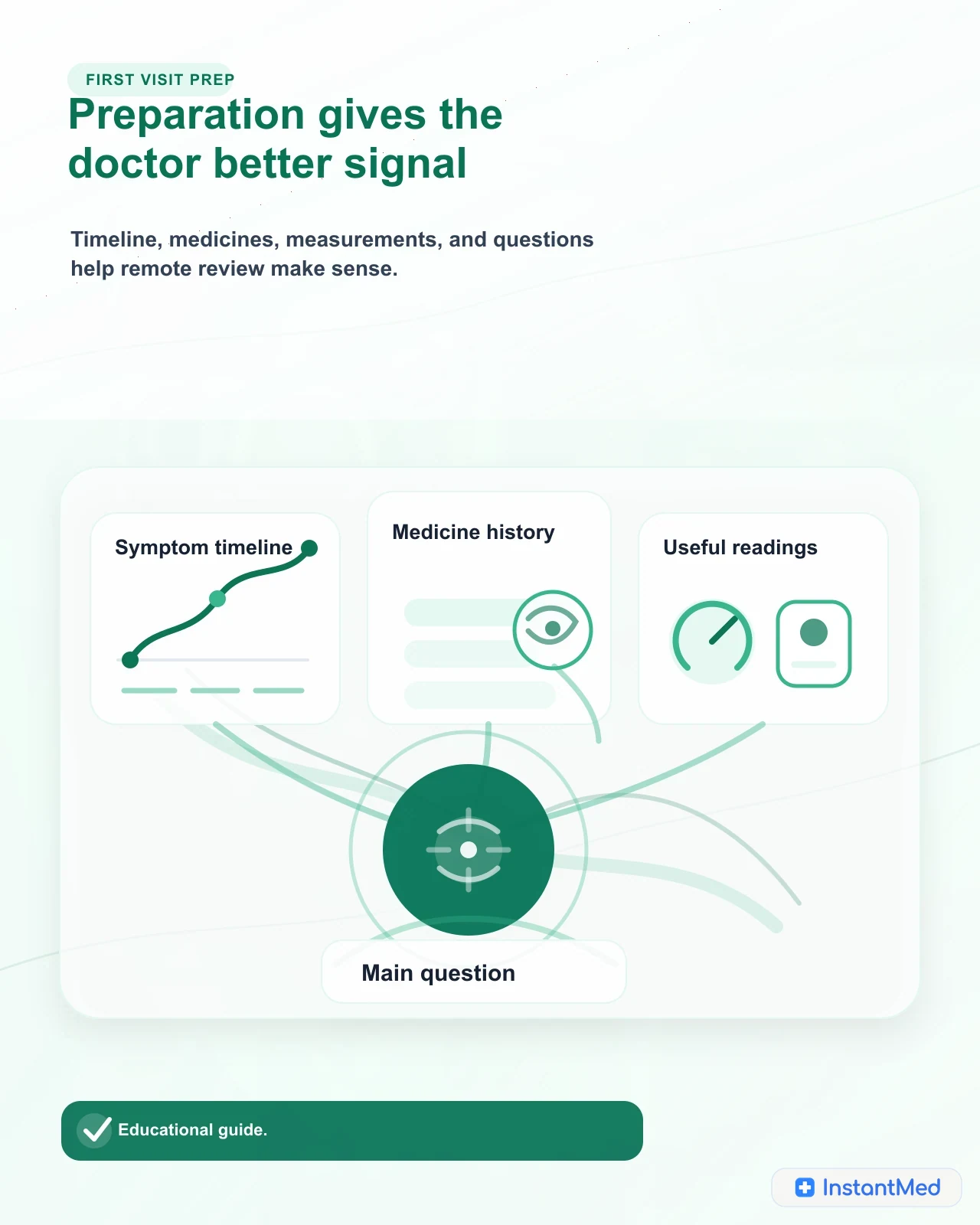
Preparation is not paperwork for its own sake. It gives the practitioner a clearer clinical signal.
Have ready:
- your main concern in one sentence
- when symptoms started and how they have changed
- severity and whether things are improving or worsening
- current medicines, doses, supplements, and recent antibiotics
- allergies and what reaction happened
- relevant medical conditions
- pregnancy or breastfeeding status where relevant
- recent test results, discharge summaries, or specialist letters if you have them
- photos only if the service specifically asks and provides a secure upload process
- your usual GP or pharmacy details when continuity matters
- questions you want answered
If your concern is urgent, preparation is not the priority. Use emergency or urgent care first.
How to describe symptoms clearly
A first telehealth consultation is easier when your history is specific.
Instead of "I feel sick," try:
- "Symptoms started on Monday afternoon."
- "The cough is worse at night and I have measured a temperature of 38.2."
- "I am short of breath walking across the room."
- "I took paracetamol at 8 am and it helped for two hours."
- "I have asthma and used my reliever more than usual."
- "I am asking whether remote advice is enough or whether I need in-person care."
Specific detail does not force a particular outcome. It helps the practitioner decide whether the problem is low risk, unclear, examination-dependent, or urgent.
What happens during review
The practitioner may not simply read the first sentence and decide. A safe review can include several checks.
They may assess:
- whether your identity and contact details are clear enough
- whether the consent and privacy information is understood
- whether your symptoms suggest urgent or in-person care
- whether your medicine list, allergies, or medical history changes the risk
- whether the requested outcome is clinically supported
- whether more information, phone, video, records, tests, or local review are needed
- whether the consultation and decision can be documented properly
For a video or phone consultation, start with the main concern, answer questions fully, and ask what should make you seek urgent care. For a form-based consultation, treat free-text boxes as the consultation history: timing, severity, context, medicines, and what you need decided.
Outcomes are not guaranteed
A first telehealth consultation can end in different ways.
The outcome may be:
What happens
The practitioner may advise, ask more, issue when appropriate, decline, or redirect.
- advice and self-care guidance
- a request for more information
- a recommendation for phone or video review
- a certificate, eScript, referral, or test request when clinically appropriate
- a decline if the requested outcome is not supported
- a recommendation to see a GP clinic, urgent care, emergency care, or another service
The safest services explain this before you pay or submit sensitive information. Be cautious when a site makes the document, medicine, diagnosis, or approval sound guaranteed before clinical review.
Medicare, bulk billing, and private fees
Medicare may fund some telehealth consultations when the relevant MBS item and eligibility rules apply. Many GP telehealth items depend on the patient, provider, consultation type, and billing context.
Private telehealth is different. A private service may charge a clear out-of-pocket fee and not process the consultation as a Medicare item. That does not automatically make it illegitimate. It means the billing pathway is different.
Before you start, check:
- the upfront fee
- whether a Medicare rebate applies
- whether any gap remains after rebate
- whether additional pharmacy, pathology, imaging, or specialist costs may apply
- what happens if the practitioner redirects or declines the request
Privacy and records
Telehealth often involves sensitive health information before you meet or speak with a practitioner. That can include symptoms, medicines, allergies, pregnancy status, mental health information, images, and payment details.
Check whether the service explains:
- what information it collects
- why it collects it
- who can access it
- how records and uploaded images are stored
- whether information may be shared for care, safety, legal, or complaints reasons
- how you can contact the service about privacy
- how to make a complaint
Avoid sending health information through ordinary social media messages, workplace accounts, public comments, or unsecured channels when a proper healthcare pathway is available.
When to use urgent or in-person care
Decision guide
Where a first telehealth visit fits
May fit telehealth
- The problem is low risk, you can explain the history clearly, and the practitioner can get enough information remotely.
- You can answer follow-up questions and understand that the outcome may be advice, a document, prescription, referral, decline, or redirect.
Needs in-person care
- The decision depends on examination, observations, procedures, tests, immunisation, complex medicine changes, or continuity from your usual GP.
- Your symptoms, identity, medicine details, or requested outcome are too uncertain for remote review.
Urgent care
- Chest pain, severe breathing trouble, stroke signs, collapse, severe allergic reaction, uncontrolled bleeding, poisoning, overdose, major injury, or immediate self-harm risk should bypass routine telehealth.
- Call 000 or use local urgent care for emergency symptoms.
After the consultation
After the review, keep the outcome somewhere you can find it again.
Depending on the consultation, you may receive:
- written advice
- a certificate or document
- an eScript token
- a referral
- a pathology or imaging request
- a consultation summary
- instructions for follow-up or urgent warning signs
Share important telehealth outcomes with your usual GP when continuity matters, especially for medicines, repeated symptoms, chronic conditions, mental health, or specialist referrals. Telehealth works best when it supports ongoing care rather than fragmenting it.
How to check a service before your first use
A legitimate service should make its clinical and business process clear before you submit sensitive health information.
Look for:
After care
Records, pharmacy or documents, GP continuity, and urgent thresholds can all matter after telehealth.
- an Australian business name and contact pathway
- clear pricing before payment
- privacy, terms, refund, and complaints information
- meaningful clinical questions, not only a payment form
- practitioner accountability for clinical decisions
- a way for the practitioner to ask follow-up questions
- plain information that requests may be declined or redirected
- no guarantee of certificates, prescriptions, diagnosis, or approval
Ahpra's public register can confirm practitioner registration when a practitioner name or registration number is provided. Registration is not the whole quality check, but it is an important starting point.
Common first-time misconceptions
"Telehealth always means video." No. Phone, secure forms, secure messages, and hybrid review can all be part of telehealth.
"A form means no doctor reviewed it." Not necessarily. A structured form can be the history-gathering part of a real review.
"The practitioner will issue what I asked for." Not always. They may ask for more information, decline, or redirect care.
"Medicare means free." Some telehealth is bulk billed, some is rebated with a gap, and some is private fee.
"Telehealth replaces having a GP." Telehealth can help with suitable remote issues, but ongoing care, examination, procedures, and complex management often need a regular GP or local service.
Related guides
- Telehealth consultation in Australia: what to expect
- What is telehealth?
- Is telehealth safe in Australia?
- How telehealth safety screening works
- How to verify an online doctor
Sources
- Australian Government Department of Health, Disability and Ageing: Telehealth
- MBS Online: MBS Telehealth Services
- Medical Board of Australia: Telehealth consultations with patients
- Ahpra: Register of practitioners
- Healthdirect: Virtual care clinics
- Healthdirect: Calling triple zero (000)
- OAIC: Health information
Frequently Asked Questions
What should I expect at my first telehealth consultation?
Expect to provide identity and contact details, explain the problem clearly, share relevant history and medicines, consent to the remote process, and receive advice, follow-up questions, an outcome, or a redirect if remote care is not suitable.
Do I need a video call for telehealth?
Not always. Some telehealth consultations happen by phone, secure form, secure message, or a mix of formats. The right format depends on the clinical question and whether the practitioner can get enough information remotely.
What should I prepare before a telehealth appointment?
Prepare a symptom timeline, severity, current medicines, allergies, relevant medical conditions, recent test results, photos only if securely requested, and the main question you want answered. Use urgent care first for emergency symptoms.
Can Medicare cover my first telehealth consultation?
Some telehealth consultations can be Medicare-funded when MBS item rules, provider requirements, patient eligibility, and billing conditions apply. Some services charge privately. Ask whether a rebate applies to the specific consultation.
What if the practitioner cannot help online?
They may ask for more information, recommend video or phone, decline the request, or redirect you to a GP clinic, urgent care, emergency care, tests, or another service. A redirect can be the safest outcome.
InstantMed Medical Team
Related Articles
11 min read
Telehealth Consultation in Australia: What to Expect
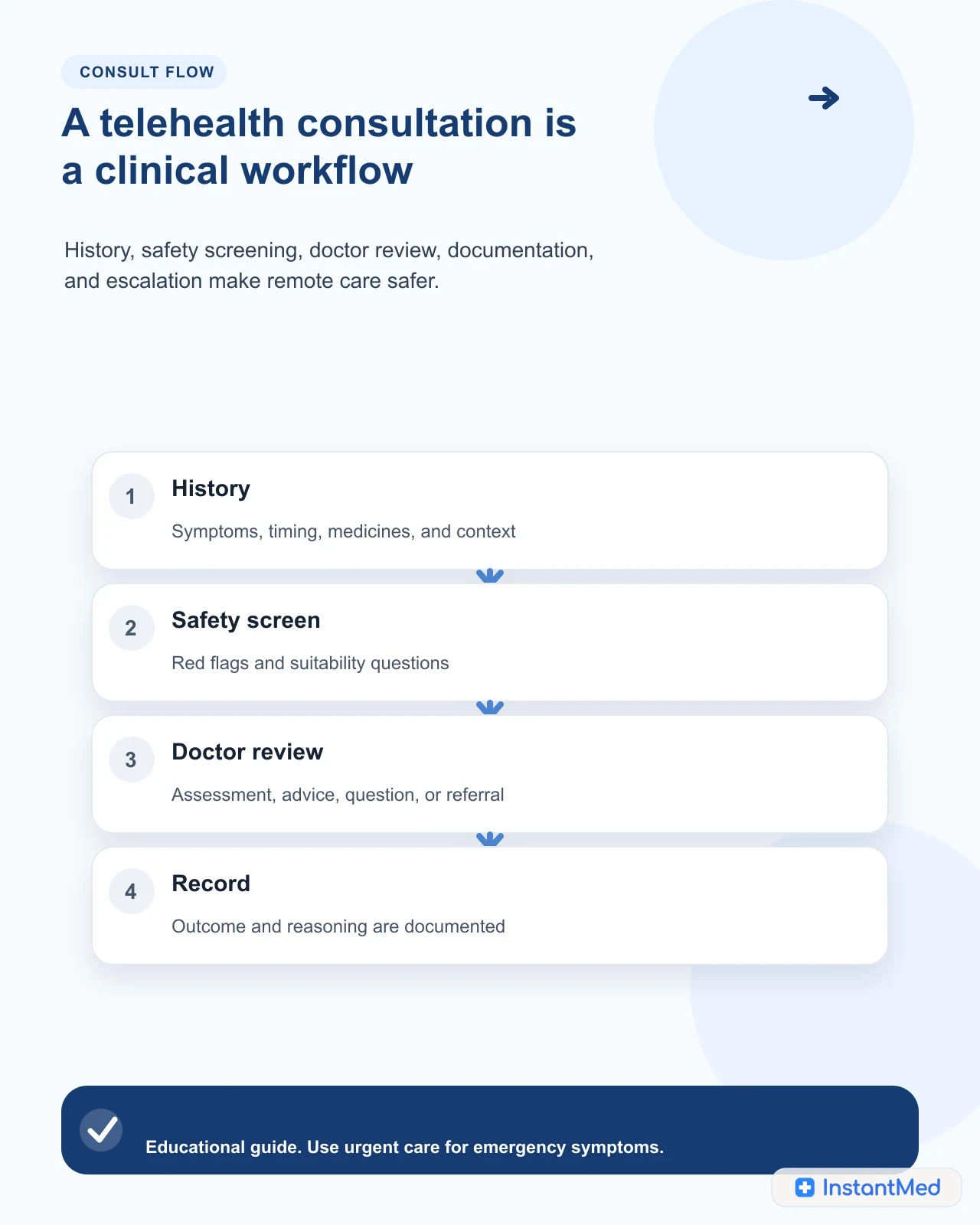
A telehealth consultation is a real clinical review delivered by phone, video, secure message, or structured online form. Learn what happens, what to prepare, and when remote care is not enough.
InstantMed Medical Team
11 min read
What Is Telehealth? How Online Healthcare Works in Australia
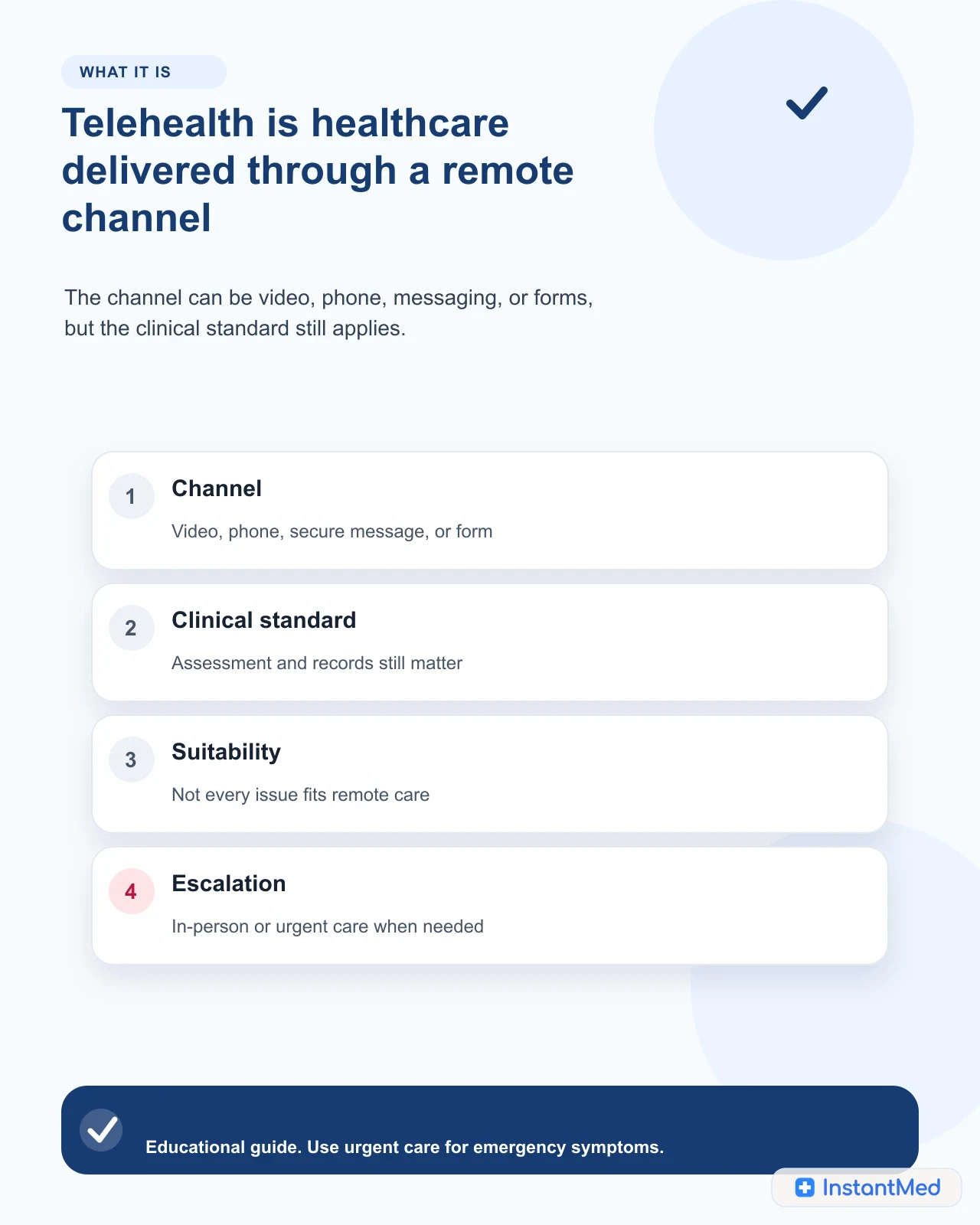
Telehealth is healthcare delivered remotely by phone, video, secure messaging, or structured online forms. The channel is different, but the practitioner still needs enough information to provide safe care.
InstantMed Medical Team

11 min read
Is Telehealth Safe in Australia?
Telehealth can be safe when the service is regulated, the doctor has enough information, and there is a clear path to in-person or urgent care when remote review is not enough.
InstantMed Medical Team