Loading article
Back to Health Guides
Sertraline vs Escitalopram: Comparing SSRIs for Anxiety and Depression
How Australia's two most prescribed antidepressants compare.
8 min read
·Updated 11 June 2026
·Doctor Reviewed
AHPRA Verified
In this article
- 1How SSRIs Work
- 2Sertraline
- 3Escitalopram
- 4Effectiveness: Head-to-Head
- 5Side Effects
Medical information only. This article is for general information and does not constitute medical advice. Treatment decisions are made by an AHPRA-registered doctor after reviewing your circumstances.
Review
InstantMed Clinical Team
Clinical governance review for guide content
Updated
11 June 2026
General information only, not personal medical advice.
Important Warning
Crisis support: If you or someone you know is experiencing a mental health crisis, contact Lifeline (13 11 14, 24/7), Beyond Blue (1300 22 4636, 24/7), or call 000 in an emergency. This article is informational -- it is not a substitute for individualised medical advice from your doctor.
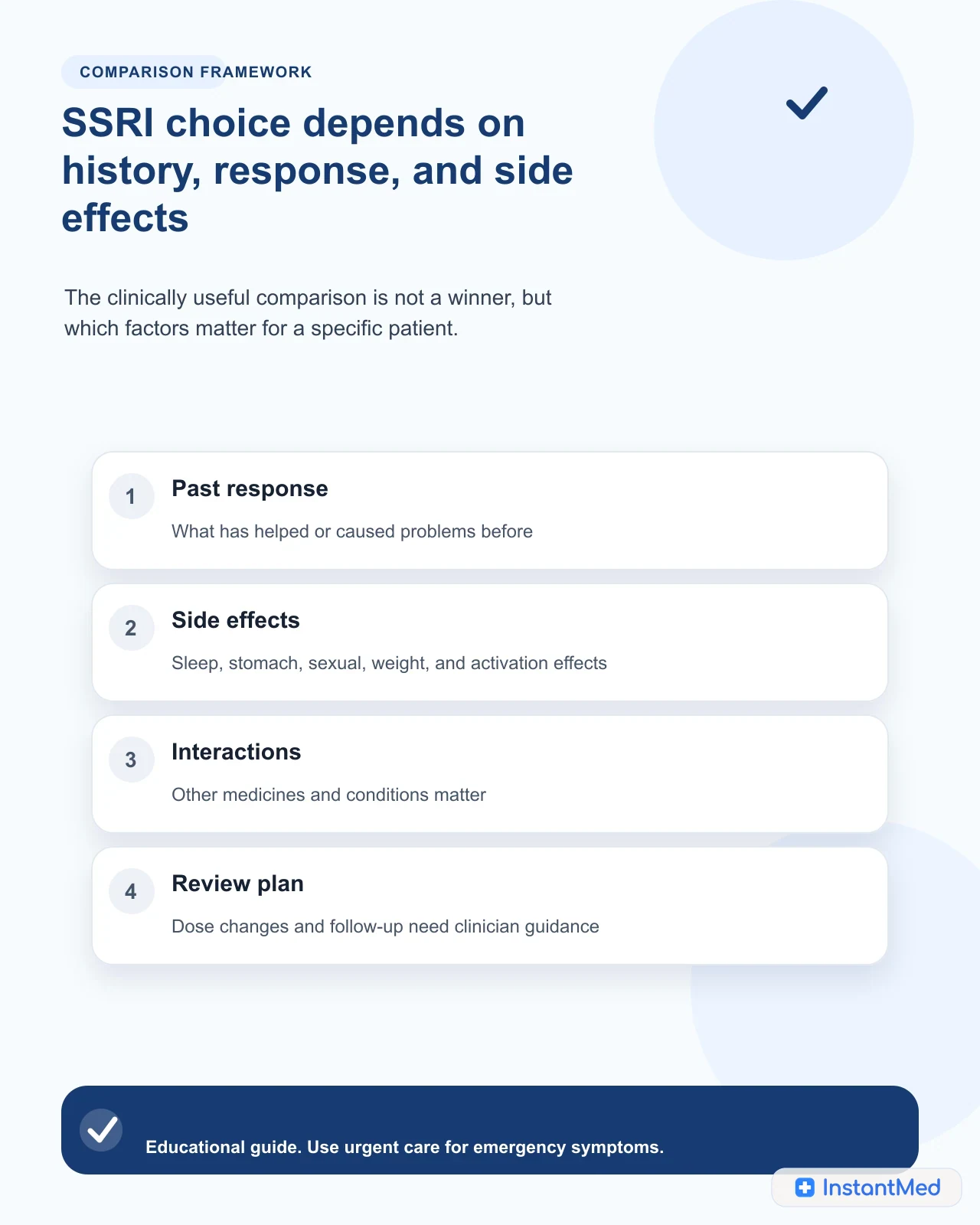
Selective serotonin reuptake inhibitors (SSRIs) are the first-line pharmacological treatment for depression and most anxiety disorders in Australia. The Australian Therapeutic Guidelines (eTG) and the Royal Australian College of General Practitioners (RACGP) both recommend SSRIs as first-line agents, alongside or following psychological therapy for mild-to-moderate presentations. Sertraline and escitalopram are the two most prescribed SSRIs in Australia, and both are listed on the Pharmaceutical Benefits Scheme (PBS). This guide covers how they compare -- but it is important to note that medication choice for mental health is highly individual. What works best varies significantly between people, and your doctor's assessment of your specific situation should guide the final choice.
How SSRIs Work
SSRIs increase serotonin availability in the brain by blocking its reabsorption (reuptake) into presynaptic nerve cells. This increases the concentration of serotonin in the synaptic cleft, which over time modulates the neurobiological pathways involved in mood, anxiety, and emotional processing. SSRIs do not produce immediate effects -- it typically takes 2-4 weeks for therapeutic effects to begin and 6-8 weeks for the full effect to be established. This delayed onset is one of the most important things to communicate to patients starting treatment.
Sertraline
| Feature | Detail |
|---|---|
| Available doses | 25mg, 50mg, 100mg tablets |
| Starting dose | 25-50mg daily |
| Target dose | 50-200mg daily |
| Half-life | Approximately 26 hours |
| TGA-approved indications | Depression, OCD, panic disorder, PTSD, social anxiety disorder, premenstrual dysphoric disorder (PMDD) |
| PBS listing | Yes -- depression and OCD |
Sertraline has the broadest range of TGA-approved indications among SSRIs in Australia. It is the SSRI with the most favourable safety data in pregnancy (lowest observed risk of congenital malformations based on available prospective data) and is often preferred for patients with comorbid PTSD and depression.
Escitalopram
| Feature | Detail |
|---|---|
| Available doses | 5mg, 10mg, 20mg tablets |
| Starting dose | 5-10mg daily |
| Target dose | 10-20mg daily (maximum 20mg per TGA product information) |
| Half-life | Approximately 27-32 hours |
| TGA-approved indications | Depression, generalised anxiety disorder (GAD), social anxiety disorder, OCD |
| PBS listing | Yes -- depression and GAD |
Escitalopram is the S-enantiomer of citalopram -- the purified pharmacologically active form. It is often described as the "cleanest" SSRI in terms of receptor selectivity, meaning fewer off-target effects and a straightforward interaction profile. The TGA maximum recommended dose is 20mg; higher doses increase the risk of QT interval prolongation (see side effects section).
Effectiveness: Head-to-Head
The landmark Cipriani et al. network meta-analysis, published in The Lancet in 2018 and encompassing 522 randomised trials with 116,477 participants, ranked escitalopram as one of the most effective and best-tolerated antidepressants overall. Sertraline ranked highly on the acceptability dimension and was specifically noted for its good balance of efficacy and tolerability -- making it a frequent first choice in guidelines worldwide.
| Condition | Preferred SSRI | Evidence basis |
|---|---|---|
| Depression (general) | Either is first-line | Cipriani 2018: both ranked highly; clinically similar |
| Generalised anxiety disorder (GAD) | Escitalopram | TGA approval; strong evidence from controlled trials |
| Panic disorder | Sertraline | TGA-approved; well-established trial evidence |
| PTSD | Sertraline | TGA-approved; RACGP guidelines preference |
| OCD | Either (high doses often needed) | Both TGA-approved; sertraline up to 200mg; escitalopram up to 20mg |
| PMDD | Sertraline | Only SSRI with TGA approval for this specific indication |
| Pregnancy | Sertraline | Most safety data; lowest observed congenital risk |
Side Effects
Both SSRIs share common class side effects, but there are differences worth noting.
Common side effects (both agents):
- Nausea -- most prominent in the first 1-2 weeks, usually settles with continued use
- Headache
- Sexual dysfunction (reduced libido, difficulty achieving orgasm) -- affects 30-50% of users and is the most common reason for long-term discontinuation
- Sleep disturbance (insomnia or drowsiness, depending on individual response)
- Increased anxiety in the first 1-2 weeks (paradoxical but common; usually resolves within 2 weeks)
- Modest weight changes (typically 1-2kg over 6-12 months)
Sertraline-specific:
- More likely to cause diarrhoea and GI upset (sertraline has mild dopamine reuptake activity, which affects gut motility)
- May be more activating (useful for some patients, problematic for others who experience initial anxiety)
Escitalopram-specific:
- Dose-dependent QT interval prolongation -- the TGA has set a maximum recommended dose of 20mg specifically because of this effect. Avoid in patients with known QT prolongation or those taking other QT-prolonging medications (some antihistamines, antibiotics, antifungals, and antipsychotics)
- Generally considered slightly better tolerated overall, with a lower GI side-effect burden than sertraline
Important Warning
Warning: SSRIs should not be stopped abruptly. Discontinuation symptoms -- dizziness, electric shock sensations (brain zaps), irritability, and flu-like symptoms -- are well-recognised and can be distressing. Always taper gradually under medical supervision. Sertraline's somewhat shorter effective half-life may produce slightly more prominent discontinuation effects than escitalopram in some patients.
Drug Interactions
Escitalopram has a cleaner drug interaction profile than sertraline because it has minimal effect on cytochrome P450 liver enzymes. Sertraline is a moderate inhibitor of CYP2D6, meaning it can increase plasma levels of medications that depend on CYP2D6 for metabolism (including some tricyclic antidepressants, beta-blockers, and opioid analgesics).
Both SSRIs are absolutely contraindicated with monoamine oxidase inhibitors (MAOIs) due to serotonin syndrome risk. Both require caution with other serotonergic medications including tramadol, St John's Wort (Hypericum perforatum), and high-dose triptans.
PBS Status and Cost in Australia
Both sertraline and escitalopram are PBS-listed for depression and their respective approved indications. The PBS co-payment (PBS, 2026) is up to $25.00 per prescription for general patients and up to $7.70 for concession card holders. Generic versions of both agents are widely available and are bioequivalent to branded versions (Zoloft, Lexapro) per TGA requirements. Generics are typically priced at or near the PBS co-payment floor.
Safety boundary
Worsening mood, self-harm thoughts, serotonin symptoms, pregnancy, or withdrawal need prompt clinical advice.
Screening Tools Your Doctor May Use
Before starting an SSRI, your doctor may use validated screening instruments to characterise the severity and likely diagnosis:
- PHQ-9 (Patient Health Questionnaire-9): a 9-item self-report scale for depression severity, scored 0-27
- GAD-7 (Generalised Anxiety Disorder-7): a 7-item scale for anxiety severity, scored 0-21
- K10/K6 (Kessler Psychological Distress Scale): used in Australian primary care for psychological distress screening
These tools guide the initial decision between medication, psychological therapy, or combined treatment, and provide a baseline for monitoring treatment response.
Starting and Stopping SSRIs Safely
Starting: both should be initiated at the lowest dose and increased gradually every 1-2 weeks as tolerated. The first 2-4 weeks are typically the most difficult -- side effects are most prominent before therapeutic benefits appear. Your doctor should review you within 2-4 weeks of starting.
Stopping: taper gradually over at least 4 weeks (longer if you have been on the medication for more than 6 months). The eTG recommends a structured tapering plan, particularly for patients who have been on SSRIs for over a year. Never stop abruptly.
Duration: Australian guidelines recommend continuing an SSRI for at least 6-12 months after remission of a first depressive episode to reduce relapse risk. For recurrent depression (two or more episodes), the RACGP and eTG recommend discussing longer-term maintenance treatment.
Getting an SSRI Prescribed
SSRIs require a prescription from an AHPRA-registered doctor. Initial assessment should include a comprehensive history, validated screening tools (PHQ-9, GAD-7), risk assessment, and discussion of both medication and non-medication options. For mild-to-moderate presentations, psychological therapy -- particularly cognitive behavioural therapy (CBT) -- is recommended alongside or instead of medication. Under Medicare's Better Access initiative, patients with a Mental Health Treatment Plan from their GP can access up to 10 subsidised psychology sessions per calendar year.
For ongoing repeat prescriptions of a stable, well-managed SSRI regimen, telehealth is a practical option that avoids unnecessary GP visits while maintaining appropriate oversight.
Sources Used In This Guide
- Healthdirect: Antidepressant medicines
- Australian Prescriber: choosing and changing antidepressants
- Royal Australian and New Zealand College of Psychiatrists (RANZCP)
- Beyond Blue: antidepressant medication
- TGA: Poisons Standard and prescription (Schedule 4) medicines
Frequently Asked Questions
How long do SSRIs take to work?
Most people notice some improvement at 2-4 weeks, with full therapeutic effect at 6-8 weeks. If there is no meaningful improvement after 4-6 weeks at an adequate dose, discuss alternatives with your prescribing doctor. Starting at too low a dose for too short a period is a common reason for apparent treatment failure.
Can I drink alcohol on an SSRI?
Moderate alcohol is generally not contraindicated, but alcohol can worsen depression and anxiety over time and may increase drowsiness. The Australian Guidelines to Reduce Health Risks from Drinking Alcohol recommend no more than 10 standard drinks per week. Many doctors recommend minimising alcohol, particularly in the first few weeks of treatment.
Will I gain weight on an SSRI?
SSRIs can cause modest weight changes, typically 1-2kg over 6-12 months. Sertraline and escitalopram are considered weight-neutral compared to some other antidepressants such as mirtazapine, which causes more significant weight gain. Individual responses vary.
Can I switch from one SSRI to another?
Yes, with medical guidance. A direct switch between sertraline and escitalopram (tapering one while cross-titrating to the other) is usually straightforward because both are standard SSRIs without major pharmacokinetic complexities. Your doctor will advise on the crossover schedule.
Are SSRIs addictive?
No. SSRIs are not addictive and do not cause craving or compulsive use. However, stopping abruptly can cause discontinuation symptoms -- dizziness, sensory disturbances, irritability, flu-like symptoms. This is why gradual tapering under medical supervision is important, particularly after longer-term use.
InstantMed Medical Team
Related Articles
9 min read
How to Get a Mental Health Certificate for Work
Mental health-related illness can support sick leave evidence in Australia. Learn what a certificate usually says, what employers can ask for, and when to seek urgent support.
InstantMed Medical Team
8 min read
How to Get a Prescription Online in Australia
Online prescriptions are legal and safe when issued by AHPRA-registered doctors following Australian prescribing standards. This guide covers the full process, from submitting your request to filling your eScript at any pharmacy.
InstantMed Medical Team
9 min read
Generic vs Brand Name Medications in Australia
Generic medicines in Australia must meet TGA standards for active ingredient, quality, and bioequivalence. Learn what can differ between brands, how pharmacy substitution works, and which medicine types need extra caution.
InstantMed Medical Team