Loading article
Back to Health Guides
Can I Take Sick Leave If My Child Is Sick?
Australian carer's leave rules, workplace evidence, school or childcare absence notes, exclusion periods, and when a sick child needs in-person care before paperwork.
11 min read
·Updated 5 July 2026
·Doctor Reviewed
AHPRA Verified
In this article
- 1What a sick-child certificate is for
- 2Carer's leave and the Fair Work evidence rule
- 3What your employer can ask for
- 4School and childcare absence rules
- 5How long a sick child should stay home
Medical information only. This article is for general information and does not constitute medical advice. Treatment decisions are made by an AHPRA-registered doctor after reviewing your circumstances.
Review
InstantMed Clinical Team
Clinical governance review for guide content
Updated
5 July 2026
General information only, not personal medical advice.
Jump to section
1What a sick-child certificate is for2Carer's leave and the Fair Work evidence rule3What your employer can ask for4School and childcare absence rules5How long a sick child should stay home6When a paediatric-capable telehealth service may fit7What to prepare before asking for evidence8Red flags before paperwork9Common mistakes to avoid10Related Guides11Sources
Yes, you may be able to take personal/carer's leave if your child is sick and needs your care or support. In Australia, many people call this "sick leave", but the workplace category is usually carer's leave because the absence is for your child rather than your own illness.
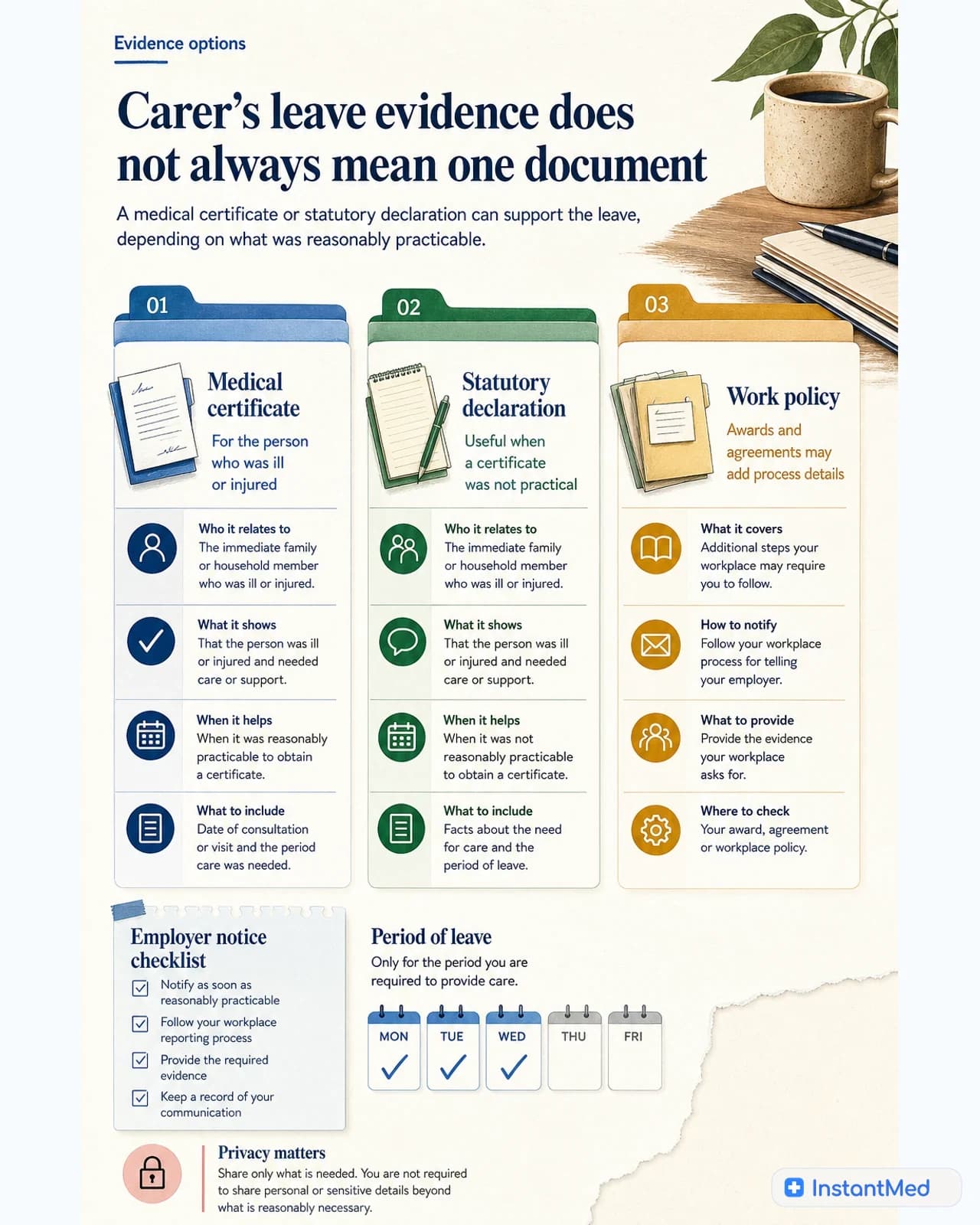
You may also need evidence. Workplace carer's leave evidence is not saying you were personally unfit for work; it supports that your absence was connected to a caring responsibility. Your employer can ask for reasonable evidence. Schools and childcare services may separately ask for an absence explanation or return-clearance evidence for the child.
InstantMed accepts patients aged 18 and over only. Its carer's leave pathway is for the adult employee requesting evidence for their own absence; it does not assess the child or issue documentation in a minor's name.
What a sick-child certificate is for
A carer's leave certificate has a different job from an ordinary employee sick certificate.
For the parent, the workplace question is whether you were entitled to carer's leave because your child needed care or support. For the school or childcare service, the practical question is why the child was away and whether they should stay away for infection-control reasons.
That means useful workplace evidence usually connects:
- the caring circumstance in appropriately limited terms
- the dates or period relevant to the absence
- the need for a parent or guardian to provide care
- the practitioner or other evidence source supporting the leave claim
It should not become a public file of your child's private health details. Evidence can often support the leave reason without naming a diagnosis.
Carer's leave and the Fair Work evidence rule
Fair Work describes sick and carer's leave as personal/carer's leave. Full-time and part-time employees accrue paid sick and carer's leave as one balance. The annual entitlement for a full-time employee is 10 days, pro rata for part-time employees, and unused paid sick and carer's leave carries over.
Paid carer's leave can be used when an immediate family member or household member needs care or support because they are sick, injured, or affected by an unexpected emergency. A child is an immediate family member, and stepchildren and adoptive relationships are included.
Casual employees are not entitled to paid personal/carer's leave, but Fair Work says casuals are entitled to unpaid carer's leave per occasion.
The exact process can still vary. Awards, enterprise agreements, contracts, and workplace policies can set notice steps or evidence expectations, as long as they do not undercut the National Employment Standards.
What your employer can ask for
Your employer can ask for evidence that supports the leave. That can happen even for a single day. Many workplaces only ask after two or more days, but that is a policy choice, not the outer limit of Fair Work's evidence rule.
The safest approach is to give notice as soon as practicable, then provide evidence if asked. If your workplace uses HR software, record the leave as carer's leave or personal/carer's leave rather than ordinary sick leave if the absence is for your child.
| Evidence detail | Usually relevant | Usually private |
|---|---|---|
| Child was unwell | Yes, because it explains the caring need | The full diagnosis is often not needed |
| Care was required | Yes, this is the carer's leave link | Detailed family arrangements are usually unnecessary |
| Parent absence dates | Yes, this connects the evidence to work days | Work performance commentary is not a medical certificate job |
| Doctor or practitioner details | Yes, it helps verify the certificate | Extra clinical notes are not usually needed |
| Return or review advice | Sometimes, especially for infectious illness | School or employer should not get more health detail than needed |
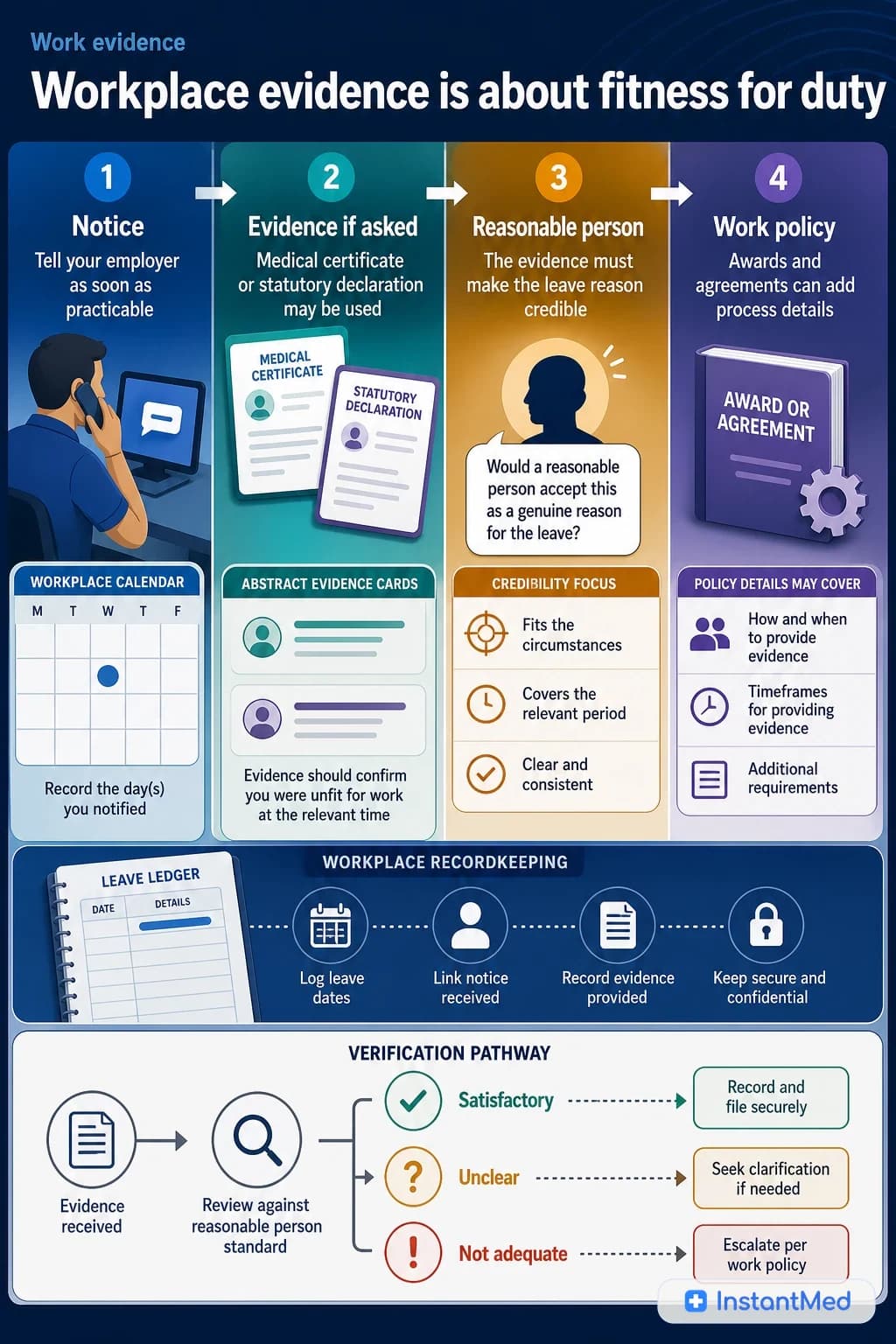
If your employer disputes the evidence, the issue is usually not whether telehealth exists. The issue is whether the evidence is credible, complete, consistent with the absence, and provided under the policy or award that applies to you. For the broader workplace boundary, see the related guide on whether an employer can reject a medical certificate.
School and childcare absence rules
School absence rules sit beside workplace rules. They are not the same system.
Schools generally expect parents to explain absences. Some schools ask for a medical certificate after a longer absence, repeated short absences, assessment periods, exam periods, or when the explanation is unclear. The threshold varies by state, school sector, and individual school policy.
Childcare and preschool services can be stricter because infectious illness spreads quickly in young children. A centre may ask a child to stay away for the minimum public-health exclusion period, and it may set a return policy that is more cautious than a school note.
Two practical points matter:
- A certificate does not force a school or childcare centre to accept a child before its infection-control policy says they can return.
- A return or clearance certificate is a different question from an initial absence certificate. It asks whether the child is well enough and no longer within the relevant exclusion period.
How long a sick child should stay home
Exclusion periods are not about punishing absence. They are about reducing spread. Healthdirect summarises common school exclusion periods, and NHMRC's 2024 *Staying Healthy* guidelines explain that minimum exclusion periods are based on how easily an illness spreads and how long a person is likely to be infectious.
Return timing
A child may need to stay home until symptoms settle, the minimum period has passed, and the school or childcare policy is satisfied.
| Illness or symptom pattern | Common minimum return point | Watch the policy boundary |
|---|---|---|
| Common cold | No fixed exclusion if the child seems well | Keep home if feverish, miserable, coughing heavily, or unable to participate |
| Influenza or influenza-like illness | When the child is well | Some services may require symptoms to have settled |
| COVID-19 symptoms or diagnosis | When acute symptoms have gone | Follow current state or territory health advice |
| Gastro, vomiting, or diarrhoea | At least 24 hours after last vomit or loose bowel motion | Norovirus or unclear cause may require 48 hours |
| Conjunctivitis | When eye discharge has stopped | A doctor may diagnose a non-infectious cause |
| Hand, foot and mouth | When all blisters have dried | Centre policy may be stricter for outbreaks |
| Chickenpox | When all blisters have dried, often about 5 days after rash begins | Immunocompromised contacts need special advice |
| Measles | Usually until 4 days after rash appears | Public health unit advice matters |
| Whooping cough | 5 days after starting appropriate antibiotics, or 21 days from cough onset without antibiotics | Contacts may need public health advice |
| Head lice | Once effective treatment has started | Many schools allow return the next day |
If the child is well enough but the exclusion period has not passed, the infection-control rule still matters. If the exclusion period has passed but the child is still clearly unwell, they may still need more time at home or medical review.
When a paediatric-capable telehealth service may fit
Some paediatric-capable telehealth services may provide assessment or documentation when the doctor can safely understand the illness, care need, and dates from the history provided. InstantMed is not one of those services: it accepts patients aged 18 and over only.
Telehealth is weaker when the doctor needs to examine the child, check hydration, listen to breathing, assess a rash, examine an ear or throat, or decide whether the child is deteriorating. It is also weaker for babies and very young children because they can become unwell quickly and may show subtle signs.
Decision guide
General paediatric telehealth boundary
May fit telehealth
- A paediatric-capable service accepts the child and the presentation is appropriate for remote care.
- The child is alert, drinking, passing urine, and not rapidly worsening.
- The question is evidence for a short caring absence or return timing.
Needs in-person care
- The child is very young, symptoms are unclear, or examination may change care.
- There is persistent fever, severe pain, dehydration concern, breathing symptoms, or a rash that needs inspection.
- The school or childcare service needs specific clearance after a notifiable or outbreak-related illness.
Urgent care
- Difficulty breathing, blue or pale blotchy skin, non-blanching rash, seizure, unusual drowsiness, or rapid deterioration.
- Fever above 38 C in a baby under 3 months.
- Green vomit, blood or mucus in stool, severe abdominal pain, or inability to keep fluids down.
What to prepare before asking for evidence
Good information helps the child's GP or paediatric-capable service decide whether remote assessment or documentation is appropriate. Before that review, gather:
- 1
Your child's name and date of birth.
- 2
When symptoms started and how they changed.
- 3
Temperature readings, vomiting or diarrhoea timing, rash details, pain location, and fluid intake.
- 4
Whether the child is alert, drinking, passing urine, and breathing normally.
- 5
The dates you need to cover for work, school, or childcare.
- 6
Any centre policy that mentions exclusion or return-clearance requirements.
- 7
Relevant medical history, medicines, allergies, immune problems, or recent hospital care.
- 8
Whether any urgent signs are present now.
If the doctor cannot safely decide from the information provided, the correct outcome is not a certificate with a guess. It is more information, in-person review, or urgent care.
Red flags before paperwork
The certificate is never the first priority if your child may be seriously unwell.
Healthdirect advises urgent care for serious symptoms such as difficulty breathing, pale or blue skin, very drowsy behaviour, seizures, non-blanching rash, or a child becoming very unwell quickly. It also flags fever above 38 C in babies under 3 months as requiring immediate hospital assessment.
Urgent signs
Breathing trouble, dehydration, non-blanching rash, seizure, or unusual drowsiness should be treated as care-first signals.
For less dramatic but still concerning symptoms, arrange prompt medical review. Examples include vomiting or diarrhoea that continues, a high fever for 2 full days, not drinking fluids for more than 6 hours, fewer wet nappies or less urination than usual, a rash, pain that is not settling, or symptoms that are not improving.
Common mistakes to avoid
The most common paperwork mistakes are understandable. Parents are tired, the child is miserable, and work is asking for something formal.
Avoid these traps:
- Asking for a certificate that says you were personally sick when the absence was for your child.
- Sending your employer unnecessary diagnosis details about your child.
- Assuming school absence rules and carer's leave evidence rules are identical.
- Treating minimum exclusion periods as permission to return while the child is still unwell.
- Expecting telehealth to overrule a childcare centre's infection-control policy.
- Waiting for paperwork when the child has urgent symptoms.
The cleaner framing is: the adult employee's caring responsibility, appropriate evidence, the child's privacy preserved, and safety first.
Related Guides
- Carer's leave medical certificates in Australia
- Medical certificates for work
- Can an employer reject a medical certificate?
- Work-from-home sick certificates
Sources
- Fair Work Ombudsman: Sick and carer's leave
- Fair Work Ombudsman: Paid sick and carer's leave
- Fair Work Ombudsman: Notice and medical certificates
- NHMRC: Staying Healthy guidelines
- NHMRC: Managing infections
- Healthdirect: School exclusion periods
- Healthdirect: Fever and high temperature in children and babies
- Healthdirect: Symptoms of serious illness in babies and children
- Healthdirect: Looking after a sick child
- Healthdirect: Diarrhoea in children
Frequently Asked Questions
Can I use carer's leave when my child is sick?
Yes, if you are entitled to personal/carer's leave and your child needs care or support because of illness, injury, or an unexpected emergency. Full-time and part-time employees use the same paid personal/carer's leave balance for their own illness and carer's leave. Casual employees can usually access unpaid carer's leave per occasion.
Can my employer ask for a certificate for one day caring for a sick child?
Yes. Fair Work says an employer can ask for evidence for sick or carer's leave, including short absences. A medical certificate or statutory declaration can be acceptable evidence if it would satisfy a reasonable person that the employee was entitled to the leave.
Does the certificate need my child's diagnosis?
Usually no. Workplace evidence normally needs to support that your child was unwell, needed care, and that your absence dates were connected to that care. A diagnosis is private health information and is not usually needed unless a specific policy or safety context genuinely requires more detail.
How long should my child stay home with gastro, chickenpox, or conjunctivitis?
Healthdirect and NHMRC exclusion guidance says gastro or diarrhoea generally needs at least 24 hours after the last vomit or loose bowel motion, with 48 hours sometimes required if the cause is unclear or norovirus is involved. Chickenpox usually needs exclusion until all blisters have dried. Conjunctivitis usually needs exclusion until eye discharge has stopped.
Can the same certificate cover school and my employer?
Do not assume so. School documentation concerns the child, while workplace carer's leave evidence concerns the adult employee's absence. The school, childcare service, award, agreement, or employer may require different evidence.
Can telehealth issue a certificate for a sick child?
Some paediatric-capable services may use telehealth when clinically appropriate, but InstantMed currently accepts patients aged 18 and over only and does not assess or issue certificates for minors. Contact the child's GP or another paediatric-capable service.
When should I skip the certificate and seek urgent care?
Seek urgent care if your child has difficulty breathing, blue or pale blotchy skin, a non-blanching rash, a seizure, unusual drowsiness, severe or persistent pain, signs of dehydration, green vomit, blood or mucus in stool, or a fever above 38 C in a baby under 3 months. Call 000 for emergency symptoms.
InstantMed Medical Team
Related Articles
8 min read
Medical Certificate for Carer's Leave
Carer's leave lets eligible employees take time off to care for an immediate family or household member who is sick, injured, or affected by an unexpected emergency.
InstantMed Medical Team
9 min read
Medical Certificates for Work: Complete Australian Guide
A work medical certificate is evidence that you were unfit for work, not a public explanation of your diagnosis. This Australian guide explains employer evidence rules, privacy, telehealth, stat decs, and return-to-work issues.
InstantMed Medical Team

9 min read
Can an Employer Reject a Medical Certificate in Australia?
An employer should not reject a credible medical certificate simply because it came from telehealth, but they can ask reasonable questions if evidence is incomplete or inconsistent. Learn the practical boundaries.
InstantMed Medical Team